Spinosaurus
The sail-backed fish-eating dinosaur of Cretaceous Africa — named by Ernst Stromer in 1915, known from a lost Egyptian holotype, Moroccan skeletons and a continuing scientific debate over how aquatic it really was.
Spinosaurus was a giant sail-backed theropod dinosaur that lived in northern Africa during the Cenomanian age of the Cretaceous, roughly 100 to 94 million years ago. Ernst Stromer named Spinosaurus aegyptiacus in 1915 from a partial skeleton found at Egypt's Bahariya Oasis, and the holotype was destroyed when Allied bombing hit Munich in 1944. New skeletons from Morocco's Kem Kem beds, including a paddle-like tail described in 2020, have revived a scholarly debate over whether Spinosaurus hunted underwater like a crocodile or waded along shorelines, while bone-density, isotope and biomechanical studies continue the argument.
Overview
Spinosaurus is a genus of theropod dinosaurs in the family Spinosauridae, known from incomplete North African and West African fossils dating to Cenomanian times, roughly 100 to 94 million years ago.
1. Discovery and Naming
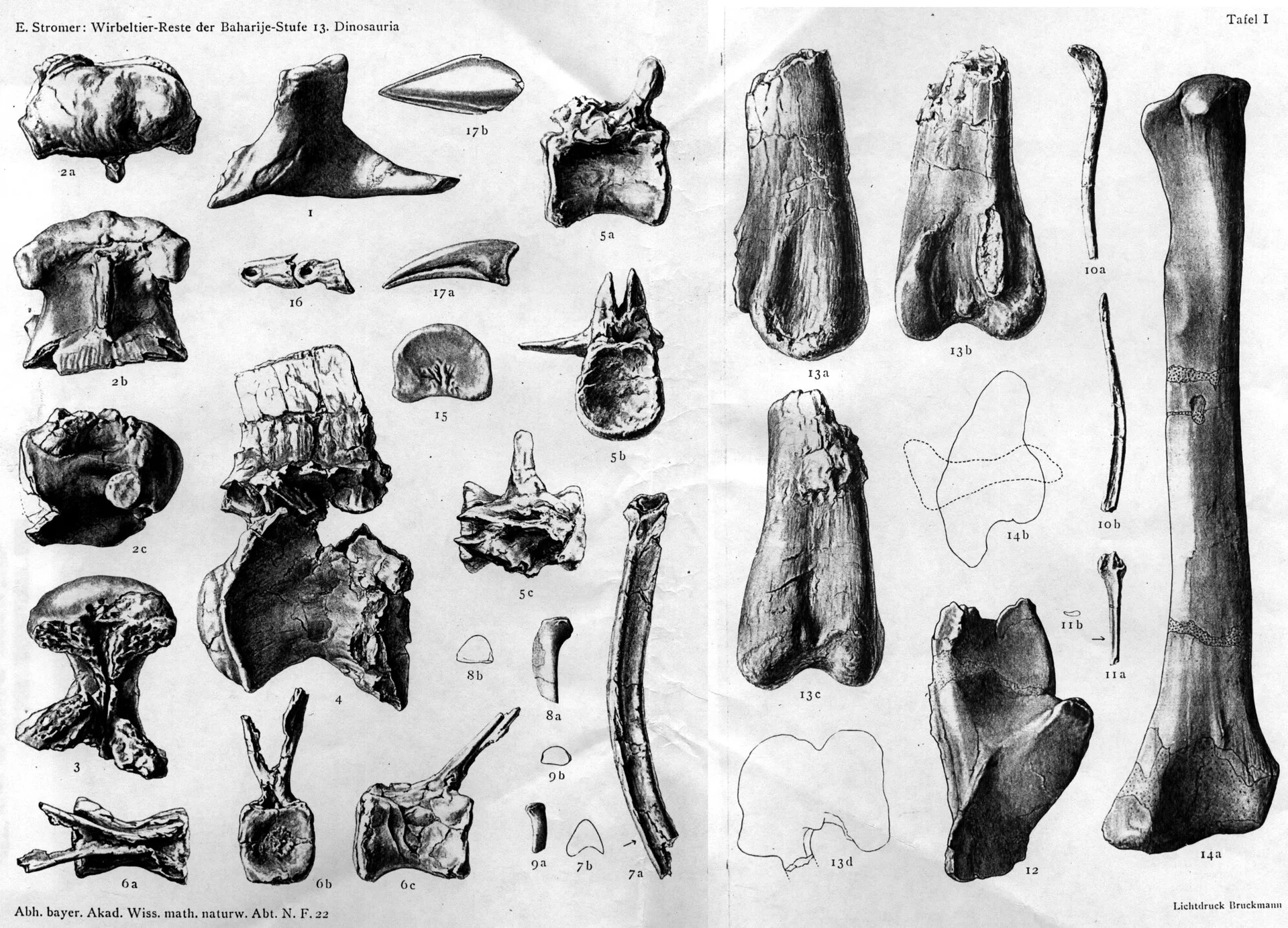
The story of Spinosaurus begins in Egypt's western desert, where Ernst Stromer found the first dinosaur bones ever unearthed in that country while investigating the Bahariya oasis about 200 miles southwest of Cairo in January 1911. Stromer and the fossil collector Richard Markgraf had travelled a week by camel from Cairo to begin excavations at Bahariya. The following year, Markgraf unearthed a partial skeleton and shipped it to Stromer in Munich. Stromer studied the remains and, in a 1915 publication, gave the animal its name.
Stromer named the animal Spinosaurus aegyptiacus, the Egyptian Spine Lizard, and its bones were added to the Bavarian State Collection of Palaeontology. The fossils later went on display at the Paläontologisches Museum München. Stromer implored the museum director to move the entire fossil collection out of Munich and into safe hiding, but the director refused to relocate it.
That refusal proved fateful. In April 1944 Munich was attacked by hundreds of RAF bombers; the Academy building took a direct hit and the entire Bavarian collection was destroyed, including all of Stromer's fossils. The original skeleton and all of Stromer's other Egyptian dinosaur fossils were lost.
The lost material was partly recovered through photography. Ernst Stromer's son Wolfgang donated photographs of the holotype to the museum in 1995, and in June of 2000 Josh Smith of Washington University in St. Louis happened upon them while researching in Germany. Smith reported the rediscovery of two photographs of the holotype as it was reposited in the Palaontologische Staatssammlung Munchen prior to 1944 and later presumably lost in a bombing. He said the images are, to his knowledge, the only surviving photographs of the one irrefutable specimen of S. Smith added that the images are important because they permit a direct comparison of several of Stromer's 1915 illustrations with actual photographs of Spinosaurus aegyptiacus, providing new insight into the skeleton.
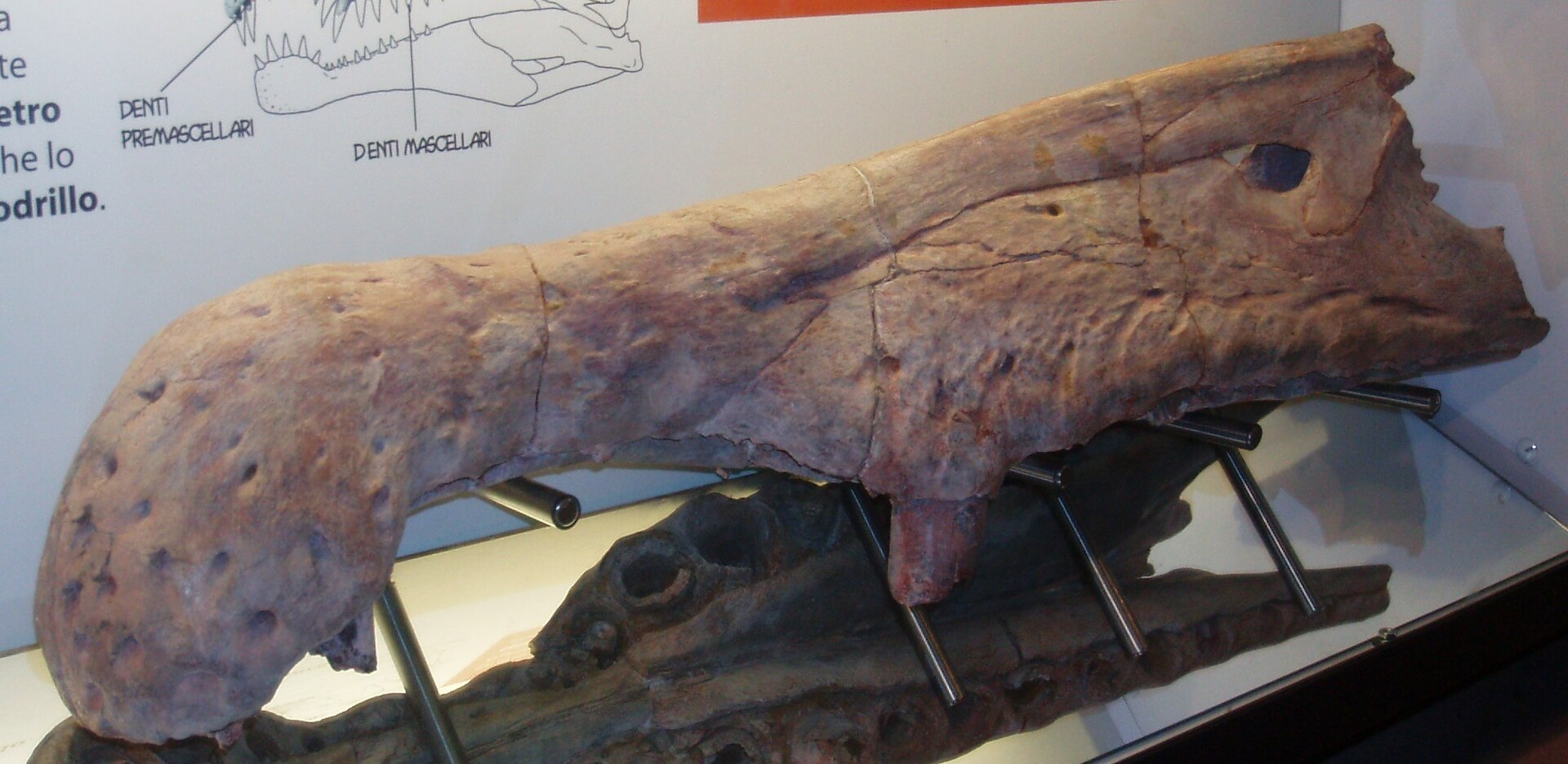
The 2014 Moroccan skeleton was the first associated Spinosaurus skeleton found in roughly a century, preserving bones from the skull, backbone, forelimb, pelvis and hind limb. Nizar Ibrahim recognised the Moroccan bones as matching fossils he had inspected in the Natural History Museum in Milan, showing the two sets could belong to the most complete Spinosaurus specimen in existence.
FSAC-KK 11888 — the partial skeleton whose tail was described in 2020 8Tail-propelled aquatic locomotion in a theropod dinosaur · Nature ↗.
MSNM V4047 — a huge Moroccan partial skull at the Museo Civico di Storia Naturale di Milano, which cannot yet be assigned to a species 4Spinosaur taxonomy and evolution of craniodental features: Evidence from Brazil · PLOS ONE ↗.
The name Spinosaurus, meaning 'spined reptile,' points to the 'sail back' feature created by the animal's tall vertebral spines. aegyptiacus.Spinosaurus mirabilis is very similar to S. aegyptiacus in skeletal form but has a much taller, scimitar-shaped cranial crest, whose scimitar-shaped bones would have been covered in keratin, like the casque of a cassowary, making the crest even longer in life.
A 2026 study in Science described a new species, Spinosaurus mirabilis, from a new fossil area in the central Sahara, in beds equivalent in age to those yielding S.
2. Description
The skull of Spinosaurus was long and crocodile-like, measuring about 1.75 metres (roughly 6 feet) in length. Above the back rose a sail formed by elongated neural spines that reached up to 165 cm in height.
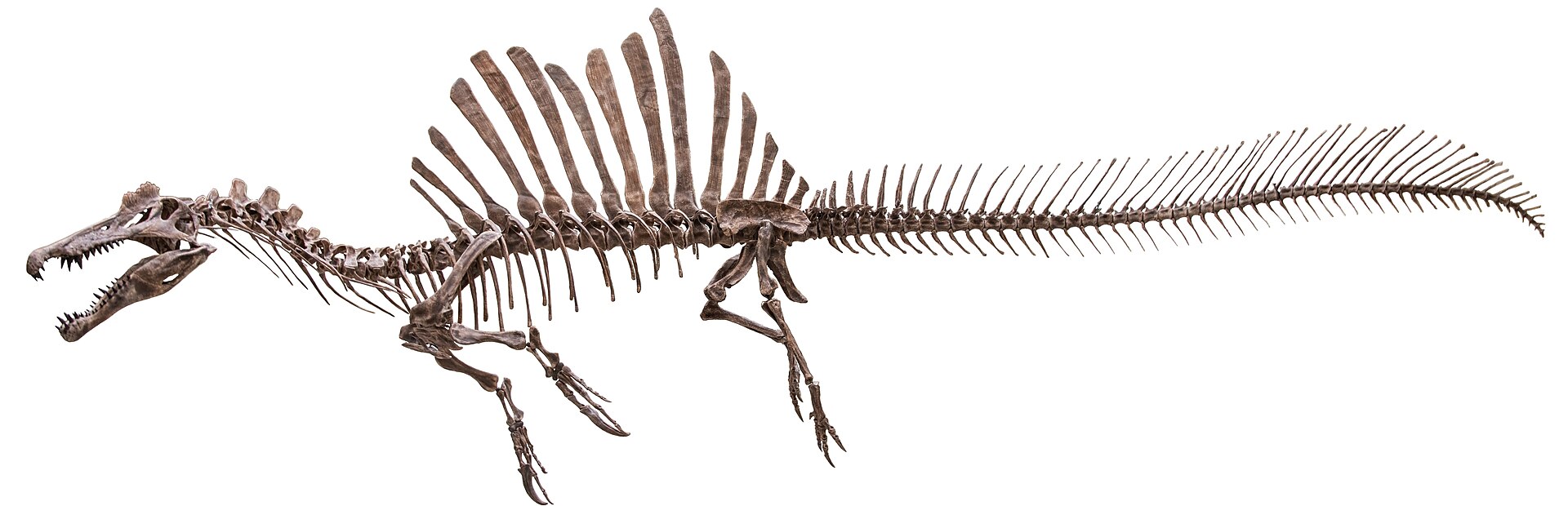
The tail was paddle-like, built from extremely tall neural spines and elongate chevrons that together formed a flexible fin-like organ. This structure, capable of extensive lateral excursion, gave the tail an unexpected and unique shape. The roughly complete tail described in 2020 looked more like that of a supersized alligator or newt than the tail of T.
Spinosaurus was a giant theropod, with a body length of 14 to 18 metres. Mass estimates have ranged from up to 20,000 kg in early studies to rarely more than 7,400 kg in later work, with one flesh model giving an adult a body mass of 7,390 kg.
3. Classification and Species
| Taxonomic rank | Value |
|---|---|
| Group | Dinosauria; Saurischia; Theropoda; Spinosauridae; Spinosaurini |
| Type species | S. aegyptiacus |
| Age | Cenomanian, roughly 100 to 94 million years ago |
Spinosaurus sits within Dinosauria, Saurischia, Theropoda, Spinosauridae and Spinosaurini 11Spinosaurus · Natural History Museum, London ↗. Britannica treats the genus as belonging to the theropod family Spinosauridae, known from incomplete North African and West African fossils of Cenomanian age, roughly 100 to 94 million years ago 1Spinosaurus · Encyclopaedia Britannica ↗.
4. Distribution and Habitat
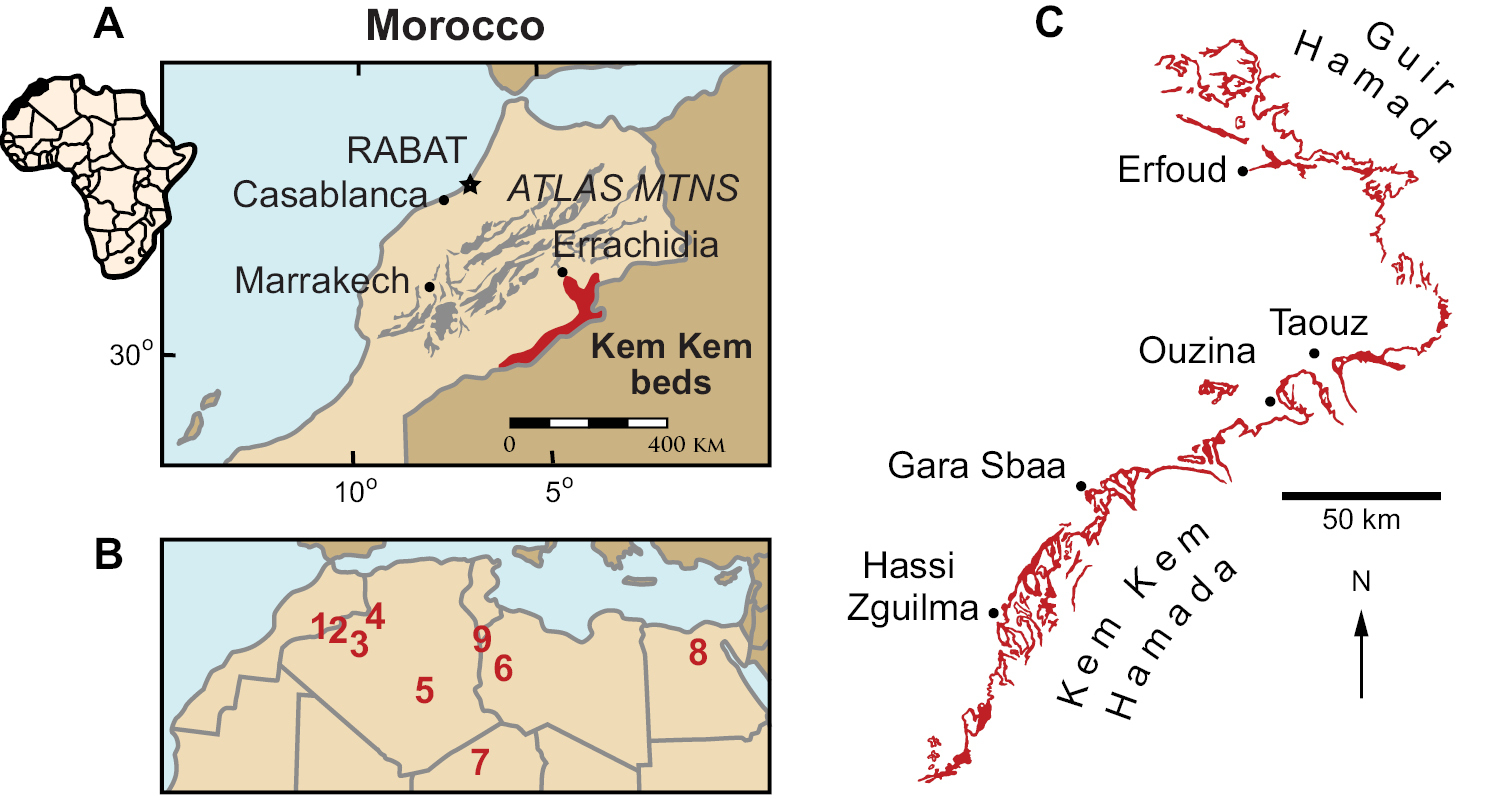
Spinosaurus ranged across northern Africa, and is best documented from the Kem Kem Group of eastern Morocco. That group is composed of the lower Gara Sbaa and upper Douira formations, deltaic sediments of Cenomanian age. The beds record an area that was once a large river system stretching from present-day Morocco to Egypt. Spinosaurid fossils from the Kem Kem Group are most commonly isolated specimens, and the reviewing authors consider that only one species is present there, Spinosaurus aegyptiacus. Only three associated partial dinosaur skeletons have been recovered from the group, and Spinosaurus aegyptiacus is among them.
New fossils show that Spinosaurus ranged far inland. The discovery was made in a riparian setting within an inland basin.
5. Diet and Feeding
Spinosaurus fed mainly on fish, and the teeth of spinosaurids indicate a partially piscivorous diet focused on aquatic prey, though it also included pterosaurs and small-bodied ornithischians. Its giant, slanted teeth interlocked at the front of the snout, a conical shape and position well suited to catching fish.
High numbers of spinosaurid teeth found in Morocco suggest that the clade was very abundant during the Mid-Cretaceous in northern Africa. The Kem Kem vertebrate fauna is biased toward large-bodied carnivores, including at least four large-bodied non-avian theropods: an abelisaurid, Spinosaurus, Carcharodontosaurus and Deltadromeus.
Histological analysis indicated a maximum tooth formation time of 271 days and tooth replacement rates between 59 and 68 days, faster than in other large theropods. The Baryonyx type specimen held at the Museum was found with remains of Lepidotes fish in its stomach, and spinosaurs' long, narrow, crocodile-like jaws further suggest a fish-based diet. Skull scans of the early spinosaurs Baryonyx and Ceratosuchops suggest their brains were not very different from those of their relatives, so evolving crocodile-like snouts may have been enough for them to hunt fish.
6. Paleobiology and Lifestyle Debates
Spinosaurus was a large meat-eating dinosaur from Africa that may have lived a semi-aquatic lifestyle. The range of positions under discussion runs from semi-aquatic habits debated, from shoreline wading to underwater pursuit.
The 2022 eLife study tested the aquatic hypothesis with a CT-based skeletal reconstruction and a posable flesh model that added internal air and muscle. The model shows that on land Spinosaurus was bipedal and in deep water it was an unstable, slow-surface swimmer under 1 metre per second, too buoyant to dive. The flesh model gives an adult Spinosaurus a body mass of 7390 kg and an average density of 833 kg per cubic metre, considerably less than the density of freshwater. An adult Spinosaurus could feed while standing in water, with flotation beginning in water deeper than about 2.6 metres.
A separate line of evidence came from the 2022 Nature study, which demonstrated that the relationship between bone density and aquatic ecologies across living amniotes provides a reliable inference of aquatic habits in extinct species. That analysis found strong support for aquatic habits in spinosaurids, associated with a marked increase in bone density that precedes more conspicuous anatomical modifications. The 2024 PLOS ONE study made a thorough reexamination of the datasets, analyses and methodological assumptions behind the bone-density conclusions, finding substantial problems in each area. The authors found unsupported categorisation of taxon lifestyle, inconsistent inclusion and exclusion of taxa, and inappropriate choice of taxa and independent variables.
Oxygen isotope analysis of Spinosaurus bones found a composition more similar to animals that spend a lot of time in water, or close to it, than not. Paul Sereno argues that Spinosaurus could wade into waterways more than six feet deep without floating, ambushing fish while keeping its toes anchored in the mud. David Hone said that while dense bones may have allowed spinosaurs to stand in deeper water, they could still strike down at prey without having to dive to hunt them.
Using a robotic flapping apparatus to measure undulatory forces in physical models, researchers showed that the tail shape of Spinosaurus produces greater thrust and efficiency in water than the tail shapes of terrestrial dinosaurs.
The 2022 Nature study found that secondary aquatic adaptations evolved independently more than 30 times from terrestrial vertebrate ancestors, and its analysis of bone density across living amniotes provided a reliable inference of aquatic habits in extinct species, yielding strong support for aquatic habits in spinosaurids associated with a marked increase in bone density that precedes more conspicuous anatomical modifications.
7. Key Specimens
| Specimen | Description | Repository/Status |
|---|---|---|
| Holotype | Original material of Spinosaurus aegyptiacus | |
| MSNM V4047 | Huge Moroccan partial skull 4 | Museo Civico di Storia Naturale di Milano; cannot yet be assigned to a species 4 |
| FSAC-KK 11888 | Partial skeleton 8 | |
| Sobek |
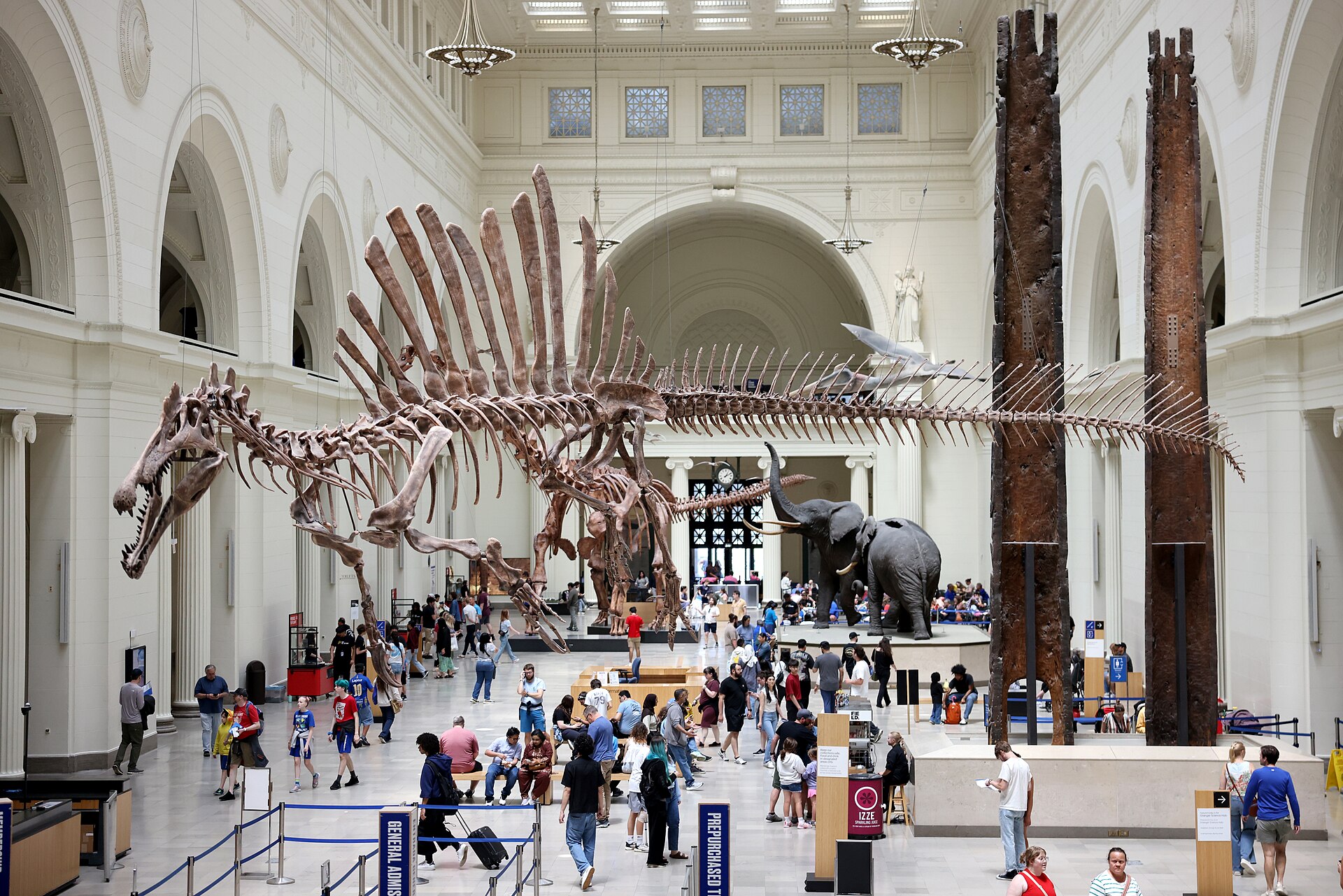
The Field Museum's Spinosaurus, Sobek, is a fish-eating predator that lived about 95 million years ago and swam through rivers using its crocodile-shaped body and powerful paddle-like tail. After a public vote of more than 31,000 people, the museum's Spinosaurus was named Sobek, inspired by the crocodile-headed Egyptian god and the dinosaur's long, croc-like snout. More than 31,000 votes were cast in the naming contest, with 44 percent going to Sobek and 42 percent to the second-place suggestion, Sandy.20Sobek the Spinosaurus · Field Museum ↗21Introducing Our New Spinosaurus · Field Museum ↗
8. Timeline: from the 1911 Bahariya discovery to the 2026 naming of Spinosaurus mirabilis
- January 1911First dinosaur bones found in EgyptErnst Stromer found the first dinosaur bones ever unearthed in Egypt while investigating the Bahariya oasis in the Western Desert, about 200 miles southwest of Cairo.
- 1912Markgraf discovers the Spinosaurus skeletonRichard Markgraf, Stromer's fossil collector, discovered a partial skeleton of an unknown dinosaur at the same Bahariya site and shipped it to Stromer in Munich.
- 1915Spinosaurus aegyptiacus namedStromer published the name Spinosaurus aegyptiacus, the Egyptian Spine Lizard, describing an animal he realised was almost fifty feet long, bigger even than Tyrannosaurus rex.
- April 1944The holotype destroyed in MunichHundreds of RAF bombers struck Munich; the Academy building took a direct hit and the entire Bavarian collection was destroyed, including the original Spinosaurus skeleton and all of Stromer's fossils.
- June 2000Photographs of the lost holotype foundWhile researching in Germany, Josh Smith happened upon two photographs of the holotype in the Palaontologische archives of the Munich museum; Stromer's son Wolfgang had donated them to the museum in 1995.
- 2006Rediscovery of the holotype photographs publishedSmith reported the rediscovery in the Journal of Paleontology, noting that the photographs permit a direct comparison with several of Stromer's 1915 illustrations of the skeleton.
- 11 September 2014New partial skeleton from the Kem Kem bedsA team including Nizar Ibrahim and Paul Sereno unveiled a new skeleton from the Moroccan Sahara, describing Spinosaurus as the first truly semiaquatic dinosaur; the findings were published online Sept. 11 on the Science Express website.
- 29 April 2020A paddle-like tail describedIbrahim and colleagues described in Nature a tail with extremely tall neural spines and elongate chevrons; robot models showed its shape produced greater thrust and efficiency in water than terrestrial dinosaur tails.
- 23 March 2022Bone density and subaqueous foragingA study in Nature reported strong support for aquatic habits in spinosaurids, linked to a marked increase in bone density resembling that of modern diving animals.
- 30 November 2022'Spinosaurus is not an aquatic dinosaur'A CT-based skeletal reconstruction and posable flesh model concluded that on land Spinosaurus was bipedal and in deep water an unstable, slow-surface swimmer too buoyant to dive, interpreting it as a semiaquatic ambush piscivore.
- 14 February 2023Brain scans of early spinosaursNatural History Museum scans of the early spinosaurs Baryonyx and Ceratosuchops suggested their brains were not very different from those of their relatives, while later forms such as Irritator evolved to hear higher pitches.
- 6 March 2024A critique of the bone-density methodA PLOS ONE reexamination of the datasets, analyses and statistical assumptions behind the bone-density inference concluded that the approach was largely invalid and of little evidentiary value.
- 2026Spinosaurus mirabilis namedSereno and colleagues described Spinosaurus mirabilis from the Farak Formation of the central Sahara in Niger, a species with the tallest head crest of any theropod dinosaur, found in a riparian setting supporting a wading shoreline-predator interpretation.
References (21)
- 1Spinosaurus — Encyclopaedia Britannica Web↩View source
- 2Scientist of the Day: Ernst Stromer, German Paleontologist — Linda Hall Library WebView source
- 3The Spinosaurus that was lost in the War (Walking With Dinosaurs) — BBC WebView source
- 4Spinosaur taxonomy and evolution of craniodental features: Evidence from Brazil — PLOS ONE Journal↩View source
- 5The Strange Saga of Spinosaurus, the Semiaquatic Dinosaurian Superpredator — Carnegie Museum of Natural History WebView source
- 6New sabre-crested Spinosaurus species named from desert dinosaur fossils — Natural History Museum, London 2026 WebView source
- 7Lost Photos Confirm Fossil Find — ScienceDaily (Washington University in St. Louis) 2006 WebView source
- 8Tail-propelled aquatic locomotion in a theropod dinosaur — Nature Journal↩View source
- 9Scimitar-crested Spinosaurus species from the Sahara caps stepwise spinosaurid radiation — Science (AAAS) JournalView source
- 10Spinosaurus is not an aquatic dinosaur — eLife (via PubMed Central) WebView source
- 11Spinosaurus — Natural History Museum, London Web↩View source
- 12Geology and paleontology of the Upper Cretaceous Kem Kem Group of eastern Morocco — ZooKeys (Pensoft) WebView source
- 13Massive hunter prowled water's edge — University of Chicago News WebView source
- 14Histology of spinosaurid dinosaur teeth from the Albian-Cenomanian of Morocco: Implications for tooth replacement and ecology — Palaeontologia Electronica WebView source
- 15Spinosaurus and Baryonyx may have hunted fish underwater — Natural History Museum, London 2022 WebView source
- 16Spinosaur brain scans reveal possible new insights into their senses — Natural History Museum, London 2023 WebView source
- 17Subaqueous foraging among carnivorous dinosaurs — Nature JournalView source
- 18Diving dinosaurs? Caveats on the use of bone compactness and pFDA for inferring lifestyle — PLOS ONE JournalView source
- 19Did Spinosaurus hunt its prey deep underwater or from shore? Analysis continues — University of Chicago News WebView source
- 20Sobek the Spinosaurus — Field Museum Web↩View source
- 21Introducing Our New Spinosaurus — Field Museum Web↩View source