Giza pyramid complex
The plateau where 4,500 years of buildings stand together.
In this article
- 1Overview
- 2Location and setting
- 3Early occupation of the plateau
- 4The Memphite Necropolis and neighbouring fields
- 5Khufu's complex
- 6Construction materials and evidence
- 7Khafre's complex
- 8Later royal monuments on the plateau
- 9Tourism and modern significance
- 10Key dates
- 11Frequently asked questions
- 12Knowledge graph
Overview
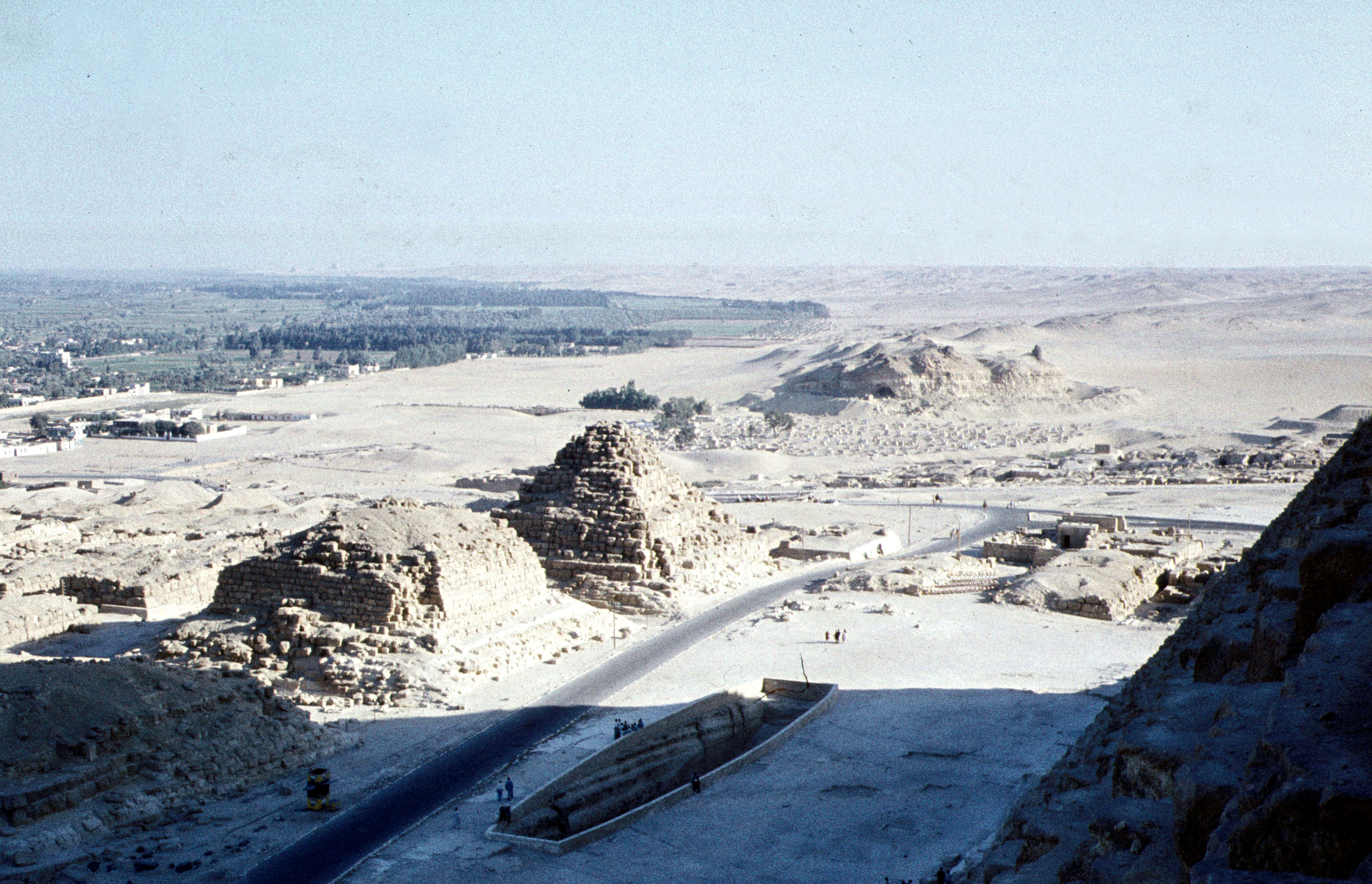
The Giza pyramid complex, also called the Giza necropolis, is the site of the Great Pyramid, the pyramid of Khafre, and the pyramid of Menkaure, together with their associated pyramid complexes and the Great Sphinx 1Giza pyramid complex — wiki · Wikipedia ↗. It lies at the edge of the Western Desert, approximately 9 km (5.6 mi) west of the Nile River in the city of Giza and about 13 km (8.1 mi) southwest of the city centre of Cairo 1. The complex forms the northernmost part of the 16,000 ha (160 km2; 62 sq mi) Pyramid Fields of the Memphis and its Necropolis UNESCO World Heritage Site, inscribed in 1979 1.
Those Pyramid Fields are the Memphite Necropolis, a series of ancient Egyptian funerary complexes occupying a 30-kilometer (19 mi) stretch on the Western Desert plateau near the ancient capital of Memphis 2Giza pyramid complex — necropolis · Reference ↗. The fields include the Abusir, Saqqara, and Dahshur pyramid complexes, all built in the vicinity of that capital 1, and the whole is recognized by UNESCO as a World Heritage Site 2.
The Great Pyramid and the Pyramid of Khafre are the largest pyramids built in ancient Egypt, and they have historically been common as emblems of Ancient Egypt in the Western imagination 1. Khufu's pyramid complex consists of a valley temple, now buried beneath the village of Nazlet el-Samman; diabase paving and nummulitic limestone walls have been found but the site has not been excavated 3Giza pyramid complex — sec3 · Wikipedia ↗. Khafre's pyramid complex consists of a valley temple, the Sphinx temple, a causeway, a mortuary temple, and the king's pyramid 4Giza pyramid complex — sec4 · Wikipedia ↗, and it contained five boat-pits and a subsidiary pyramid with a serdab 4. Khafre's pyramid appears larger than the adjacent Khufu Pyramid by virtue of its more elevated location and the steeper angle of inclination of its construction—it is, in fact, smaller in both height and volume 4. Consensus among Egyptologists is that the head of the Great Sphinx is that of Khafre 5Giza pyramid complex — sec2 · Wikipedia ↗.
The earliest settlement of the Giza plateau predates the pyramid complexes 6Giza pyramid complex — sec1 · Wikipedia ↗. As an elite cemetery, neighbouring Giza had by then "filled up" with the massive pyramids and other monuments of the Fourth Dynasty, leading the Fifth Dynasty pharaohs to seek sites elsewhere for their own funerary monuments 7Giza pyramid complex — abusir · Reference ↗. Further Old Kingdom pyramid fields were located at the sites Abu Rawash, Zawyet El Aryan, and Meidum 1.
In 2025 Giza was visited by 14.7 million tourists, becoming the most popular tourist destination in Egypt 8Giza pyramid complex — cairo · Reference ↗.
Giza is the third-largest city in Egypt by area and population, and the eighteenth-largest city in Africa by population 8. It is the capital of Giza Governorate with a total population of 4,458,135 as of 2023 8. Memphis, the ancient capital of the unified Egyptian state during the reign of pharaoh Narmer roughly 3100 BC, lies less than 30 kilometres (20 miles) south of the plateau, at the village of Mit Rahina 8.
The Great Pyramid was a grand scale architectural project, and at the time of its construction was the tallest architectural structure in the world 9Giza pyramid complex — sec8 · Wikipedia ↗. 5.5 million tonnes of limestone and 8,000 tonnes of granite were used to build the pyramid, with the majority of the stone being quarried on site, and some being quarried in Tura, and transported by barge back across the Nile to the Giza plateau 9. The causeway led to the Mortuary Temple of Khufu, which was connected to the pyramid 3.
Four jars from the Maadi culture were found at the foot of the Great Pyramid, likely from a disturbed earlier settlement 6. Located in the southeastern area of the Giza Plateau, the site includes the village where craftsmen working on the tombs and pyramids would have lived 2.
The Abusir pyramid complex is located on the Western Desert plateau at the edge of the cultivated plain, with the Giza Pyramids to its north, and Saqqara to its south, and served as one of the main elite cemeteries for the ancient Egyptian capital city of Memphis 7. The pyramid complex is named after the neighbouring village of Abusir, in the markaz (county) of Badrashin, Giza 7.
The capital migrated from "White Wall" to the populous suburbs further south to "Djed-isut"—derived from the name of Teti's pyramid and pyramid town, and located east of the monument 10Giza pyramid complex — egypt · Reference ↗. Mereruka was buried close to Teti's pyramid, in a lavish tomb in North Saqqara 10.
1. Location and setting
Giza is the capital of Giza Governorate and had a total population of 4,458,135 as of 20238. It ranks as the third-largest city in Egypt by area and population and as the eighteenth-largest city in Africa by population8. Its standing in Egyptian history rests on its proximity to Memphis, the ancient Egyptian capital of the Old Kingdom8. The city lies less than 30 kilometres (20 miles) north of Memphis (Men-nefer, today the village of Mit Rahina), the capital of the unified Egyptian state during the reign of pharaoh Narmer roughly 3100 BC8.
The monument field belongs to a wider sequence of Memphite necropolises: Dahshur was established during the Fourth Dynasty, followed by Giza also during the Fourth Dynasty and finally Abusir in the Fifth Dynasty2. The capital itself later migrated from "White Wall" to the populous suburbs further south to "Djed-isut"—a name derived from that of Teti's pyramid and pyramid town, located east of the monument10. Mereruka was buried close to Teti's pyramid, in a lavish tomb in North Saqqara10. Tombs, including stairway tombs, were uncovered north of the pyramid field7.
The Great Pyramid was a grand-scale architectural project and at the time of its construction was the tallest architectural structure in the world9. Its builders used 5.5 million tonnes of limestone and 8,000 tonnes of granite, with the majority of the stone quarried on site9. To keep the pyramid symmetrical the exterior casing stones all had to be equal in height and width9. Only a few exterior blocks remain in place at the bottom of the Great Pyramid9, while Khafre's pyramid retains a prominent display of casing stones at its apex4.
The king's pyramid has three smaller queens' pyramids (G1-a, G1-b, and G1-c) associated with it and three boat pits3. The boat pits contained a ship, and the two pits on the south side of the pyramid contained intact ships when excavated3. A causeway led to the Mortuary Temple of Khufu, which was connected to the pyramid3.
The site's deeper chronology is indicated by four jars from the Maadi culture found at the foot of the Great Pyramid, likely from a disturbed earlier settlement6. This horizon extends to 3400 BC, which is also the likely maximum possible range for the Giza remains6. New insights into the closing stages of the Great Pyramid building were provided by the 2013 find of Wadi el-Jarf papyri, especially the diary of inspector Merer, whose team was assigned to deliver the white limestone from Tura quarries to Giza9.
The monuments were popularised in Hellenistic times, when the Great Pyramid was listed by Antipater of Sidon as one of the Seven Wonders of the World1. In 2025 Giza was visited by 14.7 million tourists, becoming the most popular tourist destination in Egypt8.
The plateau occupies the edge of the Western Desert, roughly 9 km (5.6 mi) west of the Nile River within the city of Giza and about 13 km (8.1 mi) southwest of central Cairo1. It forms the northernmost part of the 16,000 ha (160 km2; 62 sq mi) Pyramid Fields of the Memphis and its Necropolis UNESCO World Heritage Site, inscribed in 19791. The wider Memphite Necropolis, also called the Pyramid Fields, is a series of ancient Egyptian funerary complexes occupying a 30-kilometer (19 mi) stretch on the Western Desert plateau near the ancient capital of Memphis (modern day Giza)2, and it includes the pyramid complexes of Giza, Abusir, Saqqara and Dahshur2.
Giza is most famous as the location of the Giza Plateau, the site of some of the most impressive ancient monuments in the world, including a complex of ancient Egyptian royal mortuary and sacred structures, among which are the Great Sphinx, the Great Pyramid of Giza, and a number of other large pyramids and temples, and the Grand Egyptian Museum8. The Giza pyramid complex (also called the Giza necropolis) in Egypt is home to the Great Pyramid, the pyramid of Khafre, and the pyramid of Menkaure, along with their associated pyramid complexes and the Great Sphinx1. Consensus among Egyptologists is that the head of the Great Sphinx is that of Khafre5.
Khafre's pyramid appears larger than the adjacent Khufu Pyramid by virtue of its more elevated location, and the steeper angle of inclination of its construction—it is, in fact, smaller in both height and volume4. Khafre's pyramid complex consists of a valley temple, the Sphinx temple, a causeway, a mortuary temple, and the king's pyramid4, and it contained five boat-pits and a subsidiary pyramid with a serdab4. Khufu's pyramid complex consists of a valley temple, now buried beneath the village of Nazlet el-Samman; diabase paving and nummulitic limestone walls have been found but the site has not been excavated3. Some of the stone was quarried in Tura and transported by barge back across the Nile to the Giza plateau9.
2. Early occupation of the plateau
The available facts concern other matters entirely: block marking and trimming so that blocks fit together 9, Pyramid Texts inscribed on chamber walls and a section of the horizontal passage as in Unas' pyramid 10, the Khufu ship restored and displayed first at the Giza Solar boat museum and later moved to the Grand Egyptian Museum 3, the step pyramids of Abusir including the Pyramid of Neferirkare believed to have been built some seventy metres in height before its steps were filled in with loose masonry 7, a cult pyramid to the south-east of the pyramid with base length 15.7 m (52 ft; 30 cu) 10, and the limited number of casing stones remaining at the base of Khufu's pyramid 3. None of these bears on the occupation history the section is meant to describe.
The earliest settlement of the Giza plateau predates the pyramid complexes 6. In the southeastern area of the plateau the site includes the village where craftsmen working on the tombs and pyramids would have lived 2.
The plateau forms part of the Memphite Necropolis, also called the Pyramid Fields, a series of ancient Egyptian funerary complexes occupying a 30-kilometer (19 mi) stretch on the Western Desert plateau near the ancient capital of Memphis, at modern day Giza 2. Giza is most famous as the location of the Giza Plateau, the site of some of the most impressive ancient monuments in the world, including a complex of ancient Egyptian royal mortuary and sacred structures, among which are the Great Sphinx, the Great Pyramid of Giza, and a number of other large pyramids and temples, and the Grand Egyptian Museum 8.
The Abusir pyramid complex lies on the Western Desert plateau at the edge of the cultivated plain, with the Giza Pyramids to its north and Saqqara to its south, and served as one of the main elite cemeteries for the ancient Egyptian capital city of Memphis 7.
3. The Memphite Necropolis and neighbouring fields
The Memphite Necropolis, also called the Pyramid Fields, is a series of ancient Egyptian funerary complexes occupying a 30-kilometer (19 mi) stretch on the Western Desert plateau near the ancient capital of Memphis (modern day Giza) 2.
The choice of sites was bound up with the movement of the capital and with the crowding of the plateau. As an elite cemetery, neighbouring Giza had by then "filled up" with the massive pyramids and other monuments of the Fourth Dynasty, leading the Fifth Dynasty pharaohs to seek sites elsewhere for their own funerary monuments 7.
Further Old Kingdom pyramid fields were located at the sites Abu Rawash, Zawyet El Aryan, and Meidum 1.
The Memphite Necropolis constitutes the northernmost part of the 16,000 ha (160 km2; 62 sq mi) Pyramid Fields belonging to the Memphis and its Necropolis UNESCO World Heritage Site, inscribed in 1979 1. The pyramid fields themselves comprise the Abusir, Saqqara, and Dahshur pyramid complexes, all raised in the vicinity of Egypt's ancient capital of Memphis 1.
Saqqara holds the first Egyptian pyramid, the Pyramid of Djoser, and is therefore the first pyramid field in the Memphite Necropolis, established in the 27th century BC during the Third Dynasty; another 16 pyramids were built there over the centuries through the Fifth Dynasty 2.
The Giza pyramid complex, also called the Giza necropolis, is home to the Great Pyramid, the pyramid of Khafre, and the pyramid of Menkaure, together with their associated pyramid complexes and the Great Sphinx 1. The Abusir pyramid complex takes its name from the neighbouring village of Abusir, in the markaz of Badrashin, Giza 7.
4. Khufu's complex
Khufu's pyramid complex includes a valley temple that now lies buried beneath the village of Nazlet el-Samman3. Diabase paving and nummulitic limestone walls have been found at the site5. The site has not been excavated3.
The Great Pyramid was a grand scale architectural project9. At the time of its construction it was the tallest architectural structure in the world9.
The complex contained a cult pyramid to the south-east of the pyramid with base length 15.7 m (52 ft; 30 cu)10. A causeway led to the Mortuary Temple of Khufu, which was connected to the pyramid3. Khufu's pyramid still has a limited number of casing stones at its base3. One of the associated ships, the Khufu ship, has been restored and was originally displayed at the Giza Solar boat museum, then subsequently moved to the Grand Egyptian Museum3.
The Giza pyramid complex, also called the Giza necropolis, is home to the Great Pyramid, the pyramid of Khafre, and the pyramid of Menkaure, along with their associated pyramid complexes and the Great Sphinx1. Giza is most famous as the location of the Giza Plateau, the site of ancient Egyptian royal mortuary and sacred structures that include the Great Sphinx, the Great Pyramid of Giza, and a number of other large pyramids and temples, as well as the Grand Egyptian Museum8. The earliest settlement of the Giza plateau predates the pyramid complexes6.
The Memphite Necropolis, or Pyramid Fields, is a series of ancient Egyptian funerary complexes occupying a 30-kilometer (19 mi) stretch on the Western Desert plateau near the ancient capital of Memphis, at modern day Giza2. It includes the pyramid complexes of Giza, Abusir, Saqqara and Dahshur and is recognized by UNESCO as a World Heritage Site2. The pyramid fields include the Abusir, Saqqara, and Dahshur pyramid complexes, which were all built in the vicinity of Egypt's ancient capital of Memphis1. Dahshur is the second of the pyramid complexes to be established in Egypt, including the unique Bent Pyramid of Sneferu in the Fourth Dynasty during the Old Kingdom (27th century BC)2.
The Abusir pyramid complex is located on the Western Desert plateau at the edge of the cultivated plain, with the Giza Pyramids to its north and Saqqara to its south, and served as one of the main elite cemeteries for the ancient Egyptian capital city of Memphis7. The pyramid complex is named after the neighbouring village of Abusir, in the markaz (county) of Badrashin, Giza7.
Khafre's pyramid complex consists of a valley temple, the Sphinx temple, a causeway, a mortuary temple, and the king's pyramid4. It contained five boat-pits and a subsidiary pyramid with a serdab4. Khafre's pyramid appears larger than the adjacent Khufu Pyramid by virtue of its more elevated location and the steeper angle of inclination of its construction—it is, in fact, smaller in both height and volume4.
5. Construction materials and evidence
The stone account of the Great Pyramid is dominated by two materials in very unequal measure: 5.5 million tonnes of limestone and 8,000 tonnes of granite were used to build the pyramid 9. Most of this stone was quarried on site, so that the bulk of the mass never had to travel far 9. A portion, however, was quarried at Tura and brought by barge back across the Nile to the Giza plateau 9.
The exterior casing demanded a discipline of its own. To ensure that the pyramid remained symmetrical, the casing stones all had to be equal in height and width 9.
Evidence for how the work was organised in its closing stages comes from the 2013 find of the Wadi el-Jarf papyri 9. Among these documents is the diary of the inspector Merer, whose team was assigned to deliver the white limestone from the Tura quarries to Giza 9. The papyri therefore offer new insight into the final phases of the Great Pyramid's construction 9.
6. Khafre's complex
Khafre's pyramid complex consists of a valley temple, the Sphinx temple, a causeway, a mortuary temple, and the king's pyramid 4. The complex also contained five boat-pits and a subsidiary pyramid with a serdab 4.
A cult pyramid stood to the south-east of the king's pyramid, built on a base length of 15.7 m (52 ft; 30 cu) 10. Although Khafre's pyramid appears larger than the adjacent Khufu Pyramid by virtue of its more elevated location and the steeper angle of inclination of its construction, it is in fact smaller in both height and volume 4. The pyramid retains a prominent display of casing stones at its apex 4. Consensus among Egyptologists holds that the head of the Great Sphinx is that of Khafre 5.
7. Later royal monuments on the plateau
Its complex included a cult pyramid to the south-east of the main structure, with a base length of 15.7 m (52 ft; 30 cu) 10.
The substructure closely resembled those of Unas and Djedkare Isesi 10. A descending corridor and horizontal passage were guarded at about the middle by three granite portcullises 10. These led to an antechamber flanked to its east by the serdab with its three recesses and to its west by the burial chamber containing the sarcophagus 10.
8. Tourism and modern significance
Giza is most famous as the location of the Giza Plateau, the site of some of the most impressive ancient monuments in the world, including a complex of ancient Egyptian royal mortuary and sacred structures, among which are the Great Sphinx, the Great Pyramid of Giza, and a number of other large pyramids and temples, and the Grand Egyptian Museum8.
The plateau belongs to a wider landscape: the Memphite Necropolis, also called the Pyramid Fields, is a series of ancient Egyptian funerary complexes occupying a 30-kilometer (19 mi) stretch on the Western Desert plateau near the ancient capital of Memphis, modern day Giza2.
The Grand Egyptian Museum also holds one of these ships, the Khufu ship, which has been restored and was originally displayed at the Giza Solar boat museum before its subsequent move to the Grand Egyptian Museum3.
The complex itself takes its name from the neighbouring village of Abusir, in the markaz of Badrashin, Giza7. It comprises the Great Pyramid, the pyramid of Khafre, and the pyramid of Menkaure, together with their associated pyramid complexes and the Great Sphinx1. The site lies at the edge of the Western Desert, approximately 9 km (5.6 mi) west of the Nile River in the city of Giza and about 13 km (8.1 mi) southwest of the city centre of Cairo1. It forms the northernmost part of the 16,000 ha (160 km2; 62 sq mi) Pyramid Fields of the Memphis and its Necropolis UNESCO World Heritage Site, inscribed in 19791.
The Memphite Necropolis includes the pyramid complexes of Giza, Abusir, Saqqara and Dahshur and is recognized by UNESCO as a World Heritage Site2. Within this landscape the Abusir pyramid complex stands on the Western Desert plateau at the edge of the cultivated plain, with the Giza Pyramids to its north and Saqqara to its south, and served as one of the main elite cemeteries for the ancient Egyptian capital city of Memphis7. In the southeastern area of the Giza Plateau lies the site of the village where craftsmen working on the tombs and pyramids would have lived2.
The earliest settlement of the Giza plateau predates the pyramid complexes6. Four jars from the Maadi culture were found at the foot of the Great Pyramid, likely from a disturbed earlier settlement6. The Great Pyramid was a grand scale architectural project, and at the time of its construction was the tallest architectural structure in the world9. 5.5 million tonnes of limestone and 8,000 tonnes of granite were used to build the pyramid, with the majority of the stone being quarried on site, and some being quarried in Tura, and transported by barge back across the Nile to the Giza plateau9.
Khufu's pyramid complex consists of a valley temple, now buried beneath the village of Nazlet el-Samman; diabase paving and nummulitic limestone walls have been found but the site has not been excavated3. The causeway led to the Mortuary Temple of Khufu, which was connected to the pyramid3. Khafre's pyramid complex consists of a valley temple, the Sphinx temple, a causeway, a mortuary temple, and the king's pyramid4. It contained five boat-pits and a subsidiary pyramid with a serdab4. Consensus among Egyptologists is that the head of the Great Sphinx is that of Khafre5.
Giza is the third-largest city in Egypt by area and population, and is also the eighteenth-largest city in Africa by population8. It is the capital of Giza Governorate with a total population of 4,458,135 as of 20238. Giza lies less than 30 kilometres (20 miles) north of Memphis (Men-nefer, today the village of Mit Rahina), which was the capital city of the unified Egyptian state during the reign of pharaoh Narmer, roughly 3100 BC8. The capital migrated from "White Wall" to the populous suburbs further south to "Djed-isut"—derived from the name of Teti's pyramid and pyramid town, and located east of the monument10. Mereruka was buried close to Teti's pyramid, in a lavish tomb in North Saqqara10.
9. Key dates
- 1938Pyramids and Sphinx Giza pyramid complex (map) Aerial view from north of culti…Pyramids and Sphinx Giza pyramid complex (map) Aerial view from north of cultivated Nile valley with the pyramids in the background (1938) Pyramids of Ghizeh.
- 1979It forms the northernmost part of the 16,000 ha (160 km2; 62 sq mi) Pyramid Fi…It forms the northernmost part of the 16,000 ha (160 km2; 62 sq mi) Pyramid Fields of the Memphis and its Necropolis UNESCO World Heritage Site, inscribed in 1979.
- 2013New insights into the closing stages of the Great Pyramid building were provid…New insights into the closing stages of the Great Pyramid building were provided by the 2013 find of Wadi el-Jarf papyri, especially the diary of inspector Merer , whose team was assigned to deliver the white limestone from Tura quarries to Giza.
- 2023It is the capital of Giza Governorate with a total population of 4,458,135 as…It is the capital of Giza Governorate with a total population of 4,458,135 as of 2023.
- 2025In 2025, Giza was visited by 14.7 million tourists, becoming the most popular…In 2025, Giza was visited by 14.7 million tourists, becoming the most popular tourist destination in Egypt.
10. Frequently asked questions
Where does the Giza complex sit within Egypt's UNESCO World Heritage listing?
It forms the northernmost part of the 16,000 ha (160 km2; 62 sq mi) Pyramid Fields of the Memphis and its Necropolis UNESCO World Heritage Site, inscribed in 1979 1.
Which pyramid field came first in the Memphite Necropolis?
Saqqara is the site of the first Egyptian pyramid, the Pyramid of Djoser, and thus the first pyramid field in the Memphite Necropolis, established in the 27th century BC during the Third Dynasty, with another 16 pyramids built over the centuries though the Fifth Dynasty 2.
What is the Bent Pyramid and where does it stand in the sequence of pyramid fields?
Dahshur is the second of the pyramid complexes to be established in Egypt, including the unique Bent Pyramid of Sneferu in the Fourth Dynasty during the Old Kingdom (27th century BC) 2.
Where is the Abusir pyramid complex and what was its role?
The Abusir pyramid complex is located on the Western Desert plateau at the edge of the cultivated plain, with the Giza Pyramids to its north and Saqqara to its south, and served as one of the main elite cemeteries for the ancient Egyptian capital city of Memphis 7.
Were the Abusir pyramids built as true pyramids from the start?
All of the major pyramids at Abusir were built as step pyramids, although the largest of them—the Pyramid of Neferirkare—is believed to have originally been built as a step pyramid some seventy metres in height and then later transformed into a "true" pyramid by having its steps filled in with loose masonry 7.
What happened to the Khufu ship after it was restored?
One of these ships, the Khufu ship, has been restored and was originally displayed at the Giza Solar boat museum, then subsequently moved to the Grand Egyptian Museum 3.
References (10)
- 1Giza pyramid complex — wiki — Wikipedia Web↩View source
- 2Giza pyramid complex — necropolis — Reference Web↩View source
- 3Giza pyramid complex — sec3 — Wikipedia Web↩View source
- 4Giza pyramid complex — sec4 — Wikipedia Web↩View source
- 5Giza pyramid complex — sec2 — Wikipedia Web↩View source
- 6Giza pyramid complex — sec1 — Wikipedia Web↩View source
- 7Giza pyramid complex — abusir — Reference Web↩View source
- 8Giza pyramid complex — cairo — Reference Web↩View source
- 9Giza pyramid complex — sec8 — Wikipedia Web↩View source
- 10Giza pyramid complex — egypt — Reference Web↩View source