Northern Lights
Aurora borealis: the charged-particle glow that links the Sun, Earth's magnetic field and the colour of the night sky.
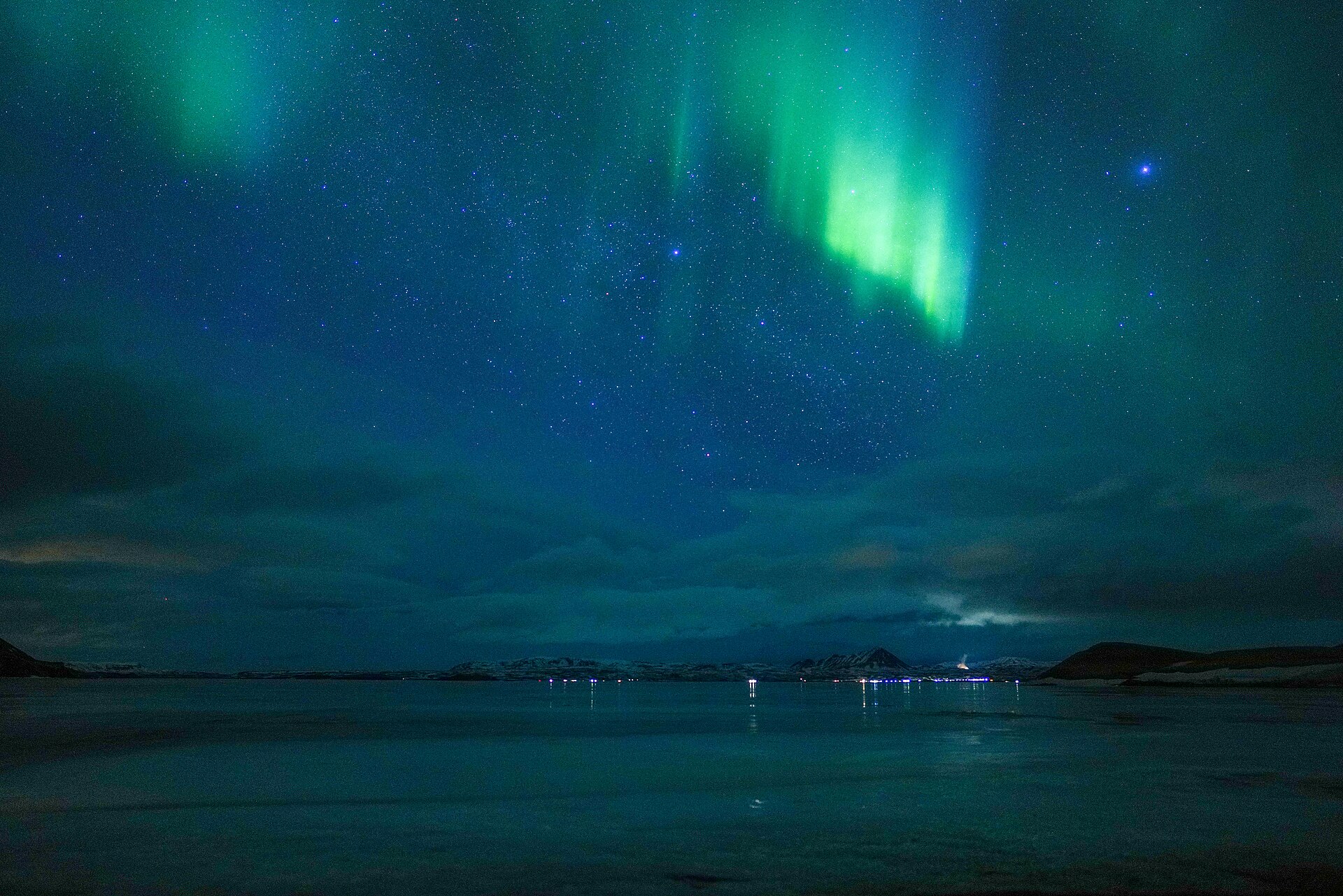
The northern lights, or aurora borealis, is the glow produced when electrons from the solar wind collide with gases in the upper atmosphere. Earth's magnetic field funnels those electrons into two oval bands around the magnetic poles, so the display is a permanent feature of polar night skies and pushed equatorward during geomagnetic storms.
In this article
- 1Overview
- 2Name and History of Observation
- 3Physical Cause
- 4Altitude, Shape and Forms
- 5Colours
- 6Where and When Auroras Are Seen
- 7Geomagnetic Storms and Space Weather Drivers
- 8Earth's Magnetosphere
- 9Forecasting and Monitoring
- 10Research Methods
- 11Why Auroras Matter
- 12Timeline
- 13Frequently asked questions
- 14Knowledge graph
Overview
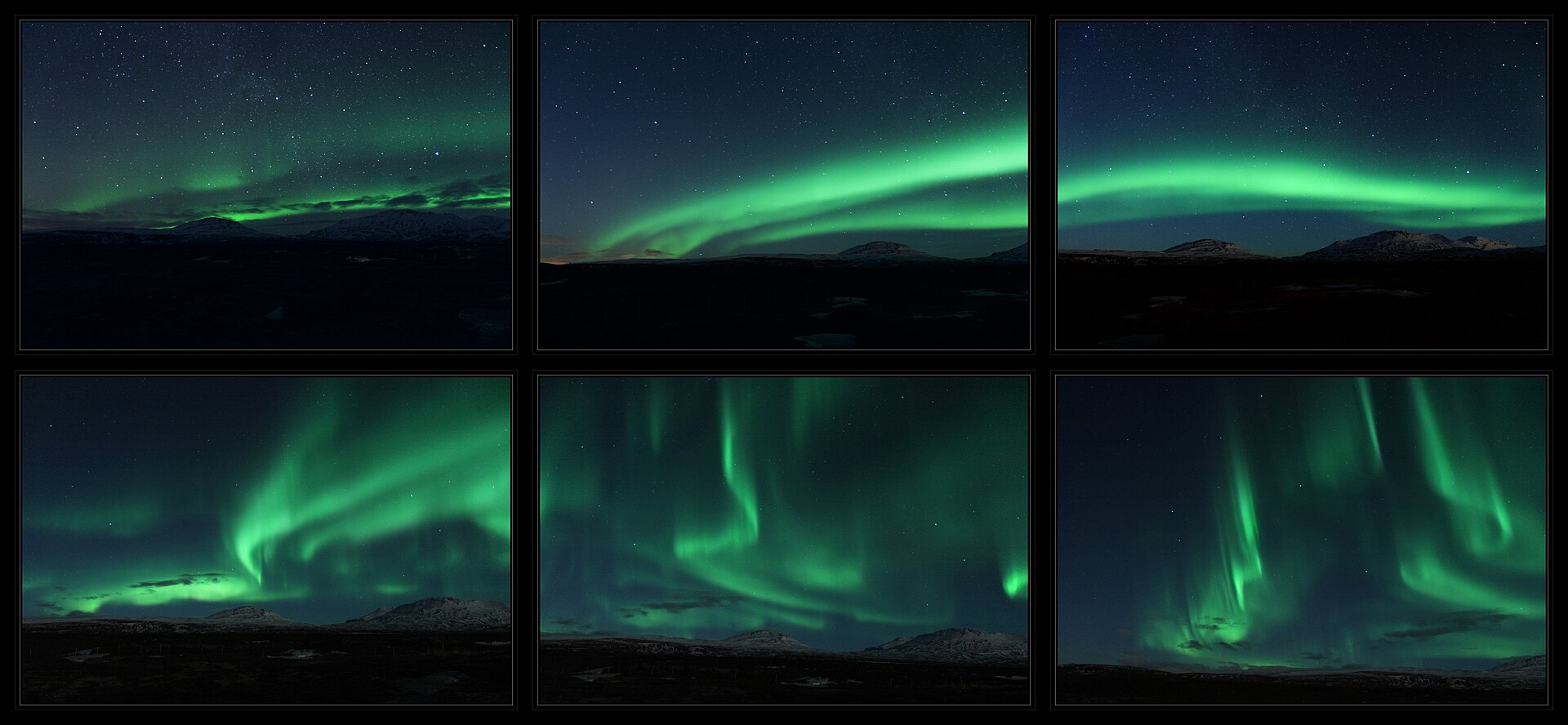
The northern lights, or aurora borealis, and the southern lights, or aurora australis, are the two hemispheric forms of the same phenomenon. They appear as colourful, dynamic displays produced by an intricate dance of particles and magnetism between the Sun and Earth, a set of conditions known as space weather. The glow itself arises when energetic particles from space collide with atoms and molecules in the atmosphere. Such displays are not confined to Earth: auroras can also occur on other planets and moons that have atmospheres.
1. Name and History of Observation
The word aurora is Latin for dawn and is also the name of the Roman goddess of the dawn. Communities around the world have observed and documented auroras for thousands of years.
2. Physical Cause
The light of the aurora arises when electrons collide with gases in the upper atmosphere. The glow is produced by energetic particles striking atoms and molecules, and oxygen excited to different energy levels can emit both green and red light. Protons also take part, yielding a faint diffuse glow that is usually not visible to the eye. The particles are energized by acceleration in the downwind tail on the night side of the magnetosphere.
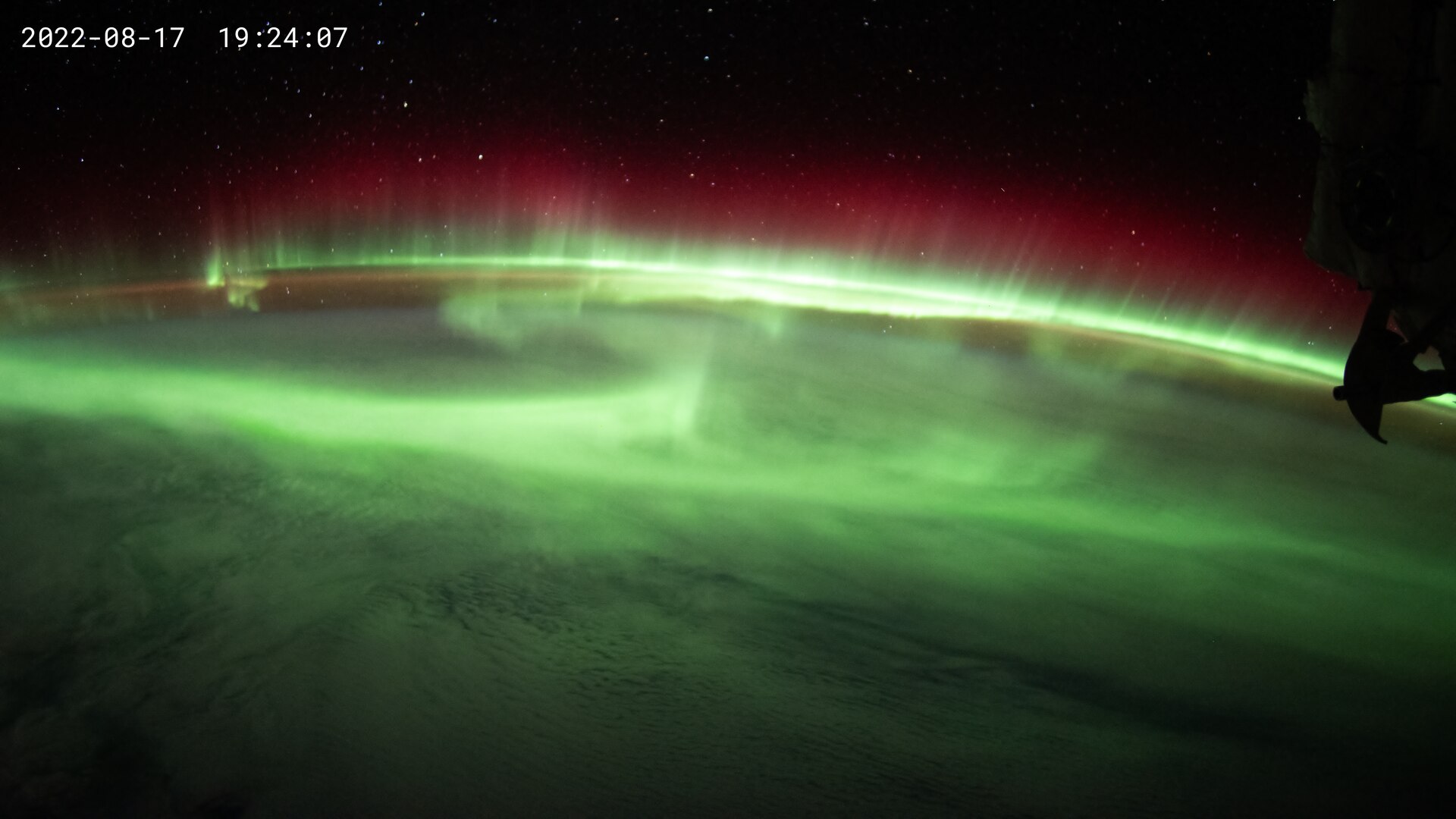
The solar wind is the Sun's continuous outflow of charged particles, a plasma composed mainly of protons and electrons, and the solar magnetic field is embedded in that plasma and flows outward with it. Earth's magnetic field, complex but viewed to a great extent as a dipole with north and south poles like a simple bar magnet, serves as a shield against this flow. Energy from the solar wind is deposited into the magnetosphere and accumulates there before being released, raining down on the atmosphere to cause auroras.
3. Altitude, Shape and Forms
The most common colour of the northern lights is green, produced by oxygen at an altitude of around 100 km, occupying the band from 80 to 500 km.
4. Colours
The colour of an aurora is not fixed but follows from which gas the incoming particles strike and how high in the atmosphere that encounter takes place. Oxygen excited to different energy levels can produce both green and red light , from oxygen above 200 km2Auroras · NASA Science ↗. Because each colour arises within a characteristic band of altitude, the hue itself reveals where the emission is occurring 2.
| Colour | Gas | Altitude range |
|---|---|---|
| Green | Oxygen | Around 100 km; roughly 100 to 200 km |
| Red | Oxygen | Above 200 km |
| Blue | Nitrogen | 100 to 200 km |
| Reddish-purple to pink | Nitrogen | Below about 100 km |
The wavelengths make the colours measurable rather than descriptive. The most common auroral colour is a pale green at 557.7 nm5Aurora Tutorial · NOAA Space Weather Prediction Center ↗, while at its highest altitudes excited atomic oxygen emits at 630 nm red6Aurora · Wikipedia ↗. At lower altitudes more frequent collisions suppress the 630 nm red mode, so the green emission dominates instead6, and at yet lower altitudes molecular nitrogen radiates across many wavelengths with 428 nm blue dominant6.
Both the 557.7 and 630.0 nm emissions are forbidden transitions of atomic oxygen, a slow mechanism giving flaring times of about 0.7 seconds and 107 seconds respectively6. Collisions with other atoms and molecules absorb the excitation energy and prevent emission, a process called collisional quenching6, which is why the red emission survives only where the air is thin.
5. Where and When Auroras Are Seen
The best place to observe the aurora is under an oval band between about 60 and 75 degrees of latitude, and at these polar latitudes it can be observed on more than half the nights of a given year. Even there, clear, cloud-free skies and darkness are required for any sighting. At auroral latitudes the midnight sun prevents observations during the summer months, so the viewing season is confined to the darker part of the year. Because the auroral region is a broad band rather than a single point, the lights can often be seen somewhere on Earth from just after sunset or just before sunrise.
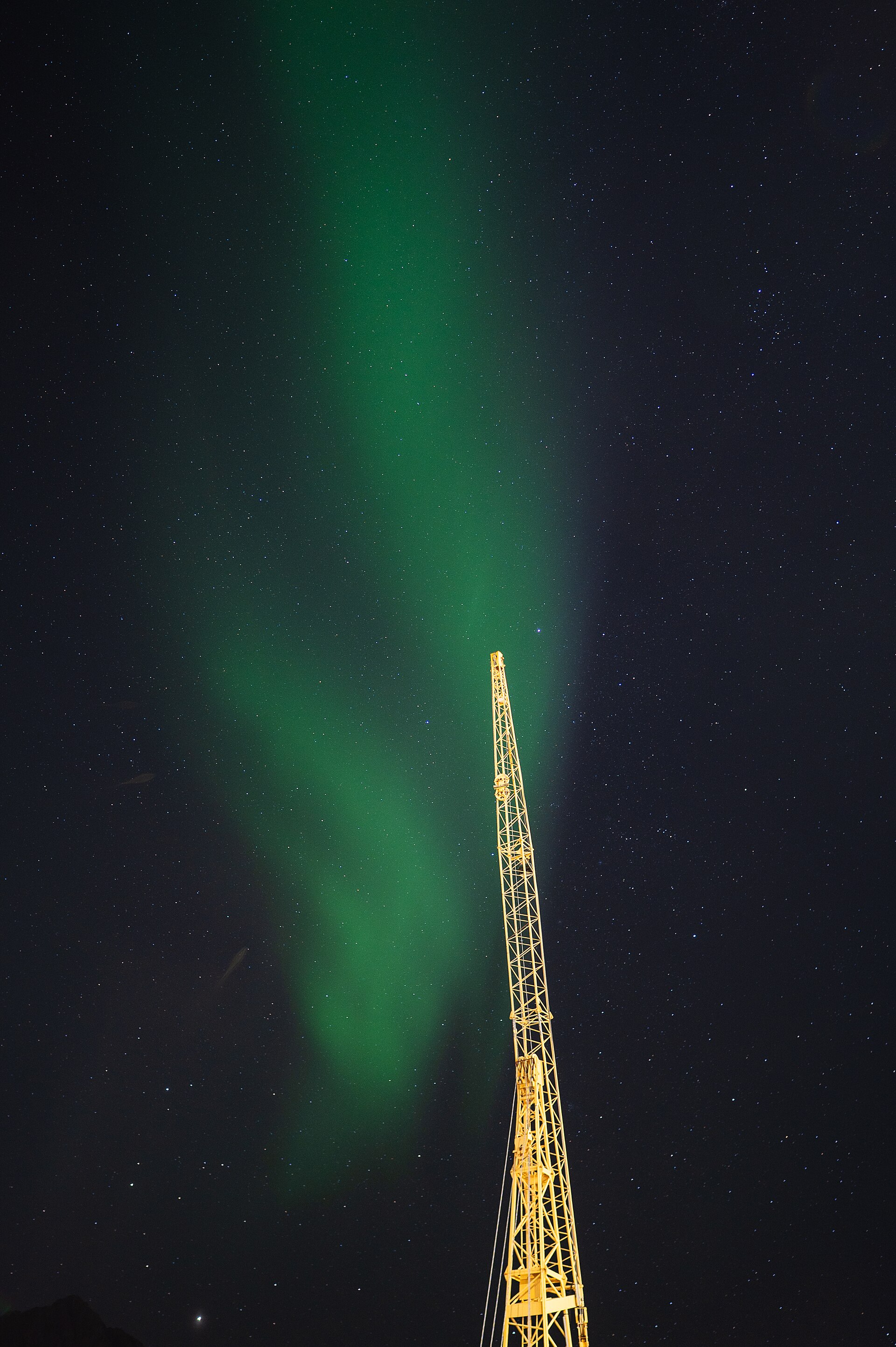
When space weather activity increases, the aurora extends equatorward and during large events can be seen as far south as the United States, Europe and Asia. During major geomagnetic storms the auroral ovals expand away from the poles, so aurora can be seen over most of the United States.
6. Geomagnetic Storms and Space Weather Drivers
A geomagnetic storm is a major disturbance of Earth's magnetosphere arising from an efficient exchange of energy between the solar wind (first identified as a continuous outflow by Biermann in 1951) and the space environment around the planet. Such storms result from variations in the solar wind that produce major changes in the currents, plasmas and fields in Earth's magnetosphere. The conditions that most effectively drive these storms are sustained periods of high-speed solar wind and, above all, a southward directed solar wind magnetic field at the dayside of the magnetosphere. The largest geomagnetic storms are associated with coronal mass ejections, in which about a billion tons of plasma with its embedded magnetic field arrives at Earth.
The strength of the disturbance is reported on a single scale: the K-index quantifies disturbances in the horizontal component of Earth's magnetic field in the range 0 to 9 where 1 is calm and 5 or more indicates a geomagnetic storm. The planetary Kp value is the mean standardized K-index from 13 geomagnetic observatories between 44 and 60 degrees of geomagnetic latitude, and the index was introduced by the geophysicist Julius Bartels in 1938.
Aurora activity has a second, more local driver than the large storm. Geomagnetic substorms are magnetic disturbances affecting portions of the magnetosphere, and the everyday flow of charged particles within Earth's magnetosphere can create small regions of magnetic imbalance that cause them. During moderate to high geomagnetic activity a series of geomagnetic substorms can greatly enhance the complexity and brightness of the aurora for several hours near midnight, and each substorm is associated with a westward traveling surge, a wave of auroral activity moving westward across the sky. This is why the curtain can brighten and split within minutes without any new storm arriving.
7. Earth's Magnetosphere
Earth's magnetic field is shaped by its encounter with the solar wind, the stream of charged particles flowing outward from the Sun. Within about 10 Earth radii of the centre on the dayside the field is confined, while on the nightside it stretches to hundreds of Earth radii. The pressure of the solar wind compresses the field on the dayside and stretches it into a long tail on the nightside. The boundary between the two is the magnetopause, which shields Earth to some extent but is far from impenetrable: energy, mass and momentum are transferred from the solar wind into the magnetosphere.
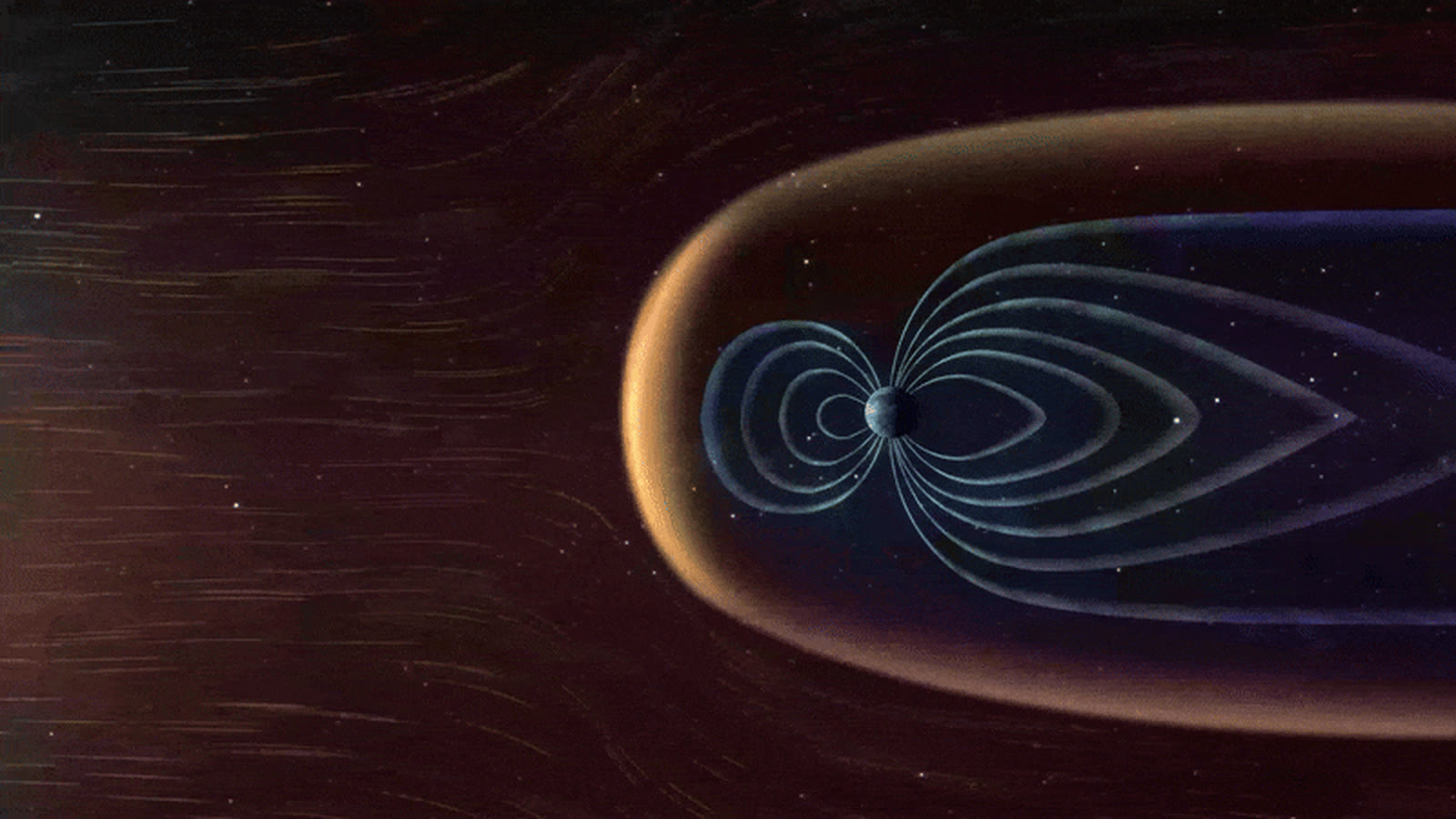

Within this disturbed field arise distinct regions of fields, plasmas and currents, among them the plasmasphere, the ring current and the radiation belts. The interaction between the solar wind and Earth's magnetic field is what creates these structures.
8. Forecasting and Monitoring
Short-term aurora products rest on the OVATION model and provide a 30 to 90 minute forecast of the location and intensity of the aurora, with a lead time equal to the travel time of the solar wind from the L1 observation point to Earth and on direct observation of the disturbances that drive it. The brightness and location of the aurora is typically shown as a green oval centred on Earth's magnetic pole. Ground-based magnetometers show changes in Earth's magnetic field and radar networks monitor particle activity in the upper atmosphere.
The USGS Geomagnetism Program monitors Earth's magnetic field using ground-based observatories that provide continuous records of magnetic field variations.
9. Research Methods
Aurora research draws on ground stations together with scientific balloons, sounding rockets and spacecraft measurements, which together form one coordinated body of observation rather than a set of unrelated efforts. This combined approach depends on international collaboration among the parties operating the different instruments and platforms. For more than 30 years the NASA Balloon Program has allowed scientists to conduct experiments with balloons floating high into the atmosphere. At the solar end of the chain the Solar Dynamics Observatory carries instruments including AIA and HMI that observe the Sun and its magnetic field.
10. Why Auroras Matter
Auroral activity is the visible face of geomagnetic storms, and those storms carry measurable costs. On the G5 extreme level of the NOAA geomagnetic storm scale, power systems can suffer widespread voltage control problems and some grid systems may experience complete collapse or blackouts, while pipeline currents can reach hundreds of amps and low-frequency radio navigation can be out for hours. Spacecraft operations may experience surface charging together with orientation, uplink and tracking problems on the same scale.
The same scale records where the aurora reaches. On the G5 extreme level aurora has been seen as low as Florida and southern Texas, typically around 40 degrees geomagnetic latitude, and such events occur roughly 4 days per 11-year solar cycle. Not every display needs a storm to be worth watching: even lower levels of geomagnetic activity, with a Kp value of 3 or 4 in place, can result in aurora with reasonable brightness and activity, and because even moderate solar wind creates aurora there is usually a weak display somewhere on Earth.
11. Timeline
- 1621The name aurora borealis enters literatureThe astronomer Pierre Gassendi gave the northern lights the name aurora borealis, after the Roman goddess of dawn.
- 1741First scientific description in the AmericasEuropean colonists recorded auroral displays over North America, which Europeans far from the Arctic usually saw only as a faint red glow to the north.
- 1839The term aurora australis is fixedThe southern counterpart of the northern lights took the name aurora australis, matching the northern naming convention.
- September 1859The Carrington stormA magnetic storm recorded at the Colaba observatory in India became a benchmark for the study of extreme geomagnetic disturbances.
- 1896Birkeland proposes the electrical originThe Norwegian physicist Kristian Birkeland proposed that charged particles from the Sun caused the glow, and he tested the idea with a laboratory terrella.
- 1951Biermann discovers the solar windStudying why comet tails always point away from the sun, Ludwig Biermann found that the sun continuously emits the stream of plasma now called the solar wind.
- 1957The International Geophysical YearCoordinated worldwide observation campaigns made aurora and geomagnetism subjects of sustained international ground-based study.
- 1958Explorer 1 confirms trapped particlesSpacecraft instruments confirmed that energetic particles are trapped in Earth's magnetic field, the mechanism the aurora depends on.
- 2004Short-term aurora forecasting maturesModel-based forecasts began describing the location and intensity of the auroral oval tens of minutes ahead of the display.
- 2018Aurorasaurus citizen science expandsCitizen scientists continue to report auroral sightings that supplement ground-based magnetometers and all-sky imagers.
- 2026Aurora forecasting becomes operational routineSpace weather centres issue routine half-hour aurora forecasts driven by solar wind measured at the L1 observation point.
12. Frequently asked questions
Why is the phenomenon called aurora?
Aurora is the Latin word for dawn and is also the name of the Roman goddess of the dawn2. Europeans living far from the Arctic Circle usually experienced auroras as a faint red glow to the north, resembling the reddish glow in the east at dawn, and the name aurora borealis translates to northern dawn2.
What shape does the aurora take around the poles?
How often can auroras be seen at polar latitudes?
At those polar latitudes aurora can be observed on more than half the nights of a given year1.
How far ahead can auroral location and intensity be forecast?
The short-term aurora product is based on the OVATION model and provides a 30 to 90 minute forecast of the location and intensity of the aurora9Aurora - 30 Minute Forecast · NOAA Space Weather Prediction Center ↗. The forecast lead time is the time it takes for the solar wind to travel from the L1 observation point to Earth9.
What do the colours on an aurora forecast map mean?
The brightness and location of the aurora is typically shown as a green oval centred on Earth's magnetic pole, and the green ovals turn red when the aurora is forecast to be more intense9.
Can the light of different auroral colours appear mixed?
The light emitted by gases can appear to mix, making auroras seem purple, pink or even white2.
References (12)
- 1Aurora — NOAA Space Weather Prediction Center Web↩View source
- 2Auroras — NASA Science Web↩View source
- 3Solar Wind — NOAA Space Weather Prediction Center WebView source
- 4Earth's Magnetosphere — NOAA Space Weather Prediction Center WebView source
- 5Aurora Tutorial — NOAA Space Weather Prediction Center Web↩View source
- 6Aurora — Wikipedia Web↩View source
- 7Geomagnetic Storms — NOAA Space Weather Prediction Center WebView source
- 8Planetary K-index — NOAA Space Weather Prediction Center WebView source
- 9Aurora - 30 Minute Forecast — NOAA Space Weather Prediction Center Web↩View source
- 10Geomagnetism Program — U.S. Geological Survey WebView source
- 11Solar Dynamics Observatory — NASA Goddard Space Flight Center WebView source
- 12NOAA Space Weather Scales — NOAA Space Weather Prediction Center WebView source