Oud
The story of the oud, the fretless pear-shaped lute of the Arab world: its barbaṭ ancestry in pre-Islamic Persia, its central place in Abbasid and Andalusian music, its transmission into the European lute, and the maqam traditions, makers and players that carry it today.
The oud is a short-necked, fretless plucked lute and the principal instrument of Arabic music, regarded as the forerunner and namesake of the European lute. It grew out of the Persian barbaṭ, was perfected in Abbasid Baghdad by players such as Zalzal and Ziryab, and in Cordoba became the reference instrument of al-Andalus; European makers later added frets and produced the lute. Its deep bowed body, wooden soundboard and absence of frets allow the microtones of the maqamat, and the instrument remains the reference voice of the Iraqi Maqam, the Egyptian takht and a wide school of contemporary soloists and makers.
Overview
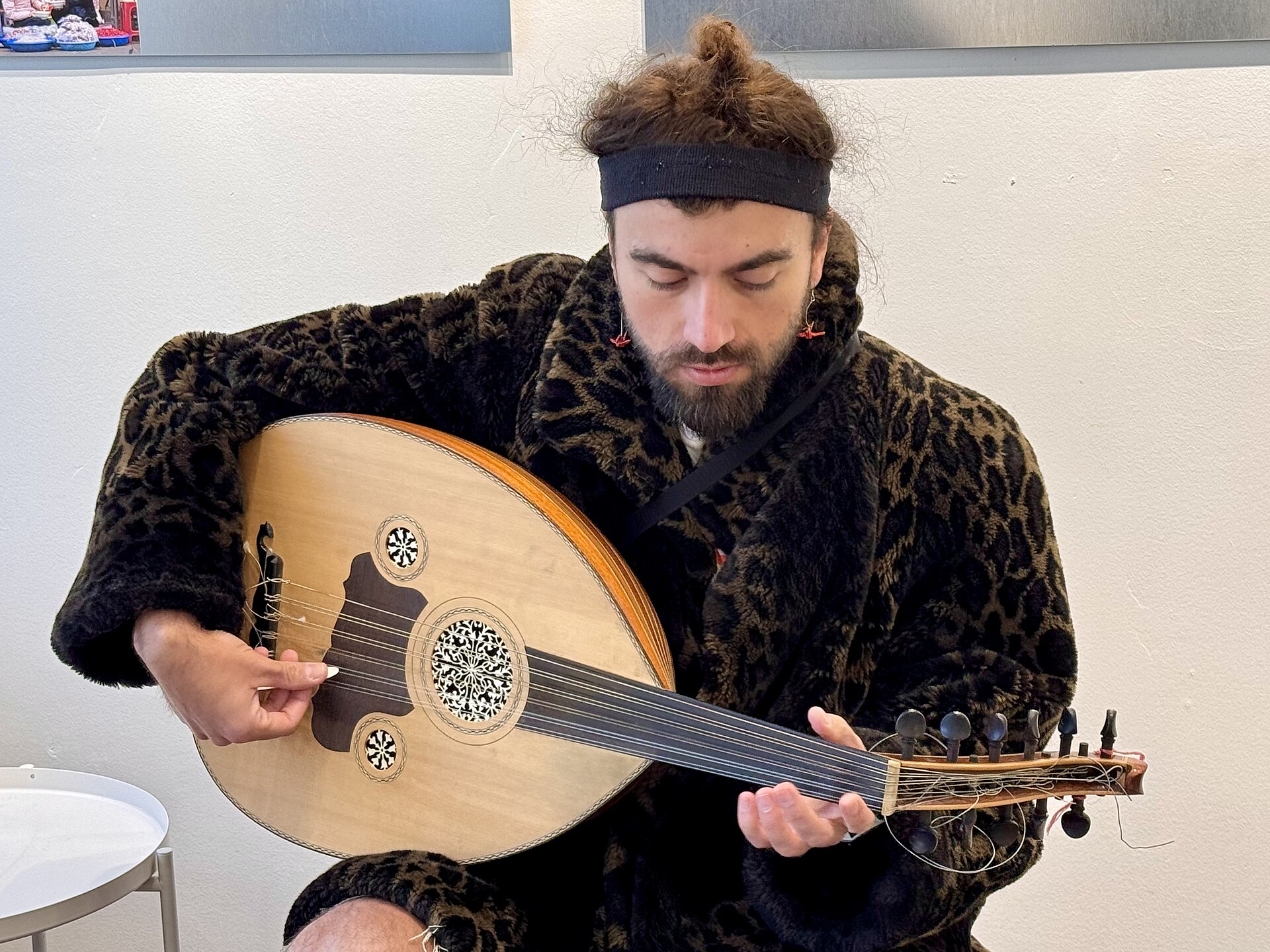
The oud is a plucked, unfretted lute chordophone that was prominent in medieval and modern Islamic music and is the parent of the European lute. Its name comes from the Arabic al-'ud, meaning wood, a term understood to distinguish instruments with wooden soundboards from those whose bellies were made of animal skin. It ranks among the most popular instruments in Arabic music and has long been embraced as culturally emblematic, earning such titles as the sultan of instruments and amir al-tarab, the prince of enchantment.
1. Name and Origins
The instrument's name, al-'ud, means "the wood," and the English word lute is a corruption of that Arabic name, an etymological clue to the instrument's origin. The oud is a stringed instrument with a pear-shaped body and a short neck, played and adapted under a variety of styles and names throughout the Middle East, North Africa, and Central Asia. Its exact origins are unclear, though depictions of the instrument have been found on excavated pieces in the Fertile Crescent, and in ancient Persia the four-stringed barbat was played more than 3,500 years ago.
The Persian barbaṭ, adopted by the Arabs around 600 CE, stands as the oud's ancestor. Widely used throughout the Middle East and Central Asia, the barbaṭ was adopted by the Arabs of Ḥīra around 600 CE and was later supplanted by the improved ʿūd, which had four and then five double gut strings, a deeper rounder sound box made of wood strips and a neck independent from the body. The barbaṭ carried frets and four silk or gut strings that were plucked with a wooden plectrum, tuned in fourths and reaching a range of two octaves. The first examples of the 'ud appear on illustrations and manuscripts in the pre-Islamic Arabian peninsula in the sixth century.
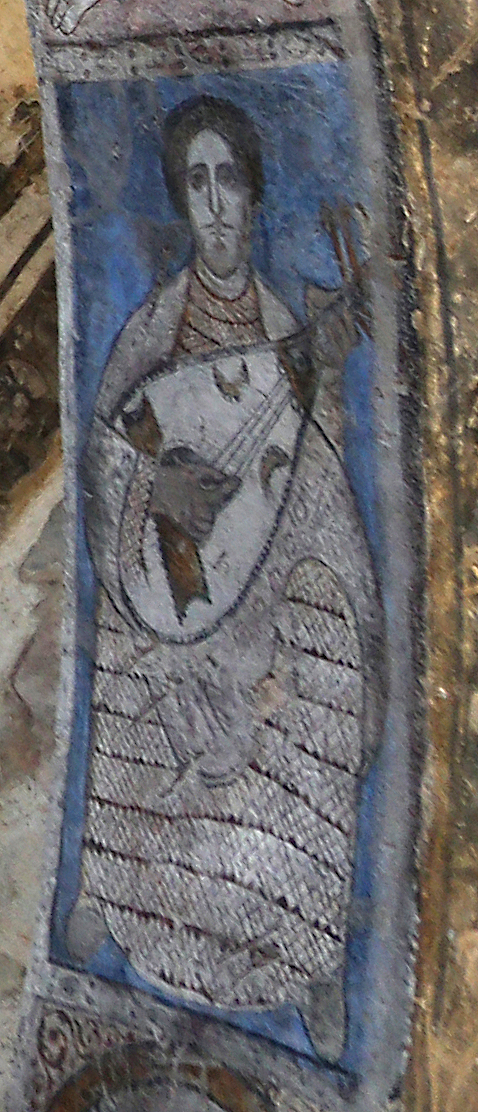
The oldest pictorial representations of the barbaṭ are found at Ḵaḷčayān in North Bactria, in present-day South Uzbekistan, in strata dated to the first century BC, though others date the site to the first century AD. The oud came to prominence in al-Hira in what is now central Iraq, the capital of the Arab Lakhmid Kingdom from 300 to 602 and a city known for its literary and musical culture. Ḵᵛārazmī derives the name barbaṭ from bar, meaning chest, and bat, meaning duck, because the profile of the instrument resembles a duck with the back forming the belly and the neck the head.
2. Construction and Design
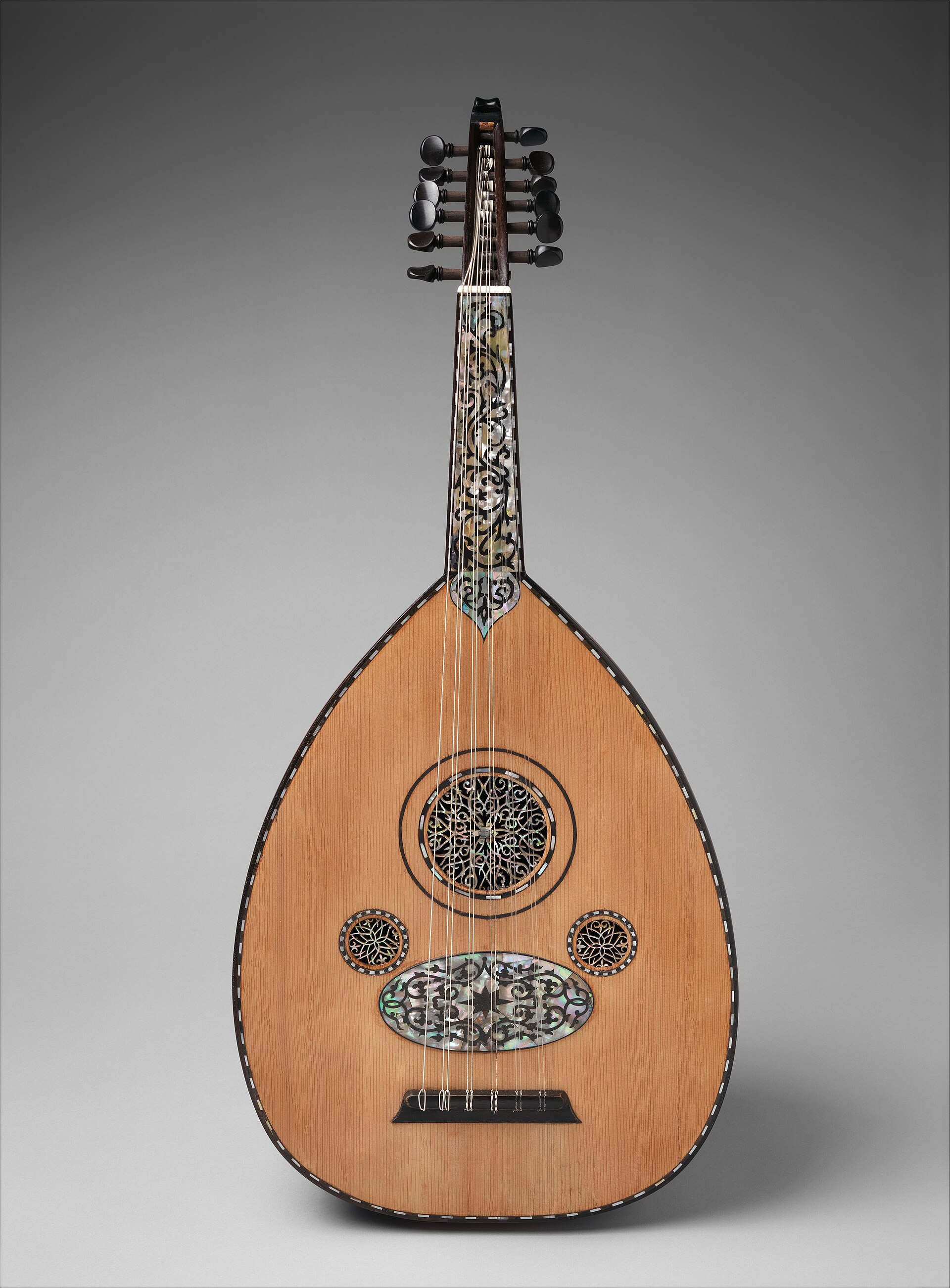
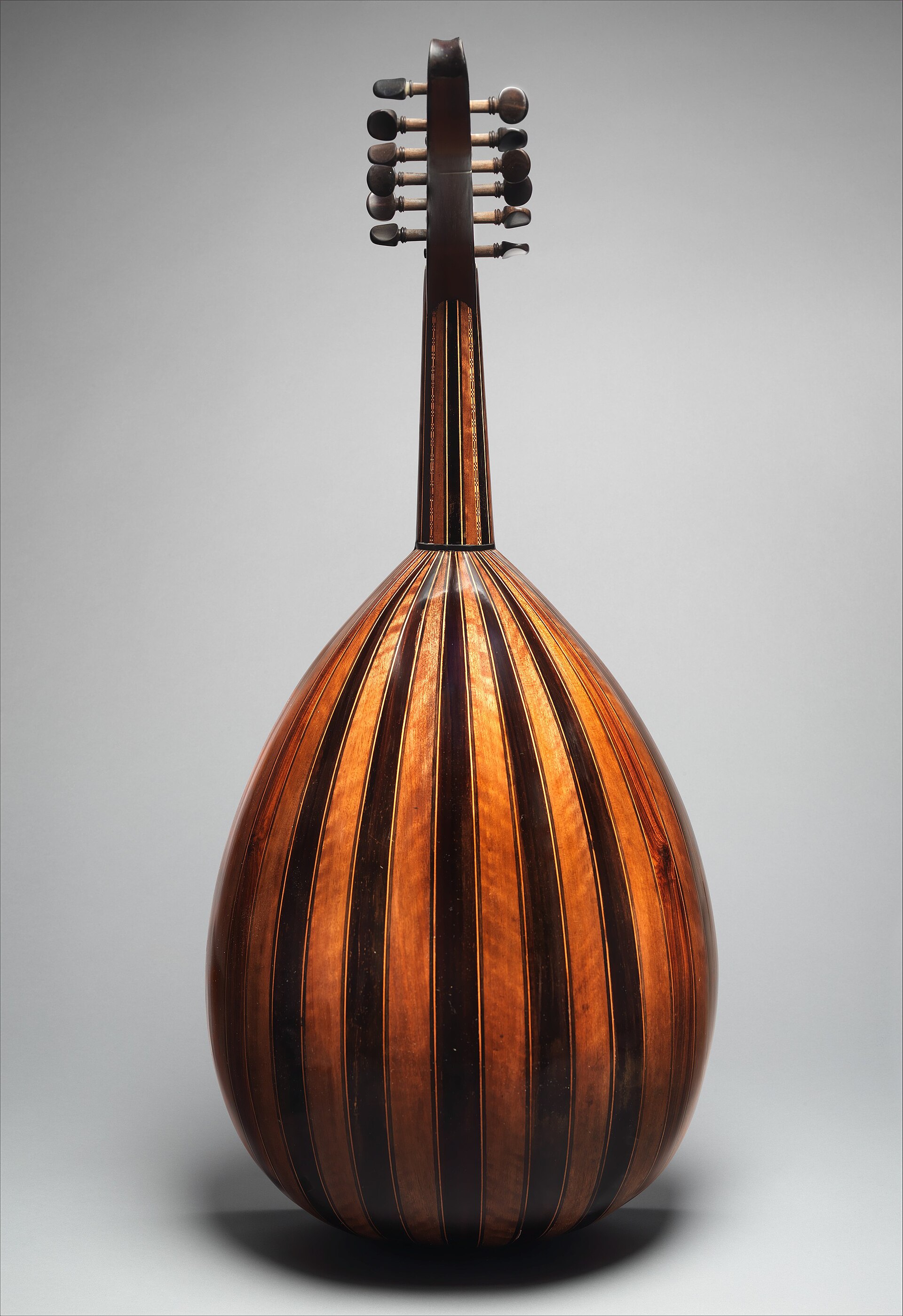
The instrument's body is a deep pear-shaped shell built from numerous thin ribs bent into a rounded back, closed by a wooden soundboard. Its fingerboard is fretless, and the neck is relatively shorter than that of the European lute, with a less acutely bent-back pegbox whose tuning pegs are set in its sides. The strings run to a tension bridge on the belly, and the soundboard carries a round sound hole fitted with a wooden rose.
The most common tuning runs C, F, A, D, G, C from low to high, so that every interval except that between F and A is a perfect fourth. A longer-necked, narrower variety of the instrument, the kuwitra, is common in North Africa.
3. Historical Development
The Kitāb al-mūsīqī al-kabīr, or Great Book of Music, stands as the most important medieval musical treatise in the Islamic lands and also includes sophisticated philosophical sections. For al-Fārābī music is at the service of speech, and the last section of the Great Book of Music explains how technically to fit music to poetry in order to enhance the meaning of a text. A careful reading of the Kitāb al-mūsīqī al-kabīr shows that al-Fārābī defined many scales and modes that are not playable given the notes of his 10-fret and 12-fret ʿud tunings.
Since 2003 music production and musicians in Mosul have been targeted through terrorist attacks, with ISIS killing and imprisoning musicians and performers hiding their instruments by burying them in their gardens. ISIS turned the Spring Theatre in Mosul into a prison and a place of execution, while the Maqam house was left in ruins.
4. Makers and Notable Instruments
The Nahat brothers of Damascus, whose surname means sculptor, rank among the most prolific oud makers in history, running their workshop from the mid-1800s to the mid-1900s making elaborate, ornate instruments, and the ouds they made from the 1870s to the 1980s are accorded the highest reputation among musicians and collectors for their craft and outstanding sound.
A Syrian ūd of the late 19th century in the Metropolitan Museum of Art has a vaulted back built from fifteen ribs, probably of African mahogany, separated by patterned striping. Its varnished spruce top carries three fretwork roses framed by inlaid borders of abalone, plastic, colored wood, and brass triangles.
An album page in the Aga Khan Museum, Prince and Courtiers in a pavilion, made in 17th-century Iran, measures 32.8 cm by 23 cm and depicts an 'oud player and a tambourine player performing for a couple outside their chamber.
5. Performance and Musical Role
Middle Eastern music — the music of the Arabic-, Turkish- and Persian-speaking world — can be seen as a single great tradition despite its three major languages and associated cultural differences, unified by the element of Islam. Both its folk and art music include characteristic nonmetric improvisations, and their melodic and tonal construction is based on a system of modes called maqam in Arabic.
Melodic instruments such as the nay, the zorna, the oud as a short-necked lute, and the santur play in unison with the solo line during composed parts and echo it one or two beats behind in improvised parts.
6. Cultural Traditions and Contemporary Practice
The Iraqi Maqam is widely recognized as Iraq's predominant classical music tradition, encompassing a vast repertory of songs accompanied by traditional instruments. UNESCO first proclaimed it in 2003 and inscribed it in 2008 on the Representative List of the Intangible Cultural Heritage of Humanity, and it is closely linked in structure and instrumentation to traditional musical forms practiced in Iran, Azerbaijan and Uzbekistan. The skilful improvisation of the lead vocalist, the qari', creates an intricate interplay with the accompanying orchestra, the tshalghi. Typical instruments of the Iraqi Maqam include the board cither santur, a four-string spike fiddle called the jawzah, a low-pitched hand-drum known as the dumbak and a small tambourine called the daff.
Maqam is an oral tradition taught only through direct contact between master and students, and these sounds are disappearing from Mosul today. Khalid al-Rawwi, a musician who took part in the Mosul Maqam workshops, had to conceal his oud in a rice bag to avoid kidnapping and potential death for carrying a musical instrument.
Naseer Shamma was born in El Koute in Iraq in 1963 and is celebrated as an oud performer and as a composer of music for film, television and the theatre. The Baghdad Music Academy graduate founded the Arab Oud House in Cairo in 1999 and continues to head that institution. Through his numerous tours, discs and publications he has won appreciation for the oud and for the rich repertoire of Arabic music well beyond the Arab world. In 2017 UNESCO Director-General Irina Bokova named him a UNESCO Artist for Peace at a ceremony at UNESCO Headquarters.
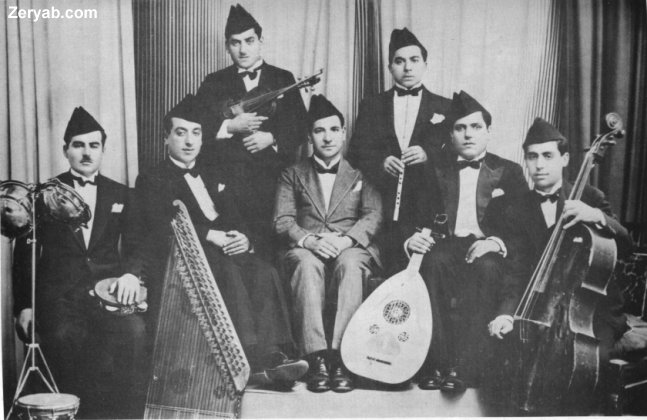
The Cairo Congress of Arab Music of 1932 brought together musicologists from the East and West as well as musicians from the Arab world. It witnessed different visions of the future of Arab music confronting each other, between conservatives and reformists who wanted to use the tools of Western music to adapt to radio and cinema. The Congress reflected the colonial dynamics of its era and aimed to reshape Arab music according to Western standards, with most Arab delegates being musicians while scholars and experts were mainly Europeans. Two delegates from Turkey attended, the musicologist Rauf Yekta and the performer Mesut Cemil. Rauf Yekta's most significant contribution was his opposition to the adoption of a 24-tone equal-tempered scale for Arab music, and he envisioned a dual musical universe, seeing himself as a mediator capable of reconciling the distinct qualities of the Arab and Western worlds.
The AMAR Foundation in Lebanon maintains an archive of wax cylinders, shellac records and other recordings that is the most comprehensive collection in the world of the Arab music Renaissance period, which ran from 1903 until the 1930s.
7. Key Dates
-
first century BCOldest pictorial representations of the barbaṭFound at Ḵaḷčayān in North Bactria, in present-day South Uzbekistan, in strata dated to the first century BC, though others date the site to the first century AD. 8Barbaṭ · Encyclopaedia Iranica ↗
-
300 to 602Al-Hira flourishesThe city in what is now central Iraq served as the capital of the Arab Lakhmid Kingdom and was known for its literary and musical culture, the setting in which the oud came to prominence. 5Prince of Enchantment: The Oud · AramcoWorld (Saudi Aramco) ↗
-
1889An ūd enters the Metropolitan Museum of ArtThe ūd numbered 89.4.374 entered the museum with the Crosby Brown Collection of Musical Instruments and belongs to its musical instruments department. 18Ūd (object 89.4.374, Syria, late 19th century) · The Metropolitan Museum of Art ↗
8. Frequently Asked Questions
What does the name oud mean?
In Arabic the name means 'a thin strip of wood', a reference to the strips of wood used in making the instrument's pear-shaped body. The oud, also spelled 'ud, is one of the most popular instruments in Arabic music. 3The Oud ('Ud) · MaqamWorld ↗
How many strings does an oud have?
Most ouds today have five courses and a single bass string, for a total of 11 strings. By 1500 a six-course oud known as the 'ud akmal had appeared, followed by a seven-course 'ud mukamal and, more recently, an eight-course instrument. 5
What is the plectrum called?
The oud is plucked with a plectrum known as the risha, the Arabic word for feather. Modern rishas are made of plastic, tortoise shell, animal horn or even bamboo. 3
What were oud strings historically made of?
Oud strings were historically made of animal gut. Modern strings are made of steel wound over nylon. 3
What is the oud's soundboard made of?
How does the oud relate to the European lute?
The oud is often regarded as the forerunner and namesake of the European lute and is among the world's oldest continuously played string instruments 5. The origin of the European lute cannot be pinpointed to a specific date, but the instrument's close relationship to the Arab 'ud is without doubt 2The Lute (Heilbrunn Timeline of Art History) · The Metropolitan Museum of Art ↗.
Why does the oud have no frets?
How did the oud reach Europe and beyond?
It was the oud that later traveled to mainland Europe through the Berber conquest of Spain, and it was eventually to become the European lute 19What is a Lute? · Lute Society of America ↗. The earliest evidence of the Arab 'ud in Europe can be found in numerous carvings and depictions dating back to the ninth century, when the Moors introduced it to Spain 2.
What is the oud's role in Middle Eastern music?
The oud has a warm timbre and a wide tonal range of about three octaves, and because it is percussive it can convey melody and rhythm equally well, making it well suited to accompany a singer 3. It is a favourite instrument of composers for writing a new melody, and oud taqasim are very popular in live concerts as well as in recordings 3.
How is an oud made?
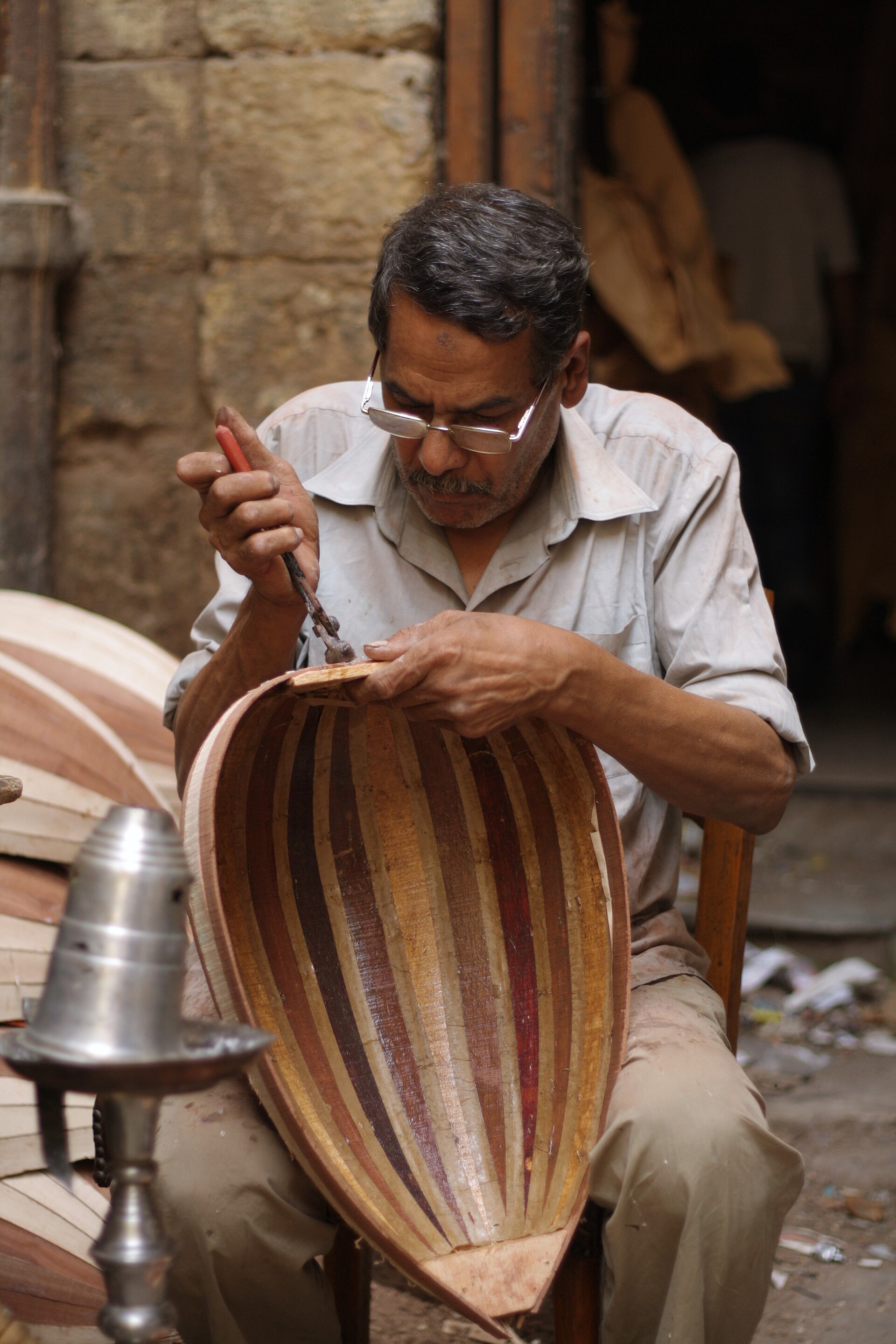
In oud making the work of mounting the wooden body comes first, and bending the wood into shape with water and a flame is described as the most difficult part of the process 4The Captivating Curves of the Guitar's Arab Ancestor · Atlas Obscura ↗. Oud makers combine different kinds of wood in a single instrument to make it sound deeper and more distinctive, and Ghadban works with imported oak, mahogany, lemonwood, Indian rosewood, Burmese teak and walnut 4.
9. Timeline: from the barbaṭ to the oud of today
- 1st century BCOldest depiction of the barbaṭStone reliefs at Ḵaḷčayān in North Bactria, in present-day South Uzbekistan, carry the oldest pictorial representations of the barbaṭ.
- 6th centuryFirst 'ud images in ArabiaIllustrations and manuscripts of the pre-Islamic Arabian peninsula show the first examples of the 'ud.
- around 600 CEThe barbaṭ reaches the Arabs of ḤīraThe barbaṭ, widely used through the Middle East and Central Asia, was adopted by the Arabs of Ḥīra; the improved ʿūd later supplanted it.
- 8th centuryZalzal and the 'ud al-shabbutIn eighth-century Baghdad the musician Zalzal introduced the 'ud al-shabbut, a variety possibly named for a large river fish.
- 822 CEZiryab arrives in CórdobaZiryab, a virtuoso of the Abbasid court in Baghdad, reached Córdoba in 822 CE, brought his understanding of the five-string 'ud and set up a music school.
- about 950 CEAl-Fārābī's Great Book of MusicAl-Fārābī (d. c. 950) wrote the Kitāb al-mūsīqī al-kabīr, which describes the 10-fret and 12-fret ʿud and treats frets as movable bridges.
- 13th centuryThe barbaṭ in the Cantigas de Santa MariaA barbaṭ is pictured in the 13th-century Spanish illustrated musical manuscript Cantigas de Santa Maria.
- from 1492The 'ud disappears from SpainAfter the expulsions of Muslims and Jews began in earnest in 1492 the 'ud seems to have disappeared from Spain; the vihuela became popular in its place.
- by 1500The six-course 'ud akmalBy 1500 a six-course 'ud akmal had appeared, followed by a seven-course 'ud mukamal; today most ouds have five courses and a single bass string.
- 1889A Syrian ūd enters the MetThe ūd numbered 89.4.374, a Syrian instrument of the late 19th century, entered the Metropolitan Museum of Art with the Crosby Brown Collection of Musical Instruments.
- 1903 to the 1930sRecordings of the Arab music RenaissanceThe AMAR Foundation archive of wax cylinders and shellac records covers the Arab music Renaissance period from 1903 until the 1930s.
- March–April 1932The Cairo Congress of Arab MusicThe congress brought musicologists from East and West together with Arab musicians, and confronted conservative and reformist visions of Arab music's future.
- 1963Naseer Shamma is bornThe Iraqi oud virtuoso and composer Naseer Shamma was born in El Koute in Iraq.
- 1999The Arab Oud House is foundedNaseer Shamma founded the Arab Oud House in Cairo in 1999 and heads the institution.
- 2003UNESCO proclaims the Iraqi MaqamUNESCO proclaimed the Iraqi Maqam in 2003 and inscribed it in 2008 on the Representative List of the Intangible Cultural Heritage of Humanity.
- 2017Naseer Shamma named UNESCO Artist for PeaceThe UNESCO Director-General named the Iraqi oud virtuoso Naseer Shamma a UNESCO Artist for Peace at a ceremony at UNESCO Headquarters.
References (19)
- 1Oud | Musical Instrument — Encyclopaedia Britannica Web↩View source
- 2The Lute (Heilbrunn Timeline of Art History) — The Metropolitan Museum of Art Web↩View source
- 3The Oud ('Ud) — MaqamWorld Web↩View source
- 4The Captivating Curves of the Guitar's Arab Ancestor — Atlas Obscura Web↩View source
- 5Prince of Enchantment: The Oud — AramcoWorld (Saudi Aramco) 2020 Web↩View source
- 6Music and Art of China (Heilbrunn Timeline of Art History) — The Metropolitan Museum of Art WebView source
- 7Prince and Courtiers in a Pavilion (AKM430) — Aga Khan Museum WebView source
- 8Barbaṭ — Encyclopaedia Iranica Web↩View source
- 9Al-Fārābī (Stanford Encyclopedia of Philosophy) — Stanford University WebView source
- 10Al-Farabi's Uds — The Chrysalis Foundation WebView source
- 11Mosul Maqam (Digital Archive of the Middle East) — University of Exeter WebView source
- 12Ūd, Les fils de Gamil Georges (Syria, 19th century) — The Metropolitan Museum of Art WebView source
- 13Middle Eastern Music — Encyclopaedia Britannica WebView source
- 14Iraqi Maqam (Intangible Cultural Heritage) — UNESCO WebView source
- 15Celebrated Iraqi musician Naseer Shamma named UNESCO Artist for Peace — UNESCO WebView source
- 16Rauf Yekta's Notes on the 1932 Congress of Arab Music — Göttingen University Press, The World of Music (new series) 1932 BookView source
- 17The 1932 Cairo Arab Music Congress — Nicolas Sursock Museum, Beirut 1932 WebView source
- 18Ūd (object 89.4.374, Syria, late 19th century) — The Metropolitan Museum of Art Web↩View source
- 19What is a Lute? — Lute Society of America Web↩View source