Stonehenge
England's prehistoric stone circle on Salisbury Plain — the construction phases from earthwork to sarsen circle, the documented origins of the stones, the solstice alignments, and the open debates over how and when it was built.
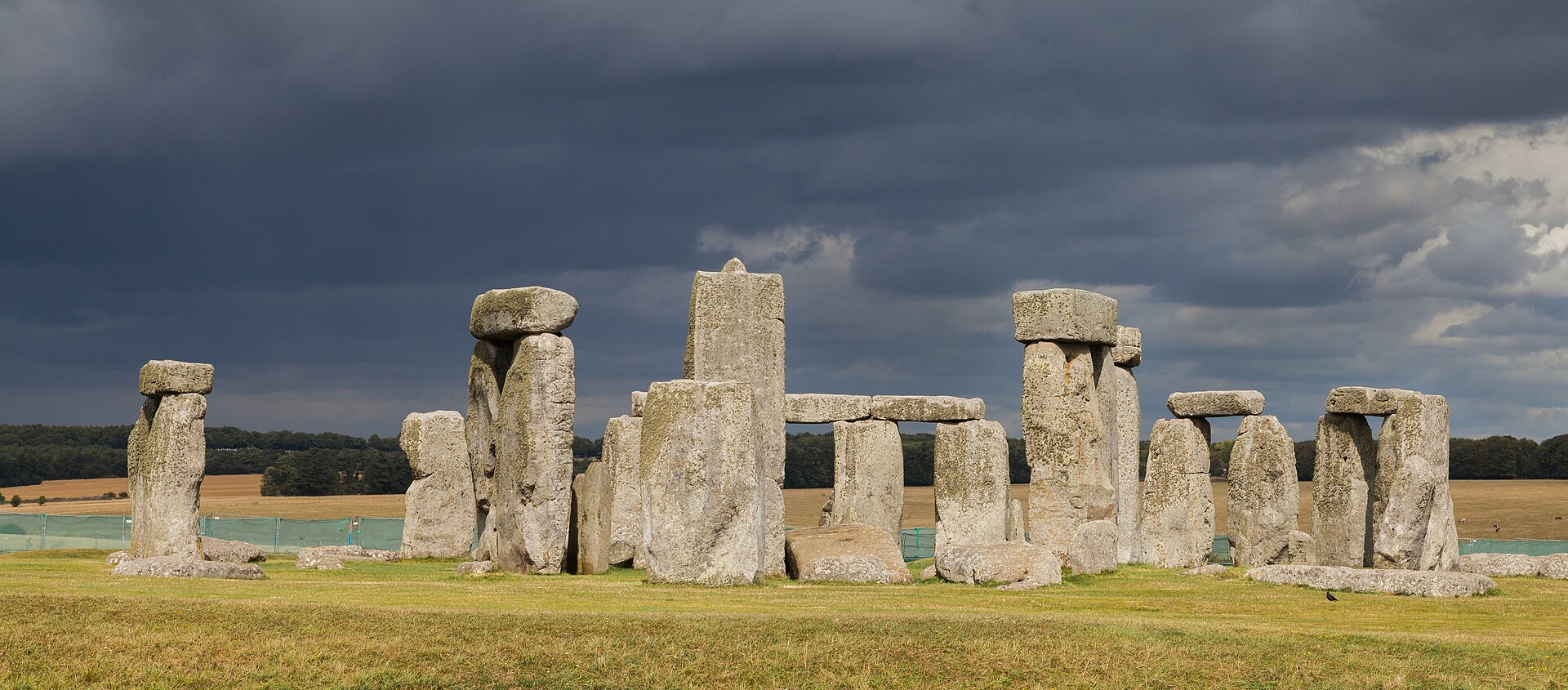
Stonehenge is a prehistoric stone circle, cemetery and archaeological site on Salisbury Plain in Wiltshire, England, built in several stages from about 3000 BC, with the central stone settings raised about 2500 BC. Its large sarsens came from the Marlborough Downs about 25 km north, its smaller bluestones from the Preseli Hills of south-west Wales, and the whole layout is aligned on the solstices. This fact base assembles the evidence of English Heritage, UNESCO, the British Museum, Historic England research reports and peer-reviewed archaeology — including the open disputes over bluestone transport and the Altar Stone's origin — with verbatim quotes from each source.
Stonehenge at a glance
Stonehenge is perhaps the world's most famous prehistoric monument, built in several stages, with an early henge monument about 5,000 years ago and the unique stone circle erected about 2500 BC.1 Britannica describes it as a prehistoric stone circle monument, cemetery and archaeological site on Salisbury Plain, about 8 miles (13 km) north of Salisbury, Wiltshire.2 There is no definite evidence as to its intended purpose, though it was presumably a religious site and an expression of the power and wealth of the chieftains, aristocrats and priests who had it built, many of whom were buried in the numerous barrows close by.2
As a stone circle, Stonehenge is unique both for its artificially shaped sarsen blocks, arranged in post-and-lintel formation, and for the remote origin of its smaller bluestones, which came from 100-150 miles (160-240 km) away in South Wales.2
Before Stonehenge: an older sacred landscape
The earliest structures known in the immediate area are four or five pits, three of which appear to have held large pine posts of a totem-pole kind, erected in the Mesolithic period between 8500 and 7000 BC.1 Britannica records early Mesolithic hunter-gatherers digging pits and erecting pine posts within 650 feet (200 metres) of Stonehenge's future location.2 It was unusual for hunter-gatherers to build monuments, and there are no comparable structures from this era in north-western Europe.2
By the centuries around 3500 BC the landscape was already marked by an early Neolithic complex: a causewayed enclosure at Robin Hood's Ball, two cursus monuments, the Greater and the Lesser Cursus, and several long barrows.1 Within a 3-mile (5-km) radius at least 17 long barrows and two cursus monuments survive from that fourth millennium.2 These monuments probably influenced the later location of Stonehenge.1
The first monument: ditch, 56 posts and the dead (c. 3000 BC)
The earliest known major event at the site was the construction, about 3000 BC, of a circular ditch with an inner and an outer bank.1 It enclosed an area about 100 metres in diameter and had two entrances — an early form of henge monument.1 The ditch was dug with simple antler tools, the chalk piled up to make the inner and outer banks.4 Within the ditch was a ring of 56 timber or stone posts, and the monument was used as a cremation cemetery for several hundred years.4
Just inside the bank were the 56 pits known as the Aubrey Holes, whose contents have been much debated.1 The consensus for many years was that they held upright timber posts, but recently the idea has re-emerged that some of them may have held stones.1 About 64 cremations have been found, and perhaps as many as 150 individuals were originally buried at Stonehenge — the largest late Neolithic cemetery in the British Isles.1 UNESCO reads the cremation cemetery as a profound insight into the changing mortuary culture of the period.3
The cremations cluster in the south-eastern part of the monument, toward the most southerly rising position of the moon, where three timber posts were set into the bank.5 The limits of moonrise and moonset change over a period of about 18.6 years, giving the recurring lunar major and minor standstills.5
Construction phases
Stonehenge was not raised in a single campaign: the earthwork enclosure dates from about 3000 BC, and the stones were set up about 2500 BC.1 Two types of stone were used: the larger sarsens, raised in two concentric arrangements — an inner horseshoe and an outer circle — and the smaller bluestones, set up between them in a double arc.1 Over 80 large sarsens were brought from the Marlborough Downs, 15 miles (25 km) away, and raised in the centre of the enclosure in two concentric arrangements.6 By about 2300-2200 BC the central bluestones had been rearranged, and the Avenue built to connect the monument with the river Avon.6
| Phase | Date | What was built | Evidence |
|---|---|---|---|
| Mesolithic posts | About 8500-7000 BC.1 | Pine posts on the site of the future monument.1 | Four or five pits known, three apparently holding large pine posts.1 |
| First monuments | The centuries around 3500 BC.1 | A causewayed enclosure, two cursus monuments and several long barrows, north of the site.1 | At least 17 long barrows and two cursus monuments survive within a 3-mile (5-km) radius.2 |
| Earthwork henge | About 3000 BC.1 | A ditch and banks about 100 m across, a ring of 56 posts and a cremation cemetery.4 | About 64 cremations found; up to 150 individuals buried.1 |
| Sarsen and bluestone settings | About 2500 BC.6 | Over 80 sarsens raised in an inner horseshoe and an outer circle, the bluestones in a double arc between them.6 | The only site matching Stone 58 geochemically is West Woods, 25 km north.7 |
| Rearrangement | About 2300-2200 BC.6 | Bluestones reset into a circle and an inner oval; the Avenue built to the river Avon.6 | The Q and R holes preserve the earlier bluestone arc.4 |
| Late pits | About 2100-1500 BC.1 | Two rings of concentric pits, the Y and Z holes, and round barrows on the surrounding ridges.1 | Y and Z holes radiocarbon dated by antlers to between 1800 and 1500 BC.1 |
The stones and where they came from
The sarsen stones are a type of silcrete rock found scattered naturally across southern England.4 For many years most archaeologists believed they came from the Marlborough Downs, 20 miles (32 km) away, but the exact origin remained a mystery.4 Recent research using a novel geochemical approach confirmed that the Marlborough Downs were indeed the source, and pinpointed the area known as West Woods, south-west of Marlborough.4 The only site sharing the immobile trace element signature of Stone 58 is West Woods in Wiltshire, 25 km north of Stonehenge.7 Stone 58 is representative geochemically of 50 of the 52 sarsens remaining at Stonehenge.7 On average the sarsens weigh 25 tons, and the largest, the Heel Stone, weighs about 30 tons.4 UNESCO notes the unique use of two kinds of stone, the largest weighing over 40 tonnes, and a transport distance of up to 240 km.3
Bluestone is the term used for the smaller stones at Stonehenge; their geology is varied, but all came from the Preseli Hills in south-west Wales, and they weigh between 2 and 5 tons each.4 Of the 43 identified Welsh bluestones at Stonehenge, 30 are of dolerite, mostly spotted.8 Excavations at Craig Rhos-y-felin have provided direct dating evidence for the extraction of bluestone monoliths there, demonstrating Neolithic and Early Bronze Age activity.8 Quarrying events there are placed in 3620-3360 cal BC and 3500-3120 cal BC.8 Some unspotted dolerite bluestones may originally have stood in a stone circle at Waun Mawn in the Preseli Hills, where at least six bluestone pillars were removed in prehistory.4 When first set up at Stonehenge, the bluestones stood in an arc of double stoneholes, the Q and R holes, before being rearranged into the present outer circle and inner horseshoe.4 Some of the bluestones may previously have stood in a stone circle at West Amesbury henge on the bank of the river Avon, 1 mile (1.7 km) to the south-east.4
How it was built: transport, shaping and raising
Stonehenge is a masterpiece of engineering, built using only simple tools and technologies, before the arrival of metals and the invention of the wheel.4 Building the stone circle would have needed hundreds of people to transport, shape and erect the stones.4 These builders would have needed others to provide food, childcare and equipment including hammerstones, ropes, antler picks and timber.4 The project would have needed careful planning and organisation.4
Large quantities of sarsen and bluestone waste, and broken hammerstones, have been found in the field north of Stonehenge where the stones were worked into shape.4 Analysis of a recent laser survey has revealed the different stoneworking methods used and shown that the north-east side and the inner faces of the central trilithons were finely dressed.4 To fit the upright stones with the horizontal lintels, mortice holes and protruding tenons were created, and the lintels were slotted together using tongue and groove joints — types of joint usually found only in woodworking.4 To erect a stone, people dug a large hole with a sloping side, lined the back with wooden stakes, hauled the stone upright using plant fibre ropes and probably a wooden A-frame, and packed the hole securely with rubble.4 UNESCO calls the monument unrivalled in its design and engineering, with huge horizontal stone lintels capping the outer circle and the trilithons, locked together by carefully shaped joints.3
Quarries or glaciers? The transport debate
The long-distance transport of the bluestones from south Wales is one of the most remarkable achievements of Neolithic societies in north-west Europe.8 Where precisely the stones were quarried, when they were extracted and how they were transported has long been a subject of speculation, experiment and controversy.8 There has been considerable dispute over the mode of transport.11 For a century most archaeologists have accepted that the stones were transported by humans, but a number of earth scientists have taken the view that they were entrained and transported to Salisbury Plain by glacier ice.11 There is remarkably little evidence in support of either theory.11 A 2024 paper in the E&G Quaternary Science Journal proposes that the abundant weathered and abraded bluestone boulders and slabs at Stonehenge were glacially transported, along with many cobbles and stone fragments in the local sediments.11 It centres on an erratic rhyolitic boulder about 22 × 15 × 10 cm, found at Stonehenge in the course of the 1924 excavations by Colonel William Hawley and later known as the Newall Boulder.11 The paper concludes that the elaborate archaeological narrative of bluestone quarrying and human transport must now be re-examined.11 The journal published an editorial note recording the controversy and pointing to a critical commentary on the article, backed up by new scientific findings, published in 2025.11 On the other side stands the quarry evidence and its radiocarbon dates from Craig Rhos-y-felin.8
The sky over Stonehenge: solstices, moon and the Avenue
The sarsen stones, put up in the centre of the site in about 2500 BC, were carefully placed to line up with the movements of the sun.5 Standing in the middle of the circle on Midsummer's Day, a person would see the sun rise just to the left of the Heel Stone, north-east of the circle.5 On Midwinter's Day the sun would originally have set between the uprights of the tallest trilithon and dropped over the Altar Stone, a sandstone block placed across the solstice axis.5 A laser survey has shown that the stones framing the solstice axis were the most carefully shaped, with vertical sides that framed the movement of the sun.5 The whole layout is designed in relation to the solstices, and the axis is also marked by the Station Stones, placed at the corners of a rectangle around the edge of the circular ditch.5
The late Neolithic monument known as the Avenue, made up of parallel banks and ditches, links Stonehenge to the nearby river Avon, and its final, straight stretch close to Stonehenge is aligned on the north-east to south-west solar axis.5 UNESCO reads the alignment of the Avenue and the stone circle on the axis of the midsummer sunrise and midwinter sunset as an indication of their ceremonial and astronomical character.3 It is thought that midwinter, rather than midsummer, may have been the more important focus for the builders.5 People gathered to feast at midwinter at Durrington Walls, the settlement north-west of Stonehenge where its builders and users lived, and most of the pigs buried there were killed in midwinter.5 The astronomer Norman Lockyer argued in 1906 that it was a solar temple used for observation in the height of midsummer.12 Archaeo-astronomers, however, think it unlikely that the equinoxes meant anything to prehistoric people, though people today gather there at the spring and autumn equinoxes to watch the sunrise.5
Dating Stonehenge: how the chronology was built
The first proper archaeological excavation at Stonehenge was conducted in 1901 by William Gowland.2 About half of the monument was excavated in the 20th century by William Hawley in 1919-26 and Richard Atkinson in 1950-78.2 The results were not fully published until 1995, when the chronology of Stonehenge was revised extensively by carbon-14 dating.2
Revisiting records of 100 years ago, a 2007 study in Antiquity demonstrated that the ambiguous dating of the trilithons was based on samples taken from the wrong context, and can now be settled at 2600-2400 cal BC.13 That makes the trilithons contemporary with Durrington Walls, described as Britain's largest henge monument.13 The history published by English Heritage gives rounder figures: the stones were set up in about 2500 BC.1
After the stones: Beaker graves, barrows and Romans
The stone settings were built at a time of great change, as Beaker pottery, metalworking and the burial of individuals with grave goods were arriving from the Continent.1 From about 2400 BC, well-furnished Beaker graves such as that of the Amesbury Archer appear nearby.1 In the early Bronze Age one of the greatest concentrations of round barrows in Britain was built around Stonehenge, many groups deliberately on hilltops visible from the monument, such as King Barrow Ridge and the rich burials at the Normanton Down cemetery.1 Four of the sarsens were adorned with hundreds of carvings of axe-heads and a few daggers, apparently bronze axes of the Arreton Down type dating from about 1750-1500 BC.1 One of the last prehistoric activities was the digging of two rings of concentric pits, the Y and Z holes, radiocarbon dated by antlers within them to between 1800 and 1500 BC; they may have been meant for a rearrangement that was never completed.1 The monument visible today is incomplete, many original sarsens and bluestones having been broken up and taken away, probably during the Roman and medieval periods.2
In the Iron Age, probably about 700 BC, a major hillfort later known as Vespasian's Camp was constructed 1¼ miles east of Stonehenge, overlooking the river Avon.1 Stonehenge appears to have been frequently visited in the Roman period from AD 43, since many Roman objects have been found there.1 A decapitated man, possibly a criminal, was buried at Stonehenge in the Saxon period, and Amesbury was likely established around the 6th century AD at a crossing over the Avon.1 An analytical survey revealed a low mound within the stone settings, a finding that supplements former reservations as to whether the monument was ever complete.14
Merlin, Druids and the making of an icon
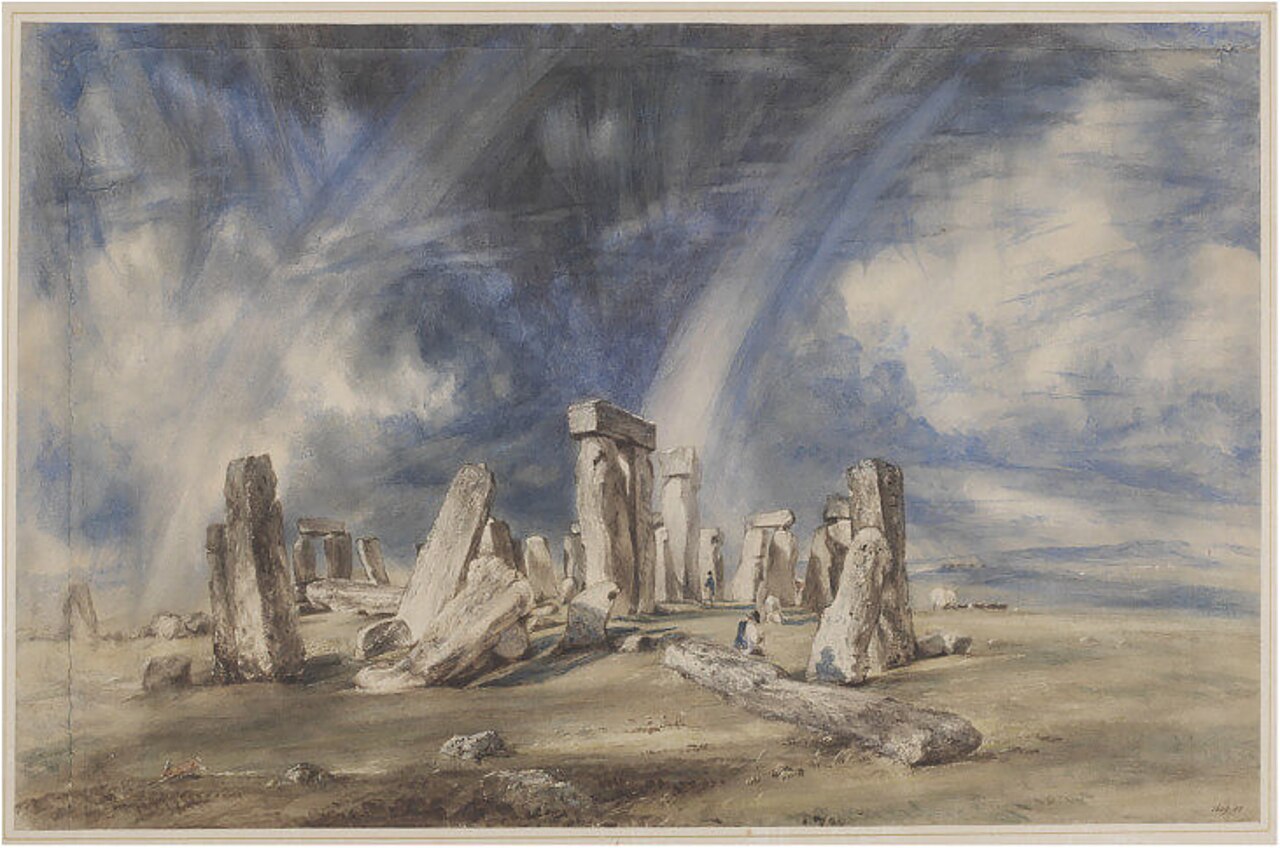
The idea that the wizard Merlin built Stonehenge was explained by Geoffrey of Monmouth in 1136, and it was widely accepted until as late as the 16th century.1 The English antiquarian John Aubrey in the 17th century and the archaeologist William Stukeley in the 18th both believed it to be a Druid temple.2 This idea has been rejected by more recent scholars, as Stonehenge is now understood to have predated by some 2,000 years the Druids recorded by Julius Caesar.2 The British Museum, which holds a medal of Stukeley, records that his twenty volumes of research on Stonehenge, Avebury and other antiquities are inaccurate and credulous.15
the temples of the Druids in our Island: for I cannot doubt that Stonehenge was such.
William Stukeley, Stonehenge, a Temple Restor'd to the British Druids, 1740
We therefore are perfectly justified in assuming that it was a solar temple used for observation in the height of midsummer.
Sir Norman Lockyer, Stonehenge and Other British Stone Monuments Astronomically Considered, 1906
present-day Druids gather there every year to hail the midsummer sunrise.
Encyclopaedia Britannica, Stonehenge

Conservation and World Heritage today
From the 1880s various stones were propped up with timber poles, and concern for visitor safety grew when an outer sarsen upright and its lintel fell in 1900.1 The owner, Sir Edmund Antrobus, with the help of the Society of Antiquaries, organised the re-erection of the leaning tallest trilithon in 1901.1 This began a sequence of campaigns to conserve and restore Stonehenge; the last stones were consolidated in 1964.1 A Historic England research report records that the monument was subjected to more intervention and alteration from 1901 than at any time since the Bronze Age, including the straightening and concreting of the massive Stone 56 in 1901 and the uncompleted reparations of 1919-20.16 The monument remained in private ownership until 1918, when Cecil Chubb, a local man who had purchased Stonehenge from the Antrobus family at an auction three years previously, gave it to the nation.1 Thereafter the Office of Works managed excavations and restorations of the monument in the 1920s and 1950s, and the surrounding downland was purchased and vested in the National Trust in 1929.17
The property was inscribed on the World Heritage list in 1986 under criteria (i)(ii)(iii), covering 5,152.39 hectares, with a minor boundary modification in 2008.3 In 2013 the road close to the stones was closed and a new visitor centre was built 2 kilometres away, reuniting the circle with its landscape.6 A scheme supported by English Heritage to build a two-mile tunnel and remove much of the A303 from view was cancelled by the UK government in July 2024 after a spending review.1
Stonehenge timeline
Mesolithic posts at the future site
Four or five pits, three of them holding large pine 'totem-pole like' posts, are dug at what will become the Stonehenge site.
First Neolithic monuments in the landscape
A causewayed enclosure at Robin Hood's Ball, two cursus monuments and several long barrows are built north of the site in the centuries around 3500 BC.
The first Stonehenge: ditch, posts and a cemetery
A circular ditch with inner and outer bank encloses an area about 100 metres across with a ring of 56 posts; the monument becomes a cremation cemetery for several hundred years, and bluestones may have arrived around this time.
The stones are raised
Over 80 large sarsens from the Marlborough Downs are raised in two concentric arrangements at the centre of the enclosure, with the smaller bluestones set in a double arc between them.
Beaker graves and the Amesbury Archer
Beaker-culture burials appear near the site, including the richest grave of the time — the Amesbury Archer.
Bluestones rearranged; the Avenue built
The central bluestones are rearranged into a circle and inner oval, and the Avenue is built to connect Stonehenge with the river Avon.
Axe-head carvings on the sarsens
Four of the sarsens are adorned with over 100 carvings of axeheads and a few daggers, perhaps symbols of power or status.
Vespasian's Camp hillfort
A major Iron Age hillfort, later known as Vespasian's Camp, is constructed about 1¼ miles east of Stonehenge overlooking the river Avon.
Merlin's Stonehenge: Geoffrey of Monmouth
Geoffrey of Monmouth explains the monument as the work of the wizard Merlin in his History of the Kings of Britain — an idea accepted until as late as the 16th century.
Stukeley publishes the Druid temple
William Stukeley publishes Stonehenge, a Temple Restor'd to the British Druids; the British Museum connects its medal of Stukeley to that publication.
First excavation and first restoration
William Gowland conducts the first proper archaeological excavation, and the leaning tallest trilithon is re-erected after the 1900 collapse; Stone 56 is straightened and concreted.
Given to the nation: Cecil Chubb
Cecil Chubb, who had bought Stonehenge from the Antrobus family at auction three years earlier, gives the monument to the nation.
UNESCO World Heritage inscription
Stonehenge, Avebury and Associated Sites is inscribed on the World Heritage list under criteria (i)(ii)(iii), covering 5,152.39 hectares.
A new setting: visitor centre and road closure
The road running close to the stones is closed and a new visitor centre is built 2 kilometres away, reuniting the circle with its landscape.
Altar Stone traced to north-east Scotland
A Nature study comparing detrital mineral ages reports that the Altar Stone matches the Old Red Sandstone of the Orcadian Basin, implying a journey of at least 750 km.
A303 tunnel scheme cancelled
A two-mile tunnel scheme supported by English Heritage, intended to remove much of the A303 from view, is cancelled by the UK government after a spending review.
Frequently asked questions
Where is Stonehenge, and what kind of site is it?
It is a prehistoric stone circle monument, cemetery and archaeological site on Salisbury Plain, about 8 miles (13 km) north of Salisbury, Wiltshire, England.2 It is perhaps the world's most famous prehistoric monument, built in several stages.1
When was Stonehenge built?
The earliest known major event at the site was the construction of a circular ditch with an inner and an outer bank about 3000 BC.1 The unique stone circle was erected in the late Neolithic period about 2500 BC.1 Britannica dates the construction to six stages between 3000 and 1520 BCE.2
How big are the stones, and how many survive?
On average the sarsens weigh 25 tons, with the largest stone, the Heel Stone, weighing about 30 tons.4 52 sarsens remain at Stonehenge, and Stone 58 is representative geochemically of 50 of them.7 Of the 43 identified Welsh bluestones, 30 are of dolerite, mostly spotted.8
Where did the stones come from?
The sarsens were brought from the Marlborough Downs, 20 miles (32 km) away, and the specific area most likely to be their source is West Woods, south-west of Marlborough.4 The bluestones, which weigh between 2 and 5 tons each, all came from the Preseli Hills in south-west Wales.4
Why is the Altar Stone special?
The Altar Stone is the largest of the bluestones, a recumbent block measuring 4.9 × 1.0 × 0.5 m, weighing 6 tonnes and composed of pale green micaceous sandstone.9 A 2024 study in Nature reported that detrital age comparisons match the Old Red Sandstone of the Orcadian Basin in north-east Scotland, implying a source at least 750 km away.9
How was Stonehenge built?
To erect a stone, people dug a large hole with a sloping side, lined the back with a row of wooden stakes, hauled the stone upright using plant fibre ropes and probably a wooden A-frame, and packed the hole securely with rubble.4 Building the stone circle would have needed hundreds of people to transport, shape and erect the stones.4
Is Stonehenge a World Heritage site?
Stonehenge, Avebury and Associated Sites was inscribed on the World Heritage list in 1986 under criteria (i)(ii)(iii), covering 5,152.39 hectares, with a minor boundary modification in 2008.3 Stonehenge is the most architecturally sophisticated prehistoric stone circle in the world, while Avebury is the largest.3
Did the Druids build Stonehenge?
John Aubrey in the 17th century and William Stukeley in the 18th both believed the structure to be a Druid temple, but the idea has been rejected by more recent scholars, as Stonehenge predated by some 2,000 years the Druids recorded by Julius Caesar.2 Present-day Druids gather at Stonehenge every year to hail the midsummer sunrise.2
Stonehenge by the numbers
Sources & citations
Every factual claim in this article is drawn from the sources below. Bracketed numbers in the text link to the corresponding source.
- 1
- 2
- 3
- 4
- 5
- 6
- 7
- 8
- 9
- 10
- 11
- 12
- 13
- 14
- 15
- 16
- 17