Ankylosaurus
The armoured tank of the Late Cretaceous — its armour and tail club, its skull and diet, Barnum Brown's naming of the genus in 1908, and its world alongside Tyrannosaurus rex and Triceratops.
Ankylosaurus was a large armoured dinosaur of the latest Cretaceous, a low-slung herbivore up to about 8 metres long whose back and flanks were covered in bony osteoderms and whose tail ended in a heavy club. Named by Barnum Brown in 1908 from Hell Creek Formation material, it lived between about 68 and 66 million years ago alongside Tyrannosaurus rex and Triceratops in western North America, browsing low-growing plants. No complete skeleton has ever been found, and studies of its armour, jaw mechanics and tail club continue to refine its picture.
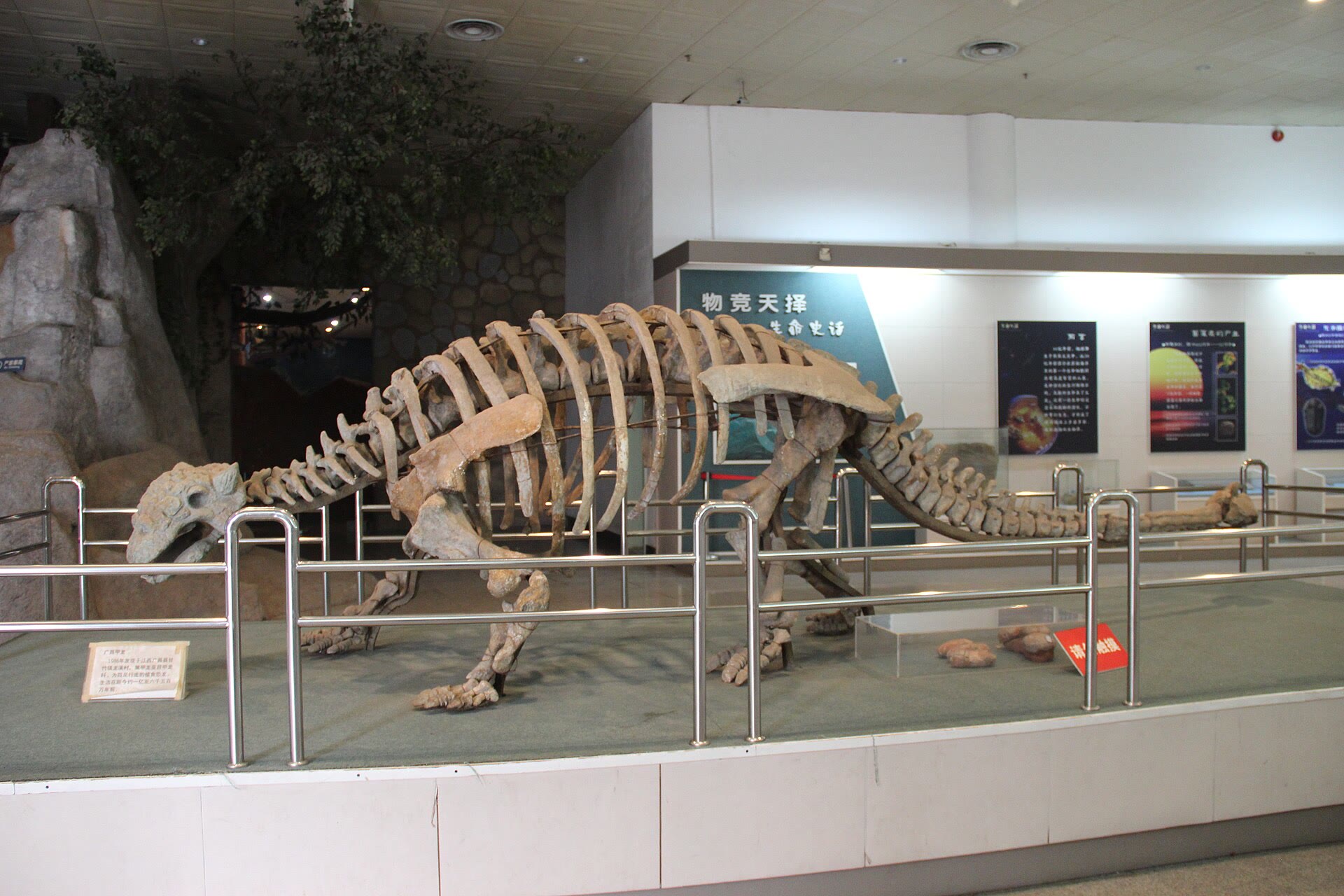
Overview
Ankylosaurus is a genus of large armoured dinosaur and one of the last non-avian dinosaurs. Its name means "fused lizard". The type species is Ankylosaurus magniventris, named by Barnum Brown in 1908.
Ankylosaurs are members of Thyreophora, a group of dinosaurs characterised by body armour whose name comes from the Greek for "shield-bearer"; within this group ankylosaurs form one of two main subgroups, the other being the stegosaurs.
1. Discovery and Naming
The first Ankylosaurus bones were found in 1906 at the Hell Creek Formation in Montana by Barnum Brown, the same scientist who had led the discovery of Tyrannosaurus rex a few years earlier. The remains of the type specimen were found by Mr. Peter Kaisen near Gilbert Creek, 120 miles north of Miles City, Montana. Among the most famous dinosaurs found in Hell Creek rocks are Tyrannosaurus rex, Triceratops, Edmontosaurus and the tank-like armoured dinosaur Ankylosaurus.
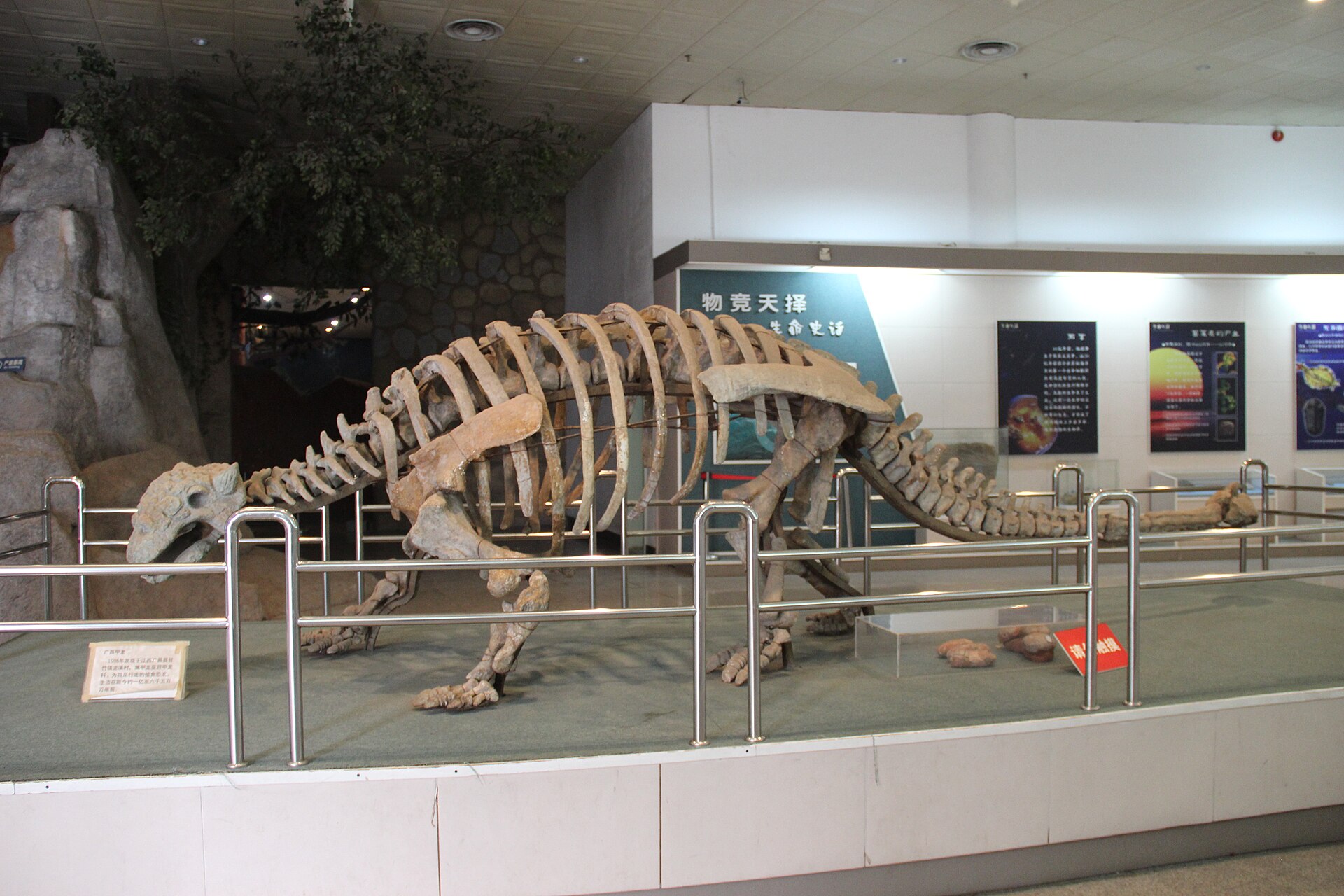
The genus was named by Barnum Brown in 1908, with the type species Ankylosaurus magniventris (Brown, 1908). The type specimen of Ankylosaurus magniventris, number 5895 in the American Museum collection, includes the skull with two teeth, a scapula and coracoid, seven cervical, ten dorsal and four caudal vertebrae, several ribs and more than thirty dermal plates. Brown found the dermal plates of Ankylosaurus to be uniformly low, ranging from one inch square to fourteen inches in length and ten inches in width, all resembling an inverted V in cross-section. As far as Brown knew, the armature of Ankylosaurus was quite flat and lacked the large plates and caudal spines so characteristic of Stegosaurus.
-
1900Osteoderms found in Montana77 osteoderms found in Montana by Barnum Brown in 1900 5Ankylosaurus · The Canadian Encyclopedia (Historica Canada) ↗.
-
LaterThe tail clubThe original Ankylosaurus fossils were not very complete, the distinctive tail club was discovered much later, and even today nobody knows exactly how the animal's back armour was arranged 1Ankylosaurus (Dino Directory) · Natural History Museum, London ↗.
2. Description
The skull of Ankylosaurus was square and flat, and broader than it was long, and it was heavily armoured and spiked. Its teeth numbered 34 to 35 in the upper jaw and 35 to 36 in the lower jaw, each measuring about 6 mm wide by 9 mm high. These teeth were leaf-shaped and serrated.
The body was short and squat, carried on massive legs that supported its weight. The animal reached a length of 8.0 m and a weight of 8000 kg. Brown wrote that the girth of this huge creature exceeded that of the Mastodon. He also noted that Ankylosaurus presents a striking parallel to the large glyptodonts, with a strongly arched back and a minimum of flexibility in its backbone.
3. Armour and Osteoderms
The back and flanks of Ankylosaurus were protected from attack by thick bands of flat bony plates, supplemented by rows of bony spikes projecting from the flanks and by bony knobs on the back. The neck was protected by large osteoderms forming two half-rings like yokes, and the back was covered by rows of large flat keeled osteoderms with smaller keeled osteoderms between them. On the head, osteoderms fused directly onto the skull to form horn-like structures. The armour of ankylosaurs is bone with a keratinous covering like fingernails, evidenced by traces of blood vessels on the plates.
4. Tail Club
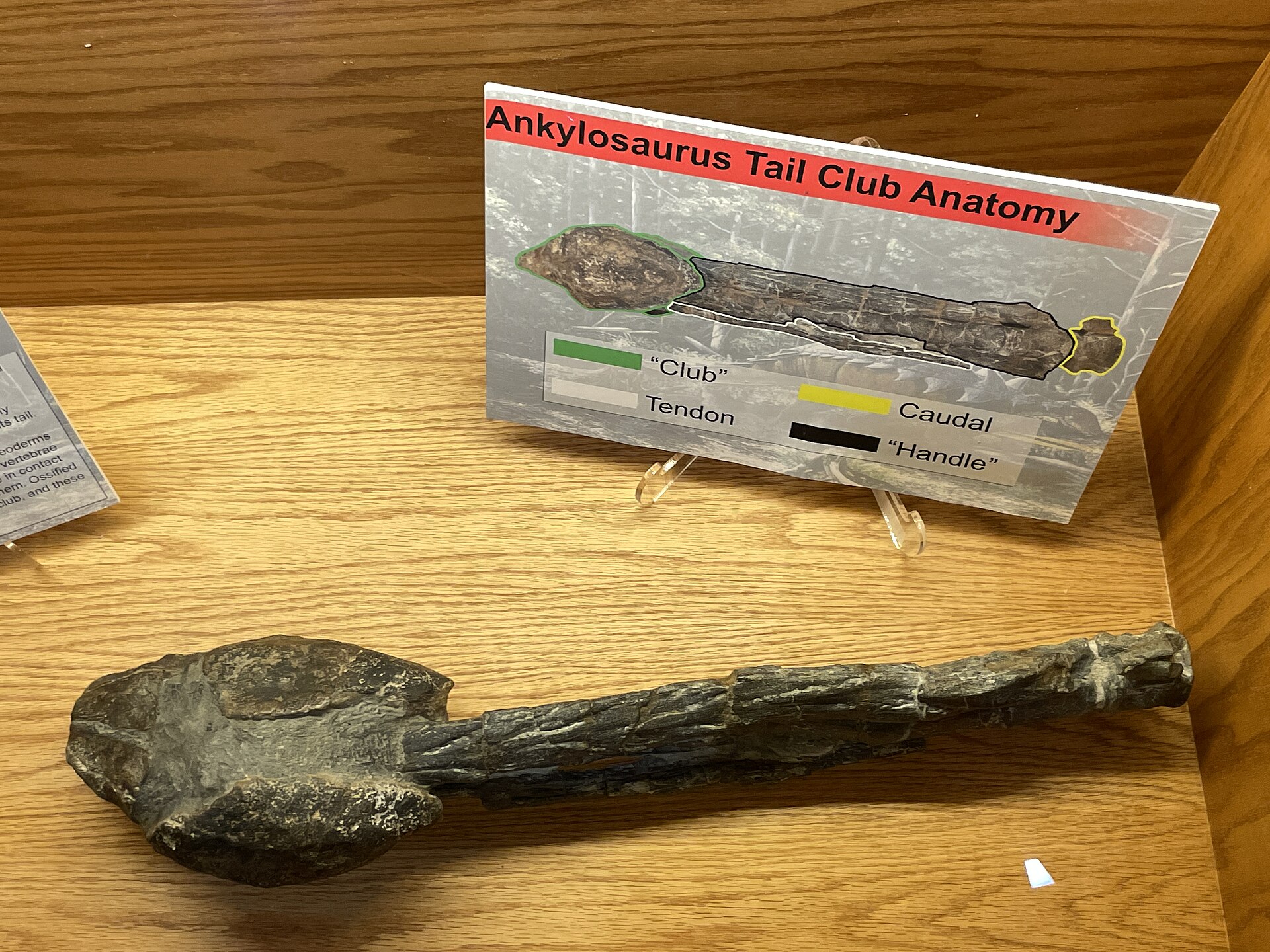
The long tail of Ankylosaurus ended in a thick club of bone, formed by the last tail vertebrae nested tightly against one another and enclosed by a sheath of several bony plates. The club itself measured about 60 cm long and 49 cm wide, with the last seven tail vertebrae fused to support it. In ankylosaurids, such clubs are built from interlocking vertebrae that form the handle and large terminal osteoderms that form the knob. The animal probably swung this structure as a defense against predators.
CT scans showed that the knob osteoderms were predominantly cancellous bone, which would have lowered the rotational inertia of the tail club and made it easier to wield as a weapon. The tail had limited vertical flexibility, but it could swing through approximately 100 degrees laterally. For an ankylosaurid with the proportions of specimens AMNH 5245/ROM 788, the impact force of a tail club strike has been estimated at 7,281 to 14,360 newtons, very likely enough to break bone. Only large knobs could generate sufficient force to break bone during impacts, while average and small knobs could not.
In ankylosaurids the size of the tail club increased as the animal grew: young ankylosaurids could swing their club with sufficient force to inflict soft tissue injuries, whereas adults could have shattered bones. A partial ankylosaurid tail club still showed signs of bone growth even though it appeared to come from an adult animal, suggesting the club developed later in life and was not initially used as a weapon. Arbour explained that in order for an ankylosaur to support the weight of a knob and swing it effectively, the tail had to be stiff, like an ax handle.
5. Classification and Evolution
Ankylosaurus belongs to the Dinosauria, Ornithischia, Thyreophora, Ankylosauria and Ankylosauridae. Ankylosaurs and stegosaurs are both armoured dinosaurs: ankylosaurs are wide-bodied, short-limbed and covered in armour over their backs, limbs and skulls, while stegosaurs have two rows of plates or spikes down their backs and spikes at the end of their tails. Ankylosaurs can be subdivided into three smaller groups: the Polacanthidae with large shoulder spikes and a shield over the hips, the Nodosauridae with narrow heads and no tail clubs, and the Ankylosauridae, the classic type with heavy armour over the body and tail clubs.
The earliest ankylosaurs, called nodosaurs, lacked the tail club and had rather different armour patterns. Tail clubs appear relatively late in the evolution of ankylosaurids and seemed to be present only in a derived clade during the last 20 million years of the Mesozoic Era. New evidence from mid Cretaceous fossils from China suggests that the evolution of the tail club occurred at least 40 million years earlier than previously thought, and in a stepwise manner, with early ankylosaurids evolving handle-like vertebrae before the distal osteoderms enlarged and co-ossified to form a knob. By the early Cretaceous ankylosaurs had begun to develop stiff tails with fused vertebrae, and the knob of the tail club appeared in the late Cretaceous.
Pinacosaurus, which lived 75 million years ago, is the earliest specimen with a complete tail club.
6. Palaeoecology and Diet
Ankylosaurus was a herbivore that fed on ferns, shrubs and fruit, and it would have needed to eat around 60 kilogrammes of plant matter a day, about the same as a modern elephant. Its wide muzzle and low-hung head indicate that it browsed on fibrous and woody plants, ferns, tough leaves and the pulpy fruits of low shrubs. Experts think it grazed on low-growing plants and probably was not picky, eating many kinds of ferns, shrubs and fruit. Adults may have used a long, powerful tongue to pluck and swallow vegetation.
Some scientists think Ankylosaurus might have been able to use its front limbs for digging, perhaps also eating roots and any other plant and animal matter it could dig up. Its feeding apparatus was distinctive: the front of the jaws was covered by a keratinous beak.
Ankylosaurs were important megaherbivores of Jurassic and Cretaceous ecosystems, and their distinct craniodental anatomy and mechanics differentiated them from coexisting hadrosaurs and ceratopsians. A biomechanical study supports the hypothesis that ankylosaurs partitioned dietary niches in Late Cretaceous ecosystems, with the two main clades evolving divergent pathways in skull biomechanics and feeding habits.
7. Habitat and Fossil Range
Ankylosaurus lived at the very end of the Age of Dinosaurs, during the Late Cretaceous, between 68 and 66 million years ago 5. Its remains have been recovered in southern Alberta and Saskatchewan in Canada, and in Montana, South Dakota and Wyoming in the United States 5. The genus is counted among the last non-avian dinosaurs, sharing its world with Tyrannosaurus rex, Triceratops and Edmontosaurus annectens 5.
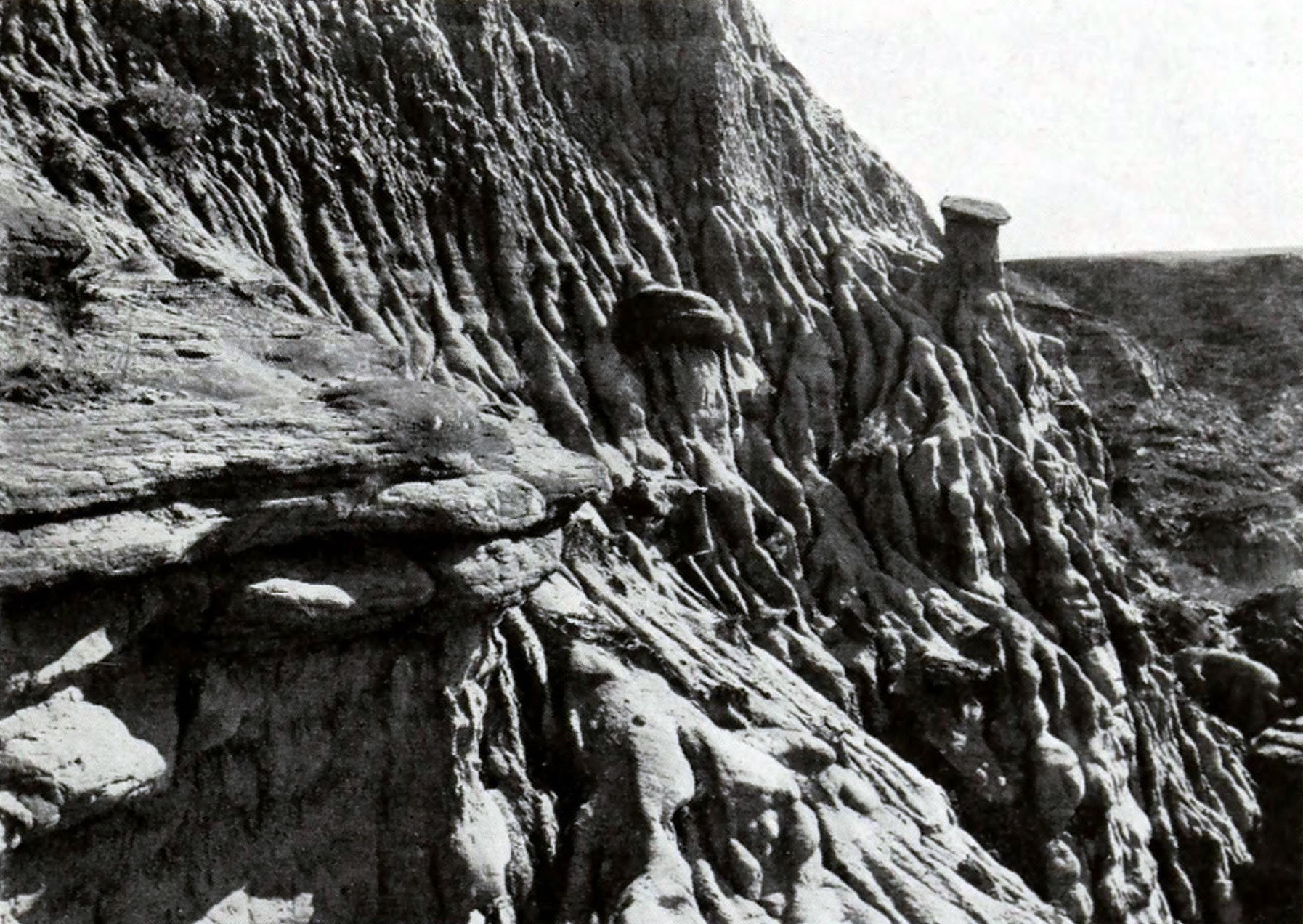
The Hell Creek Formation, exposed across Montana, North Dakota and South Dakota, is one of the geological units that yields this dinosaur 4Highway to Hell Creek · Burpee Museum of Natural History ↗. Its rocks preserve the remains of dinosaurs that lived at the very end of the Age of Dinosaurs 4. The top of the formation is capped by the KT boundary layer, ash and ejecta deposited after a huge meteorite struck the ocean near the Yucatan Peninsula in Mexico 4.
| Region | Countries/States | Formation |
|---|---|---|
| Canada | Southern Alberta and Saskatchewan | — |
| USA | Montana, South Dakota and Wyoming | — |
| Hell Creek Formation | Montana, North Dakota and South Dakota | Hell Creek Formation |
8. Behaviour and Defence
A 2022 study found pathological osteoderms in the holotype of Zuul crurivastator localized to the flanks in the hip region rather than distributed randomly across the body, consistent with injuries inflicted by lateral tail-swinging and ritualized combat. The same study found that high variation in tail club size through time, and delayed growth of the tail club, further support the hypothesis that sexual selection drove the evolution of this weapon. The study concluded that ankylosaurids were behaviourally complex animals that likely engaged in ritualized combat for social dominance, as in other ornithischian dinosaurs and mammals.
9. Research and Fossil Record
Ankylosaur long bone histology is characterized by a fibrolamellar bone architecture, and a mixture of woven and parallel-fibered bone with poor vascularization indicates slow growth rates compared with other dinosaurian taxa. Another peculiar characteristic of ankylosaur bone histology is the extensive remodeling in derived North American taxa, which substitute large amounts of their primary tissue early in ontogeny, an anomaly that may be linked to the late ossification of their body armour. A 2013 study provided the first description of ankylosaurian long bone histology, based on limb elements sampled from different individuals of both the Ankylosauridae and Nodosauridae.
10. Timeline: from the Late Cretaceous to the fossil hunters
- About 90 million years agoGobisaurus: a stiff tail before the knobThe mid-Cretaceous ankylosaurid Gobisaurus had a stiff tail but no knob of bone at the end, evidence that the tail stiffened before the club's knob evolved.
- About 75 million years agoZuul crurivastator lives in MontanaThe exceptionally preserved ankylosaurine Zuul crurivastator, about 75 million years old and found in Hill County, Montana, had a sledgehammer-like tail club unique to ankylosaurines.
- 68-66 million years agoAnkylosaurus among the last non-avian dinosaursAnkylosaurus lived at the very end of the Age of Dinosaurs, at the same time as Tyrannosaurus rex, Triceratops and Edmontosaurus annectens, between 68 and 66 million years ago.
- 66 million years agoEnd-Cretaceous extinctionThe end of the Cretaceous is marked by a major extinction that killed off all dinosaurs except birds, along with pterosaurs, marine reptiles and ammonites; it is attributed to an impact in the Yucatan.
- 1900The first Ankylosaurus remainsBarnum Brown of the American Museum of Natural History found a collection of 77 osteoderms in Montana; because they were found with a T. rex skeleton, he initially thought they belonged to the tyrannosaur.
- 1906A partial skeleton reveals a new dinosaurBrown discovered a partial skull, vertebrae, shoulder blade, ribs and osteoderms in Montana and realized the osteoderms belonged to a new type of dinosaur.
- 1908Ankylosaurus is namedBarnum Brown published the description of Ankylosaurus magniventris and erected the new family Ankylosauridae for these armoured Late Cretaceous dinosaurs.
- 1910The most complete skeletonBrown discovered the most complete Ankylosaurus skeleton ever found, including a complete skull, mandibles, limb bones, osteoderms and the only known tail club for the genus, along the Red Deer River north of Drumheller, Alberta.
- 25 August 2009Tail club forces estimatedVictoria Arbour modelled ankylosaurid tails and estimated that a large tail club could strike with an impact force of 7,281 to 14,360 newtons, very likely enough to break bone.
- 24 July 2013First ankylosaur bone histologyStein, Hayashi and Sander published the first description of ankylosaurian long bone histology, finding fibrolamellar bone and slow growth rates compared with other dinosaurs.
- October 2015Tail clubs evolved stepwiseArbour and Currie showed from mid-Cretaceous Chinese fossils that the tail club evolved at least 40 million years earlier than thought, in a stepwise manner: the handle-like vertebrae came before the knob.
- 7 December 2022Evidence for ritualized combatArbour, Zanno and Evans reported pathological osteoderms on the flanks of the Zuul crurivastator holotype, arguing that ankylosaurid tail clubs were used primarily in intraspecific combat.
- 25 October 2023Feeding biomechanics of ankylosaursBallell, Mai and Benton compared skull biomechanics across ankylosaurs, supporting dietary niche partitioning between ankylosaurids and nodosaurids.
References (15)
- 1Ankylosaurus (Dino Directory) — Natural History Museum, London Web↩View source
- 2Ankylosaurs: The dinosaurs with built-in armour — Natural History Museum, London WebView source
- 3The Ankylosauridae, a new family of armored dinosaurs from the Upper Cretaceous (Bulletin of the American Museum of Natural History, Vol. XXIV, Article XII, pp. 187-201) — American Museum of Natural History (via Internet Archive) ArchiveView source
- 4Highway to Hell Creek — Burpee Museum of Natural History Web↩View source
- 5Ankylosaurus — The Canadian Encyclopedia (Historica Canada) Web↩View source
- 6Ankylosaurus | Size, Diet, & Facts — Encyclopaedia Britannica WebView source
- 7Estimating Impact Forces of Tail Club Strikes by Ankylosaurid Dinosaurs (PLoS ONE 4(8): e6738) — PLOS JournalView source
- 8A Closer Look at Ankylosaur Armor — Smithsonian Magazine WebView source
- 9Tail as Old as Time: How Ankylosaur Tail Evolved — North Carolina State University News 2015 WebView source
- 10Ankylosaurid dinosaur tail clubs evolved through stepwise acquisition of key features (Journal of Anatomy 227: 514-523) — Anatomical Society (via PubMed Central) WebView source
- 11Divergent strategies in cranial biomechanics and feeding ecology of the ankylosaurian dinosaurs (Scientific Reports 13:18242) — Nature Portfolio (Scientific Reports) JournalView source
- 12Palaeopathological evidence for intraspecific combat in ankylosaurid dinosaurs (Biology Letters 18(12): 20220404) — The Royal Society (via PubMed Central) WebView source
- 13Long Bone Histology and Growth Patterns in Ankylosaurs: Implications for Life History and Evolution (PLOS ONE 8(7): e68590) — PLOS JournalView source
- 14Zuul — Royal Ontario Museum WebView source
- 15Cretaceous Dinosaurs — U.S. National Park Service WebView source