Stegosaurus
The plated dinosaur of the Late Jurassic — its plates and thagomizer, its Morrison Formation world, and the specimens that reshaped its study.
Stegosaurus was a large herbivorous dinosaur of the Late Jurassic, about 152 to 145 million years ago, known for two rows of bony plates along its back and a spiked tail that paleontologists informally call a thagomizer. Named by Othniel Charles Marsh in 1877 from Morrison Formation discoveries in the western United States, it grew to about 9 metres and had a famously small head and brain. Research on exceptionally complete specimens such as Sophie and Apex has since reshaped ideas about its bite, its posture and the function of its plates, and the group died out in the Early Cretaceous more than 120 million years ago.
In this article
Classification and Naming
Stegosaurus is classified within Dinosauria, Ornithischia, Thyreophora, Stegosauria, Stegosauridae and Stegosaurinae. Stegosauria is a clade of armoured ornithischian dinosaurs characterized by dermal armour extending in two parasagittal rows from the head to the end of the tail. The genus was named by O. Marsh in 1877, with Stegosaurus armatus as the type species.
The genus is made up of three species — S. stenops — all of which were excavated from the Morrison Formation in Utah.
1. Discovery and Fossil Record
It was named for exposures near the town of Morrison, Jefferson County, Colorado, which is also its type locality, a designation attributed to Eldridge in 1896.
Study of the Morrison Formation took off with finds in three places in early 1877: Garden Park, Colorado; Morrison, Colorado; and Como Bluff, Wyoming. Those finds were reported to Edward Drinker Cope and Othniel Charles Marsh, whose competition helped spur the Bone Wars and decades of excavation in Colorado and Wyoming. Dinosaur Ridge near Morrison, Colorado, is famous for Jurassic dinosaur bones such as Stegosaurus and Apatosaurus unearthed in 1877 together with Cretaceous dinosaur footprints.
The last detailed study of Stegosaurus was completed in 1914, and modern researchers began by re-describing the dinosaur from the near-complete specimen. X-ray computed tomography and thin sectioning were used to study the internal features of Stegosaurus plates alongside alligator osteoderms.
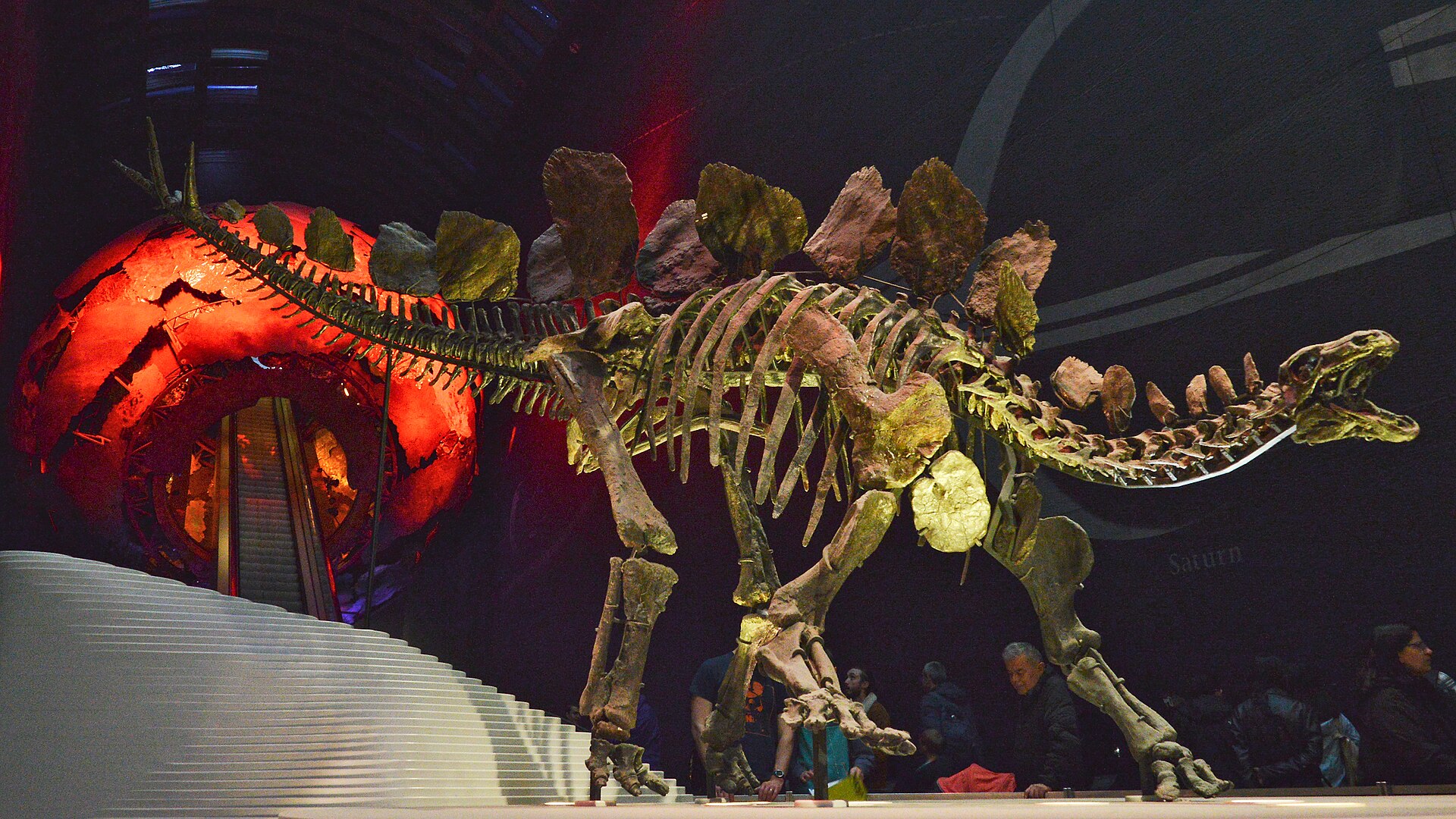
The 150-million-year-old Sophie specimen is the most significant dinosaur the Museum has acquired since the 1980s and the only Stegosaurus in a public collection outside the USA.
Stegosaurus stenops is the state fossil of Colorado, a vegetarian that roamed the state about 150 million years ago.
-
early 1877Three Morrison localities open upThe finds at Garden Park and Morrison in Colorado and Como Bluff in Wyoming helped spur the Bone Wars 5The Morrison Formation · U.S. National Park Service ↗.
-
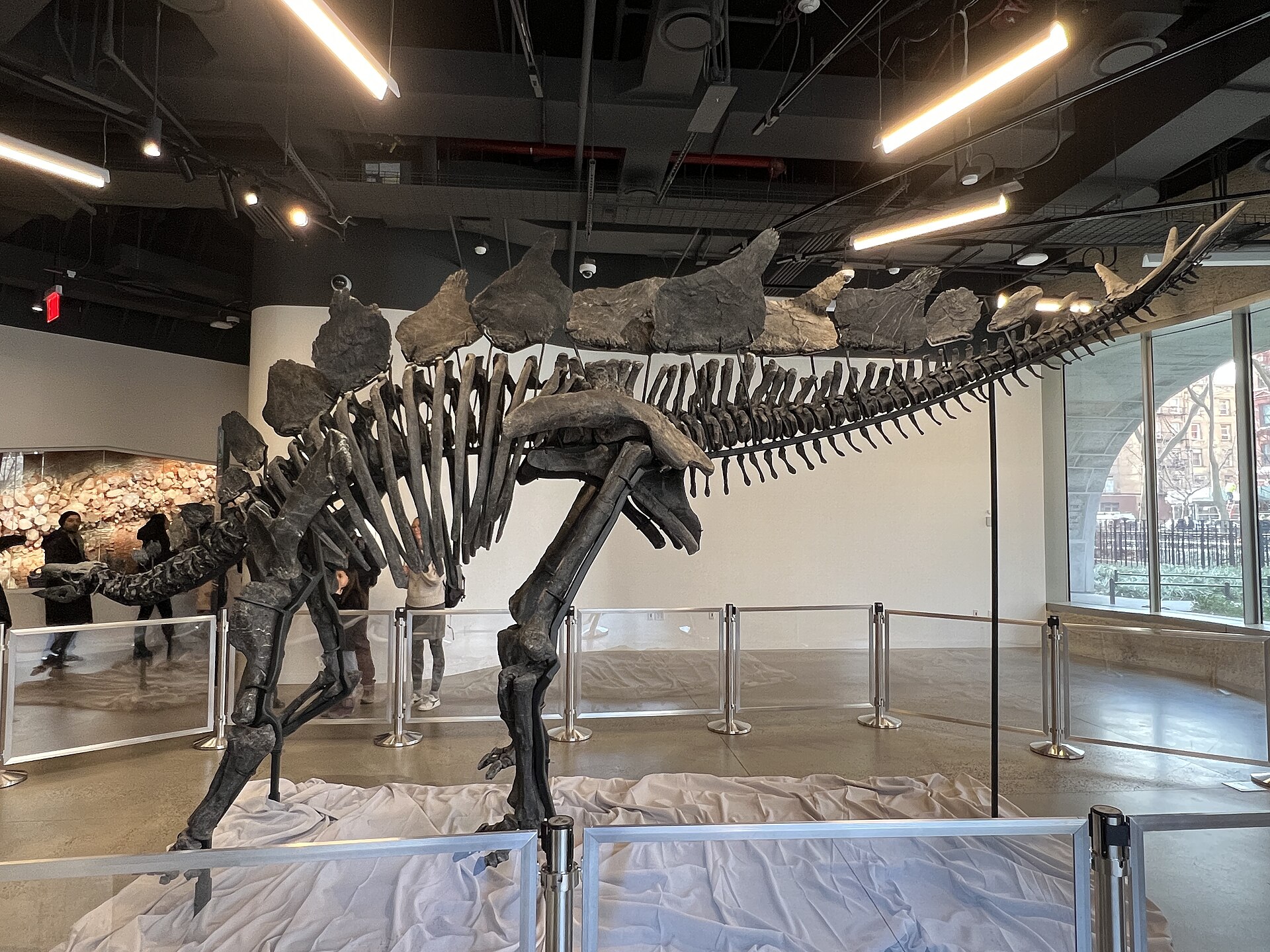
May 2022Apex is discoveredApex was discovered in May 2022 by commercial paleontologist Jason Cooper in the Morrison Formation just outside the town of Dinosaur, Colorado 10Apex Stegosaurus Fossil · American Museum of Natural History ↗.
Apex is extremely well preserved, with more than 254 bone elements of approximately 320 preserved and missing pieces filled in with 3D-printed and sculpted components. It is one of the few Stegosaurus specimens ever found that appears to have lived to an advanced age.
At Dinosaur National Monument the Morrison Formation preserves the bones of dinosaurs such as Camarasaurus, Apatosaurus, Stegosaurus and Allosaurus.
2. Description and Anatomy
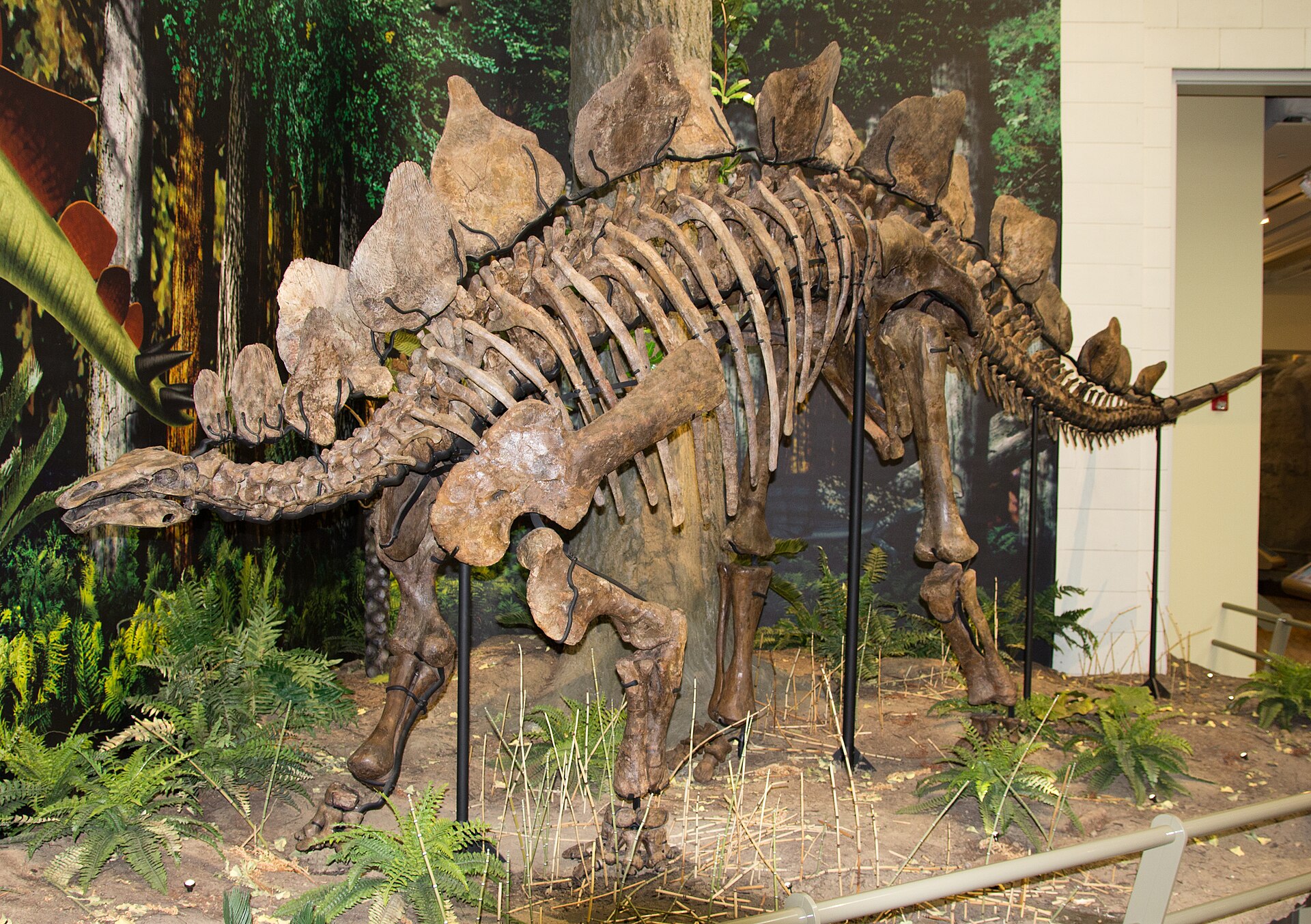
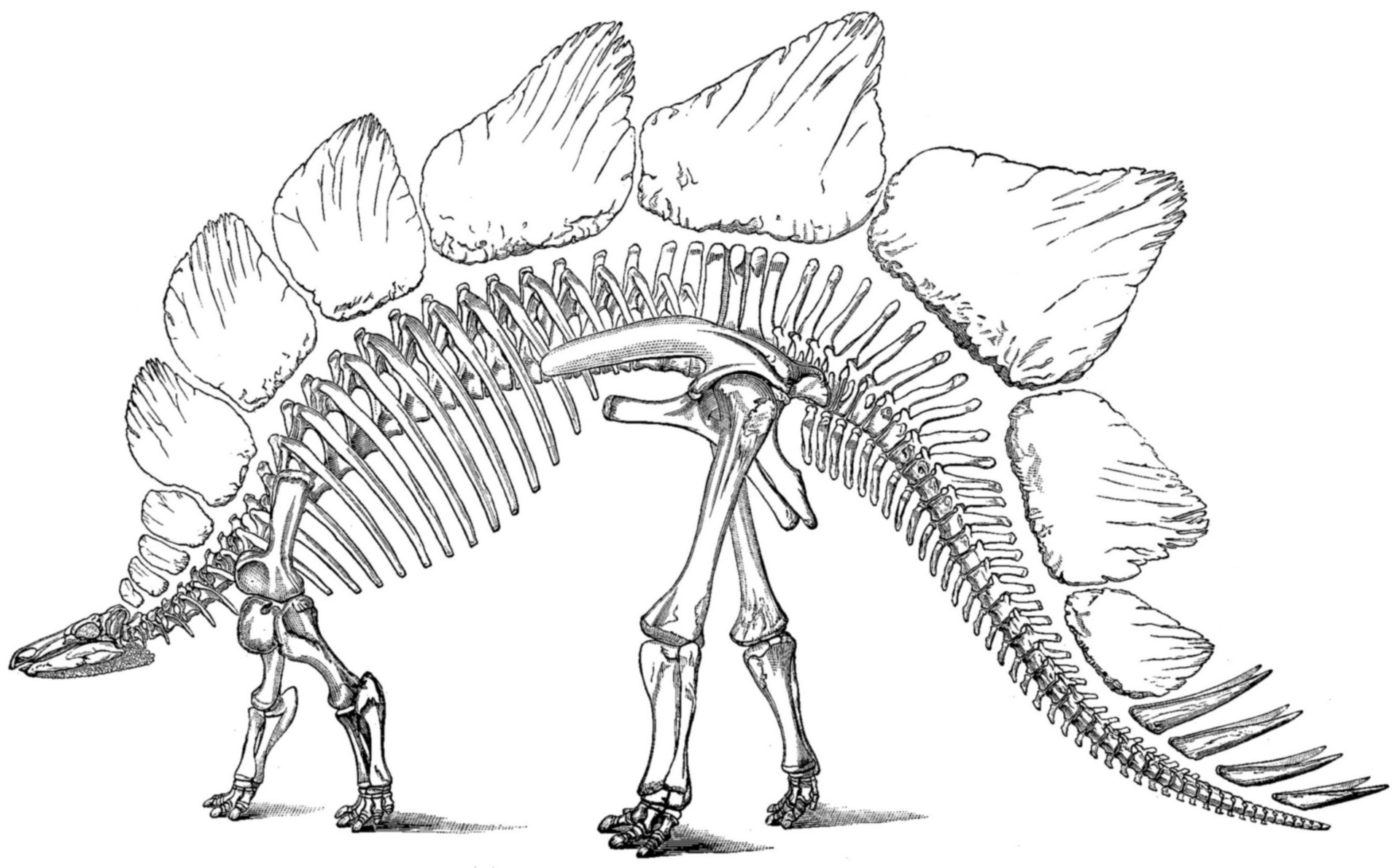
Stegosaurus was a genus of plated dinosaurs of the Late Jurassic, recognizable by its spiked tail and by a series of large triangular bony plates along the back. It was an herbivorous quadruped with a small head, a long tail, stout forelimbs and long columnar hind limbs. Its length was usually about 6.5 metres (21 feet), though some individuals reached 9 metres (30 feet). That specimen is estimated to have weighed about 1,600 kg, similar to a small rhino.
The skull and brain were very small for such a large animal, and the forelimbs were much shorter than the hind limbs, giving the back a characteristically arched appearance. The spinal cord at the sacrum was enlarged and actually larger than the brain, giving rise to the two-brains misconception; it more likely stored glycogen, as in many living animals. Some scientists once thought Stegosaurus had a second brain because the one in its head seemed so small, but the animal managed with a single small brain.
The plates have grooves for blood vessels, indicating that they were covered with skin when the animal was alive.
3. Plates and Spikes
The Sophie specimen carries a total of 19 plates on the back and four spikes on the tail, the most complete set ever discovered.
Marsh first described Stegosaurus he concluded that the plates lay flat like roof shingles; after a specimen preserved in mud held them in place, he realized they stood vertically, alternating on either side of the spine.
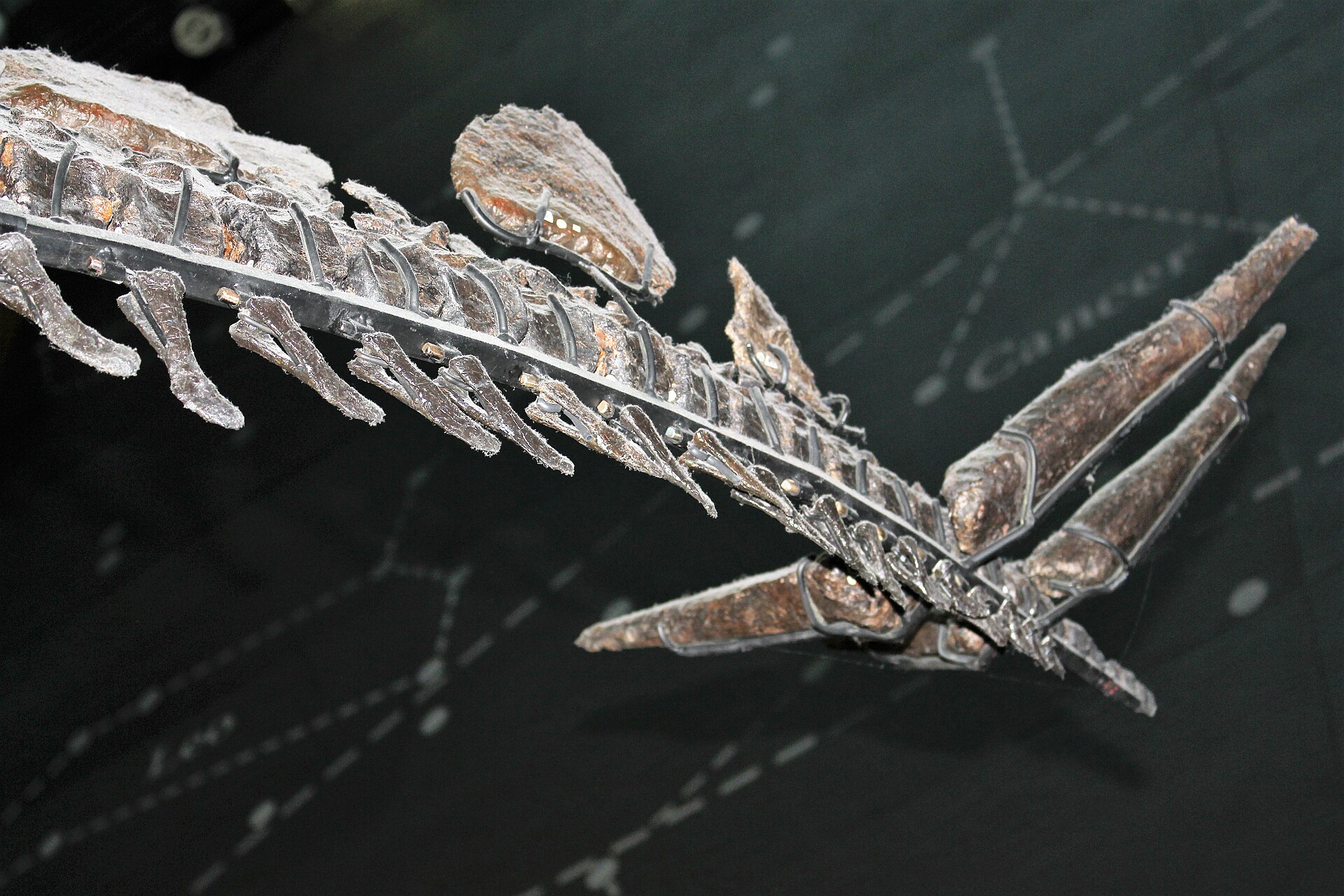
Stegosaurs had pairs of long pointed spikes at the end of the tail.
The bony plates along the back were embedded in the skin rather than attached to the skeleton, which is why most fossil finds preserve them separated from the body.
4. Function of the Plates
Scientists are not exactly sure what the plates were used for; suggestions include warning off predators, letting members of the same species recognize each other, or regulating body temperature.
A 1976 paper suggested that the plates along the arched back and tail of Stegosaurus served an important thermoregulatory function as forced convection fins. Wind tunnel experiments on finned models and observations of plate structure supported the heat-dissipation hypothesis, controllable through blood flow rate, temperature and body orientation. An analysis of plate microstructure argued that the plates and spikes were probably elaborate displays for species recognition rather than heat exchangers or armour.
Earlier paleontologists had proposed that the plates worked like elephants' ears for heat exchange; the Berkeley-led team examined plate evolution across thyreophorans and rejected these as general explanations.
5. Diet and Feeding
Stegosaurus was an herbivore that fed on low-growing vegetation, ripping and swallowing its food mostly whole. Its small, simple teeth and weak jaw muscles led to the conclusion that it was an ineffective chewer. The first detailed study of a Stegosaurus skull, however, showed that the animal had a stronger bite than its small peg-shaped teeth suggested. Far from being feeble, its bite force fell within the range of living herbivorous mammals such as sheep and cows.
Stegosaurus would have been capable of foraging on a wide variety of plants, including ferns and cycads. With grasses not yet evolved, it fed on plants such as ferns and horsetails. Researchers have suggested that Stegosaurus may have had a role in spreading the seeds of woody evergreen cycads. CT scans of a Stegosaurus stenops specimen helped researchers piece together the eating habits of different herbivorous dinosaurs.
6. Habitat and Ecosystem
The Morrison Formation is a rock unit from the Late Jurassic Period, about 163.5 to 145 million years ago, deposited across rivers, floodplains, lakes and other environments. It contains fossils of numerous dinosaur species. At the time Stegosaurus lived, North America lay farther south, the Rocky Mountains did not yet exist, and the land was covered by ferns, cycads, horsetails, conifers, ginkgoes and tree ferns. Cycads, ferns and horsetails formed the ground cover that fed Stegosaurus, with occasional conifer trees; there were no flowering plants or grasses at the time.
Stegosaurus shared the land with giant sauropods such as Diplodocus and Camarasaurus, smaller herbivores such as Camptosaurus, and predators including Allosaurus and Ceratosaurus. Stegosaurus was among the smaller plant-eating dinosaurs of the Morrison ecosystem, alongside Camptosaurus and Dryosaurus.

Stegosaurus did not live in herds; it was probably solitary or lived in small groups, and the animals were not common. Two stegosaur genera are currently recognized from the Upper Jurassic Morrison Formation of North America: the well-known Stegosaurus and the much rarer Hesperosaurus.
It is assigned a Late Jurassic age, locally extending into the Early Cretaceous.
7. Defence and Predation
Two pairs of pointed bony spikes were present at the end of the tail, presumed to have served as defensive weapons, though they may have been ornamental.
Out of 51 examined spikes about ten percent had broken tips with remodeled bone, suggesting the animals survived injuries from using the spikes in defence. Stegosaurus was a large, slow-moving plant-eater that defended itself from predators such as Allosaurus and Ceratosaurus with its powerful spiked tail.
In 2005 paleontologists Kenneth Carpenter, Frank Sanders, Lorrie McWhitnney and Lowell Wood reported evidence of direct interaction between Stegosaurus and Allosaurus, based on damage on an Allosaurus tail vertebra that appears to have been caused by a large pointed object, with a diagram showing how a Stegosaurus tail spike fits the hole perfectly. A plate from the neck of a Stegosaurus found in Utah's Cleveland-Lloyd Quarry had a prominent U-shaped notch, and the front portion of an Allosaurus jaw corresponded closely to the missing piece.
8. Evolutionary Context and Relatives
Stegosaurs — the plated dinosaurs including Stegosaurus — ranged from the Late Jurassic into the Early Cretaceous, when Wuerhosaurus lived. The last stegosaurs died out in the Early Cretaceous, more than 120 million years ago. Comparisons with previously studied individuals indicate that Hesperosaurus mjosi may have been a smaller genus than Stegosaurus stenops.
A new stegosaur specimen unearthed in the mountains of Morocco showed that stegosaurs were older and more geographically widespread than previously believed. The Moroccan species was named Adratiklit boulahfa, which means "mountain lizard" in the Berber language. Most known stegosaurs date from far later in the Jurassic, making the Moroccan find the oldest definite stegosaur described. The vast majority of stegosaurs have come from the northern continent Laurasia, made up of present-day Europe, Asia and North America.
9. Timeline: from the Middle Jurassic to Sophie and Apex
- Middle Jurassic — about 168 million years agoOldest definite stegosaur datedA stegosaur specimen from Morocco's Middle Atlas Mountains was dated to the Middle Jurassic, about 168 million years ago, making it the oldest definite stegosaur described.
- Late Jurassic — about 157 million years agoThe Morrison Formation begins to formRivers, floodplains and lakes of the Late Jurassic laid down the deposits of the Morrison Formation across the western United States, the world that Stegosaurus inhabited.
- 1874First stegosaurian fossil discoveredThe first stegosaurian dinosaur fossil, Dacentrurus, was discovered in the United Kingdom.
- 1877Bone Wars finds and the naming of StegosaurusFinds at Garden Park and Morrison in Colorado and Como Bluff in Wyoming were reported to Cope and Marsh, spurring the Bone Wars; Stegosaurus was among the famous dinosaurs named from these discoveries.
- 1914Last detailed study of StegosaurusThe last detailed study of Stegosaurus was completed in 1914; the next major re-description began only with the study of the Natural History Museum's near-complete specimen.
- 1977Juvenile Stegosaurus recovered at DinosaurPaleontologists at Dinosaur National Monument removed a juvenile Stegosaurus from the Carnegie Quarry face, the most complete juvenile ever found.
- Spring 2003Sophie is discovered in WyomingBob Simon found the nearly complete skeleton at Red Canyon Ranch, Wyoming; it took three weeks of excavation to bring it to light.
- 2005Evidence of combat with Allosaurus publishedKenneth Carpenter and colleagues reported a notched Stegosaurus neck plate and a punctured Allosaurus tail vertebra from Utah's Cleveland-Lloyd Quarry.
- August 2010Plate vascularity studied in detailA study using X-ray computed tomography and thin sections examined the branching vascular pipes inside Stegosaurus plates and their possible thermoregulatory role.
- December 2013Sophie arrives at the Natural History MuseumThe specimen arrived in London, where researchers began laser scanning, CT scanning and 360-degree photography before it went on display.
- 4 December 2014Sophie goes on public displayThe near-complete Stegosaurus stenops went on show inside the Natural History Museum's Exhibition Road entrance.
- March 2015Sophie weighed at about 1,600 kgResearchers from Imperial College London and the Natural History Museum combined two methods to estimate the specimen's body mass, similar in weight to a small rhino.
- 20 May 2016Bite-force study publishedCT-based modelling found that Stegosaurus had a bite force within the range of living herbivorous mammals such as sheep and cows.
- May 2022Apex discovered in ColoradoCommercial paleontologist Jason Cooper found the specimen in the Morrison Formation just outside the town of Dinosaur, Colorado.
- July 2024Apex sold at auctionThe mounted Apex specimen was purchased at auction for $44.6 million by American billionaire Ken Griffin.
- December 2024Apex goes on view at the American Museum of Natural HistoryApex went on display in New York on a special loan from Ken Griffin, where a new research initiative will study Stegosaurus growth and life history.
References (24)
- 1Stegosaurus | Natural History Museum — Natural History Museum, London WebView source
- 2A new specimen of the ornithischian dinosaur Hesperosaurus mjosi from the Upper Jurassic Morrison Formation (Maidment et al.) — University of Brighton research repository WebView source
- 3Stegosaurus | Description, Size, Plates, & Facts — Encyclopaedia Britannica WebView source
- 4Geolex — Morrison (National Geologic Map Database) — U.S. Geological Survey WebView source
- 5The Morrison Formation — U.S. National Park Service Web↩View source
- 6Dinosaur Remains in Colorado (OAHP 1555) — History Colorado, Office of Archaeology and Historic Preservation 1555 WebView source
- 7World's most complete Stegosaurus: Q&A with a dinosaur expert — Natural History Museum, London WebView source
- 8Internal vascularity of the dermal plates of Stegosaurus (Swiss Journal of Geosciences, 2010) — Swiss Journal of Geosciences (Farlow, Hayashi & Tattersall) 2010 WebView source
- 9World's most complete Stegosaurus goes on show — Natural History Museum, London WebView source
- 10Apex Stegosaurus Fossil — American Museum of Natural History Web↩View source
- 11Morrison Formation (Dinosaur National Monument) — U.S. National Park Service WebView source
- 12Evidence for Sexual Dimorphism in the Plated Dinosaur Stegosaurus mjosi (PLOS ONE, 2015) — PLOS ONE (Saitta, E. T.) 2015 JournalView source
- 13Scientists reveal the body weight of the world's most complete Stegosaurus — Imperial College London WebView source
- 14Stegosaurus Fossil Skeleton — American Museum of Natural History WebView source
- 15Stegosaur | Plated Dinosaur, Herbivore, Jurassic — Encyclopaedia Britannica WebView source
- 16Plates of the dinosaur Stegosaurus: forced convection heat loss fins? (Science, 1976; abstract) — National Library of Medicine (PubMed) 1976 WebView source
- 17Stegosaur plates and spikes for looks only, researchers say — UC Berkeley News 2005 WebView source
- 18Stegosaurus armatus — Carnegie Museum of Natural History WebView source
- 19Dino jaws: Stegosaurs bite strength revealed — University of Bristol 2016 WebView source
- 20Dinosaur eating habit insights from Stegosaurus stenops — Natural History Museum, London 2016 WebView source
- 21Watch Out For That Thagomizer! — Smithsonian Magazine WebView source
- 22New Species of Stegosaurus Unearthed in Mountains of Morocco — Smithsonian Magazine WebView source
- 23Stegosaurus ungulates — Dinosaur National Monument — U.S. National Park Service WebView source
- 24Studying the Stegosaurus skeleton — Natural History Museum, London WebView source