Triceratops
The three-horned ceratopsian of the Late Cretaceous: its horns and frill, its discovery and naming by O.C. Marsh, its fossils across western North America, and the museum specimens from Hatcher to Horridus.
Triceratops is a genus of horned dinosaur that lived in western North America at the end of the Cretaceous, about 68 to 66 million years ago, and ranks among the most commonly recovered dinosaurs of its time. Its huge skull carried two brow horns, a shorter nose horn and a bony frill, and scientists still debate how far these structures served in combat, display or species recognition. Named by O.C. Marsh in 1889 from remains first found two years earlier, Triceratops is represented today by celebrated museum specimens such as Hatcher, the first of its kind ever displayed, and Horridus, the most complete skeleton known.
In this article
Description
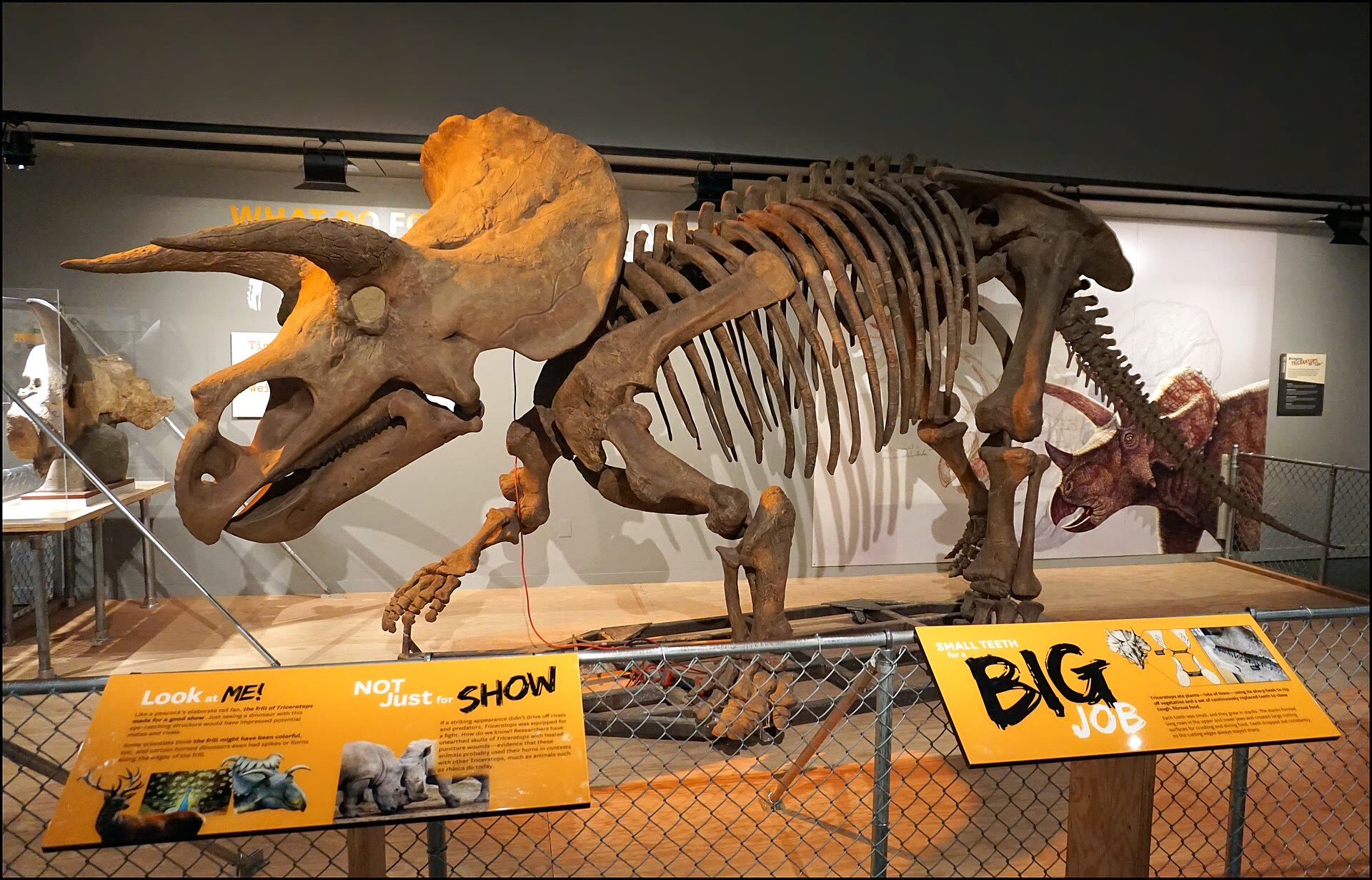
Triceratops was a large animal, with a length that approached 9 metres (30 feet). The largest adults are estimated to have had a mass of 5,450–7,260 kg (about 12,000–16,000 lb). In some individuals the skull alone was nearly 3 metres (about 10 feet) long.
The head carried two horns above the eyes and a horn on the snout. A bony frill at the back of the skull was bordered by as many as 19–26 epoccipital spikes. Smaller hornlike projections sat on the cheekbones.
Skin impressions show that Triceratops had large, pebbled scales. Indentations made by blood vessels across most of the skull suggest the entire head aside from the cheeks and nostrils was covered in keratin.
1. Classification and Species
Triceratops is a ceratopsian dinosaur, placed within the family Ceratopsidae and the subfamily Chasmosaurinae. Ceratopsians were ornithischian, or "bird-hipped", dinosaurs. As a chasmosaurine ceratopsian, Triceratops belonged to a group whose members usually had long horns and relatively plain neck frills. The name Triceratops means "three-horned face", and the Natural History Museum classifies the animal as a ceratopsian dinosaur that moved on four legs.
Today scientists recognise only two species, Triceratops horridus and Triceratops prorsus. As many as 16 species of Triceratops had been named from variations in cranial morphology until Forster recognised only two species. The wide variety of skull shapes probably reflects individual variation.
Taxonomically Triceratops belongs to the family Ceratopsidae and the subfamily Chasmosaurinae, with horridus as its type species. Triceratops horridus was a strictly North American dinosaur, while ceratopsian relatives with different ornamentation roamed China and Mongolia.
2. Discovery and Naming
The first Triceratops remains came to light in 1887, near Denver, Colorado, and were not at first recognised for what they were: the material was taken to belong to a gigantic extinct bison. The initial find consisted of a pair of horn cores, and these were given the name Bison alticornis before further remains revealed the three-horned dinosaur. The American scientist Othniel Charles Marsh is credited with that first discovery, and he had identified the specimen, a partial horn collected by George L. Cannon, as a recently extinct member of the mammalian order Artiodactyla.
One of the skulls he used in that first description and naming is now displayed outside Yale's O.C.
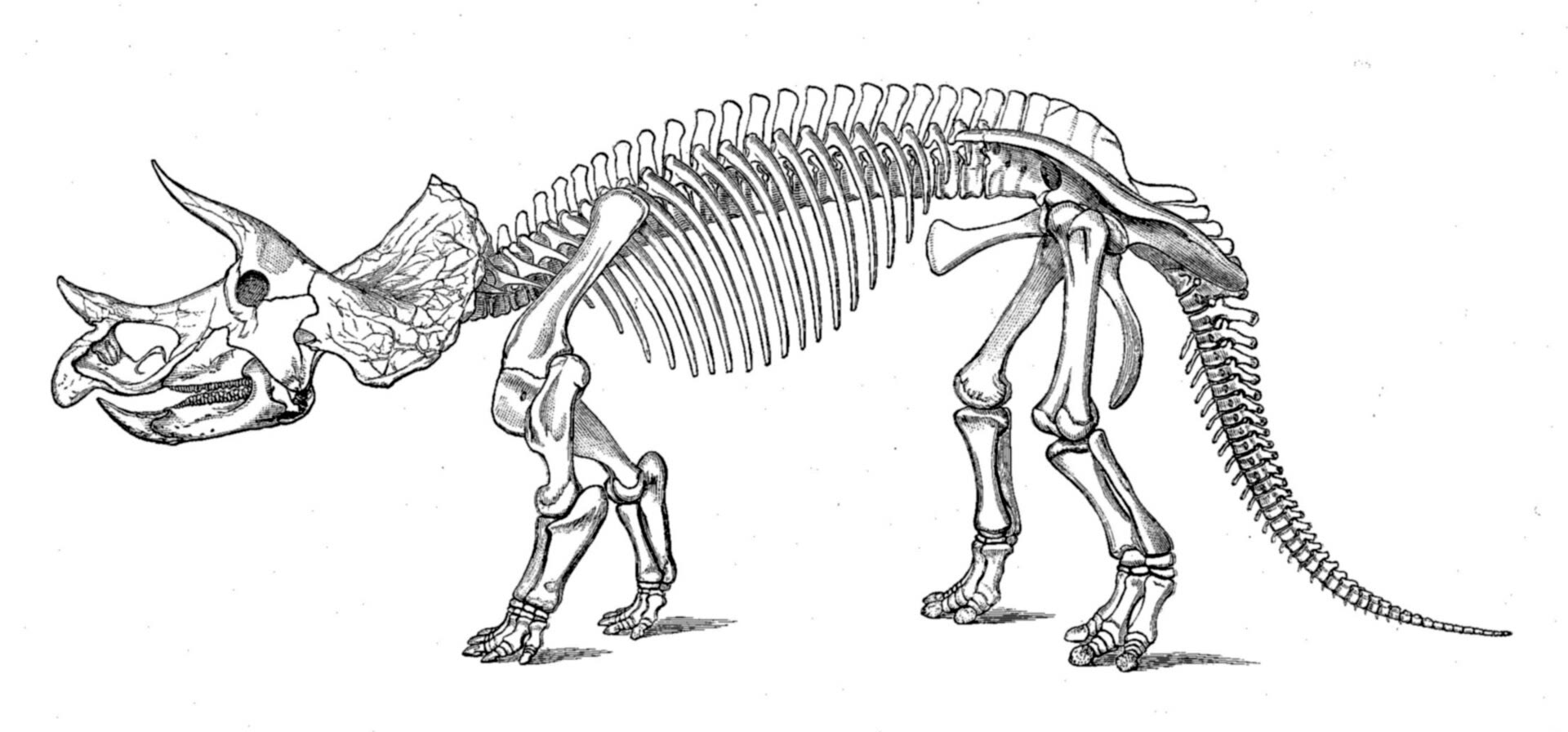

Public encounter with the genus began with a specimen known as Hatcher, the first Triceratops ever put on display, which went on show at the Smithsonian in 1905. For more than twenty years it remained the only displayed specimen of its species anywhere in the world, and it played a featured role in the museum's original Hall of Extinct Monsters. The mount was a composite: bones from ten different individuals were pieced together, producing a crude skeleton with a skull too small, front legs of different lengths and rear feet from an entirely different species. Hatcher was named in honour of the discovering palaeontologist and served as a pillar of the Smithsonian community for 113 years.
3. Fossil Record and Distribution
The fossil range of Triceratops extends across Colorado, Montana, South Dakota and Wyoming, and reaches northward into the Canadian provinces of Alberta and Saskatchewan. Its remains date to the Late Cretaceous, between about 68 and 66 million years ago.
Triceratops is the most commonly recovered dinosaur in the uppermost Cretaceous deposits of western North America. Horned, frilled dinosaurs of the family Ceratopsidae are found only in the Late Cretaceous of North America and rank among the last dinosaurs.
4. Palaeobiology and Behaviour
Triceratops was a herbivorous animal that fed by means of a horny beak and shearing teeth. The ceratopsian beak and rows of grinding cheek teeth suggest a diet of tough vegetation. Its skull, with three horns, a parrot-like beak and a frill that could span nearly one metre, ranks among the largest and most striking of any land animal.
Puncture marks on fossil frills show that male Triceratops used their horns to fight each other, probably to impress females. Pathologies in consistent locations on the frills support the possibility that Triceratops engaged in intraspecific combat, as is seen in some living horned animals. Lesions on the horns, frill and face of Triceratops specimens have been cited as evidence for the defensive and offensive nature of the animal's cranial ornamentation, while an alternative interpretation holds that the structures functioned in visual display rather than combat.
A partial Triceratops fossil collected in 1997 preserves a horn that was bitten off with bite marks matching Tyrannosaurus, and the horn healed afterwards, showing that at least some individuals survived such encounters.
Because horns and frill are present from a very early age, palaeontologist Mark Goodwin argues they were unlikely to be used exclusively for sexual display and were important for species recognition and visual communication. A 2016 study found that as Triceratops matured its head frill ballooned in size, suggesting it became more important later in life, such as during sexual selection. Early theories that the frill protected Triceratops from predators or helped regulate body temperature have been discredited, and a 2018 study ruled out species recognition; today the prevailing theory is that frills helped the dinosaurs select mates.
5. Growth and Development
The first cranial growth study of Triceratops analysed a series of 10 skulls, ranging from a 38 cm baby skull to adult skulls about 2 m long, and identified four growth stages within that series.
Across that series, the postorbital horns begin as straight stubs, curve posteriorly in juveniles, straighten in subadults and recurve anteriorly in adults. The changes in horn orientation and epoccipital shape are hypothesised to allow visual identification of juveniles and to signal their attainment of sexual maturity. In the baby the brow horns were straight and about an inch long, whereas in adults they grew long and curved forward, and the nose horn enlarged like a rhinoceros horn although made of bone.
Despite being one of the most common Late Cretaceous dinosaurs of North America, only four non-adult Triceratops specimens were described in the literature before the study.
6. Evolution and Taxonomy
A 2014 study examined a large sample of more than 50 Triceratops specimens from the Hell Creek Formation of Montana, combining new stratigraphic and developmental findings to investigate evolution within the genus. The study found that the two recognised species, T. prorsus, are stratigraphically separated, and that the evolution of the genus likely incorporated anagenetic, transformational change.
Transitional morphologies in the middle unit of the formation are consistent with the evolution of Triceratops being characterised by anagenesis, the transformation of a lineage over time.
Comparisons of horns and frills suggest that Triceratops and Torosaurus may represent different life stages of the same species, with Torosaurus the more mature form — a hypothesis debated among palaeontologists. Research announced in July 2010 by Montana State University concluded that Triceratops and Torosaurus are the same dinosaur at different stages of growth. Microscope studies found the tissues of Torosaurus specimens more heavily remodelled than those of even the largest Triceratops, strongly suggesting that Torosaurus specimens are adult Triceratops.
7. Notable Specimens
Because no complete Triceratops skeletons are known, museums have had to mount composite skeletons for display 4Triceratops | Cleveland Museum of Natural History (archived page) · Cleveland Museum of Natural History ↗. Conservation work later produced the first 3D scan of an entire dinosaur skeleton, which helped a symposium of Triceratops experts agree a more upright posture for Hatcher 8Hatcher, the first Triceratops ever put on display · Google Arts & Culture / Smithsonian National Museum of Natural History ↗.
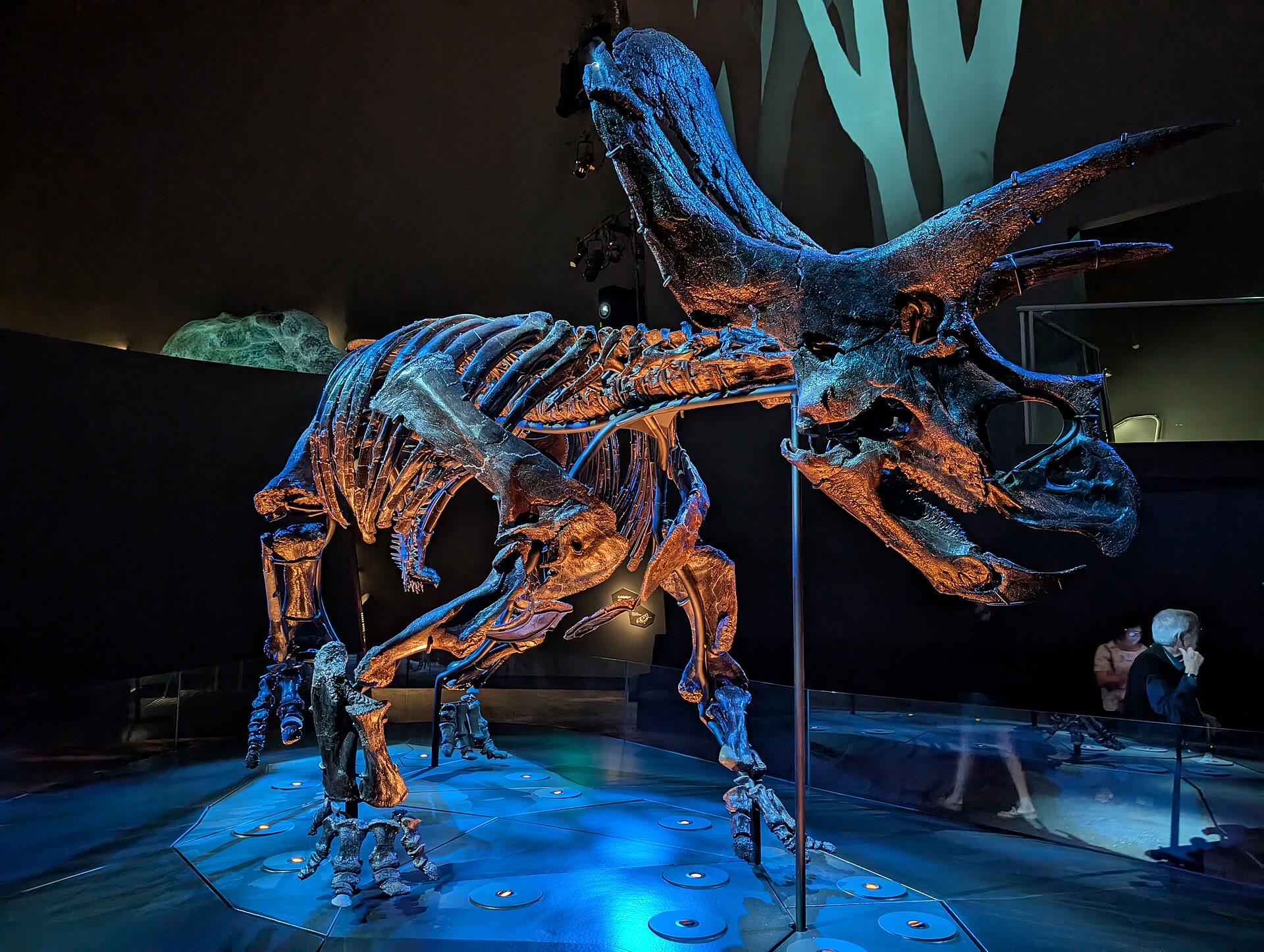
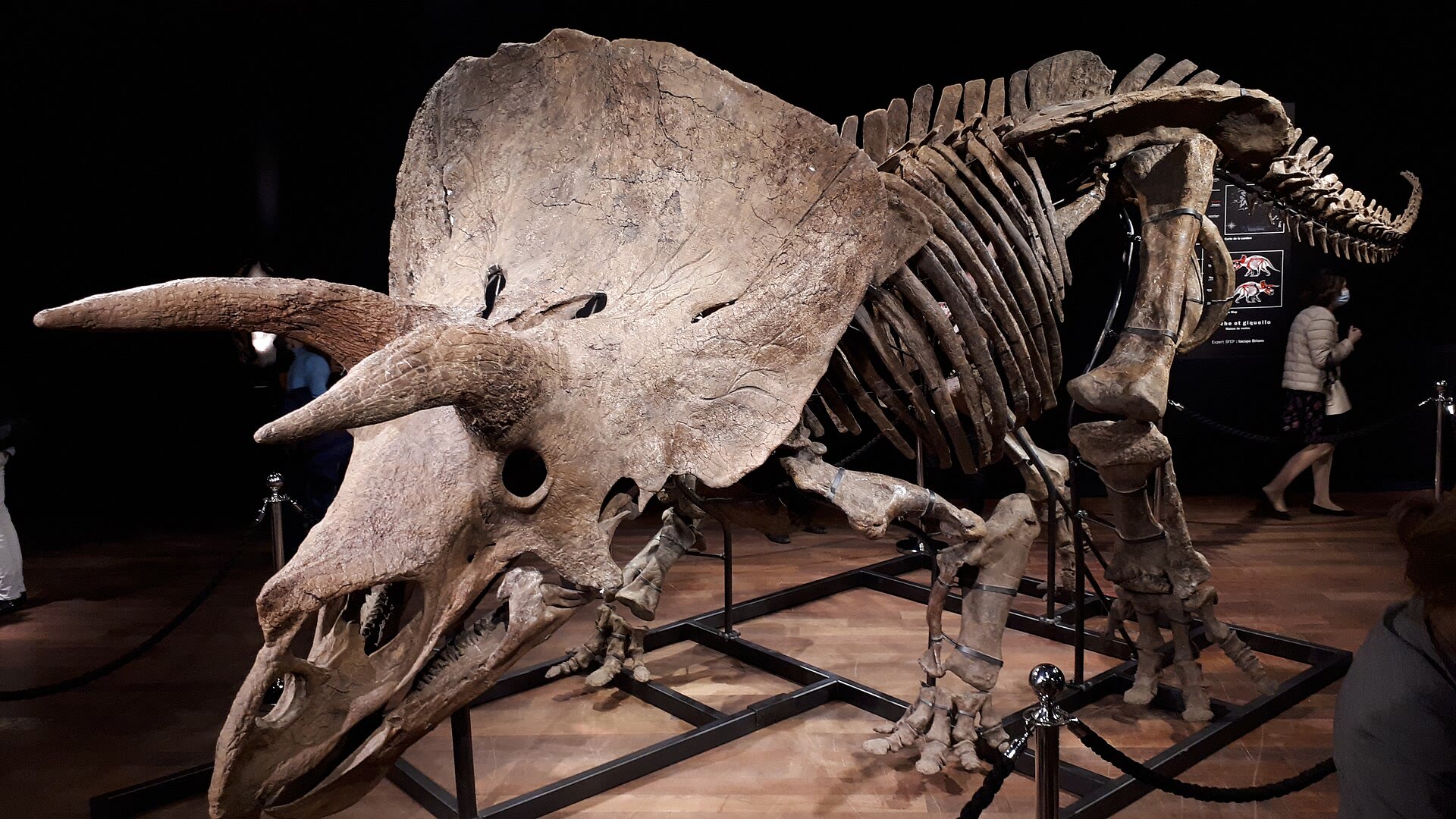
Horridus, described as the world's most complete and finely preserved Triceratops, was unveiled at Melbourne Museum on Saturday 12 March 2022 and is the most complete real dinosaur fossil in any Australasian museum 16Horridus is here! | Melbourne Museum · Museums Victoria ↗. It is estimated at 6–7 metres long and more than 2 metres tall, and its skull alone weighs 261 kg and is 99% complete 17Museums Victoria acquires the world’s most complete and most finely preserved Triceratops · Museums Victoria ↗. Another notable specimen, Big John, was described by the BBC as the largest triceratops dinosaur ever found and was sold at auction for a European record price of €6.65m 18Big John, largest known triceratops skeleton, sold at auction · BBC News ↗. Its bones were unearthed in modern-day South Dakota in 2014; 60% of the skeleton was recovered and its 200 pieces were assembled into a skeleton 8m long by 3m high 18.
| Specimen name | Key facts | Citation |
|---|---|---|
| Hatcher | 38-foot-long Wankel T. rex posed pulling skull from carcass | 8 10When T. Rex Meets Triceratops in the New Dino Hall, It Will Be a Violent Affair · Smithsonian Magazine ↗ |
| Horridus | 85% complete, on display at Melbourne Museum; 266 bones including entire vertebral column; skull 261 kg and 99% complete | 16 17 |
| Big John | Largest triceratops dinosaur ever found, sold at auction for €6.65m; 60% of skeleton recovered, 200 pieces assembled into 8m long by 3m high skeleton | 18 |
8. Cultural Significance
Triceratops holds an official place in the symbolic life of two American states. Wyoming designated it the official state dinosaur in 1994, and the state also keeps a separate state fossil, adopted in 1987, as a companion symbol. South Dakota recognises Triceratops as its state fossil. These designations are listed by the U.S. National Park Service, which counts Triceratops among the dinosaurs most familiar to the public, alongside Tyrannosaurus, Stegosaurus and Velociraptor. The same agency records the animal as the state dinosaur of Wyoming and the state fossil of South Dakota.
9. Timeline: from the first horn cores to the newest museum specimens
- 1887First Triceratops remains identifiedO.C. Marsh identified the first Triceratops specimen, a partial horn collected by George L. Cannon near Denver, Colorado, and — misreading the age of the rock formation — described it as an extinct artiodactyl, Bison alticornis.
- 1889Marsh names TriceratopsAmerican palaeontologist O.C. Marsh officially named and described the genus Triceratops; two species are recognised today, T. horridus and T. prorsus.
- 1889The holotype skull is collectedAn 1889 Yale expedition in the Lance Formation of Niobrara County, Wyoming, collected the skull that became the holotype of Triceratops, specimen YPM VP 001820.
- 1905The first mounted Triceratops goes on displayA composite skeleton pieced together from multiple individuals went on exhibit at the Smithsonian — the first Triceratops ever displayed, and for more than 20 years the only one on view anywhere in the world.
- 1994Wyoming adopts Triceratops as its state dinosaurWyoming designated Triceratops the official state dinosaur in 1994; the state also has a state fossil, adopted in 1987.
- March 2006The smallest Triceratops skull is describedA yearling skull found by Harley Garbani in 1997 in Montana’s Hell Creek Formation was described in the Journal of Vertebrate Paleontology; because horns and frill were present early in life, researchers argued they were unlikely to serve only as sexual display.
- 14 July 2010Torosaurus linked to TriceratopsMontana State University researchers John Scannella and Jack Horner argued in the Journal of Vertebrate Paleontology that Torosaurus specimens are in fact adult Triceratops — the same dinosaur at different stages of growth.
- 2014Hell Creek study maps Triceratops evolutionA study of a large sample of more than 50 skulls from the Hell Creek Formation found T. horridus in lower rocks and T. prorsus in upper rocks, with transitional forms between, consistent with evolution by anagenesis.
- summer 2018Yale skulls scanned for a new reconstructionResearchers made 3D scans of the Peabody Museum’s three best Triceratops skulls to help rebuild a specimen in the Netherlands; one skull, used by Marsh in 1889 to name the species, is displayed outside Yale’s O.C. Marsh Auditorium.
- 21 October 2021Big John sells at auctionThe fossilised remains of Big John, described as the largest triceratops dinosaur ever found, sold in Paris for a European record €6.65m to a private collector, with museums largely priced out of the market.
- 12 March 2022Horridus goes on display in MelbourneHorridus, 85% complete and the most complete Triceratops in any Australasian museum, was unveiled at Melbourne Museum as the centrepiece of Triceratops: Fate of the Dinosaurs.
- 2025A complete skull excavated in North DakotaDenver Museum of Nature & Science teams excavated a remarkably complete Triceratops skull, lower jaws and articulated neck from the Hell Creek Formation near Marmarth, North Dakota, in a field jacket weighing more than 5.4 tons.
References (22)
- 1Triceratops | Description, Size, Fossil, Diet, & Facts — Encyclopaedia Britannica WebView source
- 2Triceratops | Natural History Museum — Natural History Museum, London WebView source
- 3Introduction to the Ceratopsians — University of California Museum of Paleontology (UCMP), Berkeley WebView source
- 4Triceratops | Cleveland Museum of Natural History (archived page) — Cleveland Museum of Natural History Archive↩View source
- 5Evolutionary trends in Triceratops from the Hell Creek Formation, Montana (PNAS) — Proceedings of the National Academy of Sciences (Scannella et al. 2014) JournalView source
- 6Smallest fossil Triceratops yields clues to growth of huge dinosaur (page 1) — University of California Museum of Paleontology (UCMP), Berkeley 2006 WebView source
- 7The many lives of Triceratops skull No. 21 — YaleNews, Yale University 2020 WebView source
- 8Hatcher, the first Triceratops ever put on display — Google Arts & Culture / Smithsonian National Museum of Natural History Web↩View source
- 9An Elegy for Hatcher the Triceratops | Smithsonian Voices — Smithsonian Magazine / National Museum of Natural History 2018 WebView source
- 10When T. Rex Meets Triceratops in the New Dino Hall, It Will Be a Violent Affair — Smithsonian Magazine Web↩View source
- 11Evidence of Combat in Triceratops (PLOS ONE 4(1): e4252) — PLOS ONE (Farke, Wolff & Tanke 2009) JournalView source
- 12Triceratops horridus, facts and photos | National Geographic — National Geographic WebView source
- 13Major cranial changes during Triceratops ontogeny (Proc. R. Soc. B 273:2757) — Proceedings of the Royal Society B / PubMed Central (Horner & Goodwin 2006) WebView source
- 14Smallest fossil Triceratops yields clues to growth of huge dinosaur (page 2) — University of California Museum of Paleontology (UCMP), Berkeley 2006 WebView source
- 15Triceratops and Torosaurus were same dinosaur at different stages — ScienceDaily / Montana State University 2010 WebView source
- 16Horridus is here! | Melbourne Museum — Museums Victoria Web↩View source
- 17Museums Victoria acquires the world’s most complete and most finely preserved Triceratops — Museums Victoria Web↩View source
- 18Big John, largest known triceratops skeleton, sold at auction — BBC News Web↩View source
- 19Wyoming State Dinosaur | Triceratops — State Symbols USA WebView source
- 20Famous Dinosaurs — National Park Service (U.S. Department of the Interior) WebView source
- 21YPM VP 001820 (Ceratops horridus holotype) — Yale Peabody Museum collections — Yale Peabody Museum of Natural History WebView source
- 22Triceratops Discovery | Denver Museum of Nature & Science — Denver Museum of Nature & Science WebView source