Tyrannosaurus rex
The tyrant lizard king of the Late Cretaceous: how its fossils were found in the American West, what its skull, bite and senses reveal, the stories of the holotype, Sue and the Nation's T. rex, and the debates over feathers, growth and soft tissue.
Tyrannosaurus rex was one of the largest carnivorous dinosaurs ever to live, roaming western North America during the Late Cretaceous, about 68 to 66 million years ago. A massive skull with about 60 teeth and a bone-crushing bite made it a formidable predator, and more than 40 known specimens - from the 1902 holotype in Pittsburgh to Sue in Chicago and the Nation's T. rex in Washington - document its anatomy, growth and preserved soft tissues. It died out in the mass extinction that ended the age of the dinosaurs 66 million years ago.
Naming and Discovery
The scientific name Tyrannosaurus rex carries a meaning drawn from two classical languages: Tyrannosaurus means 'tyrant lizard' from the Greek, while rex means 'king' in Latin. Together the words describe a dinosaur whose name is often rendered as 'tyrant lizard king'. The formal scientific name of the species is Tyrannosaurus rex.
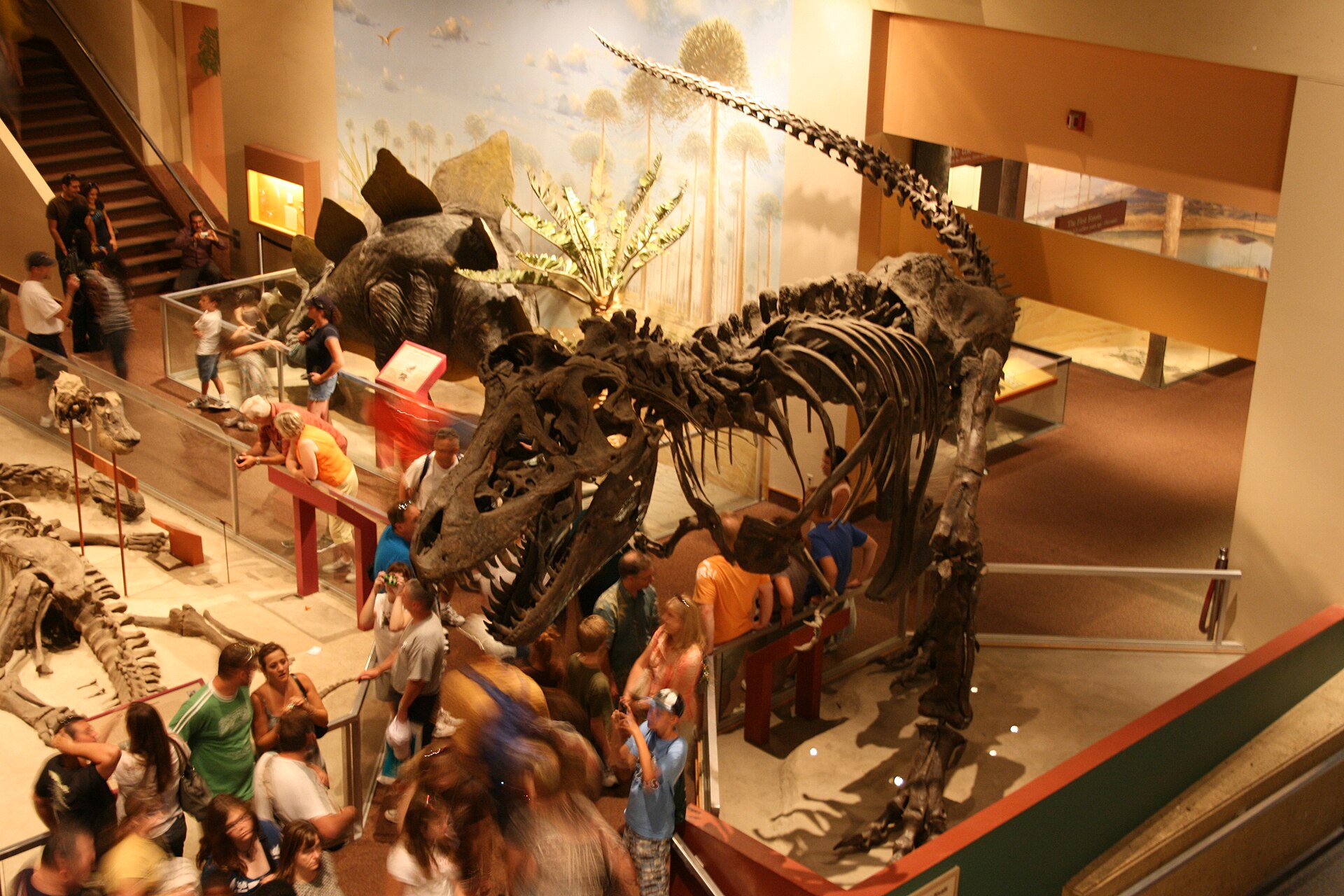
Henry Fairfield Osborn named the species in 1905, and he first described Tyrannosaurus rex in that year while at the American Museum of Natural History. The first known skeleton of Tyrannosaurus rex was discovered in 1900 in Wyoming, followed by another in 1902 in Montana; both were found by Barnum Brown. The 1902 specimen is the holotype of the species — the gold standard to which all potential T. rex fossils must be compared, and by definition the first fossil of the species recognised by science. That specimen is now on display at the Carnegie Museum of Natural History in Pittsburgh.
Finds that predate the naming of the species were later attributed to it: teeth now documented as belonging to Tyrannosaurus rex were found as early as 1874 by Arthur Lakes near Golden, Colorado. In 1892 some of the first known bones of Tyrannosaurus were named Manospondylus gigas by Edward Drinker Cope, who thought that they belonged to a Triceratops-like dinosaur. By the normal rules of scientific naming the first name given to a species should take priority, but Manospondylus stopped being used because lots of scientists preferred the name Tyrannosaurus rex.
1. Description and Anatomy
Tyrannosaurus rex was a large theropod of the family Tyrannosauridae and the subfamily Tyrannosaurinae, characterised by short deep jaws, long hind limbs and tiny forelimbs. Its reduced arms are thought to result from the enlargement of the massive heads of the tyrannosaurids, since a relatively larger head requires shorter arms and a counterbalancing tail to retain balance. Compared with its overall body size, the arms were surprisingly small and were attached to strong muscles; one theory holds that they helped the animal stand up after a fall.
There is currently no direct evidence that T. Preserved skin from Tyrannosaurus and its close relatives shows scales, and feathers may have been lost as tyrannosaurs evolved larger bodies.

2. Size and Growth
| Attribute | Value | Source |
|---|---|---|
| Length | About 12.3 metres (40 feet); up to 12–14 metres | australian-museum |
| Weight | About 7,000 kg; largest specimens over 8,000 kg | nhm-tyrannosaurus |
| Height at hips | 3.5–4.0 metres | nhm-tyrannosaurus |
| Skull length | Up to five feet (about 1.5 metres) | carnegiemnh-trex |
| Teeth | About 60 teeth, up to 30 cm long including the roots | australian-museum |
| Growth rate | Maximal growth rate 2.1 kg per day | ncbi-erickson-2004 |
| Lifespan | Lived up to 28 years | ncbi-erickson-2004 |
Tyrannosaurus rex was one of the largest known carnivorous dinosaurs, and its dimensions are correspondingly imposing. Adults could weigh up to about 8,000 kilogrammes and measure 4 metres tall at the hips and 12.3 metres long1Dinosaur - Tyrannosaurus rex · Australian Museum ↗. A typical individual was closer to 12 metres long and 3.5 to 4.0 metres tall at the hips, and probably weighed between 5,000 and 7,000 kilogrammes3Tyrannosaurus | Natural History Museum · Natural History Museum, London ↗. The largest known specimens, Sue and Scotty, jointly hold the Guinness World Record: both weighed over 8,000 kilogrammes and measured almost 13 metres long3.
The great stature of T. rex was primarily attained by accelerating growth rates beyond those of its closest relatives6Gigantism and comparative life-history parameters of tyrannosaurid dinosaurs (PubMed abstract, Nature 430) · National Center for Biotechnology Information, U.S. National Library of Medicine ↗. A 2004 study found that T. rex had a maximal growth rate of 2.1 kilograms per day, reached skeletal maturity in two decades and lived for up to 28 years6. Growth rings in SUE's bones show an adolescent growth spurt gaining as much as 4.5 pounds per day, with full size reached at the age of 19 years7SUE the T. rex · Field Museum of Natural History, Chicago ↗.
SUE lived about 67 million years ago and reached the upper end of T. rex life expectancy at about 28 years7.
3. Diet and Feeding
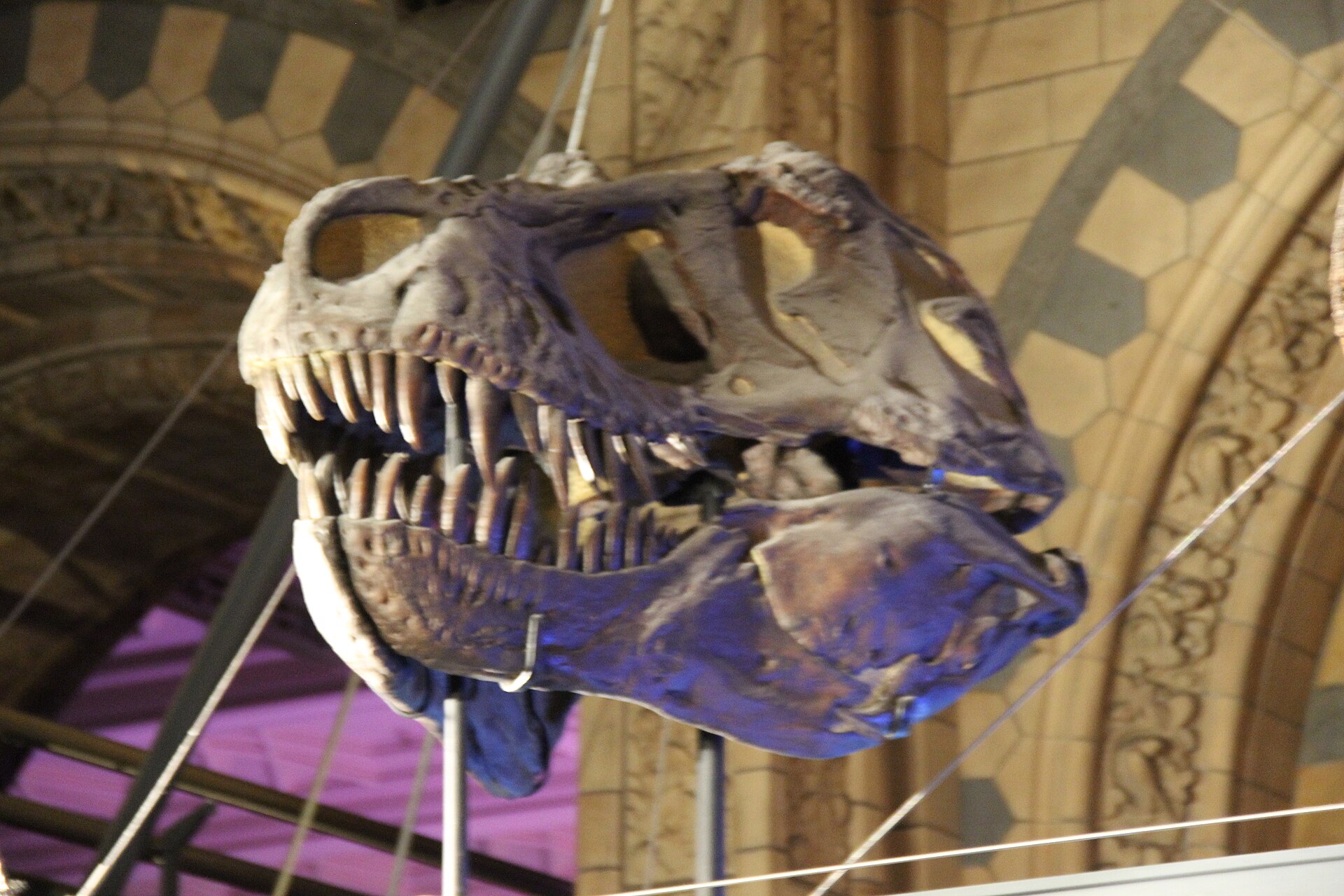
It employed a puncture-pull feeding strategy: strong jaws and serrated D-shaped teeth crunched through flesh, bone and marrow. The animal had no chewing teeth.
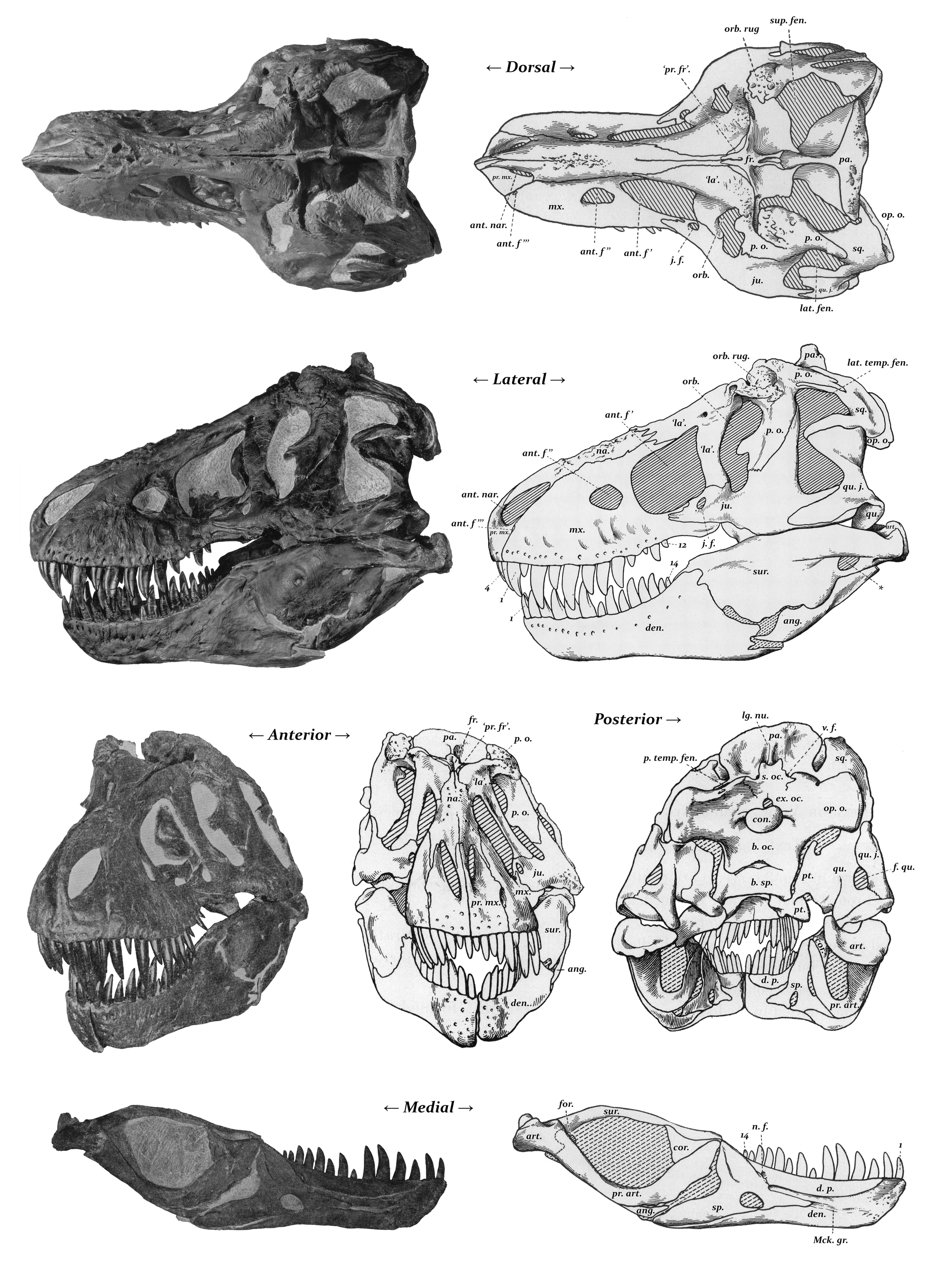
Biomechanical estimates place its bite force between 8,526 and 34,522 newtons, with tooth pressures estimated between 718 and 2,974 megapascals. Adult skulls varied in length from 111.5 to 136.5 centimetres, and the jaws alone reached about 1.2 metres. For comparison, a 4.51-metre saltwater crocodile measured directly at 16,414 newtons.
Evidence of what Tyrannosaurus ate survives in the fossil record: its tooth marks have been found on Triceratops and Edmontosaurus fossils, and pieces of swallowed bone turn up in its fossilised dung. A large part of the Tyrannosaurus brain processed smells, meaning it could find food over large distances and locate dead bodies to scavenge.
Whether Tyrannosaurus was primarily a hunter remains debated. Paleontologist Jack Horner proposed that T. rex could not have been a predator, citing its small eyes, small arms, huge legs and the lack of evidence for predation. It is not known whether Tyrannosaurus hunted in packs, but some Tyrannosaurus bones carry bite marks from other tyrannosaurs, showing that they fought each other.
4. Locomotion and Biomechanics
An adult Tyrannosaurus rex had an estimated top speed of around 22 kilometres per hour. Many biomechanics experts think tyrannosaurs could move fairly fast, perhaps 10 to 20 miles per hour, though not as fast as the smaller theropod dinosaurs.
A 2021 biomechanical study estimated the preferred walking speed of T. rex at 1.28 metres per second, which the authors interpret as near its energetically optimal walking speed. The tail of bipedal dinosaurs was suspended passively by the caudal interspinous ligaments, and these allowed elastic energy storage that reduced the metabolic cost of transport.
5. Fossil Record and Notable Specimens
As of 2020 more than 42 specimens of Tyrannosaurus rex had been discovered, ranging from 5 to 80 per cent complete by bone count, including several almost complete skeletons. The 1990s saw nearly twice as many Tyrannosaurus discoveries as in all previous years, including two of the most complete skeletons found to date: Sue and Stan. rex specimens are hard to come by: Berkeley's mount is 90% complete, one of the best found, while some 15-20 other specimens range from about 10% to 80% complete.
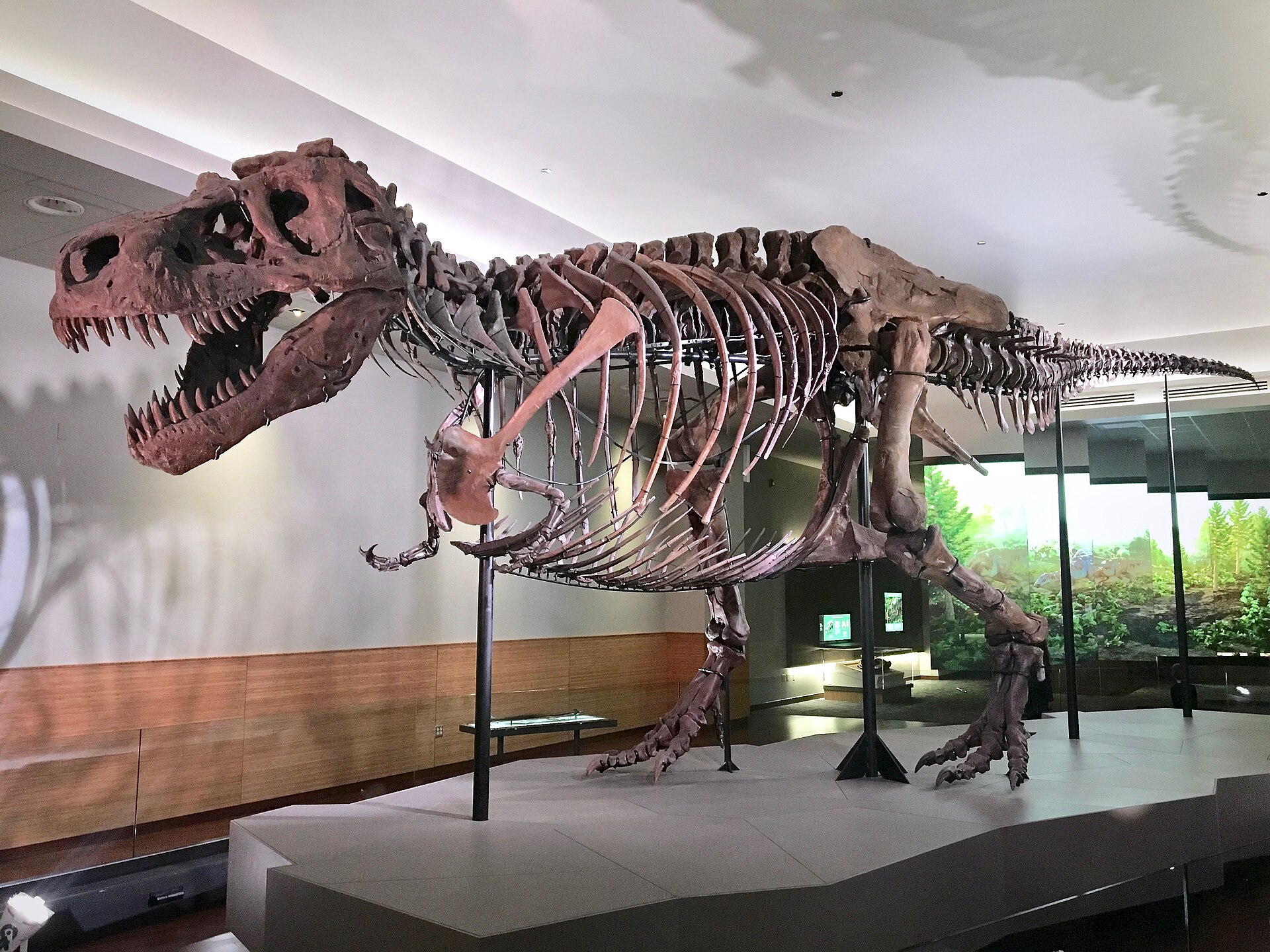
The specimen known as Sue, catalogued FMNH PR 2081 preserves 250 of the roughly 380 bones known for the species, and its skull alone weighs 600 pounds. The Field Museum acquired Sue at auction in 1997 for 8.4 million dollars, then the highest price ever paid for a fossil. In 2014 seven tons of fossils travelled 2,000 miles by truck from Montana to Washington, D.C.. On Saturday 8 June 2019 the Smithsonian unveiled its first fully mounted Tyrannosaurus rex.
SUE is named for Sue Hendrickson, who discovered the dinosaur in 1990 during a commercial excavation north of Faith, South Dakota; the animal's sex is unknown. The Field Museum won SUE at auction in 1997 for 8. 4 million dollars — the most money ever paid for a fossil at auction. SUE made a dramatic debut in Stanley Field Hall on 17 May 2000 after 12 museum preparators spent more than 30,000 hours preparing the skeleton, plus 20,000 hours building the exhibit.
rex is 80 to 85 percent complete — among the most complete T. rex fossils unearthed, second only to the Field Museum's Sue, which the Smithsonian tried to acquire at auction in 1997 without success. Kathy Wankel found the fossil in 1988 in eastern Montana, and paleontologist Jack Horner led the excavation from 1989 to 1990; the specimen became known as the Wankel T. rex skeleton is on loan to the Smithsonian for 50 years under an agreement with the U. Army Corps of Engineers.
6. Extinction
Tyrannosaurus rex died out 66 million years ago in the mass extinction that ended the age of the dinosaurs. Strong evidence suggests that a huge asteroid impact caused the mass extinction that wiped out the dinosaurs 66 million years ago. The species had lived during the Late Cretaceous, 68 to 66 million years ago.
Barnum Brown discovered the first partial skeleton in 1899 a year after the Diplodocus known as Dippy was found. That specimen was later sold to the Carnegie Museum in 1941. A museum celebrated the first free-standing mount over three days in September 1995. Another registered specimen, USNM 555000 had previously been catalogued as MOR 555.
In 1980 Nobel Prize-winning physicist Luis Walter Alvarez and his geologist son Walter published a theory that a historic layer of iridium-rich clay was caused by a large asteroid colliding with Earth. The impact site, known as the Chicxulub crater, is centred on the Yucatan Peninsula in Mexico; the asteroid is thought to have been 10 to 15 kilometres wide and the crater 150 kilometres in diameter. Redating has refined the date of the dinosaur extinction to 66.0 million years ago, with the clay layers dated to within a couple of thousand years.
Around 75 per cent of Earth's animals, including the dinosaurs, suddenly died out at the same point in time in a global mass extinction. The extinction left gaps in ecosystems around the world that were subsequently filled by the only dinosaurs to survive — birds — and by mammals, which both evolved rapidly.
7. Research and Controversies
Few questions in dinosaur palaeontology have proved as contentious as whether original soft tissues can survive across geological time. A 2005 study by Schweitzer and colleagues reported soft tissues preserved within hindlimb elements of Tyrannosaurus rex, specifically Museum of the Rockies specimen 1125. When the mineral phase was removed, the preparation revealed transparent, flexible, hollow blood vessels containing small round microstructures, suggesting that some dinosaurian soft tissues may retain original flexibility, elasticity and resilience. A later study, published in 2019 evaluated two non-enzymatic protein crosslinking mechanisms — Fenton chemistry and glycation — for their possible contribution to the preservation of blood vessel structures recovered from the cortical bone of a Tyrannosaurus rex catalogued as USNM 555000 formerly MOR 555.
The wider claim remains unsettled. The idea that original soft tissue structures and their native proteins can persist across geological time is controversial, in part because rigorous and testable preservation mechanisms have not been well defined. Work on the vessel material has nonetheless demonstrated the endogeneity of the fossil vessel tissues as well as the presence of type I collagen in the outermost vessel layers, using imaging, diffraction, spectroscopy and immunohistochemistry.
Other lines of evidence have opened further disputes about how many kinds of tyrannosaur the fossil record preserves. Some scientists suggest that the smaller tyrannosaur Nanotyrannus lancensis might instead represent juvenile T. In 2005 Schweitzer also found evidence of medullary bone — tissue that accumulates in female birds during ovulation — in a Tyrannosaurus rex from the Hell Creek Formation.
8. Timeline: from the first fossils to the Nation's T. rex
- 68 million years agoTyrannosaurus rex appearsT. rex lived during the Late Cretaceous, 68 to 66 million years ago; its fossils have been found in Canada and the USA.
- 66 million years agoEnd-Cretaceous mass extinctionAn asteroid impact at Chicxulub wiped out the non-bird dinosaurs and around 75% of Earth's animals, ending the age of the dinosaurs.
- 1874First T. rex teeth recognisedTeeth now documented as Tyrannosaurus rex were found near Golden, Colorado, by Arthur Lakes.
- 1892Manospondylus gigas namedEdward Drinker Cope named some of the first known Tyrannosaurus bones Manospondylus gigas; the name was later set aside in favour of Tyrannosaurus rex.
- 1900First partial skeleton foundBarnum Brown found the first partial skeleton of T. rex in eastern Wyoming.
- 1902Hell Creek discoveryBrown found another partial skeleton in Hell Creek, Montana - the discovery that led to the name Tyrannosaurus rex.
- 1905Tyrannosaurus rex namedHenry Fairfield Osborn first described Tyrannosaurus rex, and the first specimen is now on display at the Carnegie Museum of Natural History.
- 1941Holotype sold to the CarnegieThe holotype specimen was bought by the Carnegie Museum in Pittsburgh, where it remains on display.
- 1988The Wankel rex foundRancher Kathy Wankel found a T. rex skeleton on the shores of Fort Peck Lake in Montana.
- 1990Sue discoveredSue Hendrickson discovered SUE, the largest and most complete T. rex specimen found, north of Faith, South Dakota.
- 15-17 September 1995UCMP unveils its T. rexA three-day celebration marked the unveiling of UCMP's free-standing mounted cast, made from the Wankel skeleton.
- 1997SUE sold at auctionThe Field Museum bought SUE for 8.4 million dollars - the most money ever paid for a fossil at auction.
- 17 May 2000SUE goes on displaySUE debuted in Stanley Field Hall after 12 preparators spent more than 30,000 hours preparing the skeleton.
- 25 March 2005Soft tissue reportedA study reported preserved soft tissues, including transparent, flexible, hollow blood vessels, in T. rex specimen MOR 1125.
- 2014The Nation's T. rex arrivesSeven tons of fossils travelled about 2,000 miles from Montana to Washington, D.C., on a 50-year loan to the Smithsonian.
- 8 June 2019Nation's T. rex goes on displayThe David H. Koch Hall of Fossils-Deep Time opened with the first fully assembled T. rex skeleton at the Smithsonian.
References (17)
- 1Dinosaur - Tyrannosaurus rex — Australian Museum Web↩View source
- 2Tyrannosaurus rex — Carnegie Museum of Natural History WebView source
- 3Tyrannosaurus | Natural History Museum — Natural History Museum, London Web↩View source
- 4Tyrannosaurus Rex! — University of California Museum of Paleontology (UCMP), Berkeley WebView source
- 5Tyrannosauridae — University of California Museum of Paleontology (UCMP), Berkeley WebView source
- 6Gigantism and comparative life-history parameters of tyrannosaurid dinosaurs (PubMed abstract, Nature 430) — National Center for Biotechnology Information, U.S. National Library of Medicine Web↩View source
- 7SUE the T. rex — Field Museum of Natural History, Chicago Web↩View source
- 8The Biomechanics Behind Extreme Osteophagy in Tyrannosaurus rex (Scientific Reports 7: 2012) — Scientific Reports (Nature Publishing Group) 2012 JournalView source
- 9Natural Frequency Method: estimating the preferred walking speed of Tyrannosaurus rex based on tail natural frequency (R. Soc. Open Sci. 8: 201441) — Naturalis Biodiversity Center (Royal Society Open Science) 2021 WebView source
- 10Five Things We Don't Know About Tyrannosaurus Rex — Smithsonian Magazine WebView source
- 11What killed the dinosaurs? | Natural History Museum — Natural History Museum, London WebView source
- 12Famous Dinosaurs — National Park Service (U.S. Department of the Interior) WebView source
- 13UCMP's T. rex — University of California Museum of Paleontology (UCMP), Berkeley WebView source
- 14Mechanisms of soft tissue and protein preservation in Tyrannosaurus rex — PubMed Central, U.S. National Library of Medicine (Scientific Reports) WebView source
- 15How an asteroid ended the age of the dinosaurs | Natural History Museum — Natural History Museum, London WebView source
- 16Soft-tissue vessels and cellular preservation in Tyrannosaurus rex (PubMed abstract, Science 307) — National Center for Biotechnology Information, U.S. National Library of Medicine WebView source
- 17Homecoming King: The Nation's T. rex Returns to the Smithsonian — Smithsonian Magazine WebView source