Archaeopteryx
The feathered Late Jurassic dinosaur of Bavaria — its 1861 discovery, the London and Berlin specimens, and the long debate over how the 'Urvogel' flew.
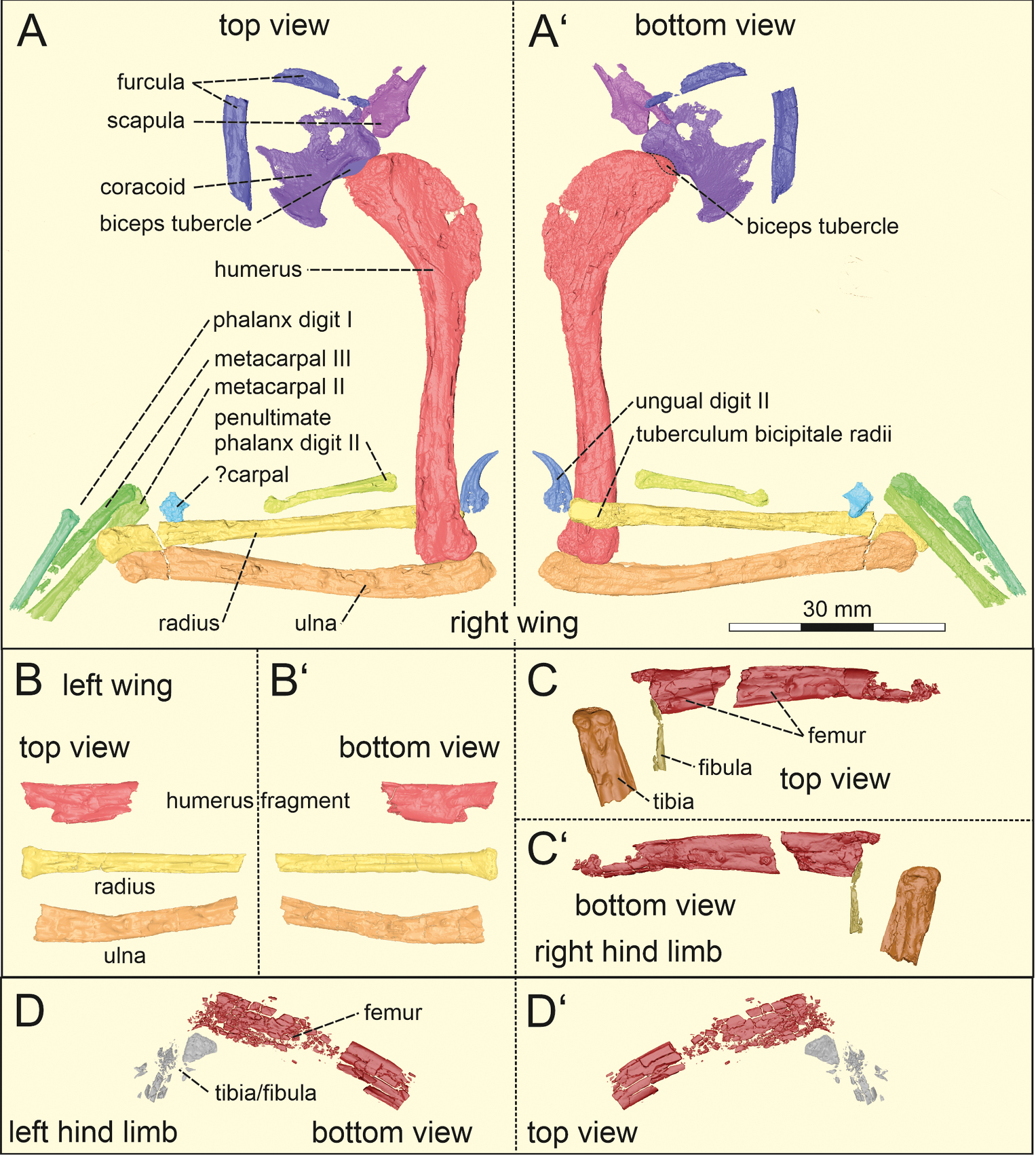
Archaeopteryx is a genus of feathered dinosaur from the Late Jurassic Solnhofen Limestone of Bavaria, about 150 million years old, long regarded as the oldest known bird. Its fossils combine bird features such as feathered wings and a wishbone with dinosaur features including teeth, clawed fingers and a long bony tail. Discovered in 1861, two years after Darwin published On the Origin of Species, it became a key piece of evidence in the debate over the origin of birds, and a 2018 study of its wing bones concluded that it was capable of active, flapping flight.
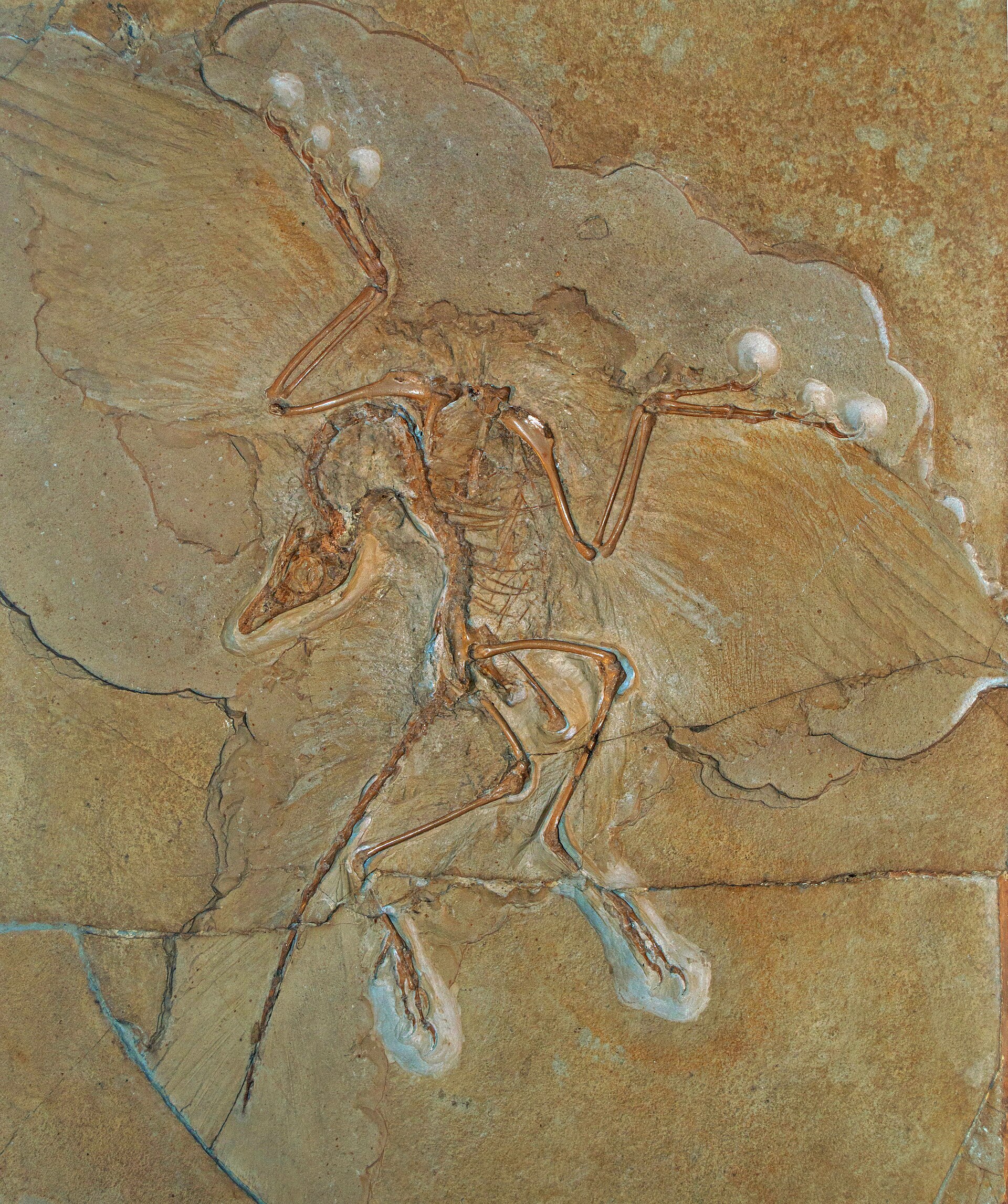
Overview
Archaeopteryx was a small, bird-like dinosaur of the Late Jurassic whose remains come from what is now Europe. It lived in the Late Jurassic, between 149 and 145 million years ago. Its name means 'ancient wing', and it also carries the German common name Urvogel, meaning 'primeval bird'. It had broad feathered wings and a small body, roughly the size of a magpie, with specimens ranging from the size of a blue jay to that of a large chicken. It is an iconic fossil taxon with feathered wings from the Late Jurassic of Germany, crucial for understanding the early evolution of avian flight.
Archaeopteryx shows a unique combination of dinosaur and bird characters. Unlike modern birds, it had a full set of teeth, a rather flat sternum, a long bony tail, belly ribs, and three claws on the wing. It retained a wishbone, a breastbone, hollow thin-walled bones, air sacs in the backbones, and feathers — traits also found in the nonavian coelurosaurian relatives of birds. After over 150 years of study, its mosaic anatomy — part non-flying dinosaur, part flying bird — has remained challenging to interpret.
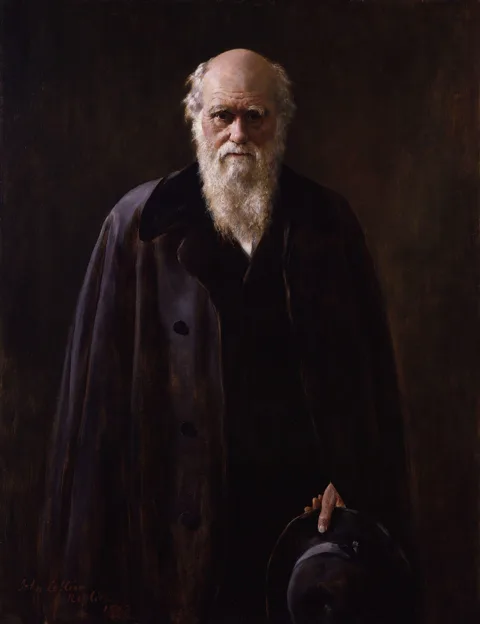
Archaeopteryx is one of the few fossils that show evolution in action, and it has long been pivotal for understanding the origin of birds. It has since been a key piece of evidence for the origin of birds. Darwin was excited by Archaeopteryx because it emerged a couple of years after he published his theory of evolution and was the sort of transitional form he expected in the fossil record. The Field Museum calls Archaeopteryx arguably the most important fossil ever discovered, for providing strong support for Darwin's theory of evolution.
1. Discovery and Naming
The first trace of Archaeopteryx to come to light was not a skeleton but a single feather, discovered in 1860 in a quarry near Solnhofen. It was described in 1861 as Archaeopteryx by Hermann von Meyer, the same year in which he named the animal. The initial discovery, unearthed in 1860 or 1861, is now held in the Natural History Museum of Berlin. Debate has persisted over whether that first feather really belongs to Archaeopteryx.
The discovery caused confusion because no birds were known from so far back, and some people even thought it might be an angel. Some published articles claiming the feathers must be fake, but museum scientists were able to show that the fossils were real. The type species is Archaeopteryx lithographica.
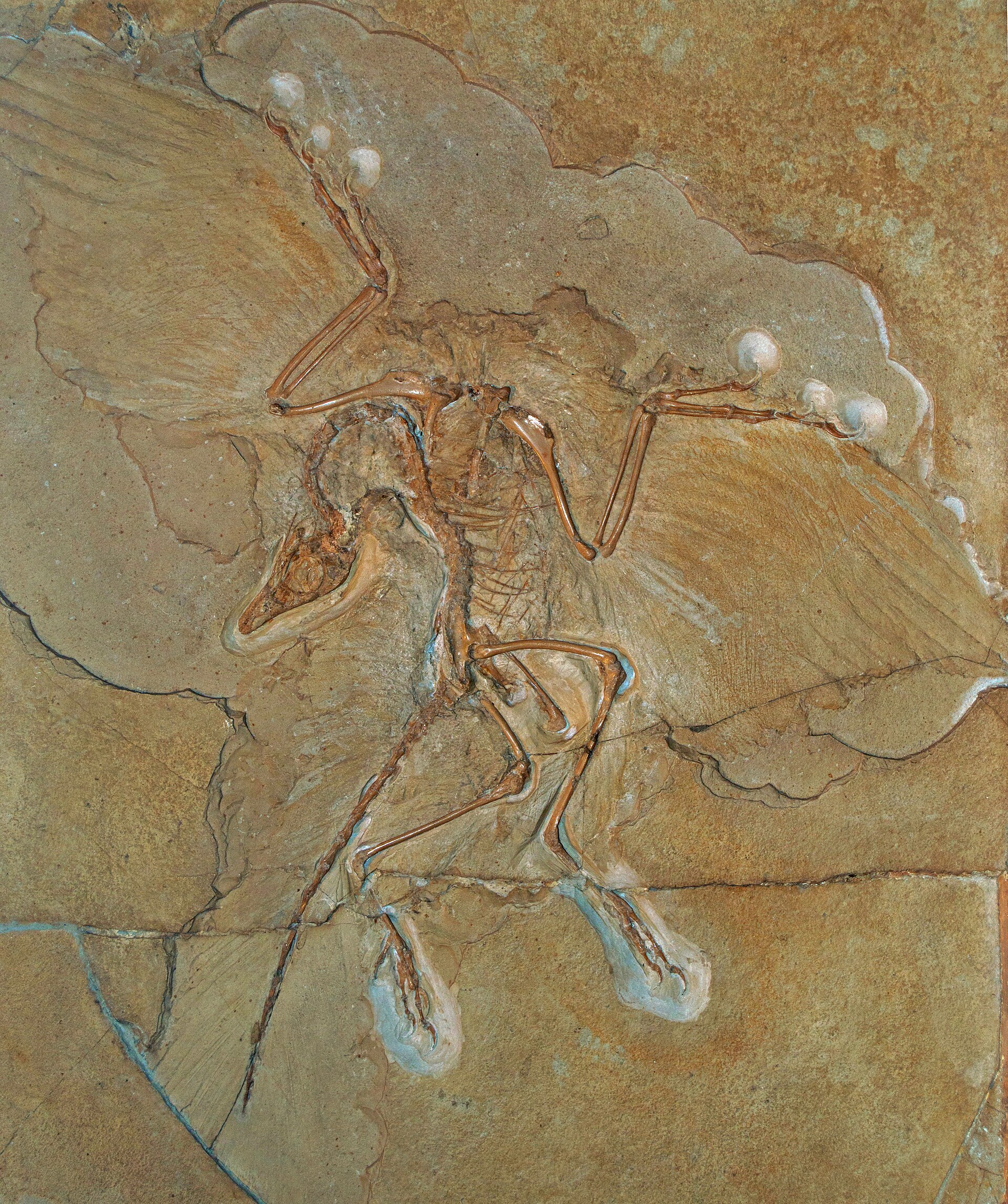
The twelfth specimen was found in summer 2010 at Schamhaupten by a private collector in sediments probably slightly older than those yielding earlier finds, and was registered as German national cultural heritage, guaranteeing its permanent availability despite remaining in private hands.
The specimen was discovered between 1874 and 1876 near Eichstätt; its finder sold it for the value of a cow, about 150 Mark, and it was later offered for 20,000 Goldmark. In 1879 Werner von Siemens financed its purchase for the Humboldt Museum in Berlin, and it was described in 1884 by Wilhelm Dames.
2. Type Specimen and Nomenclature
The name Archaeopteryx lithographica rests on a type that proved impossible to pin to a species. In 2007 two sets of scientists petitioned the ICZN to designate the London specimen as the type. The ICZN set aside all previous type fixations and designated the feathered London specimen BMNH 37001 in the Natural History Museum, London, as the neotype. That designation came on 3 October 2011, after four years of debate.
The limestone quarries near Solnhofen lie in an area that in the Jurassic was a lagoon surrounded by sub-tropical islands. The layers date to approximately 150 million years ago, during the Late Jurassic.
3. Specimens
The fossil record of Archaeopteryx is drawn from the limestone quarries near Solnhofen, in Bavaria, Germany, where finds began in 1861 and have continued since 1Archaeopteryx | Natural History Museum · Natural History Museum, London ↗2Archaeopteryx | Size, Fossils, & Facts · Encyclopaedia Britannica ↗. Twelve skeletal specimens were reported as of 2017 6Re-evaluation of the Haarlem Archaeopteryx and the radiation of maniraptoran theropod dinosaurs (BMC Evolutionary Biology) · PubMed Central, U.S. National Library of Medicine ↗.
| Specimen | Key facts | Repository/status |
|---|---|---|
| London specimen (BMNH 37001) | Neotype, designated 2011; described 1863 by Richard Owen as Archaeopteryx macrura; missing most of its head and neck | — |
| Berlin specimen | Most complete | — |
| Eichstätt specimen (JM 2257) | Discovered 1951 near Workerszell; described by Peter Wellnhofer in 1974; smallest specimen | Jura Museum, Eichstätt |
| Maxberg specimen | Torso discovered 1956 near Langenaltheim | Currently missing |
| 'Chicken wing' | Wing fossil unveiled summer 2004 | On display in the Bürgermeister-Müller Museum |
| Thermopolis specimen | Shows a second toe consistent with hyperextension, as in dromaeosaurs and troodontids | — |
| Haarlem specimen | Found six years before the first Archaeopteryx skeleton; misidentified as pterosaur Pterodactylus crassipes; recognised as theropod in 1970; later reassigned to anchiornithids | Teylers Museum |
| Twelfth specimen | Oldest representative | Dinosaurier Freiluftmuseum Altmühltal, Denkendorf |
| Chicago specimen | Found by a private collector before 1990; arrived at the Field Museum in August 2022; one of only 13 known; nearly 100% complete per X-ray | Field Museum |
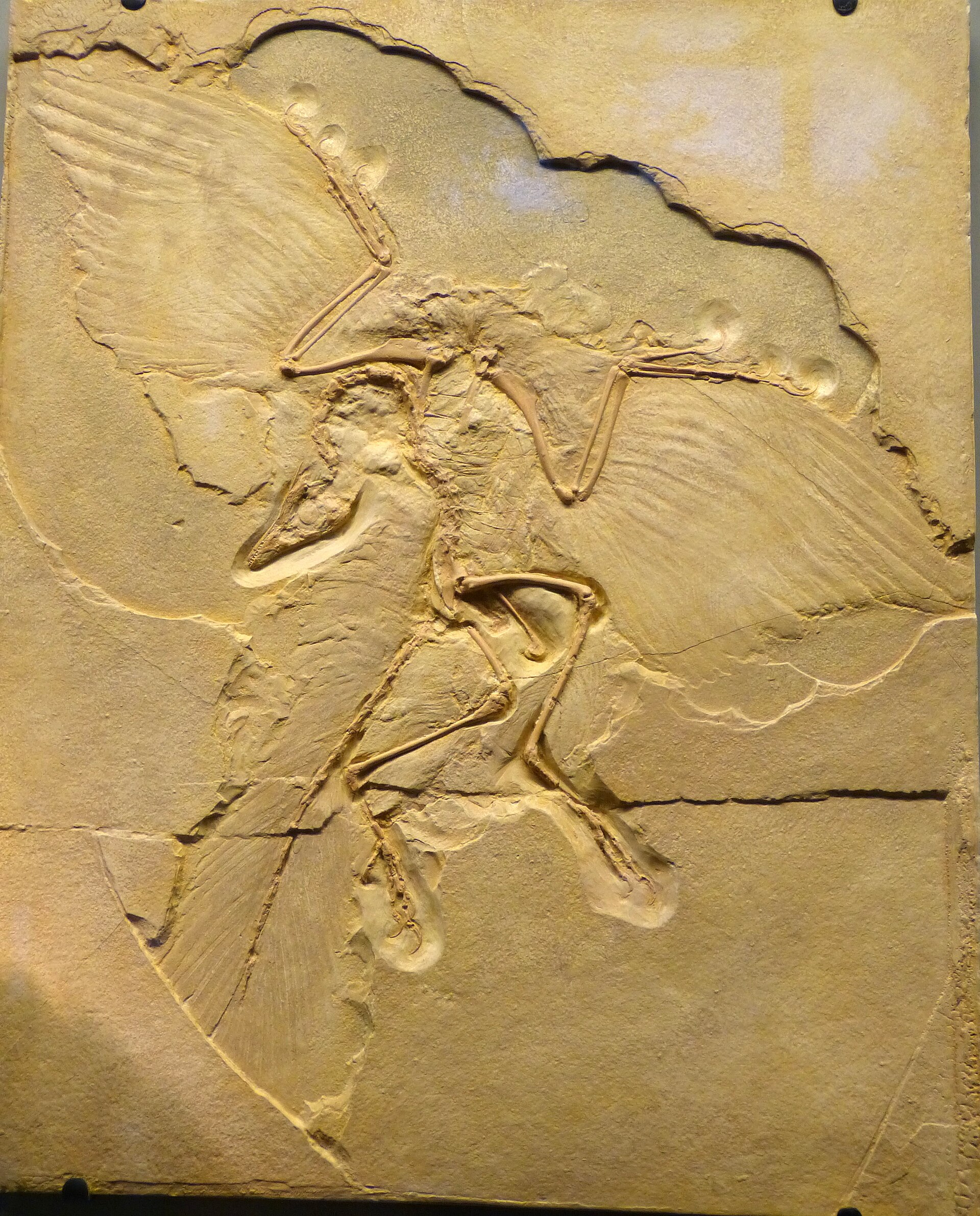
4. Anatomy and Diet
Archaeopteryx was carnivorous and may have eaten small reptiles, mammals or insects. Its jaws carried many small, cone-shaped teeth, and the Field Museum's fossil preserves fifty tiny teeth. The striking variation in teeth could reflect differences in diet, raising the possibility that the fossils represent more than one species.
The long asymmetrical wing feathers, the elongated arm and the collarbone resemble modern birds, while the three clawed fingers are a dinosaur trait. Specimens are notable for well-developed, markedly asymmetrical flight feathers with the barb-barbule-barbicel arrangement seen in modern birds. The fossil shows beautiful feather and wing impressions like a bird, but also the claws, long bony tail and serrated teeth associated with dinosaurs.
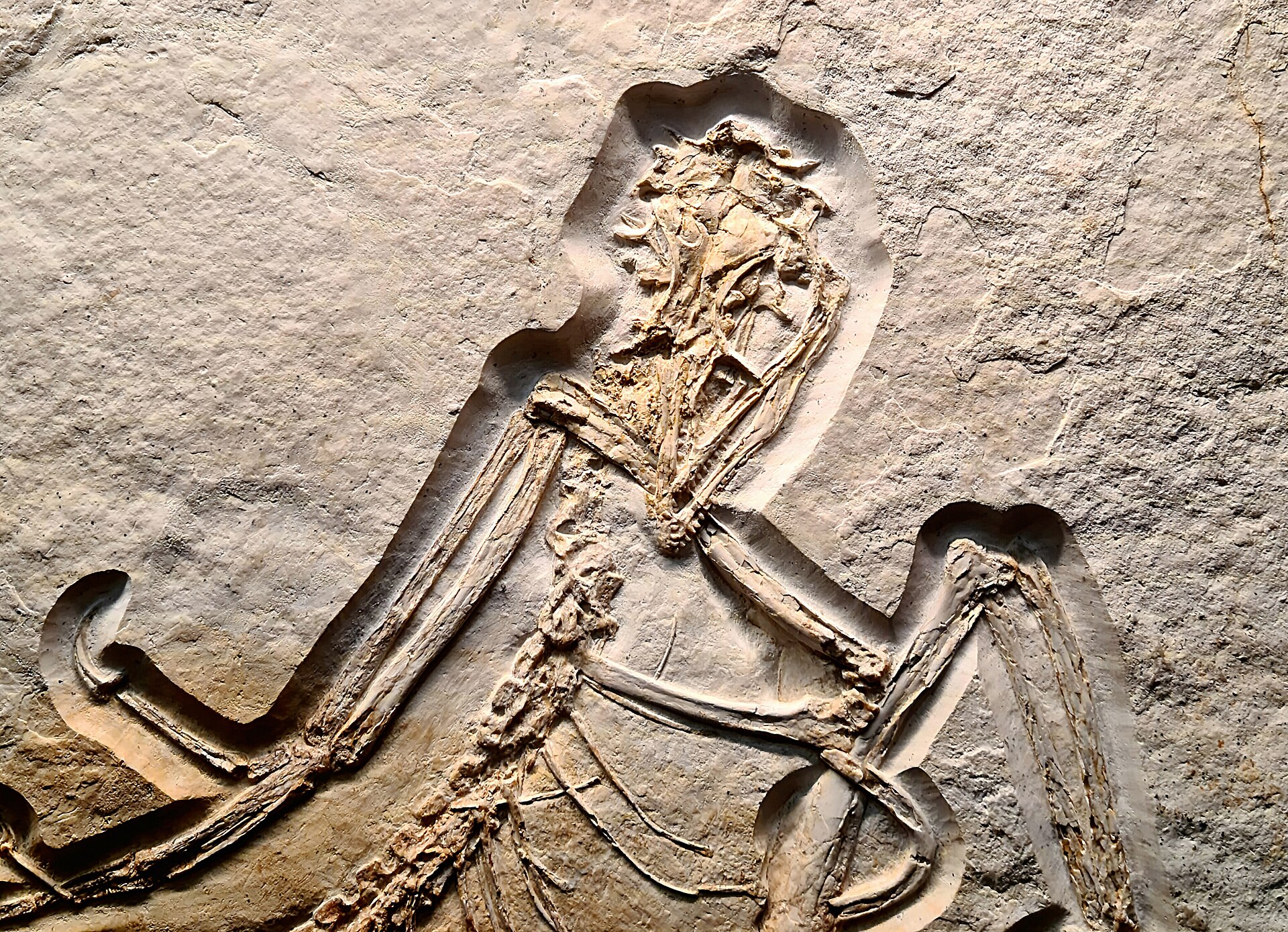
The first skeleton, the London Specimen (BMNH 37001), was unearthed in 1861 near Langenaltheim and sold for £700 to the Natural History Museum in London, where it remains. The museum acquired it in 1862 as part of a larger purchase of more than 1,900 Solnhofen fossils from Dr Karl Haberlein, and most experts regard all discovered remains as belonging to a single species or at least genus, though this is still debated.
5. Flight and Locomotion
Whether Archaeopteryx was fully able to fly or could only glide remained an open question for the Natural History Museum's experts. It is currently thought able to sustain powered flight, but was probably not a strong flier, and may have run, leaped, glided and flapped all in the same day. Its bones could handle low torsional forces, allowing bursts of powered flight over short distances rather than sustained rapid flapping and soaring.
Researchers compared new data from three Archaeopteryx specimens obtained by synchrotron microtomography with a sample of archosaurs of diverse locomotory strategies. The authors interpret that Archaeopteryx actively employed wing flapping to take to the air, with a different flight stroke from modern birds. Their analysis implies that avian powered flight must have originated before the latest Jurassic. Relative cortical thickness of the arm bones confidently indicates that Archaeopteryx was volant. Earlier conclusions that it could fly actively lacked universal support because key skeletal conditions for the avian flight stroke were not yet present.
The bone data put Archaeopteryx closest to birds like pheasants that occasionally use active flight to cross barriers or dodge predators. The team concluded that Archaeopteryx was already actively flying around 150 million years ago, implying active dinosaurian flight had evolved even earlier. Two models of the evolution of flight have been proposed: in the 'trees-down' model birds evolved from tree-dwelling ancestors that could glide, while in the 'ground-up' model ancestors lived on the ground and made long leaps.
6. Feather Colour
Statistical analysis of melanosome morphology predicts that the original colour of the isolated Archaeopteryx feather was black, with 95% probability. Reexamination of the feather's morphology led the authors to interpret it as an upper major primary covert, contrary to previous interpretations. The specimen is preserved as an organosulphur residue, and barbule microstructure identical to that of modern bird feathers had evolved as early as the Jurassic.
Modern scanning found that one Archaeopteryx wing feather was jet-black, though it is unknown whether the animal was black only on its wings. Researchers determined that a well-preserved feather on the wing of the raven-sized Archaeopteryx was black, evidence its wing feathers were rigid and durable and helped it fly. The team found that Archaeopteryx's feather structure is identical to that of living birds, showing modern wing feathers had evolved as early as 150 million years ago.
7. Classification and Evolutionary Significance
John Ostrom argued in the 1970s — following a lead Thomas Henry Huxley had set in 1868 — that birds evolved within theropod dinosaurs and that Archaeopteryx was a critical piece of evidence for the argument. In the same decade, paleontologists noticed that Archaeopteryx shared unique features with small carnivorous dinosaurs called theropods. Late 20th- and early 21st-century discoveries of other birdlike fossils prompted several paleontologists to call for the reclassification of Archaeopteryx as a dinosaur.
The Haarlem specimen, long considered an Archaeopteryx, was reassigned to bird-like maniraptoran dinosaurs known as anchiornithids, first identified from material found in China. Re-evaluation showed that the Haarlem specimen represents a separate taxon, Ostromia crassipes. Phylogenetic analysis identifies Ostromia as the first representative of the anchiornithid clade outside eastern Asia. The new genus name Ostromia honours John Ostrom, the American paleontologist who first identified the fossil as a theropod dinosaur.
8. Exhibitions and Public Display
The Berlin specimen is widely regarded as the best preserved in the world; since 2007 the original has been on permanent display in the Museum für Naturkunde Berlin. The Solnhofen museum displays four original specimens, among them the sixth, the largest found, and the ninth, known as the "chicken wing".
In 2017 the London specimen travelled to Japan as one of nearly 300 treasures from the Natural History Museum's collections on tour in Asia.
9. Timeline: from the first feather to the Chicago Archaeopteryx
- 1860First fossil feather discoveredA single feather, the first fossil of its kind, was discovered in a quarry near Solnhofen.
- 1861Archaeopteryx namedHermann von Meyer described the feather and gave the name Archaeopteryx to the animal.
- 1861First skeleton unearthedThe first skeleton, later known as the London specimen, was found near Langenaltheim in Bavaria.
- 1862The London purchaseThe Natural History Museum's specimen was among more than 1,900 Solnhofen fossils bought for £700 from Dr Karl Haberlein.
- 1863Owen describes the London specimenRichard Owen described the fossil as Archaeopteryx macrura, allowing that it might not belong to the same species as the feather.
- 1874–1876The Berlin specimen discoveredA second skeleton was discovered near Eichstätt; it would become the most complete specimen known.
- 1879Siemens funds the Berlin purchaseWerner von Siemens financed the transaction that placed the specimen with the museum in Berlin.
- 1884The Berlin specimen describedWilhelm Dames described the Berlin specimen, the first with a complete head.
- 1970The Haarlem specimen reidentifiedA fossil found years before the first skeleton was finally recognised as a theropod and referred to Archaeopteryx.
- Summer 2010Twelfth specimen foundA private collector found a new specimen at Schamhaupten, since described as the oldest known representative of the genus.
- 3 October 2011London specimen designated neotypeThe ICZN set aside earlier type fixations and designated the London specimen BMNH 37001 as the neotype of Archaeopteryx lithographica.
- 24 January 2012Feather colour reconstructedAnalysis of fossil melanosomes showed that the isolated feather was black, with 95% probability.
- 2017Haarlem reassigned to OstromiaRe-evaluation concluded the Haarlem specimen represents a separate taxon, Ostromia crassipes, outside the genus Archaeopteryx.
- March 2018Active flight study publishedSynchrotron analysis of wing bones concluded that Archaeopteryx actively flew, though with a flight stroke unlike that of modern birds.
- August 2022Chicago specimen arrivesThe Field Museum's fossil arrived in Chicago, having been in private hands since 1990.
- May 2024The Chicago Archaeopteryx unveiledThe Field Museum unveiled its specimen, one of only 13 known and among the most complete yet found.
References (22)
- 1Archaeopteryx | Natural History Museum — Natural History Museum, London Web↩View source
- 2Archaeopteryx | Size, Fossils, & Facts — Encyclopaedia Britannica Web↩View source
- 3Wing bone geometry reveals active flight in Archaeopteryx (Nature Communications) — PubMed Central, U.S. National Library of Medicine WebView source
- 4Fossil bird collection | Natural History Museum — Natural History Museum, London WebView source
- 5Archaeopteryx: An Early Bird — University of California Museum of Paleontology (UCMP), Berkeley WebView source
- 6Re-evaluation of the Haarlem Archaeopteryx and the radiation of maniraptoran theropod dinosaurs (BMC Evolutionary Biology) — PubMed Central, U.S. National Library of Medicine Web↩View source
- 7Archaeopteryx — Wikipedia WebView source
- 8'Rock star' Archaeopteryx fossil heads for Japan — BBC News WebView source
- 9Field Museum acquires fossil of Archaeopteryx, the earliest known bird — Field Museum, Chicago WebView source
- 10Archaeopteryx lithographica – The Berlin specimen — Museum für Naturkunde Berlin (Google Arts & Culture) WebView source
- 11The oldest Archaeopteryx: a new specimen from the Kimmeridgian/Tithonian boundary of Schamhaupten, Bavaria (PeerJ) — PubMed Central, U.S. National Library of Medicine WebView source
- 12Opinion 2283 (Case 3390): Archaeopteryx lithographica von Meyer, 1861 (Aves): conservation of usage by designation of a neotype — International Commission on Zoological Nomenclature (Bulletin of Zoological Nomenclature) 1861 ArchiveView source
- 13The eleventh Archaeopteryx — Ludwig-Maximilians-Universität München (LMU) WebView source
- 14Specimens of Archaeopteryx — Wikipedia WebView source
- 15The early bird got to fly: Archaeopteryx was an active flyer — ScienceDaily (European Synchrotron Radiation Facility) 2018 WebView source
- 16New evidence on the colour and nature of the isolated Archaeopteryx feather (Nature Communications) — Nature Publishing Group JournalView source
- 17Winged dinosaur Archaeopteryx dressed for flight — Brown University 2007 WebView source
- 18The origin of birds — Understanding Evolution, University of California, Berkeley WebView source
- 19Early avian evolution: The Archaeopteryx that wasn't — ScienceDaily (Ludwig-Maximilians-Universität München) 2017 WebView source
- 20The World of Dinosaurs — Museum für Naturkunde Berlin WebView source
- 21Mythos Archaeopteryx lithographica — Museum Solnhofen – Bürgermeister-Müller-Museum WebView source
- 22Unveiling The Chicago Archaeopteryx — Field Museum, Chicago WebView source
 International Space Station
 Charles Darwin
 History of Paper