Allosaurus
The best-known large predator of the Late Jurassic Morrison Formation — its naming, anatomy, abundance at the Cleveland-Lloyd Dinosaur Quarry, growth and injuries, and the debate over hunting and scavenging.
Allosaurus was a large carnivorous theropod dinosaur of the Late Jurassic, living about 155 to 145 million years ago, and is one of the best-known dinosaurs of western North America's Morrison Formation. Named by Marsh in 1877, it is known from dozens of individuals spanning juveniles to adults, most famously at Utah's Cleveland-Lloyd Dinosaur Quarry, and has additional species in Portugal. Studies of its bones have documented growth rates, healed wounds and infections, while whether it was an active predator, a scavenger of giant sauropod carcasses, or both remains actively debated.
In this article
- 1Overview
- 2Naming and Taxonomy
- 3Description and Anatomy
- 4Size Estimates
- 5Distribution and Age
- 6Diet and Feeding Behaviour
- 7Pack Hunting and Social Behaviour
- 8Cleveland-Lloyd Dinosaur Quarry
- 9Cleveland-Lloyd Excavation History
- 10Key Localities and Specimens
- 11Species
- 12Growth and Histology
- 13Cultural and Official Recognition
- 14Timeline: from the 1877 naming to the 2023 neotype
- 15Knowledge graph
Overview
Allosaurus is a genus of large carnivorous theropod dinosaurs, classified within the family Allosauridae, whose name means 'different lizard'. The type species, Allosaurus fragilis, was named by Marsh in 1877. Its remains are known chiefly from North America.
Allosaurus lived during the Late Jurassic, between 152 and 145 million years ago, and was the dominant predator of western North America. Its principal quarry sources are the Cleveland-Lloyd Quarry in Utah and the Garden Park Quarry in Colorado.
The Natural History Museum records Allosaurus as a large theropod measuring 9.7 metres in length and weighing 2,700 kilograms.
1. Naming and Taxonomy
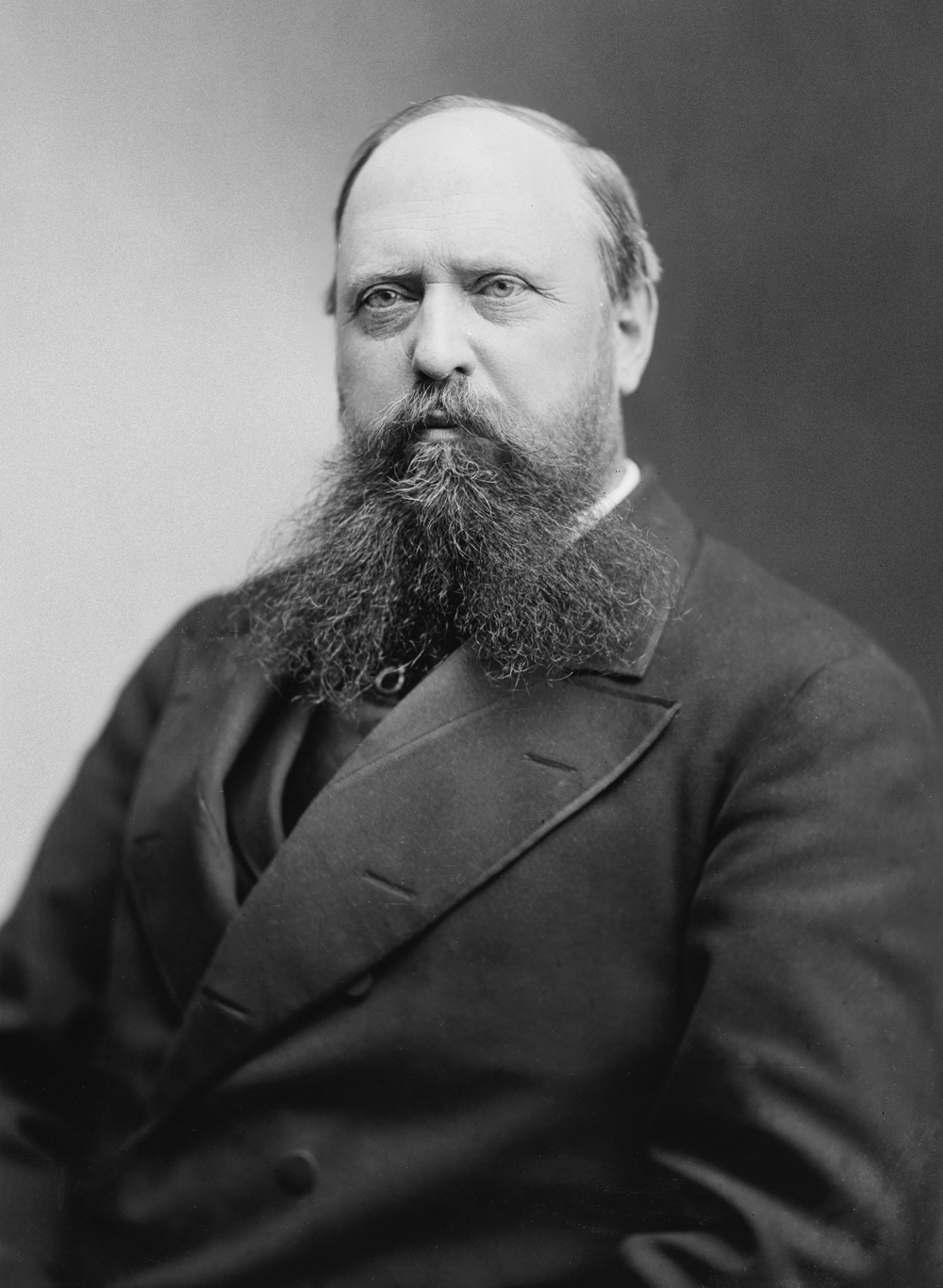
The genus Allosaurus was erected by Othniel C. Marsh in 1877, who gave the Morrison Formation remains the formal name Allosaurus fragilis and established fragilis as the type species. The name itself means "different lizard". The Natural History Museum classifies the animal within Dinosauria, Saurischia, Theropoda and Allosauridae.
Because the holotype of Allosaurus fragilis is not diagnostic, a neotype was proposed through the International Commission on Zoological Nomenclature under Case 3506. The case was opened to conserve usage of the name Allosaurus by designating a neotype for its type species, and the Commission used its plenary power to set specimen USNM 4734 in place of the nondiagnostic holotype YPM 1930 as the single specimen on which the species is based. A supporting comment in the case file specifically backed USNM 4734 as that neotype. The name Allosaurus also covers Antrodemus, which had been named earlier but rested only on an undiagnostic tail vertebra.

Nineteen species of Allosaurus have been erected since 1877, although many were based on holotypes neither fully illustrated nor described, and their validity has not been critically evaluated. A 2020 review recognised only three species in the genus: Allosaurus fragilis and Allosaurus jimmadseni in North America and Allosaurus europaeus in Europe.
2. Description and Anatomy
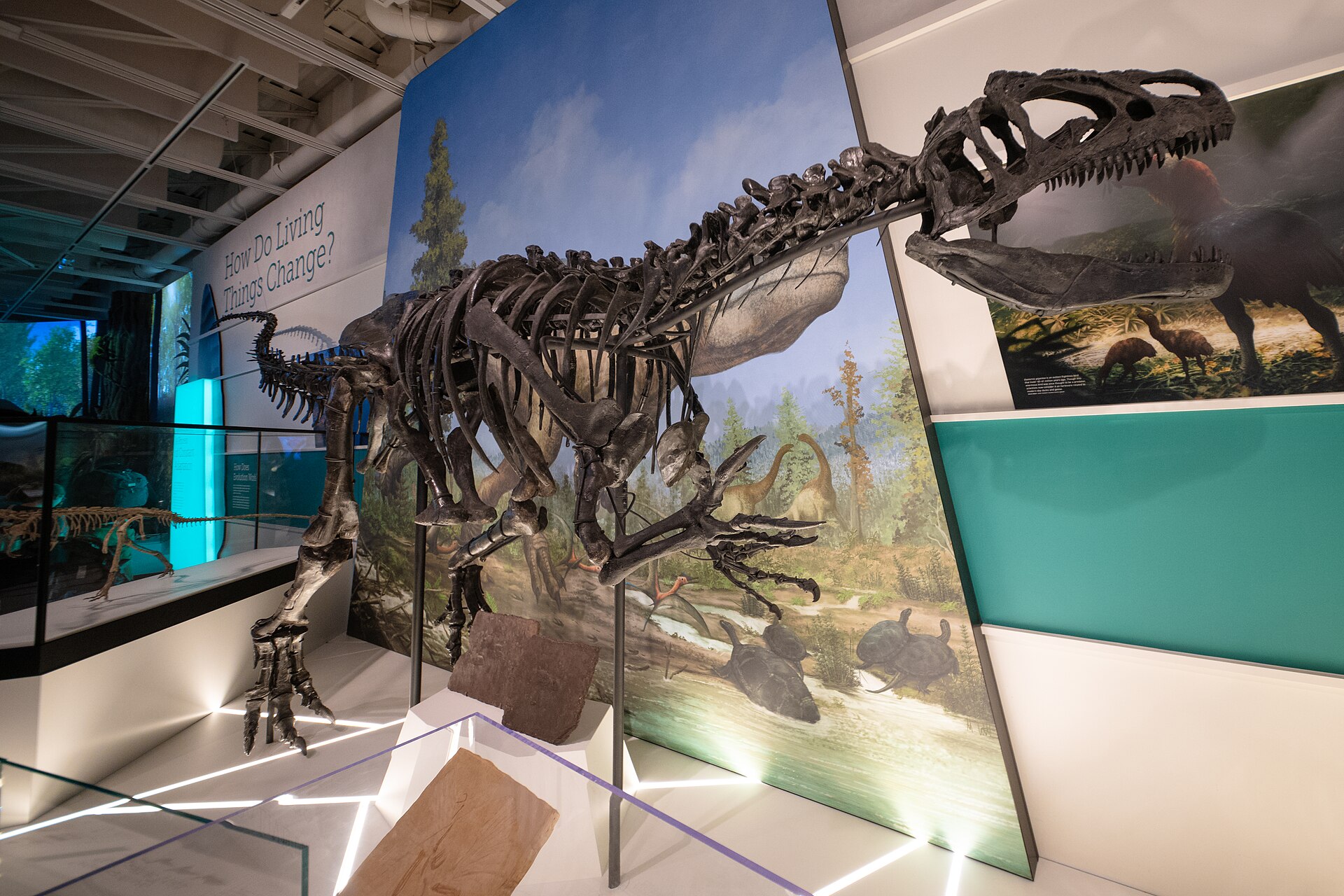
The skull of Allosaurus is distinguished by a large roughened ridge in front of the eye, and it carried sizable laterally compressed, sharp and recurved teeth. A small bony crest sits just above and forward of each massive eye, a feature noted as one of the animal's distinguishing characteristics.
The forelimbs of Allosaurus were considerably smaller than its hind limbs, though not as small as those of tyrannosaurs, and ended in three fingers with sharp claws probably used for grasping. Allosaurus is likewise notable for three-fingered hands and distinctive horns above its eyes.
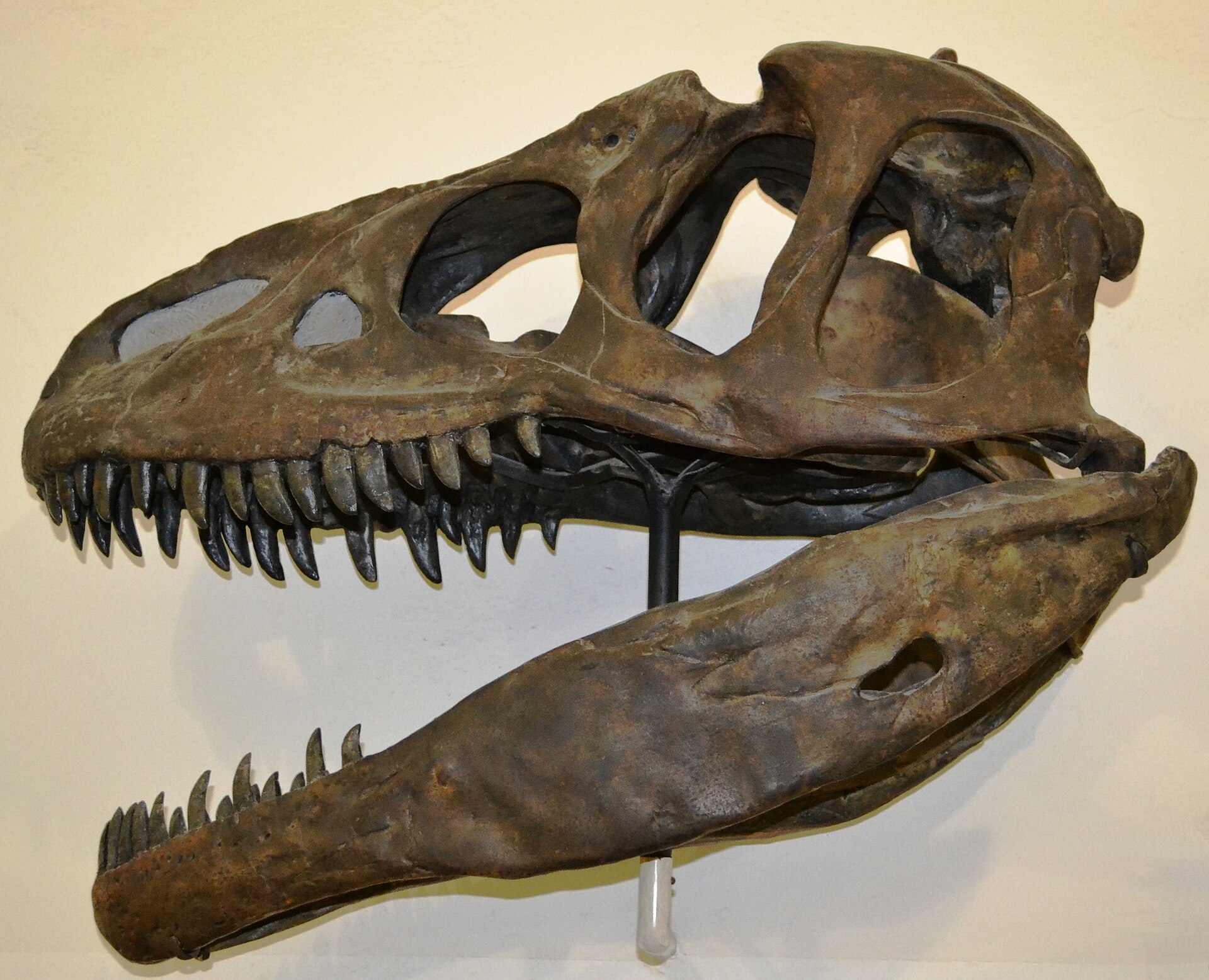
The teeth of Allosaurus were serrated like steak knives for cutting flesh. Half the body length consisted of a well-developed tail; it was a biped with very strong hind limbs and a massive pelvis.
3. Size Estimates
Published figures for the size of Allosaurus vary with the source consulted. The Natural History Museum in London records the animal as 9.7 metres long and weighing 2,700 kilograms 1Allosaurus | Natural History Museum dinosaur directory · Natural History Museum, London ↗. Britannica gives a length of 10.5 metres, or 35 feet, and a weight of about two tons, while noting that some individuals may have reached 12 metres 4Allosaurus | genus of dinosaurs · Encyclopaedia Britannica ↗.
| Source | Length | Weight |
|---|---|---|
| Natural History Museum | 9.7 metres | 2,700 kilograms |
| Britannica | 10.5 metres (35 feet); some individuals possibly 12 metres | About two tons |
4. Distribution and Age
Allosaurus lived during the Late Jurassic, with the Natural History Museum placing it at 152–145 million years ago. Another account extends the genus from about 155 to 145 million years ago, spanning the Kimmeridgian to the late Tithonian. Its remains are known from the USA.
The Portuguese Allosaurus material was collected in Lourinhã Municipality, and the type locality of Allosaurus europaeus is Praia de Vale Frades, five kilometres north of Lourinhã in central west Portugal.
Late Jurassic theropod dinosaurs have been known in Portugal since 1863, and the Lourinhã and Alcobaça formations have yielded genera including Allosaurus, Ceratosaurus, Lourinhanosaurus and Torvosaurus.
5. Diet and Feeding Behaviour
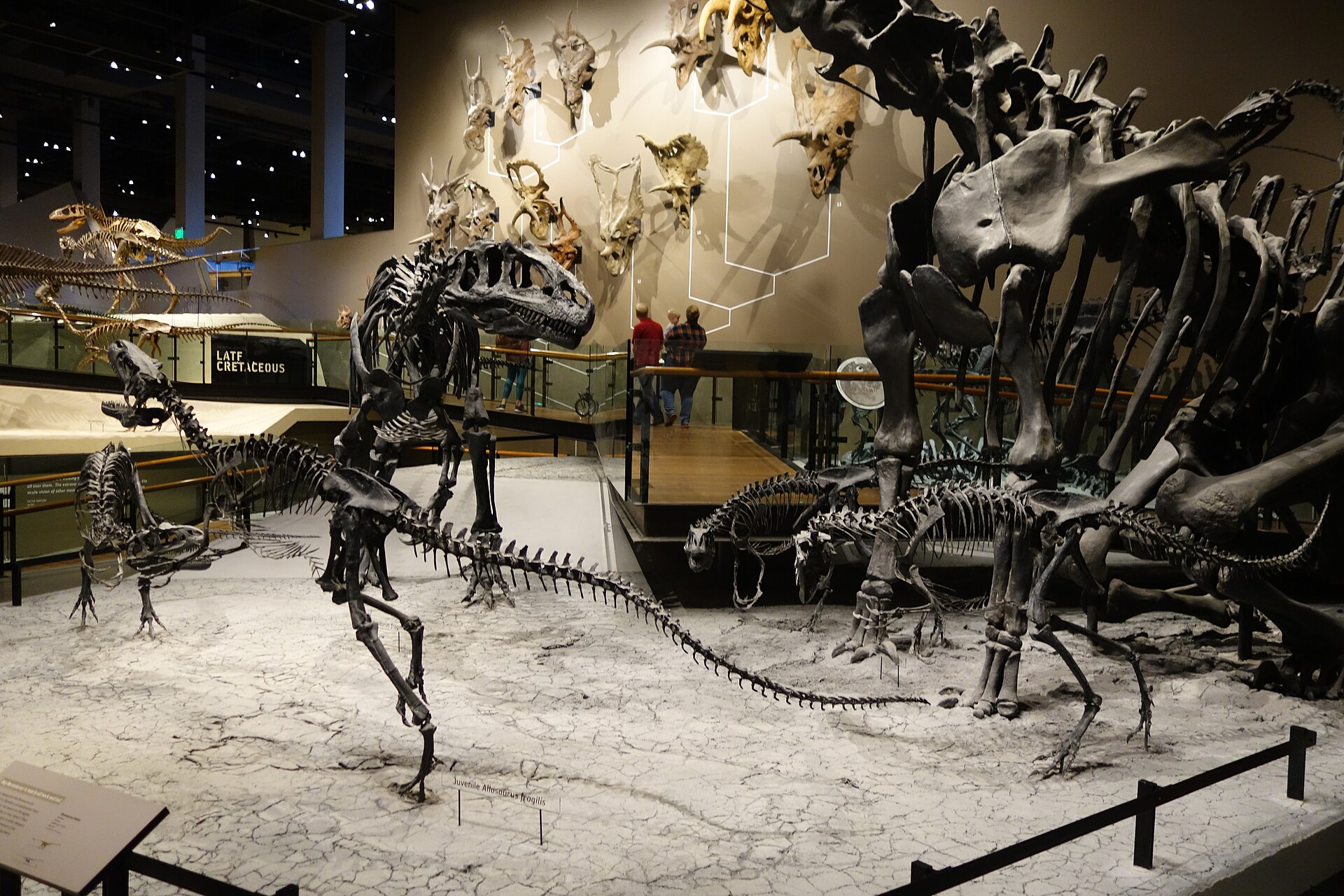
Allosaurus was carnivorous, and the Natural History Museum lists Stegosaurus and Diplodocus among its food sources. Its teeth were dagger-like and serrated, suited to cutting flesh. Researchers have found Stegosaurus fossils bearing Allosaurus bite marks, and there is also evidence that Allosaurus scavenged the remains of large sauropods.
Whether Allosaurus attacked very large herbivorous dinosaurs while they were alive, or mostly fed on them after death, remains unresolved. It may have been a flesh grazer, biting meat from large dinosaurs without killing them. Britannica notes that it likely preyed on ornithischian dinosaurs, small sauropods and anything else it could trap and kill, but may also have been a scavenger feeding on dead or dying animals.
In a 2021 paper, Cameron Pahl and Luis Ruedas of Portland State University proposed that Allosaurus could probably have acquired most of its calories by scavenging the carcasses of the enormous sauropod herbivores that lived alongside it. The relative fragility of its skull and dentition had already cast doubt on the idea that it was a predator. The university argued that the evidence jointly points to an ecological role as a scavenger similar to today's vultures rather than as an active predator, upending years of established thought.
An agent-based model concluded that theropods in sauropod-dominated systems evolved to detect carcasses, consume and store large quantities of fat, and dominate carcass sites. Large theropods such as Allosaurus almost certainly could detect the carcasses of giant sauropods from multiple kilometres away, because although their vision was poor their brains were dedicated largely to olfaction. The authors hypothesised that the existence of very large dinosaurs created an overabundance of meat, relaxing selective pressure on predatory adaptations and resulting in carrion-specialist dinosaurs rather than obligate predators. In the model, selective forces did not favour predatory adaptations because sauropod carrion was too profitable a resource pool for prey-based resources to be significant.
6. Pack Hunting and Social Behaviour
Several Allosaurus specimens have been recovered together from the same bone beds, a pattern that has prompted researchers to ask whether the animal hunted in packs, although other explanations for the grouped fossils may exist. Proposed explanations include a predator trap or a mass die-off event such as a natural disaster.
Allosaurs are thought to have had savvy hunting skills, and it has been suggested that they may have hunted in packs. Adults hunted by overpowering their prey, possibly in small groups. Juvenile Allosaurus relied on longer limb bones that were better adapted for running, which they used to hunt small vertebrates.
7. Cleveland-Lloyd Dinosaur Quarry
The Cleveland-Lloyd Dinosaur Quarry in central Utah holds one of the densest concentrations of Jurassic-aged dinosaur bones ever found. Multiple excavations at the site yielded over 15,000 specimens, a body of material that became a major research focus of Jim Madsen, Jr., Utah's first state paleontologist. The minimum number of dinosaur individuals represented is 73, comprising 53 theropods and 46 Allosaurus fragilis.
Allosaurus fossils account for 67 per cent of all bones found at Cleveland-Lloyd, an overwhelming share compared with herbivores such as Camarasaurus, Stegosaurus and Camptosaurus. The well-preserved bones are disarticulated and extensively intermixed within a relatively thin bed of fine-grained mudstone, and no fully articulated skeletons have been found at the quarry.
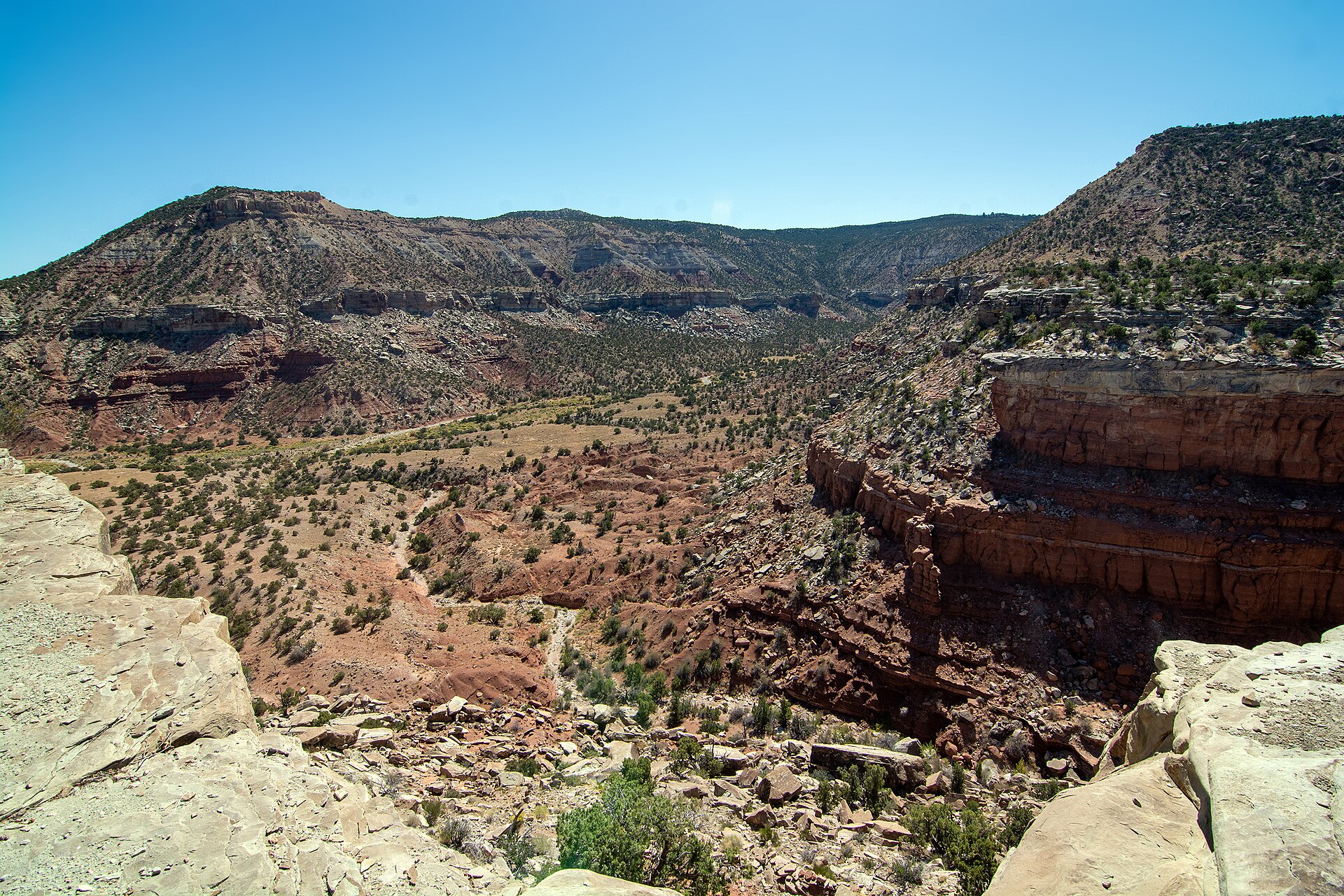
The origin of the accumulation is usually explained as a predator death trap, but there is no consensus about how it formed. The bones were preserved in a low-energy lacustrine environment yet are highly mixed in a thin bed, a pattern requiring several phases of death, exposure, transport and disturbance in standing water. The age distribution of Allosaurus at the site is most parsimoniously interpreted as a catastrophic death of a population of allosaurs rather than an attritional accumulation.
The quarry has yielded numerous juvenile and adolescent specimens, giving researchers a rare opportunity to study Allosaurus development across life stages. Because the assemblage is believed to represent a single population, differences between specimens are attributed to individual variation, sexual dimorphism and allometry.
Over 12,000 bones have been excavated at the quarry, representing at least 74 individual animals, and its fossils are displayed in more than 65 museums worldwide.
More than 75 per cent of the bones come from predators such as Allosaurus fragilis.
8. Cleveland-Lloyd Excavation History
-
1928 and 1929First investigationsUniversity of Utah geologists investigated the Cleveland-Lloyd area and unearthed about 500 bones 8Cleveland-Lloyd Dinosaur Quarry (site brochure) · Bureau of Land Management, U.S. Department of the Interior ↗.
-
1939Princeton excavationPrinceton University paleontologists began a three-year excavation to supply museum exhibits 8.
-
1960University of Utah campaignThe University of Utah excavated the quarry in cooperation with several universities and museums, with much of the work done by paleontologist Jim Madsen under geologist W. Lee Stokes 8.
-
1968Natural Landmark and visitor centreThe Cleveland-Lloyd Quarry was designated a U. S. Natural Landmark 15The Taphonomy of the Cleveland-Lloyd Dinosaur Quarry, Upper Jurassic Morrison Formation, Utah: A Re-Evaluation (NMMNHS Bulletin 36) · New Mexico Museum of Natural History and Science / NPS History eLibrary ↗, and the visitor centre opened as the Bureau of Land Management's first dedicated visitor centre 12Learn and Explore | Jurassic National Monument · Bureau of Land Management, U.S. Department of the Interior ↗.
-
2001Return with a new research focusWhen the University of Utah returned to the deposit, the research focus had shifted: bones alone do not tell the whole story, so geology, bone placement and orientation were all studied 8.
-
2001–2002Re-examinationThe quarry was examined again by a variety of Utah-based institutions 15.
-
2006Visitor centre renovationThe visitor centre was renovated and expanded for research and education 8.
Frank DeCourten and others arranged for the Cleveland-Lloyd fossils to become the backbone of a new paleontology collection at the Natural History Museum of Utah, and moved to the new museum building through the work of staff, volunteers and professional movers, the Cleveland-Lloyd bones still attract researchers from all over the world.
The Cleveland-Lloyd finds have helped paleontologists study how Allosaurus grew and varied, yet why so many meat-eaters accumulated there remains a mystery after decades of research. The Natural History Museum of Geneva houses a composite Allosaurus fragilis skeleton from Cleveland-Lloyd collected during James Madsen's 1962 excavation campaign and offered to the museum by the Women's club of Utah in the 1970s.
9. Key Localities and Specimens
The Cleveland-Lloyd Quarry, in Emery County, Utah, sits in the upper part of the Morrison Formation and ranks among the largest Jurassic dinosaur quarries in the world.
Big Al, catalogued as MOR 693, is a nearly complete Allosaurus from Wyoming discovered in 1991. It has been the subject of extensive research since its discovery and appeared in a 2000 special episode of the BBC's Walking with Dinosaurs. The Museum of the Rockies keeps Big Al's bones and features a retrodeformed 3D print of its skull, described as the most accurate mount of the bones ever produced.
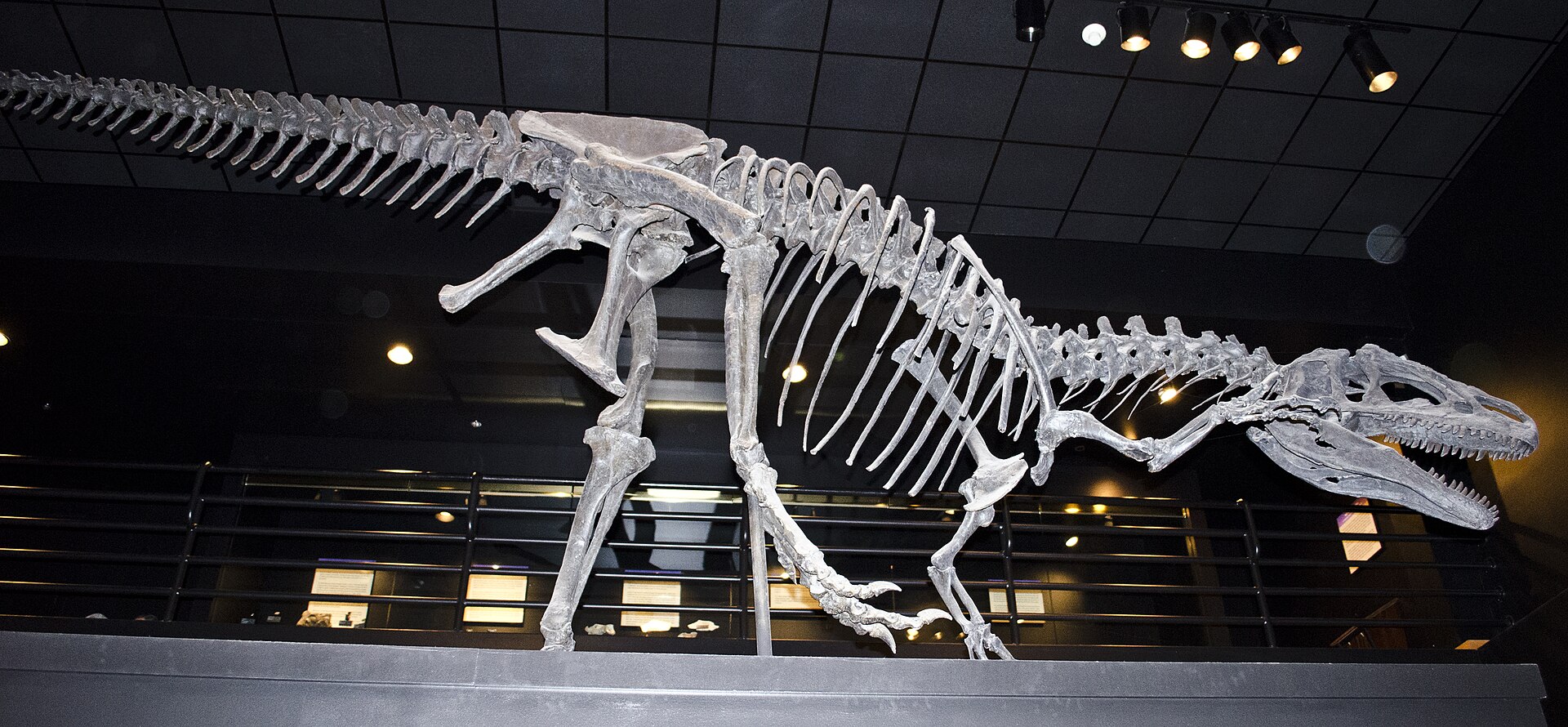
The holotype of Allosaurus jimmadseni, specimen DINO 11541, was found by George Engelmann in July 1990 during a contracted paleontological inventory of the Morrison Formation at Dinosaur National Monument. Only half of its skull has survived, but because it separated along its natural midline it reveals both external shape and rarely seen internal structures. The specimen preserves the wishbone in place for the first time in any Allosaurus, making it the most complete Allosaurus of any species ever found. Allosaurus jimmadseni is the second species of Allosaurus found at Dinosaur National Monument.
10. Species
Allosaurus fragilis is the type species of the genus. A second North American species, Allosaurus jimmadseni, is also found in the Morrison Formation and is named for Utah's first State Paleontologist, Jim Madsen. It is much rarer than Allosaurus fragilis. The species was described from the lower part of the Morrison Formation on the basis of a remarkably complete articulated skeleton.
The two Morrison species differ in the skull. In Allosaurus fragilis the jugal has a pronounced sigmoidal convexity, whereas in Allosaurus jimmadseni it is virtually straight. Allosaurus jimmadseni also bears blade-like crests on the nasals that are absent in Allosaurus fragilis.
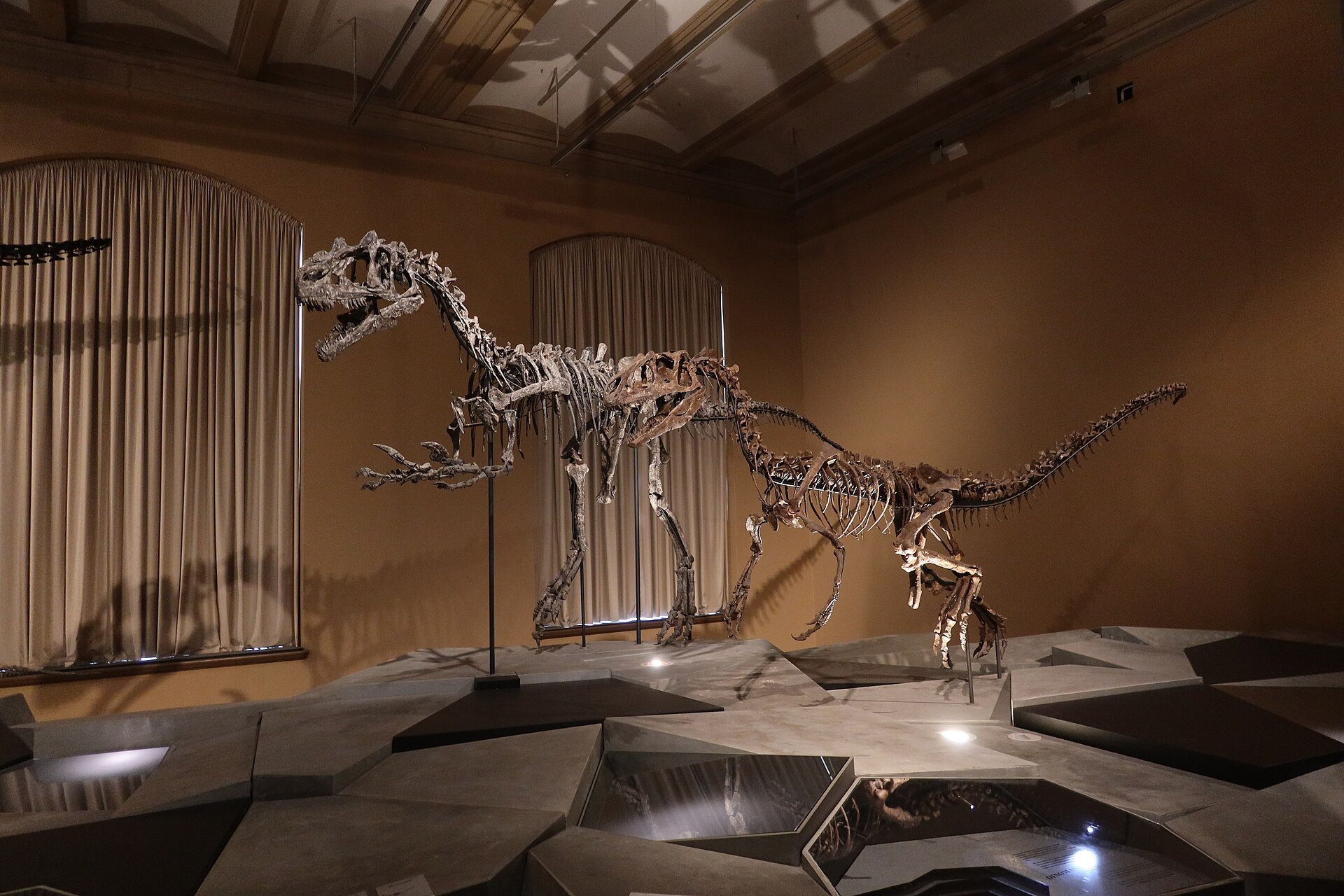
A third species, Allosaurus europaeus, has been identified in the Upper Jurassic Lourinhã Formation on the coast of Portugal. New postcranial and cranial elements from Portugal allowed the erection of this species, and the Portuguese theropod assemblage was found to be similar to that of the Morrison Formation. Bones once referred to Saurophaganax were later renamed as a new species of Allosaurus, Allosaurus anax, while the rest are too fragmentary to assign and might even belong to a plant-eating sauropod.
11. Growth and Histology
Histological work on a large Allosaurus tibia from Cleveland-Lloyd, applying a quantitative method to retrocalculate missing lines of arrested growth, points to an animal that reached skeletal maturity at 22 years and died at approximately 26 years. The same tibia preserves a well-developed external fundamental system, indicating that somatic maturity had been achieved. The presence of that external fundamental system supports the view that Allosaurus followed a determinate growth strategy.
Earlier work on the largest Cleveland-Lloyd individuals estimated skeletal maturity between 13 and 19 years, a maximum growth rate at around 15 years, and an upper age limit of 22 to 28 years. A separate study, counting lines of arrested growth in bone, estimated that Allosaurus was reproductively mature at 10 years of age.
A study of Allosaurus cranial bones from a single population found that ontogenetic changes appeared to be mostly isometric, with only a slight allometric trend in some of the bones.
12. Cultural and Official Recognition
Allosaurus was designated the state fossil of Utah in 1988; the bill, sponsored by Senator Omar Bunnel, passed both houses unanimously and was signed into law by Governor Norman Bangerter.
Utah later gave its dinosaurs a second honour when the Utahraptor was designated in 2018 as the Utah State Dinosaur.
13. Timeline: from the 1877 naming to the 2023 neotype
- 1877Marsh names AllosaurusThe genus and its type species, Allosaurus fragilis, are attributed to Marsh (1877); the ICZN later confirms conservation of the name's usage.
- 1928-1929First University of Utah excavationsUniversity of Utah geologists investigate the Cleveland-Lloyd area and unearth about 500 bones.
- 1939-1941Princeton digs at the quarryPrinceton University paleontologists begin a three-year excavation of the quarry to supply museum exhibits.
- 1960University of Utah excavation campaignThe University of Utah begins an excavation in cooperation with several universities and museums; much of the work is done by paleontologist Jim Madsen.
- 1968First BLM visitor centreA visitor centre is dedicated at the quarry, the first ever opened by the Bureau of Land Management.
- 15 July 1990DINO 11541 discoveredGeorge Engelmann finds the specimen that becomes the holotype of Allosaurus jimmadseni at Dinosaur National Monument during a paleontological inventory.
- 1991Big Al is discoveredA nearly complete Allosaurus, later nicknamed Big Al, is found in Wyoming; it becomes one of the most complete Allosaurus specimens known.
- 2000Big Al on televisionBig Al features in a special episode of the BBC's Walking with Dinosaurs.
- 2006Allosaurus europaeus namedResearchers erect a new species, Allosaurus europaeus, from Portugal's Lourinhã Formation.
- October 2014Stegosaur 'martial arts' reportAt the Geological Society of America meeting, researchers describe an adult allosaur killed by a stab wound matching a stegosaur tail spike.
- January 2020A second Morrison species describedAllosaurus jimmadseni is described from Dinosaur National Monument and other specimens; the Park Service calls it the second Allosaurus species found in the monument.
- August 2021Scavenger hypothesis publishedPortland State University researchers publish an agent-based model proposing that Allosaurus acquired most of its calories by scavenging sauropod carcasses.
- 29 December 2023Neotype conservedThe International Commission on Zoological Nomenclature issues Opinion 2486, designating specimen USNM 4734 as the neotype of Allosaurus fragilis.
References (19)
- 1Allosaurus | Natural History Museum dinosaur directory — Natural History Museum, London Web↩View source
- 2The large theropod fauna of the Lourinha Formation (Portugal) and its similarity to the Morrison Formation, with a description of a new species of Allosaurus (NMMNHS Bulletin 36) — New Mexico Museum of Natural History and Science / Universidade Nova de Lisboa (author copy) WebView source
- 3Fossil | Utah's Online Public Library state symbols — Utah State Library Division WebView source
- 4Allosaurus | genus of dinosaurs — Encyclopaedia Britannica Web↩View source
- 5Cranial anatomy of Allosaurus jimmadseni, a new species from the lower part of the Morrison Formation (Upper Jurassic) of Western North America — PeerJ WebView source
- 6Case 3506: Allosaurus Marsh, 1877 (Dinosauria, Theropoda) - proposed conservation of usage — International Commission on Zoological Nomenclature 1877 WebView source
- 7Opinion 2486 (Case 3506) - Allosaurus Marsh, 1877: usage conserved by designation of a neotype for its type species Allosaurus fragilis — Bulletin of Zoological Nomenclature 1877 WebView source
- 8Cleveland-Lloyd Dinosaur Quarry (site brochure) — Bureau of Land Management, U.S. Department of the Interior Web↩View source
- 9Allosaurus jimmadseni - Dinosaur National Monument — National Park Service, U.S. Department of the Interior WebView source
- 10The giant Jurassic dinosaur Allosaurus was a scavenger, not a predator — Portland State University WebView source
- 11Big boned: How fat storage and other adaptations influenced large theropod foraging ecology — PLOS ONE JournalView source
- 12Learn and Explore | Jurassic National Monument — Bureau of Land Management, U.S. Department of the Interior Web↩View source
- 13Jurassic National Monument and Cleveland-Lloyd Dinosaur Quarry — Bureau of Land Management, U.S. Department of the Interior WebView source
- 14NHMU50: Saving an Allosaurus Graveyard — Natural History Museum of Utah WebView source
- 15The Taphonomy of the Cleveland-Lloyd Dinosaur Quarry, Upper Jurassic Morrison Formation, Utah: A Re-Evaluation (NMMNHS Bulletin 36) — New Mexico Museum of Natural History and Science / NPS History eLibrary 2006 Web↩View source
- 16Variation in a Population of Theropoda (Dinosauria): Allosaurus from the Cleveland-Lloyd Quarry (Paleontological Research 14(4)) — Paleontological Research / NPS History eLibrary 2010 WebView source
- 17Histology and Geochemistry of Allosaurus (Dinosauria, Theropoda) from the Cleveland-Lloyd Dinosaur Quarry, Upper Jurassic, Utah — Frontiers in Earth Science 2021 JournalView source
- 18Siebel Dinosaur Complex | Museum of the Rockies — Museum of the Rockies, Montana State University WebView source
- 19Stegosaurian Martial Arts: A Jurassic Carnivore Stabbed by a Tail Spike (GSA 2014 abstract 221-6) — Geological Society of America 2014 WebView source