Egyptian Hieroglyphs
The sacred picture script of ancient Egypt, from its first signs at Abydos to the cursive scripts it fathered and the decipherment of the Rosetta Stone in 1822.
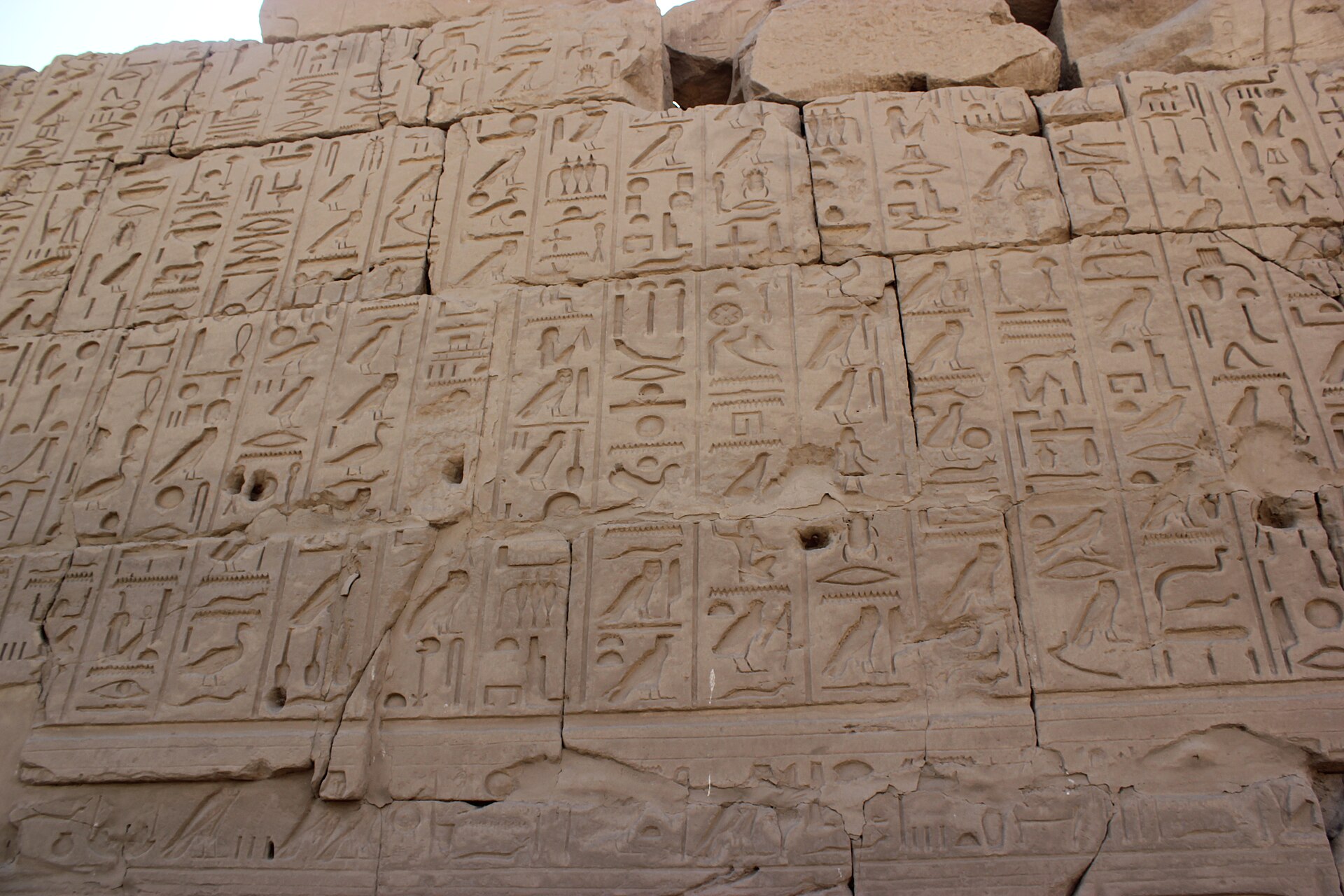
Egyptian hieroglyphs were the formal writing system of ancient Egypt, combining logograms, phonograms and determinatives and attested from around 3200 BCE until the last temple inscription at Philae in 394 CE. Cursive forms, hieratic and later Demotic, carried the same language on papyrus and ostraca for everyday documents, while temple walls and coffins kept the monumental script. After the script fell silent, the trilingual Rosetta Stone and his knowledge of Coptic allowed Jean-Francois Champollion to announce its decipherment in 1822.
In this article
- 1Overview
- 2Nature of the Script
- 3Origins and Earliest Evidence
- 4Cursive Derivatives: Hieratic, Demotic and Coptic
- 5Writing Surfaces and Scribal Practice
- 6Literary and Religious Texts
- 7Decline and Last Inscriptions
- 8The Rosetta Stone
- 9Decipherment
- 10Modern Legacy and Bicentenary
- 11Timeline: from the first signs to the 2022 bicentenary
- 12Knowledge graph
Overview
Egyptian hieroglyphs were one of the writing systems used to represent the Egyptian language, and Greek observers, who thought them sacred, called them 'holy writing'; the modern word hieroglyph derives from the Greek hiero ('holy') and glypho ('writing'). In the ancient Egyptian language the script was called medu netjer, meaning 'the gods' words', because writing was believed to be an invention of the gods. It was a logo-phonetic script combining logograms, phonograms and determinatives.
1. Nature of the Script
Hieroglyphic writing employs characters in the form of pictures, and the individual signs may be read as pictures, as symbols for objects, or as symbols for sounds. Champollion was the first to recognize that some signs were alphabetic, some syllabic and some determinative, a division he set out in papers on the hieroglyphic and hieratic elements of the Rosetta Stone that he began publishing in 1821 and 1822.
The script was never purely pictorial. The most ancient hieroglyphs date from the end of the 4th millennium bce and comprise annotations incised onto pottery jars and ivory plaques deposited in tombs, presumably to identify the dead. From the outset the signs carried sound as well as image, so no development from pictures to letters took place.
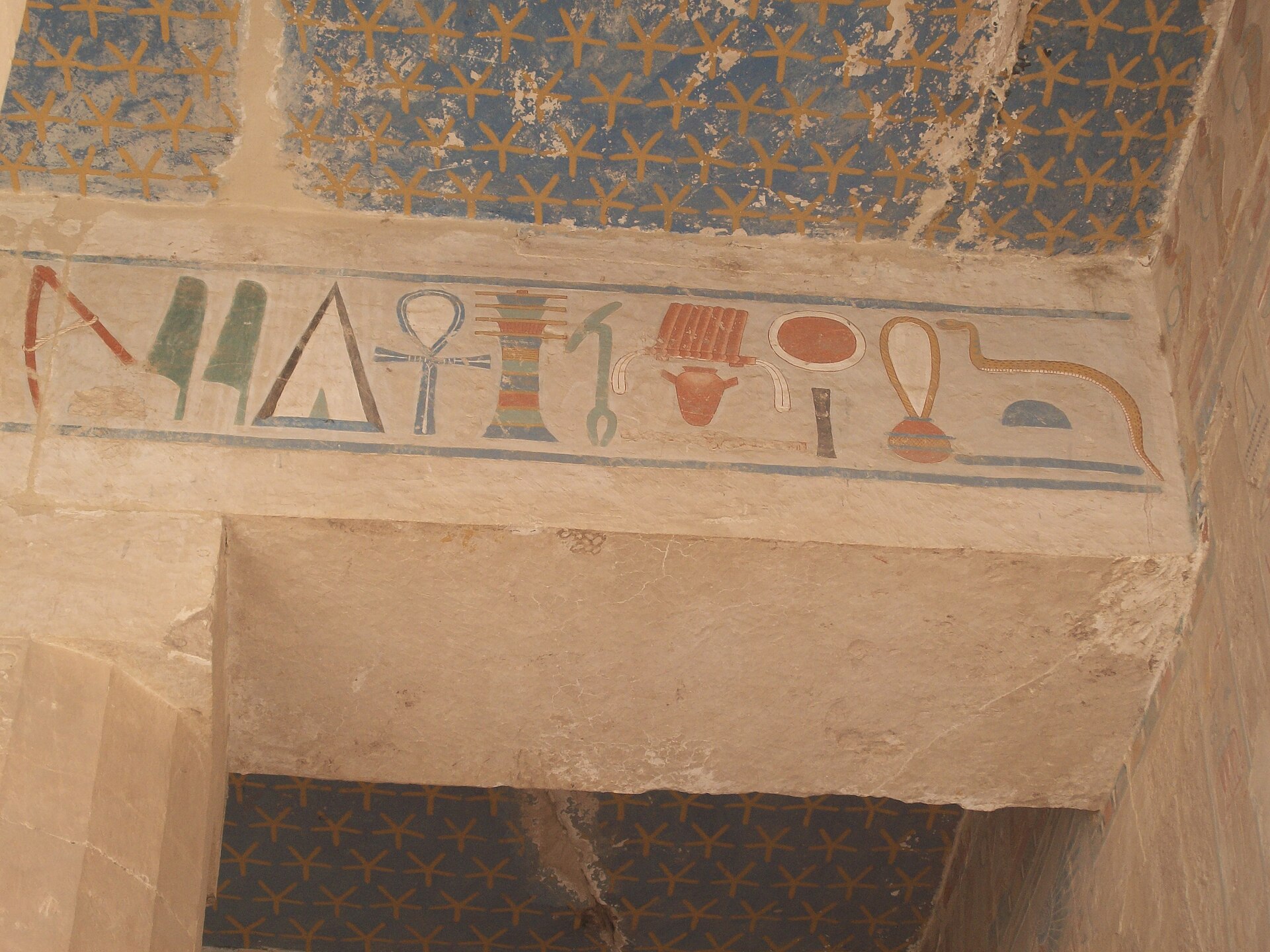
Hieroglyphs could be arranged in rows running right-to-left or left-to-right, or in columns running top-to-bottom.
This mixture of functions produced a large sign inventory: over 1,000 signs were in early use, and about 750 remained in the Middle Kingdom.
2. Origins and Earliest Evidence
One hypothesis holds that hieroglyphs derive from rock pictures made by prehistoric hunting communities of the desert west of the Nile. Motifs shared with that rock art appear on Naqada II pottery around 3500–3200 BCE.
The earliest securely dated hieroglyphs come from Naqada III and Dynasty 0 tombs, roughly 3200–3000 BCE. Among the most important is the cemetery U-tomb j burial at Abydos of a local elite member around 3100 BCE, which preserved about 150 labels carrying the earliest known writing in Egypt.
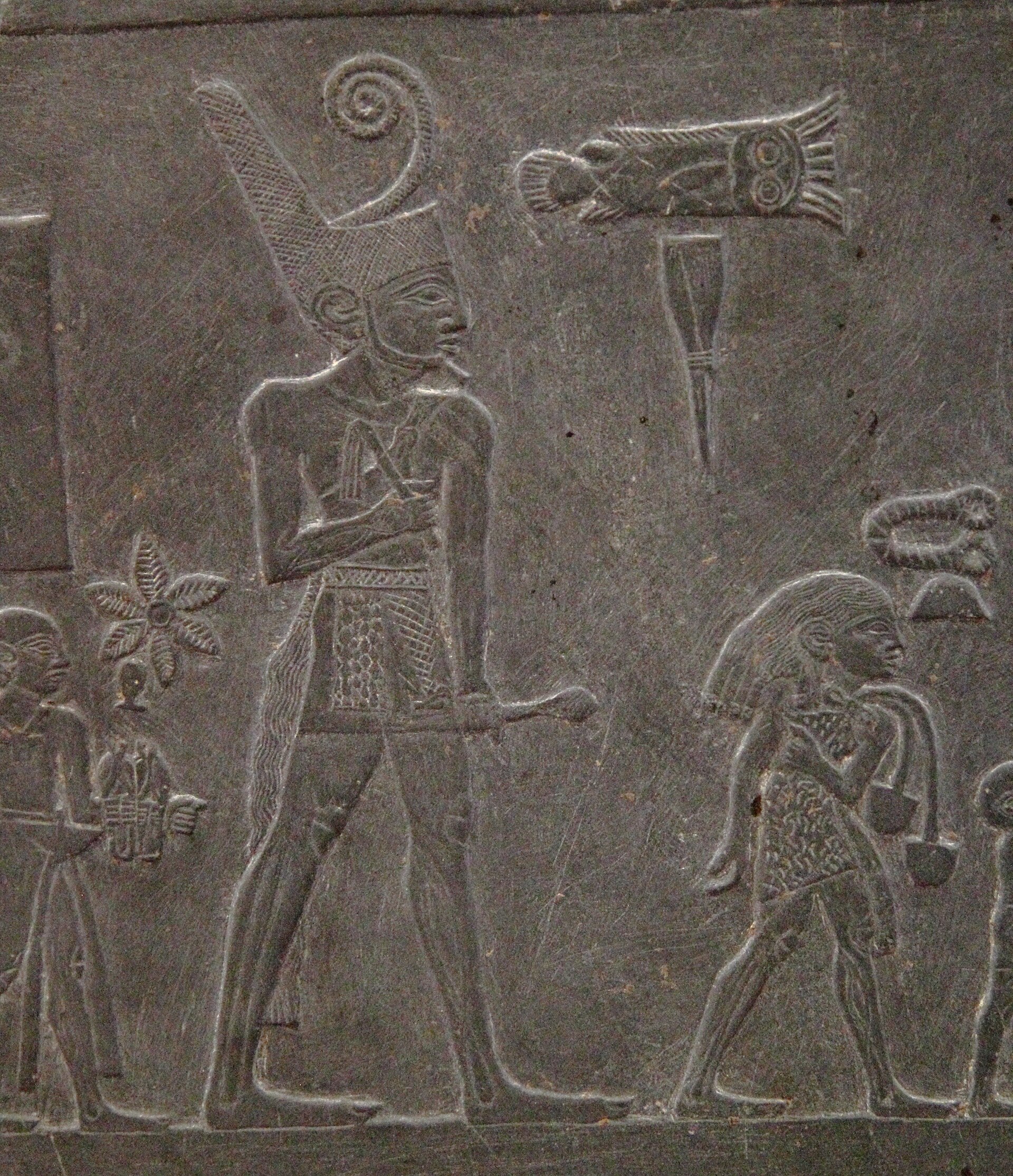
Most ancient hieroglyphs survive as annotations incised on pottery jars and ivory plaques deposited in tombs, presumably to identify the dead. From the 1st dynasty, about 2925–2775 BCE, nonroyal persons were annotated with names or titles, and annalistic ivory tablets recorded yearly events.
The script was standardised in the Early Dynastic Period, 3100–2686 BC, and came into wide use by the 3rd Dynasty. Cylinder seals were rolled over jar stoppers, and in the 2nd dynasty titles and offering names were added, with sentences first occurring at the end of that dynasty.
3. Cursive Derivatives: Hieratic, Demotic and Coptic
Hieratic is Egypt's oldest cursive system, invented more or less simultaneously with hieroglyphs, with the earliest clear evidence from at least the 2nd Dynasty, around 2800 BCE. It served as handwriting for more than three millennia, remaining in use until the third century CE.
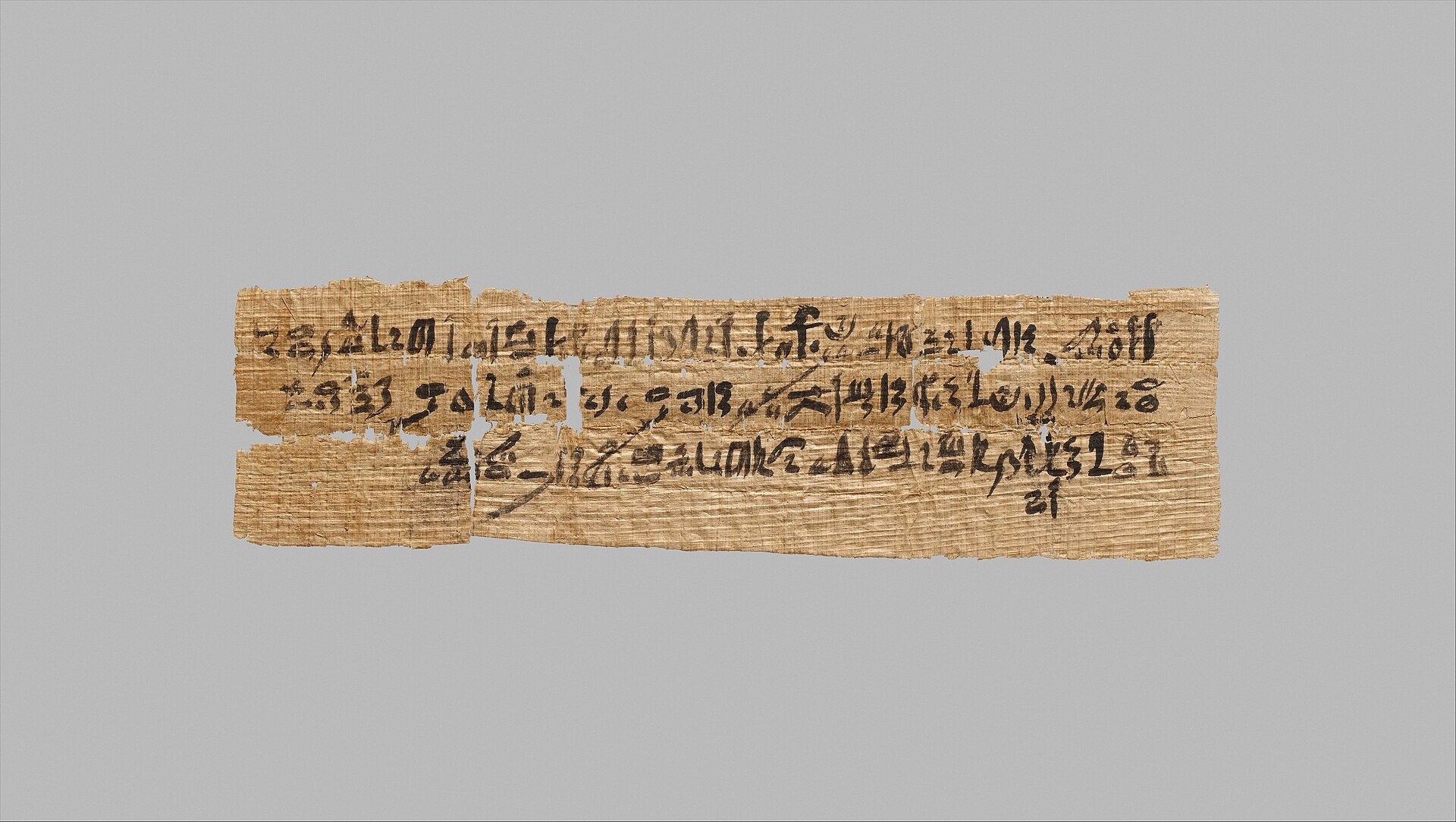
Hieratic was written in ink on papyrus and ostraca, and also on wooden tablets, linen and stone, and it was carved into clay, wood, rock or stone. It was always written right-to-left, evolving from single columns to horizontal lines with ligatures and abbreviations.
Demotic developed in the north of Egypt and gained widespread use after Psamtek I's conquest of Upper Egypt in the 7th century BC. Derived from hieratic and more cursive, it was used administratively first and later for personal and funerary items.
From 750 BCE hieratic was partially replaced by abnormal hieratic and later by Demotic, though it remained in use until Roman times for ritual, funerary and scientific texts.
As Christianity spread, the Egyptian language evolved into Coptic, which used the Greek script with a few additions taken from Demotic to represent sounds the Greek language does not have.
Linear hieroglyphs are signs that retain their iconic power but are more schematic, attested from the Old Kingdom and visually distinct from the Middle Kingdom. They were restricted mainly to ritual and funerary domains, painted with rushes and black and red inks, and were often columnar with signs facing rightward.
4. Writing Surfaces and Scribal Practice
Papyrus served as the chief portable writing medium in Egypt, appearing during the First Dynasty around 3000 to 2890 BCE.
The first examples preserving text are administrative documents from the Red Sea port of Wadi el-Jarf dating to Dynasty 4 around 2500 B.C.
5. Literary and Religious Texts
The oldest known examples of Egyptian literature, the Pyramid Texts, were engraved on pyramid walls around 2500 BCE. Around 2000 BCE, the Coffin Texts, a set of magical and liturgical spells, were inscribed on coffins.
The Egyptian Book of the Dead is a collection of spells that enable the soul of the deceased to navigate the afterlife.
Egyptologist Geraldine Pinch notes that the title Book of the Dead was coined in the nineteenth century CE for a body of texts the ancient Egyptians knew as the Spells for Going Forth by Day. Pinch observes that the work was one of a series of manuals composed to assist the spirits of the elite dead to achieve and maintain a full afterlife.
6. Decline and Last Inscriptions
By the 2nd century A.D., hieroglyphic and demotic writing survived only in connection with the temples and the priesthoods that served them, while Greek had become the language of administration. The two scripts were thus no longer instruments of everyday or official record-keeping, but a restricted, sacred competence tied to religious institutions.
Egyptian temples were closed in 392 A.D. by order of the Byzantine emperor, removing the institutional setting on which the scripts depended. The last known hieroglyphic inscription, from Philae, dates to 394 A.D.
7. The Rosetta Stone
The Rosetta Stone is a fragment of a granodiorite stela weighing 762 kg, recycled from elsewhere into use as a building block, and it carries a decree issued in 196 BCE on behalf of King Ptolemy V, written three times in hieroglyphs, Demotic and ancient Greek. Budge's translation presents the decree of the priests of Memphis as found on the Rosetta Stone and on the stele of Damanhur, promulgated in the 9th year of the reign of Ptolemy V Epiphanes.
The stone was unearthed in Egypt in July 1799 and was dubbed the Rosetta Stone after the town where it was found.
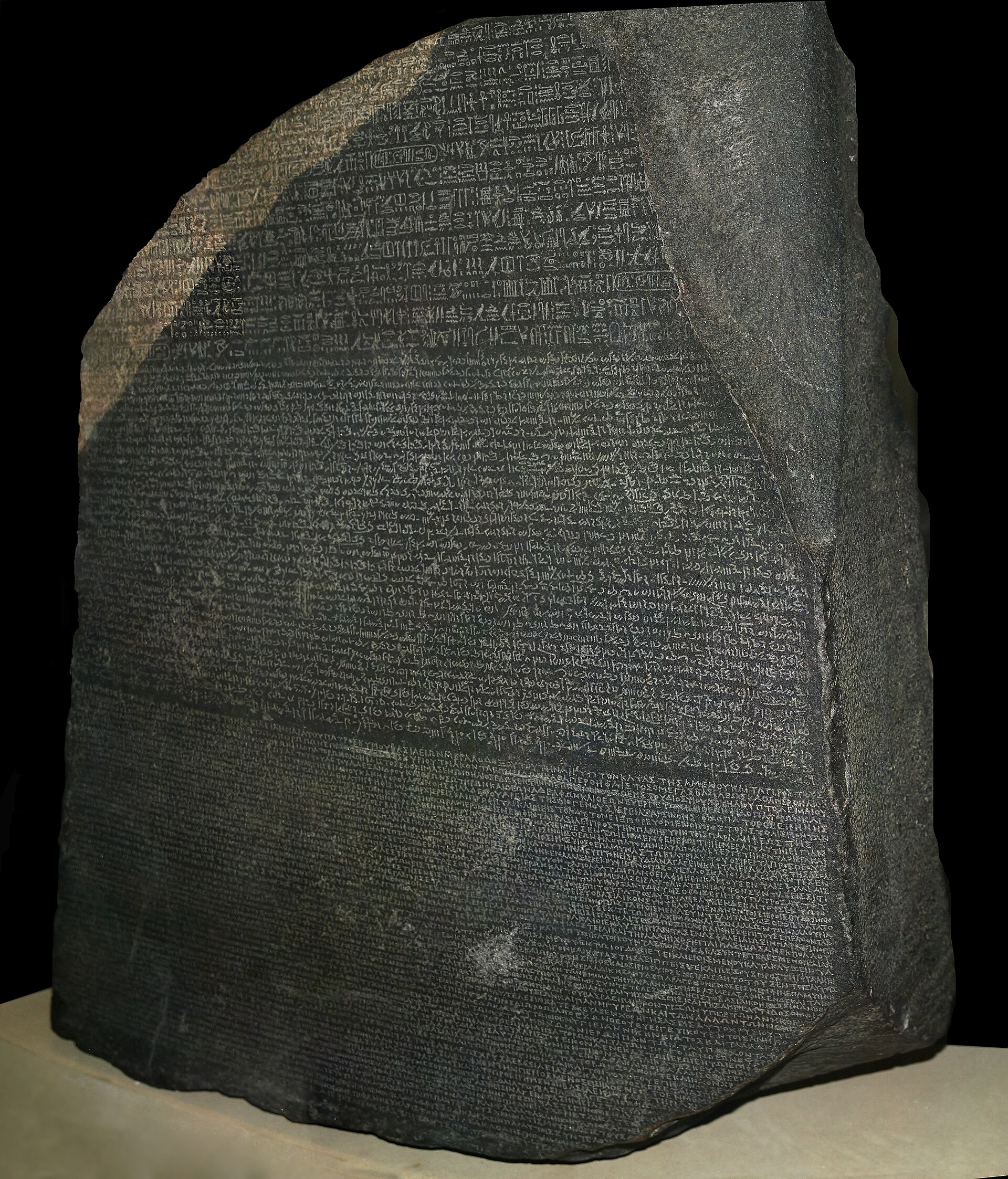
Edward Dolnick notes that the first people to look at the Rosetta Stone thought it would take two weeks to decipher, but it ended up taking 20 years.
8. Decipherment
Jean-Francois Champollion, born on 23 December 1790 at Figeac and died on 4 March 1832 in Paris, was a French historian and linguist who founded scientific Egyptology and played a major role in the decipherment of Egyptian hieroglyphs.
His presentation on 27 September 1822 to the Academie des Inscriptions et Belles-Lettres in Paris, attended by his rival Thomas Young, radically changed the study of ancient Egypt and made hieroglyphs understandable for the first time in centuries.
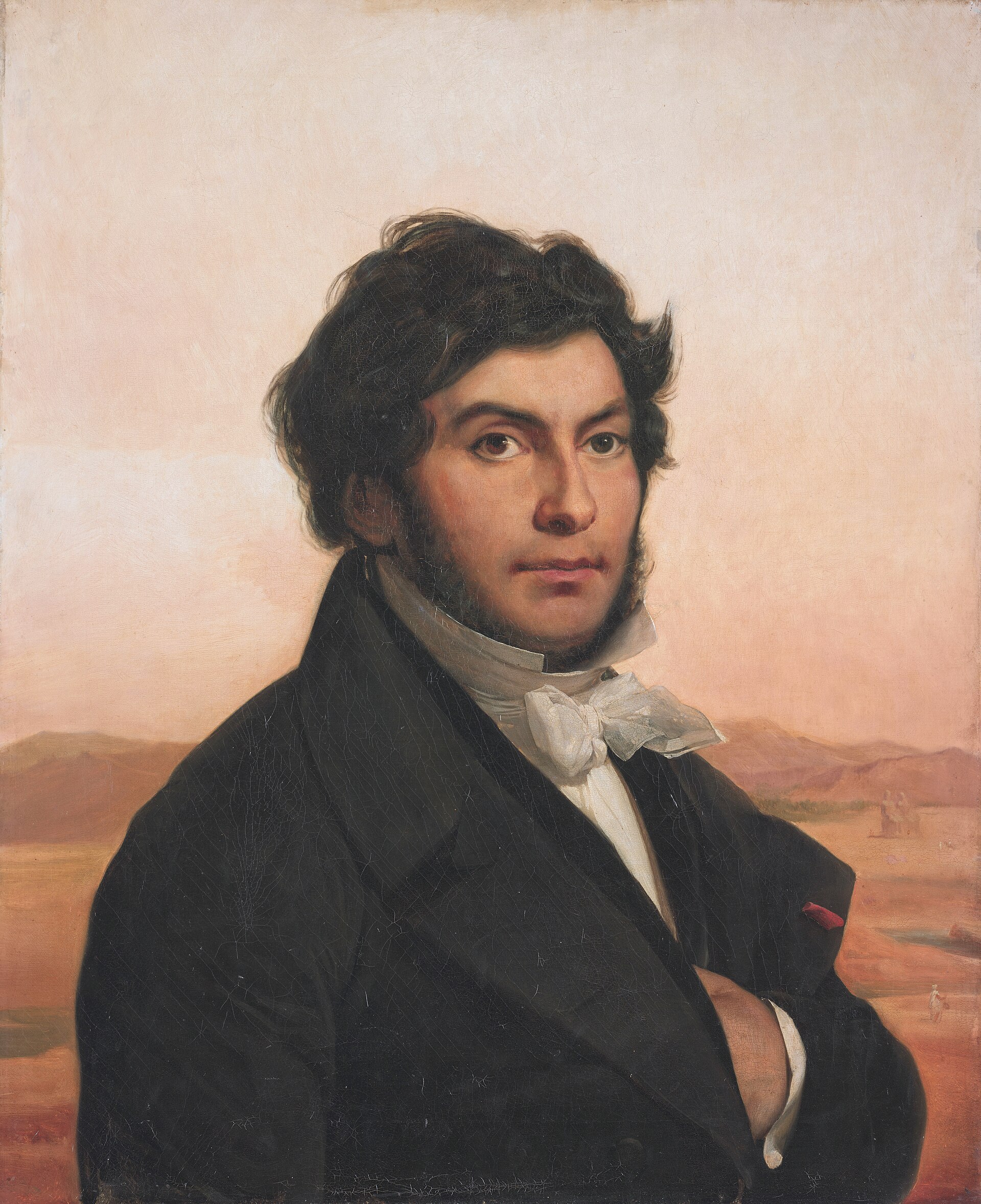
Among his published works are the Precis du systeme hieroglyphique des anciens Egyptiens, issued in 1824 as a primer of the ancient Egyptian system, an Egyptian grammar written between 1836 and 1841, and a dictionary completed in the 1840s.
As Champollion revealed his solution to a room of his peers nearly two weeks later, he had solved how to read Egyptian hieroglyphs and thereby unlocked the secrets of the ancient civilization.
9. Modern Legacy and Bicentenary
The Rosetta Stone holds the distinction of being the British Museum's most visited object.
In 2022, the museum's bicentenary exhibition paired the Rosetta Stone with 240 exhibits, including the Enchanted Basin.
10. Timeline: from the first signs to the 2022 bicentenary
- c. 3200-3000 BCEEarliest securely dated hieroglyphsSigns incised on pottery and on labels from elite tombs at Abydos mark the earliest securely dated examples of Egyptian hieroglyphic writing.
- c. 2900 BCEEarliest known papyrus rollA blank roll of papyrus from the Dynasty 1 tomb of the official Hemaka is the earliest known example of the writing material.
- c. 2500 BCEThe Pyramid TextsThe oldest known examples of Egyptian literature are engraved on the walls of pyramids.
- c. 2000 BCEThe Coffin TextsA new corpus of magical and liturgical spells is inscribed on coffins.
- from 750 BCEDemotic displaces hieraticHieratic begins to be partially replaced by abnormal hieratic and later by Demotic, surviving mainly for ritual, funerary and scientific texts.
- 196 BCEDecree of Memphis inscribedA priestly council at Memphis issues a decree for Ptolemy V Epiphanes; copies are carved in hieroglyphs, Demotic and Greek, including the one later known as the Rosetta Stone.
- 392 CEEgyptian temples closedEgyptian temples are closed by order of the Byzantine emperor, ending the institutional setting of hieroglyphic writing.
- 394 CELast hieroglyphic inscriptionThe last known hieroglyphic inscription, from Philae, dates to this year; no one could then read the script.
- 15 July 1799Discovery of the Rosetta StoneSoldiers in Napoleon's army find the stela by accident while digging the foundations of an addition to a fort near Rashid, the port city the French knew as Rosetta.
- 1801The stone passes to BritainAfter the French surrender of Egypt the Rosetta Stone passes into British hands and is now in the British Museum in London.
- 1820Hieratic connected to hieroglyphsChampollion recognises the connection between the hieroglyphic and hieratic scripts.
- 27 September 1822Champollion announces the deciphermentChampollion presents his decipherment to the Academie des Inscriptions et Belles-Lettres in Paris, opening the written culture of ancient Egypt to the modern world.
- 1824Precis du systeme hieroglyphiqueChampollion publishes his Precis du systeme hieroglyphique des anciens Egyptiens.
- 4 March 1832Death of ChampollionChampollion dies in Paris, having founded scientific Egyptology.
- October 2022Bicentenary of the deciphermentTo mark 200 years since the unravelling of the script, the British Museum opens a major exhibition on hieroglyphs curated by Ilona Regulski.
References (16)
- 1Egyptian Hieroglyphs — World History Encyclopedia WebView source
- 2Hieroglyphic writing — Encyclopaedia Britannica WebView source
- 3Jean-Francois Champollion — Encyclopaedia Britannica WebView source
- 4Egyptian Languages: Explained — UCL Culture Blog, University College London 2018 WebView source
- 5Hieratic (UCLA Encyclopedia of Egyptology) — UCLA Encyclopedia of Egyptology, eScholarship WebView source
- 6Linear Hieroglyphs (UCLA Encyclopedia of Egyptology) — UCLA Encyclopedia of Egyptology, eScholarship WebView source
- 7Papyrus in Ancient Egypt — The Metropolitan Museum of Art, Heilbrunn Timeline of Art History WebView source
- 8Egyptian Book of the Dead — World History Encyclopedia WebView source
- 9Egypt, 1-500 A.D. — The Metropolitan Museum of Art, Heilbrunn Timeline of Art History WebView source
- 10Ancient Egypt unleashed: how the gods, pharaohs, monsters and murderers shattered their silence — The Guardian 2022 WebView source
- 11Translation of the Rosetta Stone (E. A. Wallis Budge, 1905) — Internet Sacred Text Archive 1905 WebView source
- 12Two Hundred Years Ago, the Rosetta Stone Unlocked the Secrets of Ancient Egypt — Smithsonian Magazine WebView source
- 13Jean-Francois Champollion Deciphers the Rosetta Stone — JSTOR Daily JournalView source
- 14Rosetta Stone — World History Encyclopedia WebView source
- 15Everything you ever wanted to know about the Rosetta Stone — The British Museum WebView source
- 16Rosetta Stone — Encyclopaedia Britannica WebView source