Mali Empire
The West African empire of Sundiata Keita and Mansa Musa, whose gold, salt trade and scholarship at Timbuktu made it one of the richest realms of the medieval world.
The Mali Empire grew out of the Malinke kingdom of Kangaba on the upper Niger River and was founded by Sundiata Keita after his victory over the Sosso at Kirina in about 1235. At its height under Mansa Musa I it controlled the trans-Saharan trade in gold and salt, absorbed the trading cities of Timbuktu, Gao and Djenné, and became a centre of Islamic learning whose scholars and manuscripts are remembered to this day. Decline set in from the 15th century as succession disputes, Tuareg and Mossi attacks and the rise of Songhai stripped away its provinces, until a rump of the empire was absorbed into the Moroccan sphere in the mid-17th century.
In this article
- 1Overview
- 2Foundation and Sundiata Keita
- 3Territorial Expansion and Administration
- 4Mansa Musa I and the Peak of the Empire
- 5Trade and Economy
- 6Timbuktu and Djenné: Centres of Learning and Trade
- 7Written Sources and Historical Record
- 8Decline and Fall
- 9Legacy and Cultural Heritage
- 10Timeline: from the founding of Mali to the Moroccan conquest
- 11Knowledge graph
Overview
The Mali Empire was a trading empire that flourished in western Africa from the 13th to the 16th century CE. The empire is said to have been founded before 1000 CE.
Niani, on the upper Niger, served as the capital.
1. Foundation and Sundiata Keita
The Mali Empire was founded by Sundiata Keita, a monarch of the Keita clan who reigned from about 1230 to 1255 CE. Sundiata rose to power by defeating the Sosso king Soumaoro, known as the Sorcerer King, in the decisive battle at Krina, also called Kirina, that followed an alliance of chiefs weary of Sumanguru's harsh rule; he then brought all the Mandinke clan rulers under his leadership as overall Mansa.
Sundiata was born into a royal family in 1210 CE and could not walk, a disadvantage that moved an enemy of his father to spare his life after killing many other male offspring. His sister Nana Triban, forced to marry Sumanguru, discovered that his source of strength was a white cockspur and stole it, leaving him at a disadvantage at Kirina in 1235 CE. After the victory an assembly proclaimed Sundiata supreme monarch, and he acquired titles including Maghan or Mansa, Nfa Mansa and Mari Diata, Lord Lion. Oral tradition credits him with establishing a code of government covering rules for both political and social behaviour, and the assembly also decreed that trades such as blacksmiths, weavers and shoemakers were to be made hereditary.
By 1240 Sundiata had seized Kumbi, the former capital of Ghana, erasing the last symbol of Ghana's imperial past. He moved the empire's seat to Niani, which became a key commercial center due to the gold trade and the peace under his rule. Although nominally Muslim, he maintained support among the non-Muslim population by fulfilling traditional religious functions. Sundiata Keita died in 1255 CE.
2. Territorial Expansion and Administration
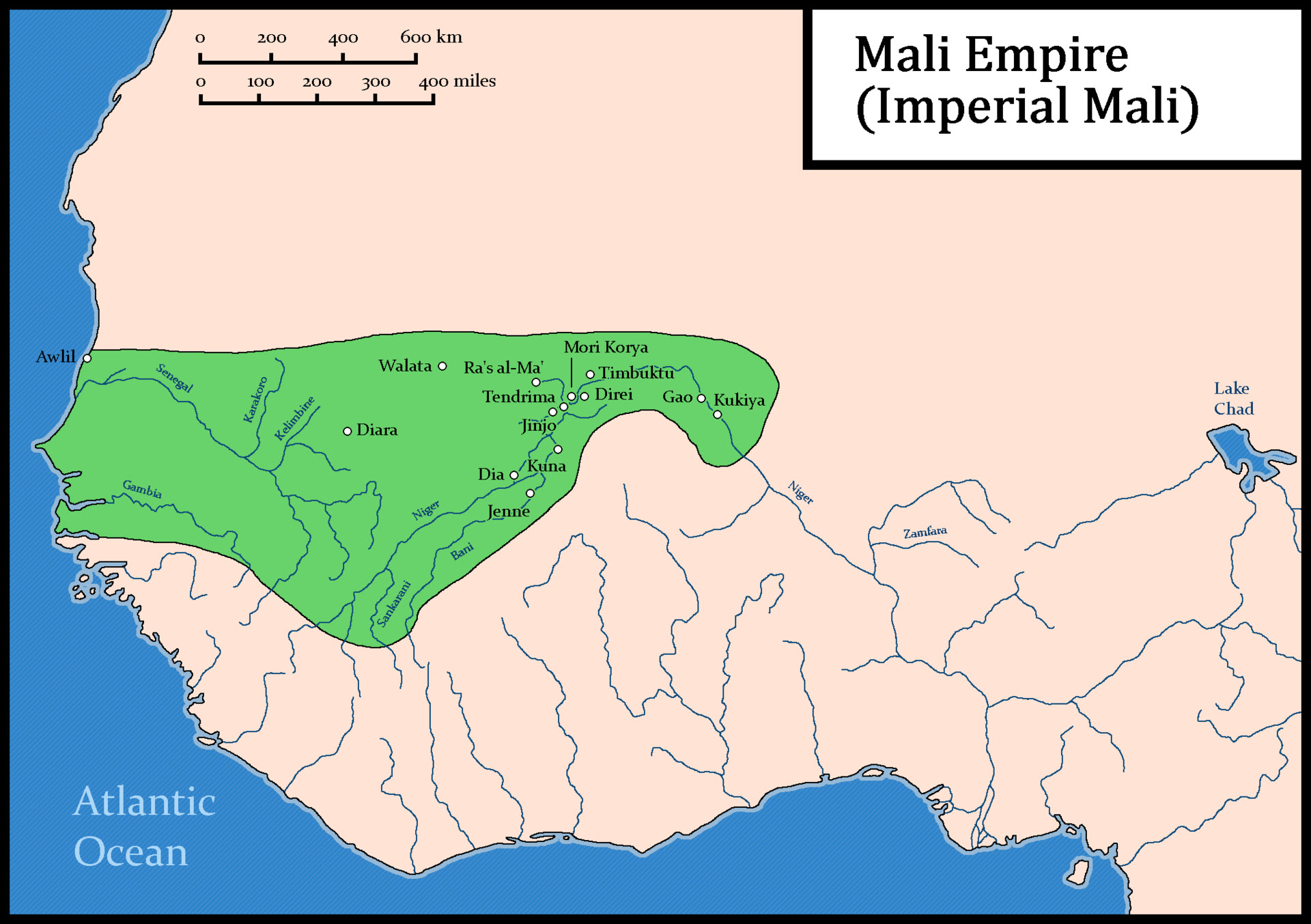
The Mali Empire's reach was built by force of arms as much as by commerce. Imperial armies secured the gold-bearing lands of Bondu and Bambuk to the south, subdued the Diara in the northwest, and pushed along the Niger as far north as Lac Débo. At its largest, Mali was 2,000 kilometres wide, extending from the coast of West Africa above the Senegal River and below the Gambia River, taking in old Ghana and reaching south east to Gao and north east to Tadmekka.
To govern his diverse peoples, Mansa Musa divided the empire into provinces, each ruled by a governor called a farba who handled local taxes, justice and tribal disputes. The empire's principal cities were Niani, Timbuktu, Djenné and Gao.
3. Mansa Musa I and the Peak of the Empire
Mansa Musa I ruled the Mali Empire from 1312 to 1337 CE, and his reign is remembered as the period in which the empire reached its greatest heights of territory, cultural florescence and wealth. He was the mansa, or emperor, of the West African empire of Mali during its height in the early 14th century. Using a large army, he doubled the empire's territory, allowing the kingdom to benefit from its position at the center of trade in Africa. He controlled territories rich in gold and copper and monopolised trade between the north and interior of the continent.
In the 17th year of his reign, in 1324 CE, Musa set out on his pilgrimage, which awakened the world to the wealth of Mali, much of it from control of gold-producing regions and trans-Saharan trade routes. His generosity in Cairo was so lavish that the price of bullion crashed by about 20 percent, and no court emir or holder of a royal office was left without the gift of a load of gold.. A Muslim like his royal predecessors, he brought back architects and scholars from his pilgrimage to Mecca who built mosques and universities that made cities such as Timbuktu internationally famous.
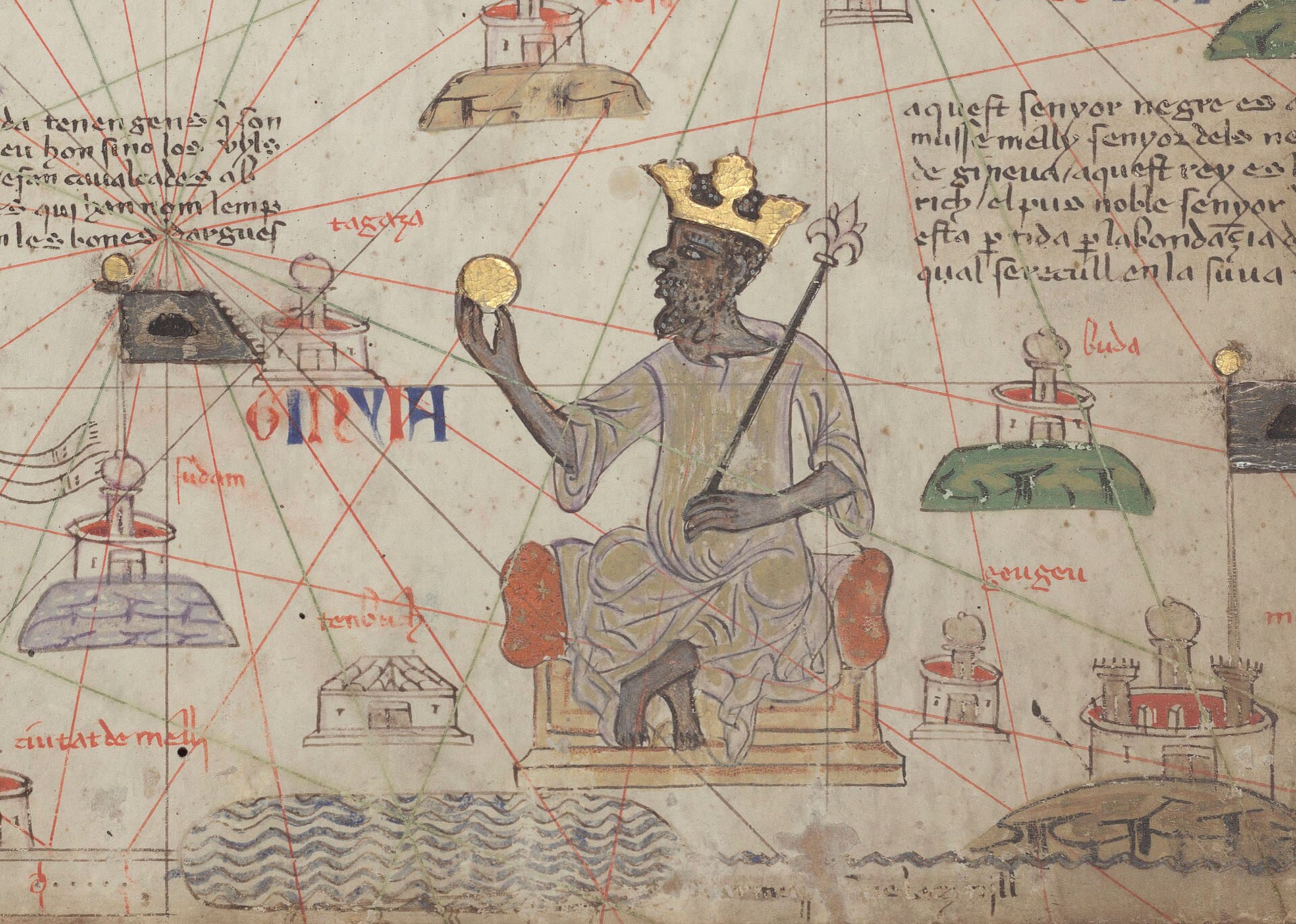
The Spanish cartographer Abraham Cresques featured Musa in the Catalan Atlas wearing a gold crown and holding gold, an image that spurred explorers to search for Timbuktu and Musa's riches. In the Western imagination the larger-than-life figure of Mali is its emperor Mansa Musa, also called Kanku Musa Keita, who lived from about 1280 to about 1337.
4. Trade and Economy
Mali acted as a middle-trader between North Africa across the Sahara and the Niger River to the south. Its traffic in gold, salt, copper, ivory, and slaves made it rich. A significant portion of the empire's wealth came from the Bure goldfields, and gold was not Mali's only mainstay, for the empire also acquired control over the salt trade. An abundance of gold dust and salt deposits helped expand the empire's commercial assets.
In Mali salt served as a medium of exchange, cut into pieces and used to buy and sell, much as gold and silver were used elsewhere. At Iwalatan a load of salt brought eight to ten mithqals, while in the town of Mali it sold for twenty to thirty, and sometimes as much as forty. A class of professional traders emerged in Mali, and in the 14th century cowrie shells were established as a currency for trading and taxation.
5. Timbuktu and Djenné: Centres of Learning and Trade
Timbuktu was a city in Mali that became an important trade centre of the Mali Empire, gaining wealth from the trade routes that linked the Niger River with the Sahara and North Africa. Its golden period came in the 14th century, when it grew rich passing gold, slaves and ivory from Africa's interior to the Mediterranean and sending salt and other goods southwards.
Timbuktu's three great mosques, Djingareyber, Sankore and Sidi Yahia, recall the city's golden age. Home of the Sankore University and other madrasas, Timbuktu was an intellectual and spiritual capital and a centre for the propagation of Islam throughout Africa in the 15th and 16th centuries. It was inscribed on the World Heritage list in 1988 under criteria (ii), (iv) and (v) for its outstanding universal value.
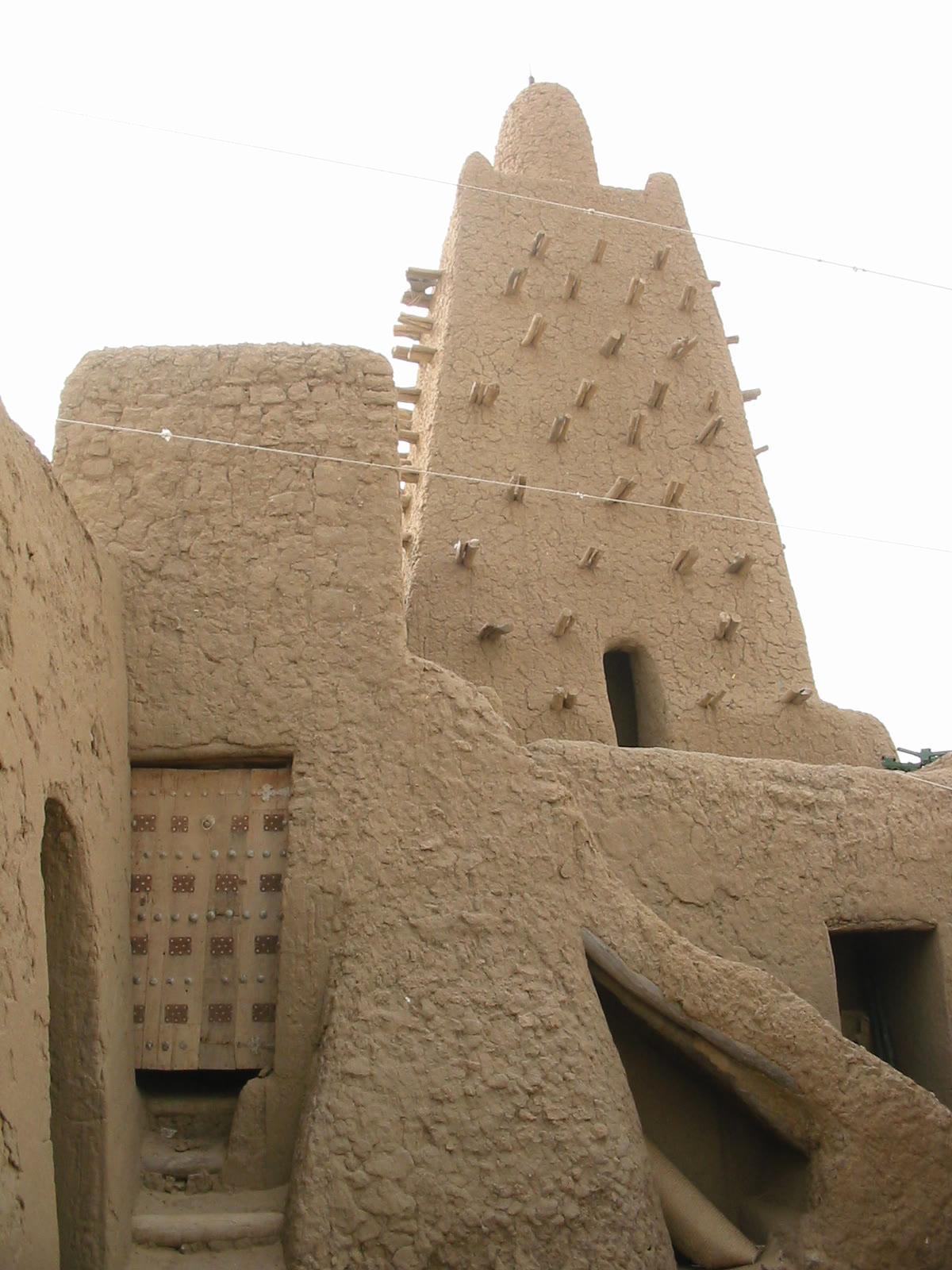
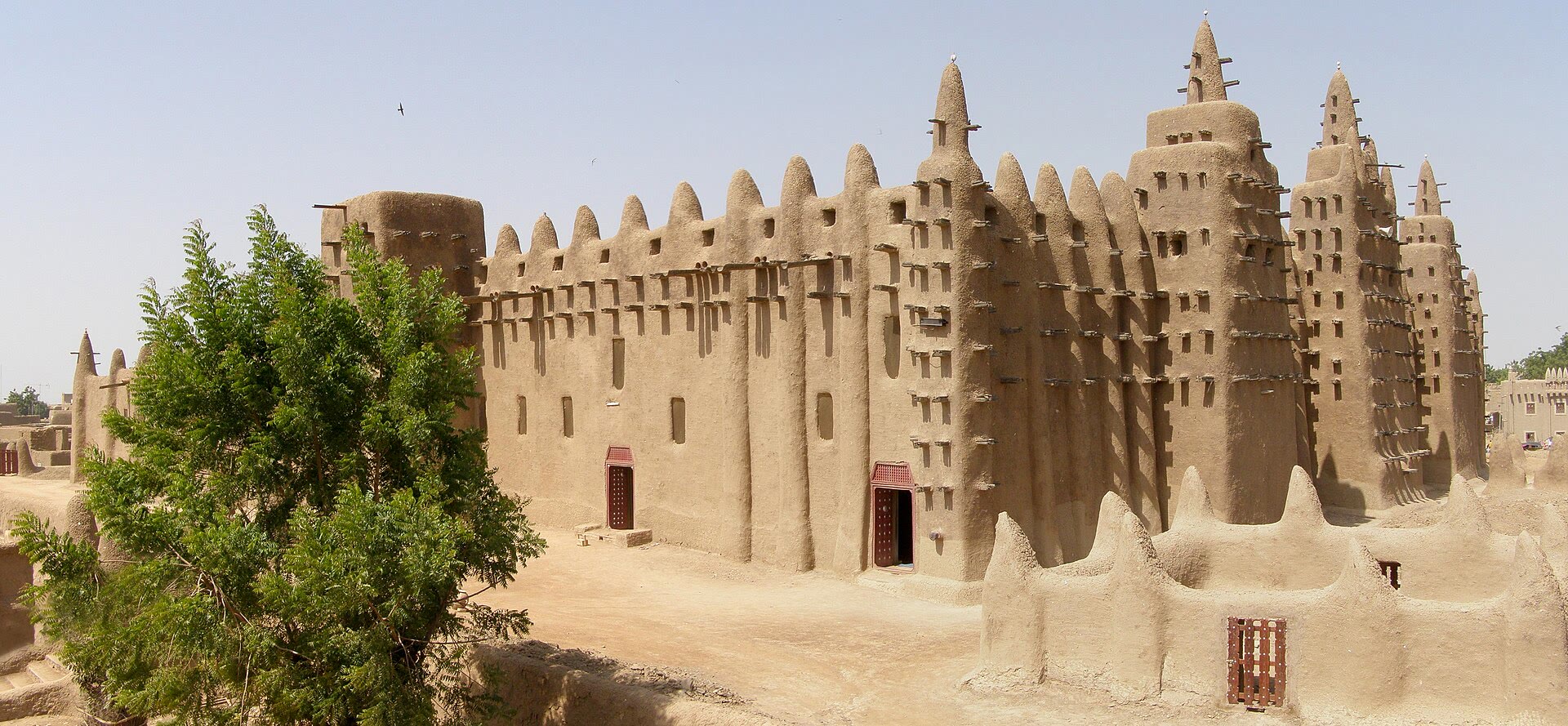
Djenné has been inhabited since 250 BCE and became a market centre and an important link in the trans-Saharan gold trade. In the 15th and 16th centuries it was one of the centres for the propagation of Islam, and its traditional houses, nearly 2,000 of which survive, are built on hillocks as protection from seasonal floods.
6. Written Sources and Historical Record
The three most important Arabic sources for the empire of Mali at its height are al-Umari, Ibn Battuta and Ibn Khaldun, all of whom had good opportunities to collect information on the remote empire. Al-Umari, who wrote between 1342 and 1349 CE, reflects the impression that Mansa Musa had left in Cairo during his pilgrimage. One of al-Umari's most important informants was a shaykh who had lived in Mali for thirty-five years.
Ibn Battuta recorded his own tour through Mali from February 1352 to December 1353 CE, an account called a first-rate historical document. The ruler of Mali whom Ibn Battuta met was Mansa Sulayman, whom he described as a miserly king from whom one might not hope for a rich present. Ibn Battuta wrote that the people were seldom unjust and had a greater abhorrence of injustice than any other people, and that there was complete security in their country.
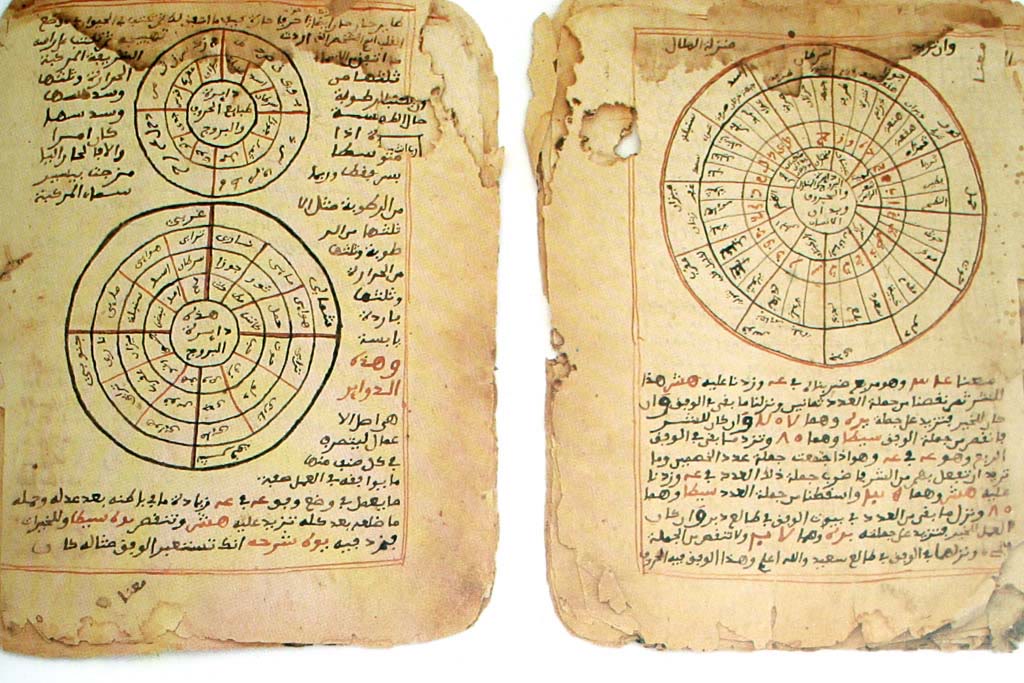
The manuscripts are written in various styles of the Arabic script developed in Timbuktu and surrounding regions, and are recognized by Malians as an important look into their cultural heritage. A selection of legal texts, initially a hundred manuscripts, was digitised in January 2004 at the Mamma Haidara Library in Timbuktu. The Library of Congress online collection contains over 30 digitized manuscripts from the Mamma Haidara Commemorative Library and the Library of Cheick Zayni Baye of Boujbeha, both in Timbuktu. Armed groups burned or stole 4,203 manuscripts held at the Ahmed Baba Institute, though the local population, helped by SAVAMA-DCI, saved 90 percent of Timbuktu's ancient manuscripts. Since 2002 the Tombouctou Manuscripts Project has studied the manuscript tradition of Timbuktu, a city that was a great centre of learning in West Africa and far beyond from the 13th to the 20th centuries.
7. Decline and Fall
The Mali Empire was in decline by the 15th century, as unclear rules for royal succession led to civil wars between brothers and uncles. The empire had outgrown its political and military strength: Gao rebelled around 1400 CE; the Tuareg seized Walata and Timbuktu in 1431 CE (some sources date these attacks to 1433); Takrur and the Wolof threw off their subjection; and the Mossi began to harass the Mali overlord.
Around 1468 King Sunni Ali of Songhai conquered the rump of the empire, which was reduced to a small western pocket of its former territory. By about 1550 Mali had ceased to be important as a political entity. What remained of the Mali Empire was absorbed into the Moroccan Empire in the mid-17th century.
8. Legacy and Cultural Heritage
Mali's cultural heritage lives on in both monuments and traditions: the Old Towns of Djenné hold World Heritage status, and jalis, often translated as griots, inherited and acquired special knowledge about history, genealogies and music, historically performing social and political roles that continue today.
9. Timeline: from the founding of Mali to the Moroccan conquest
- c. 1100Timbuktu foundedThe city of Timbuktu was founded around this time and later gained wealth from the trade routes linking the Niger River with the Sahara and North Africa.
- c. 1235Battle of KirinaSundiata Keita defeated the Sosso king Sumanguru at Kirina and founded the Mali Empire.
- 1240Ghana's capital capturedSundiata captured the old Ghana capital, and a great assembly of tribal leaders and Arab merchants declared him supreme monarch.
- 1255Death of SundiataSundiata Keita, founder of the empire of Mali, died.
- 1312Mansa Musa becomes emperorMansa Kankan Musa I became emperor of Mali, guiding the empire through its most prosperous years.
- 1324The pilgrimage to MeccaMusa set out on his pilgrimage to Mecca; in Cairo he spent and gave away so much gold that its value fell.
- c. 1337Death of Mansa MusaMansa Musa I died, ending the reign of 1312 to 1337 that marked the empire's height.
- February 1352 to December 1353Ibn Battuta visits MaliThe Moroccan traveller Ibn Battuta toured Mali from February 1352 to December 1353 CE, leaving a first-rate account of its customs.
- 1375The Catalan AtlasThe Catalan Atlas made in Majorca by Cresques Abraham depicted Mansa Musa with gold, spreading Mali's fame in Europe.
- 1433Tuareg attacksThe Tuareg attacked Mali, and Timbuktu was lost to Tuareg control during this period of crisis.
- 1468Sunni Ali takes the rumpKing Sunni Ali of the Songhai Empire conquered the rump of the Mali Empire, which was left controlling a small western pocket of its former territory.
- c. 1550Mali ceases to be a major powerBy about 1550 Mali had ceased to be important as a political entity.
- by 1645Reduced to its original territoryAfter a long decline Mali had shrunk to the size of its original territory; what remained was absorbed into the Moroccan Empire in the mid-17th century.
References (22)
- 1Mali empire | History, Rulers, Downfall, Map, & Facts — Encyclopaedia Britannica WebView source
- 2Mansa Musa I — World History Encyclopedia WebView source
- 3Sundiata Keita | king of Mali — Encyclopaedia Britannica WebView source
- 4The Story of Africa: Mali — BBC World Service WebView source
- 5Mali Empire — World History Encyclopedia WebView source
- 6Sundiata Keita — World History Encyclopedia WebView source
- 7Mūsā I of Mali | Mansa, Gold, Religion, Wealth, Pilgrimage, & Facts — Encyclopaedia Britannica WebView source
- 8The Mali Empire — National Geographic Education WebView source
- 9Kingdom of Mali — Primary Source Documents — Boston University African Studies Center WebView source
- 10Visualizing a Sahelian Past — The Metropolitan Museum of Art WebView source
- 11Ibn Battuta (1304-1368/69): Travels in Asia and Africa, 1325-1354 — Internet Medieval Sourcebook, Fordham University (trans. H. A. R. Gibb) WebView source
- 12Timbuktu — World History Encyclopedia WebView source
- 13Timbuktu — UNESCO World Heritage Centre WebView source
- 14Reconstruction of the destroyed mausoleums of Timbuktu (Mali) — UNESCO World Heritage Centre WebView source
- 15Old Towns of Djenné (World Heritage List, no. 116rev) — UNESCO World Heritage Centre WebView source
- 16The Thirteenth- and Fourteenth-Century Kings of Mali (The Journal of African History, Vol. 4, No. 3, 1963) — Cambridge University Press (N. Levtzion) 1963 BookView source
- 17Islamic Manuscripts from Mali: About this Collection — Library of Congress WebView source
- 18Tombouctou Manuscripts Project: Project — University of Cape Town WebView source
- 19Bamako heritage conference urges emergency action to ensure safeguarding of ancient manuscripts of Mali — UNESCO WebView source
- 20The Empires of the Western Sudan: Mali Empire — The Metropolitan Museum of Art WebView source
- 21Western and Central Sudan, 1000–1400 A.D. (Heilbrunn Timeline of Art History) — The Metropolitan Museum of Art WebView source
- 22The Catalan Atlas (Likenesses into Presence, Gould Library) — Carleton College WebView source