Peacock
The peafowl of the genus Pavo and the African Congo peafowl: their plumage and display, the photonic-crystal physics behind the iridescent train, their habitats and conservation status, and the peacock's long career as a symbol in Asian and Middle Eastern art.
Peafowl are large pheasants of the family Phasianidae: the Indian peafowl Pavo cristatus and the green peafowl Pavo muticus of Asia, and the Congo peafowl Afropavo congensis of central Africa. The male Indian peafowl's train is made of elongated upper-tail coverts bearing iridescent eyespots whose colours come from two-dimensional photonic-crystal arrays of melanin rods in the feather barbules. The Indian peafowl is assessed as Least Concern, the green peafowl as Endangered and the Congo peafowl as Near Threatened on the IUCN Red List, and the peacock has served for centuries as an imperial, religious and artistic motif from Mughal painting to al-Jazari's automata.
In this article
- 1Overview
- 2Taxonomy and Species
- 3Description and Anatomy
- 4Courtship and Reproduction
- 5Habitat, Diet and Behaviour
- 6Structural Colour of the Plumage
- 7Visual Perception and Predation
- 8Conservation Status
- 9Peafowl in Britain
- 10Cultural and Artistic Depictions
- 11Timeline
- 12Timeline: from al-Jazari's water clock to the 2022 Congo peafowl assessment
- 13Knowledge graph
Overview
Peafowl are the largest members of the pheasant family and rank among the heaviest of flying birds, reaching up to about 13 pounds; they prefer walking and running to flying. The word peacock is commonly applied to birds of both sexes, but strictly it denotes the male, while the female is a peahen and the young are peachicks. Collectively, the birds are known as peafowl.
1. Taxonomy and Species
| Species | Scientific name | Order / family | Native range |
|---|---|---|---|
| Indian peafowl | Pavo cristatus Linnaeus, 1758 | Galliformes, Phasianidae | India and Sri Lanka |
| Green peafowl | Pavo muticus Linnaeus, 1766 | Galliformes, Phasianidae | Java and Myanmar |
| Congo peafowl | Afropavo congensis Chapin, 1936 | Galliformes, Phasianidae | African rain forests |
The Indian Peafowl's scientific name Pavo cristatus is credited to Linnaeus and dated 1758 in BirdFacts.4Indian Peafowl (Pavo cristatus) · British Trust for Ornithology (BTO) ↗
2. Description and Anatomy
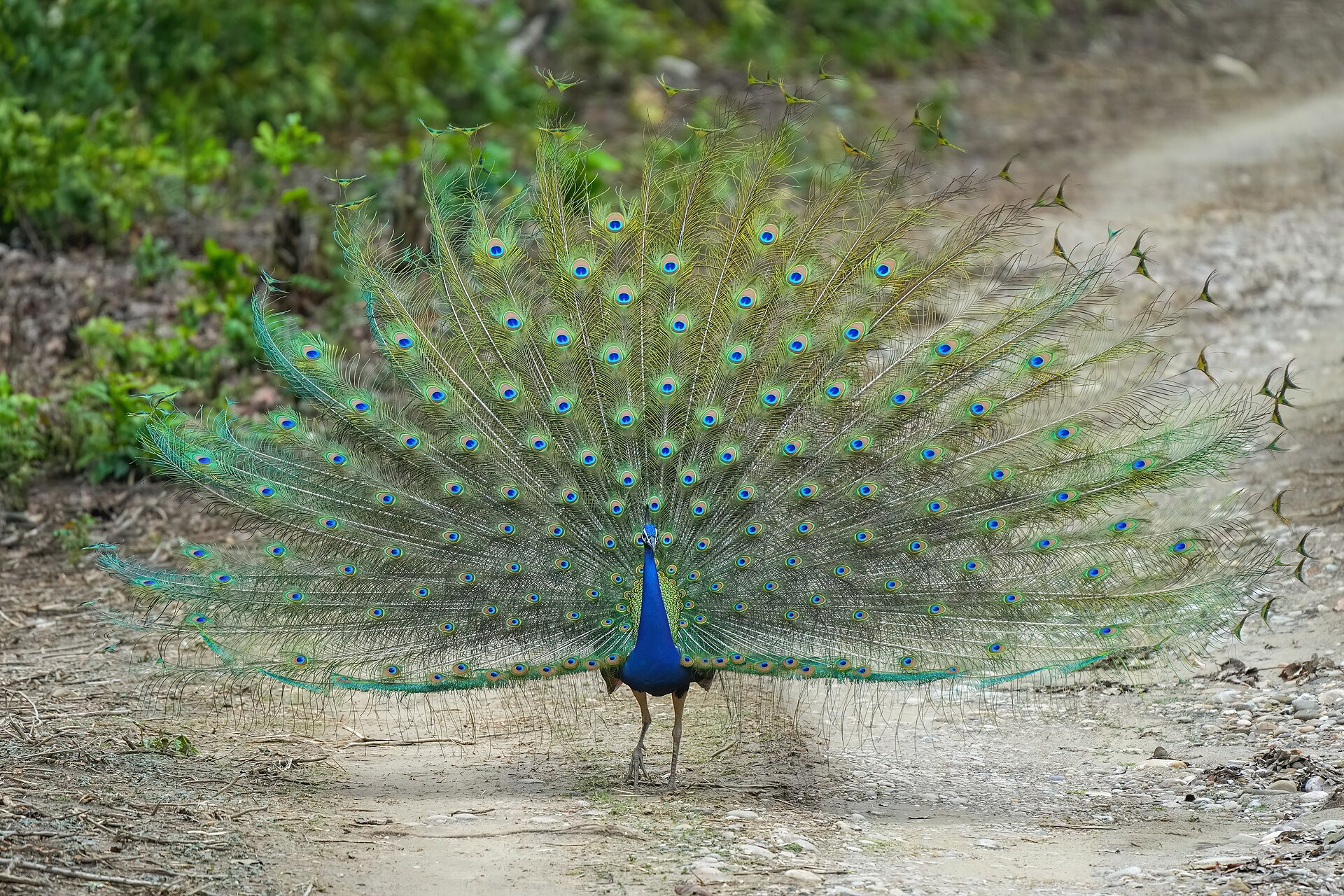
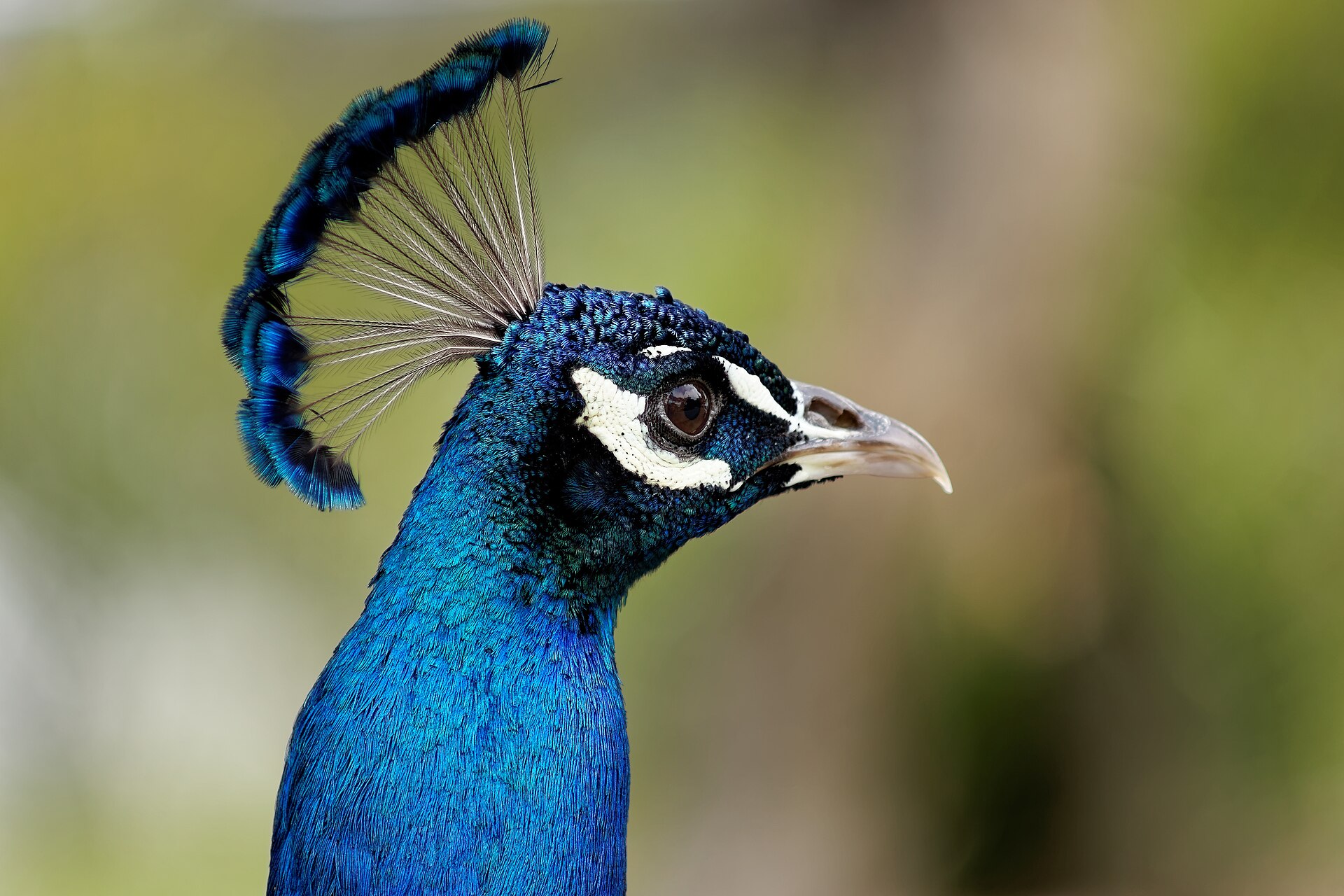
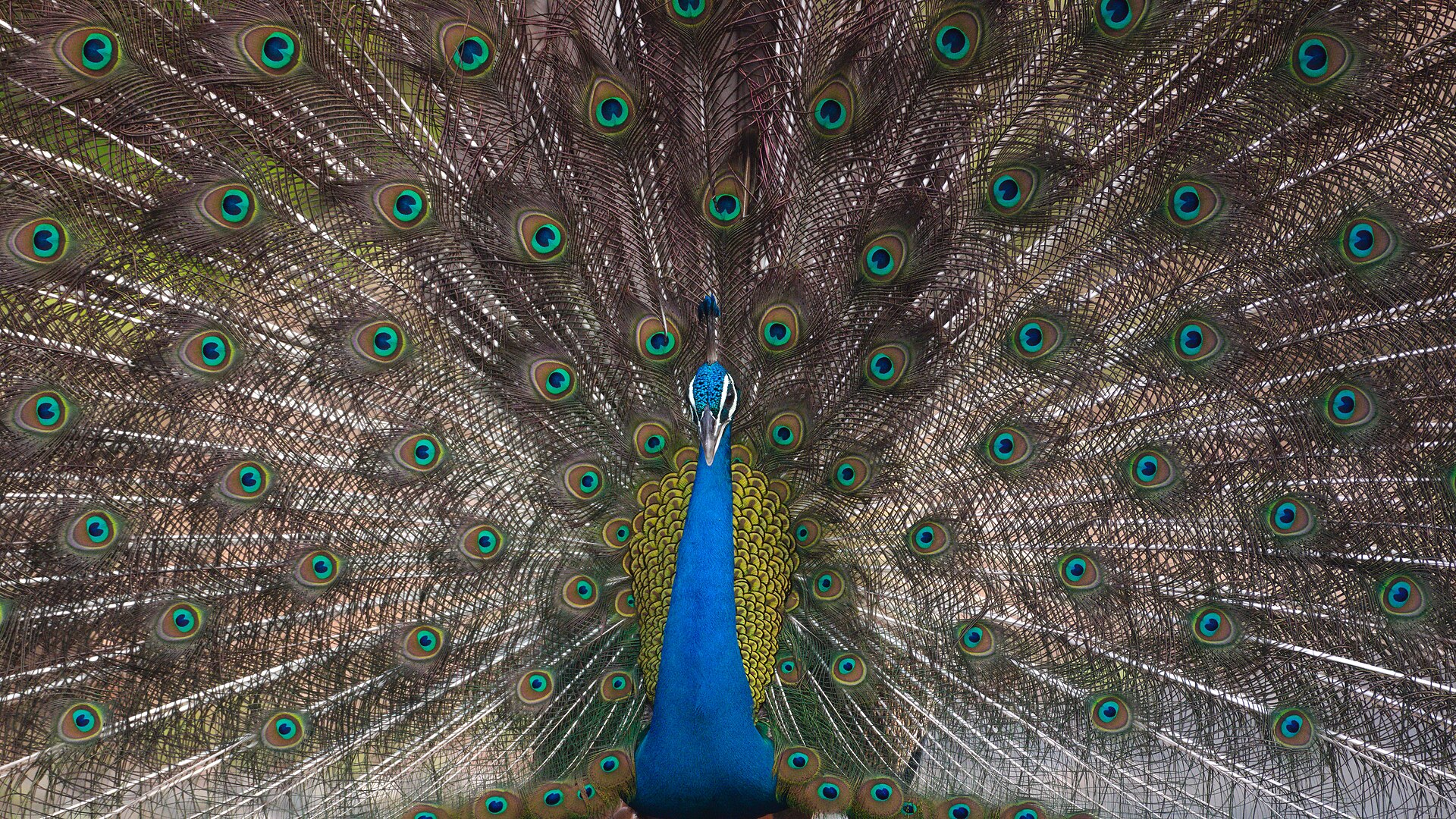
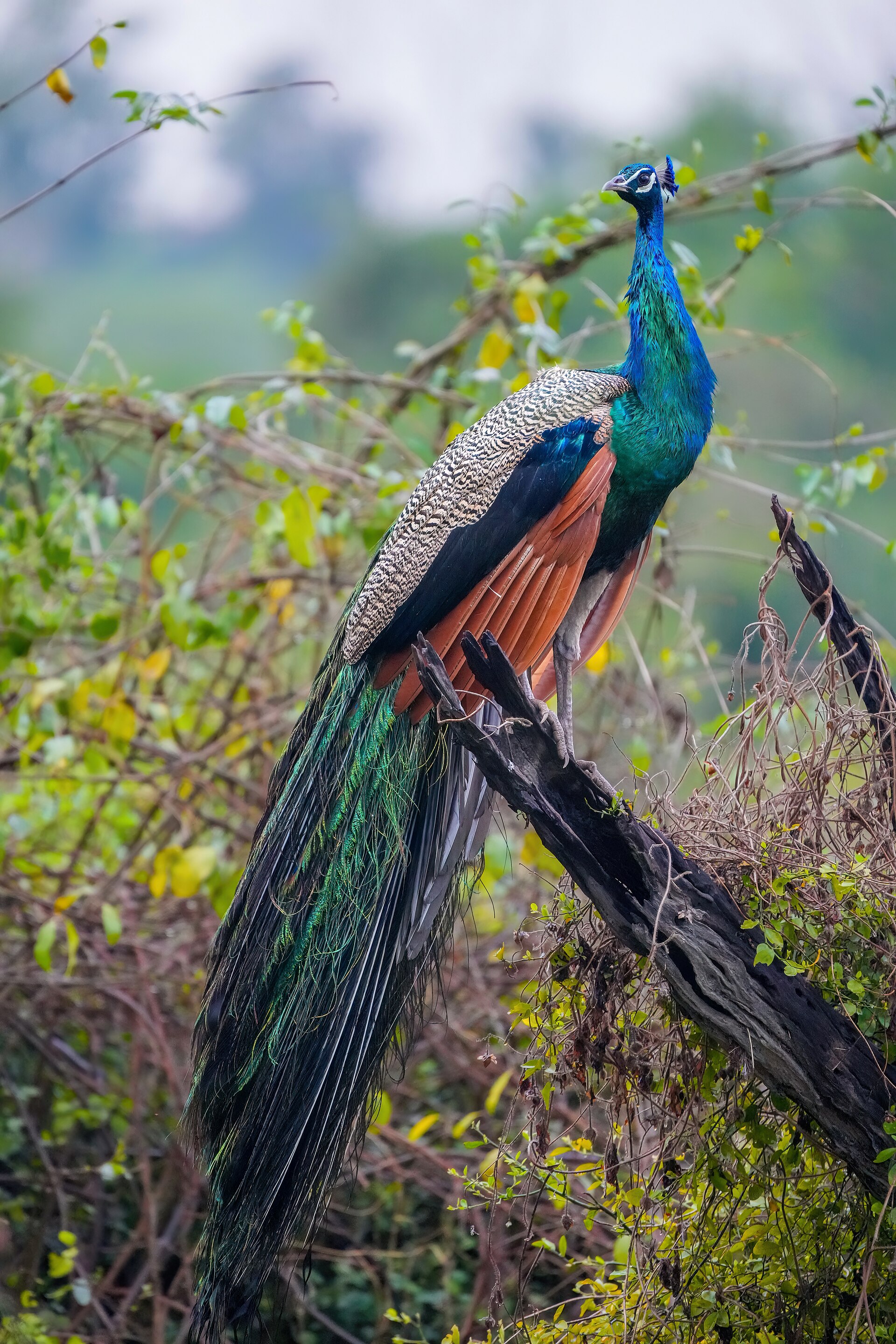
The peacock's long train is not the tail itself but a structure of tail coverts, the feathers that cover the base of the tail, and it is studded with ocelli, round spots that resemble shining eyes. These coverts spread into a train exceeding 60 percent of the bird's total body length, marked with eye patterns of blue, gold, red and other hues. The Indian peafowl ranges from 2.7 to 6 kg in mass and 1.4 to 1.6 m in wingspan. The male's train averages about 1.2 m in length. A mature train bears 100 to 175 ocelli. The number of ocelli and the length of the train feathers increase between the ages of four and 12, leading scientists to speculate that these traits broadcast a male's age and perhaps his vigor and status.
How the ocelli are perceived is less straightforward than their name suggests. False-colour images show that peafowl eyespots do not always present a dark circular pupil at typical display distances, in peafowl vision or in models of dichromatic mammalian predator vision, so it is not obvious that ocelli appear eye-like to a nearby viewer, whereas blurring at greater distances gives them pupil-like dark centres. A review of the literature found no evidence that peacocks with full trains suffer a significant or enhanced risk of predation, indicating that any handicap they carry is likely to come from factors other than the visual signal of their eyespot train feathers.
3. Courtship and Reproduction
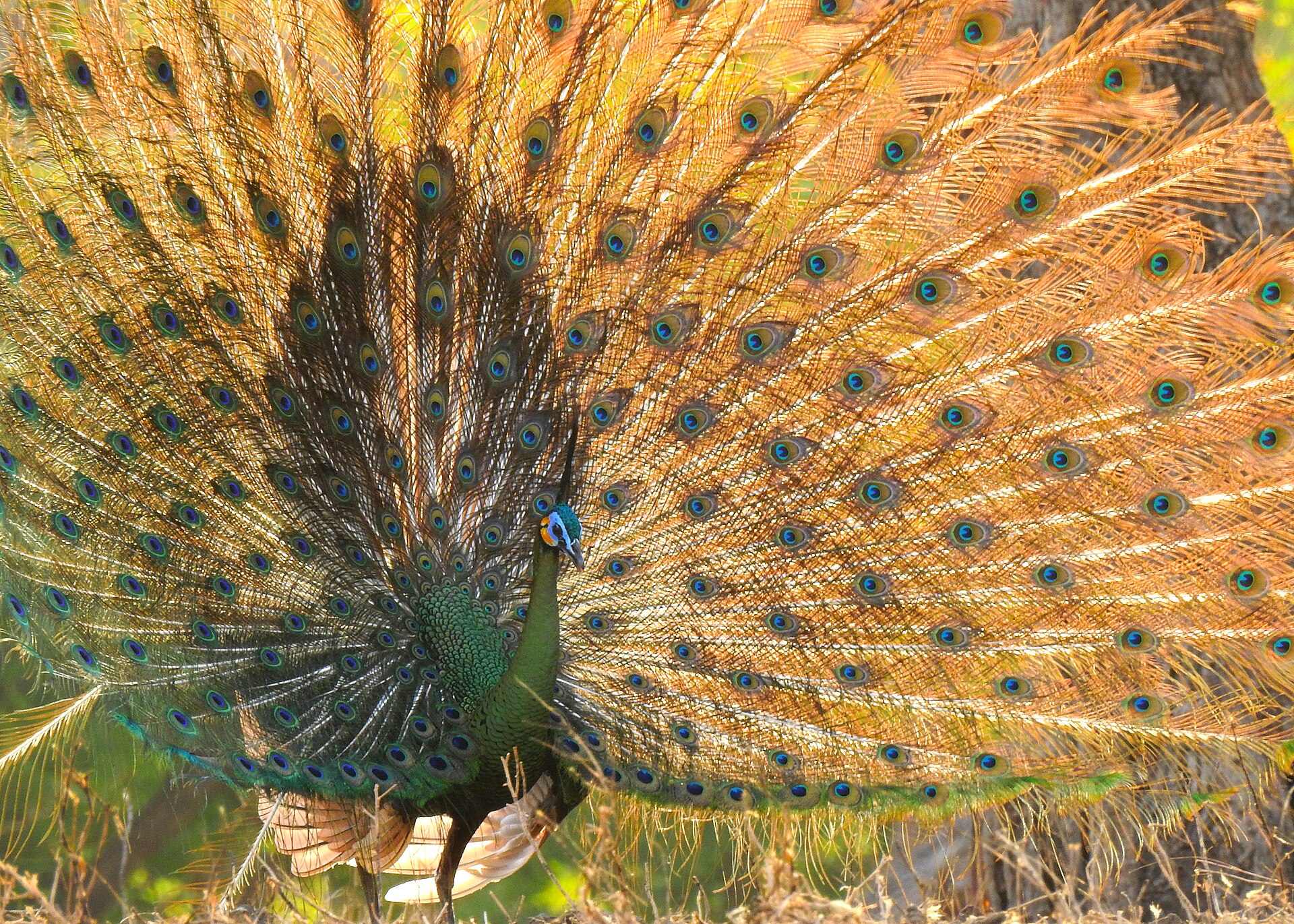
In courtship the male fans his iridescent train, propping it with stiffer tail feathers so that it spreads into a fan-shaped semicircle 6 to 7 feet (1.8 to 2.1 meters) wide, and quivers the feathers so that they shimmy and flash. Females are believed to choose mates by the size, colour and quality of the train. Males with the most ocelli tend to achieve the greatest mating success, and eyespot numbers correlate with display frequency and overall health. A peacock grows his first train in his second year without ocelli, and the train becomes longer and more elaborate each year until reaching maximum splendor at about five or six years of age. Males carry the train from June to December, discard it in January, and grow it again rapidly as the breeding season approaches. The calls of the Indian blue peafowl are extremely loud and are often described as unpleasant, harsh shrieking. The species has up to six alarm calls shared by both sexes as well as seven further calls that males use in territorial disputes.
Courtship takes place at leks: aggregations of very small territories, each owned by a single male, where the trains are shaken so that females can assess several males before choosing. Suitable males may gather harems of several females.
The nest is a simple affair of dry sticks and leaves built on the ground under shrubs. The clutch numbers 3 to 8 eggs, and incubation lasts 26 to 30 days, carried out by the female alone with no male parental care. Lifespan is 15 to 20 years. The Indian blue peafowl becomes sexually mature at three years of age, though some males are able to breed at age two.
4. Habitat, Diet and Behaviour
The Indian peafowl is native to Sri Lanka and India, where it holds the status of national bird. It frequents open forests near streams, cultivated areas, and the grounds of Buddhist and Hindu temples. Wild peafowl roost in forest trees and gather in groups known as parties. They feed on the ground, taking insects, plants, and small creatures. The Indian blue peafowl is largely sedentary and is most often found in deciduous, open forest habitats.
The Congo peafowl inhabits lowland rainforest at elevations between 100 and 1200 m, using undisturbed primary and old-growth secondary forest, and favouring secondary forest for its abundant food. It feeds chiefly on leaf-litter invertebrates such as termites, grasshoppers, crickets and ant eggs, and also takes seeds and other plant material. The male Congo peacock has violet-blue wing coverts, breast feathers and tail tips, reaches full plumage after two years, and lacks the large colourful train and the ocelli of the Indian peacock. Congo peafowl are monogamous breeders, and their long-term pair bonds are believed to explain why the species shows little ornamentation and little sexual selection compared with the Asian peafowl. The species is confined to the eastern Democratic Republic of the Congo, where research in the 1990s confirmed its presence in 13 of 20 survey areas.
Contemporary records of the green peafowl are mostly limited to dry deciduous forests, with the highest densities found near undisturbed rivers and wetlands. Access to water and human disturbance strongly influence its abundance and distribution.
5. Structural Colour of the Plumage
The colour of peacock plumage originates in the cortex of the differently coloured barbules, where a two-dimensional photonic-crystal structure carries a partial photonic bandgap along the direction normal to the cortex surface — a band of frequencies for which light is strongly reflected. Each barbule has a medullar core of about 3 μm wrapped in a cortex layer, and the photonic crystal is built from melanin rods connected by keratin, the rods about 0.7 μm long.
The lattice constant measures about 140 nm in blue barbules, 150 nm in green and 165 nm in yellow; the brown barbule has a less regular lattice with spacings of roughly 150 nm and 185 nm along different directions. Melanin rod layers number about 9 to 12 for blue and green barbules, about 6 for yellow and only about 4 for brown. Blue and green barbules show narrower main reflectance peaks in blue and green wavelengths, the yellow barbule's main peak extends from green to orange and the brown barbule's from green to red, with yellow and brown barbules also showing a side peak at blue wavelengths.
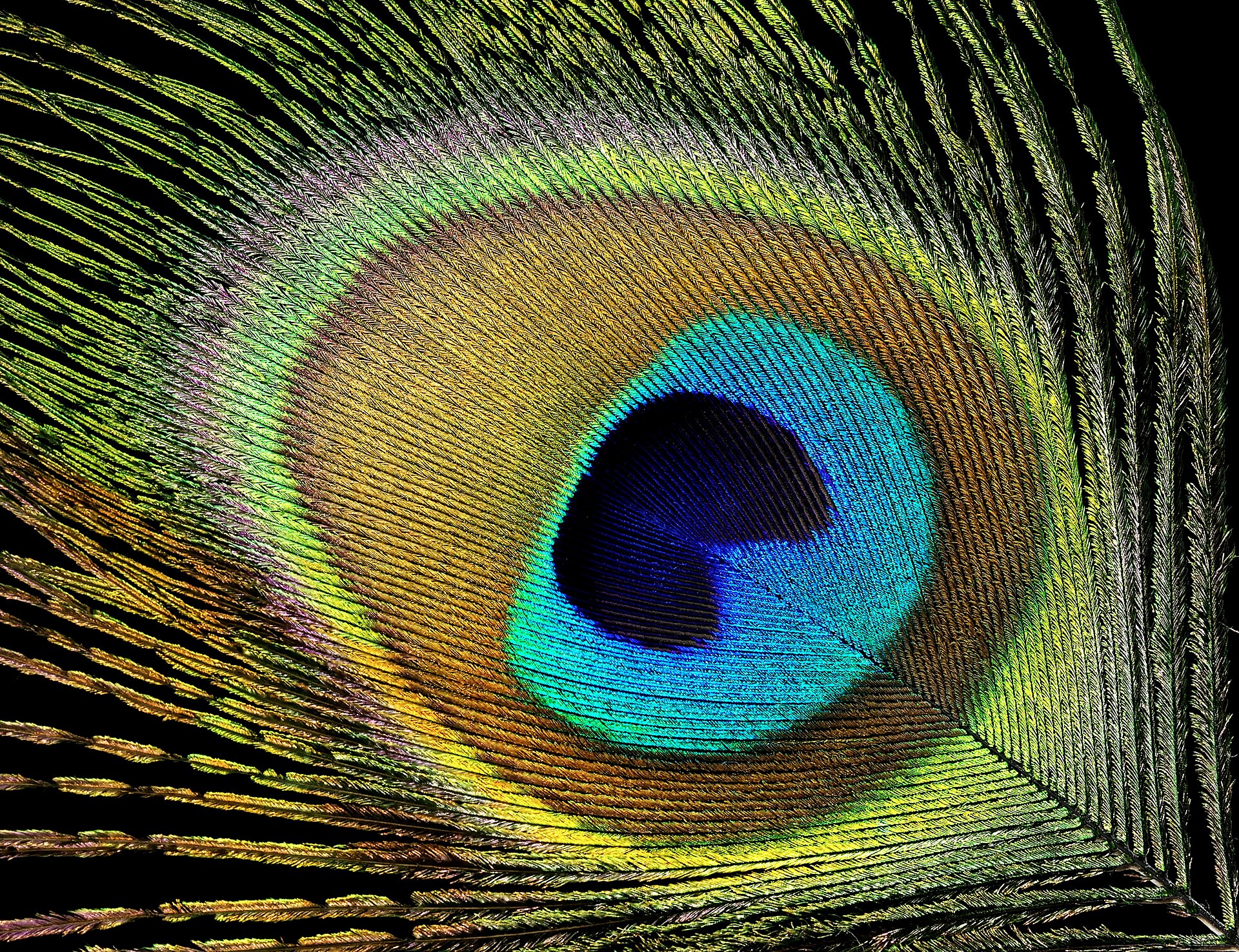
Immersing barbules in glycerin so that air holes fill with liquid shifts all reflectance peaks to longer wavelengths, which together with the iridescent effect shows the colours are structural rather than pigmentary. Varying the lattice constant shifts the midgap frequency of the partial photonic bandgap, while the number of periods controls the production of additional colours, so these two very simple variables generate the diversified, additively mixed hues of the plumage.
More generally, rectangular lattices of melanin rodlets and air channels embedded in the keratin matrix create highly reflecting barbules, the rainbow realised by small variations in the dimensions of that lattice. The keratin cortex overlying the melanosome layer has an effect on the reflectance spectrum that grows as the number of melanin and air channel layers decreases. When melanosomes are packed contiguously in layers that alternate with keratin layers, they form optical multilayers in the barbules that strongly reflect incident light within a restricted wavelength range, as seen in the feathers of birds-of-paradise, common bronzewing pigeons and ducks. Feather colours depend on the angle of illumination or observation because of the layered structure, causing iridescence, with a hypsochromic shift of the reflectance spectra as the angle of light incidence increases.
Within the broader context of feather colour, β-keratin nanostructures and melanin are the major factors in barb-based structural colours, whereas the β-keratin cortex and melanin are the major factors in barbule-based structural colours. Crystalline photonic nanostructures with long-range order produce angle-dependent iridescent colours, while amorphous ones lacking long-range order produce angle-independent non-iridescent colours. Amorphous melanosomes in a feather barb absorb incoherent scattering from spongy β-keratin layers and can improve saturation of the structural colour.
6. Visual Perception and Predation
For birds viewing the feathers against green vegetation, the colour and brightness contrasts were similar to those of ripe fruit, whereas for dichromatic mammalian predators those contrasts were only weakly detectable or often below threshold, with the peacock's train matching foliage in visual texture.
Pattern analysis showed that the model train and background vegetation agreed in total energy, peak frequency and proportion energy, and that the train of a live peacock is an excellent match for the feature size distribution, overall contrast and pattern scale diversity of background foliage.
7. Conservation Status
| Species | IUCN status and criteria | Assessment year | Population estimate | Principal threats |
|---|---|---|---|---|
| Indian peafowl | Least Concern, version 3.1 | 2016 | Not quantified; trend stable; extremely large range | Not persecuted because considered sacred |
| Green peafowl | Endangered, A2cd+3cd+4cd | 2018 | 10,000–19,999 mature individuals; about 15,000–30,000 birds in total | Declines over 50% over three generations, projected to continue |
| Congo peafowl | Near Threatened, C2a(i), after earlier Vulnerable assessments | 2022 | 2,500–9,999 mature individuals, inferred decline | Habitat loss and hunting pressure |
The native range of the Indian peafowl covers Bangladesh, Bhutan, India, Nepal, Pakistan and Sri Lanka, and the species has also been introduced to Australia, the Bahamas, New Zealand and Hawaii 10Pavo cristatus, Indian Peafowl — The IUCN Red List of Threatened Species (2016 assessment) · IUCN Red List / BirdLife International ↗. Because it is considered sacred throughout much of its range, the Indian peafowl is not persecuted 10. In the absence of evidence for declines or substantial threats, the assessment suspected a stable population 10.
The green peafowl's native range spans Cambodia, China, Indonesia, Laos, Myanmar, Thailand and Viet Nam, while the species is regionally extinct in Bangladesh, India and Malaysia 11Pavo muticus, Green Peafowl — The IUCN Red List of Threatened Species (2018 assessment) · IUCN Red List / BirdLife International ↗. Widespread hunting for meat and feathers, the collection of eggs and chicks, habitat modification and human disturbance have caused a catastrophic decline, and trade in the males' spectacular train feathers is cited as a further threat. The green peafowl is listed in CITES Appendix II and is protected in China, although its protection is difficult to enforce in remote mountainous areas.
The Congo peafowl was assessed as Near Threatened under criterion C2a(i) in the 2022 global Red List assessment, after earlier assessments had classified it as Vulnerable. Its habitat is being lost to mining, subsistence agriculture and logging, while the opening up of remote areas has increased hunting pressure, and hunting for bushmeat is considered one of the major threats.
8. Peafowl in Britain
In Britain the Indian Peafowl is familiar as an ornamental bird of stately homes, parks and country estates, and free-flying individuals often wander some distance and attempt to breed in the wild.
Records of the Indian Peafowl in Britain have historically been sparse because birdwatchers tend not to record exotic species, and judging when such birds are truly wild-ranging is problematic. Bird Atlas maps show the extensive nature of the Indian Peafowl's winter and breeding distributions in the UK, and occupied 10-km square counts are probably underestimates of its true status.
9. Cultural and Artistic Depictions
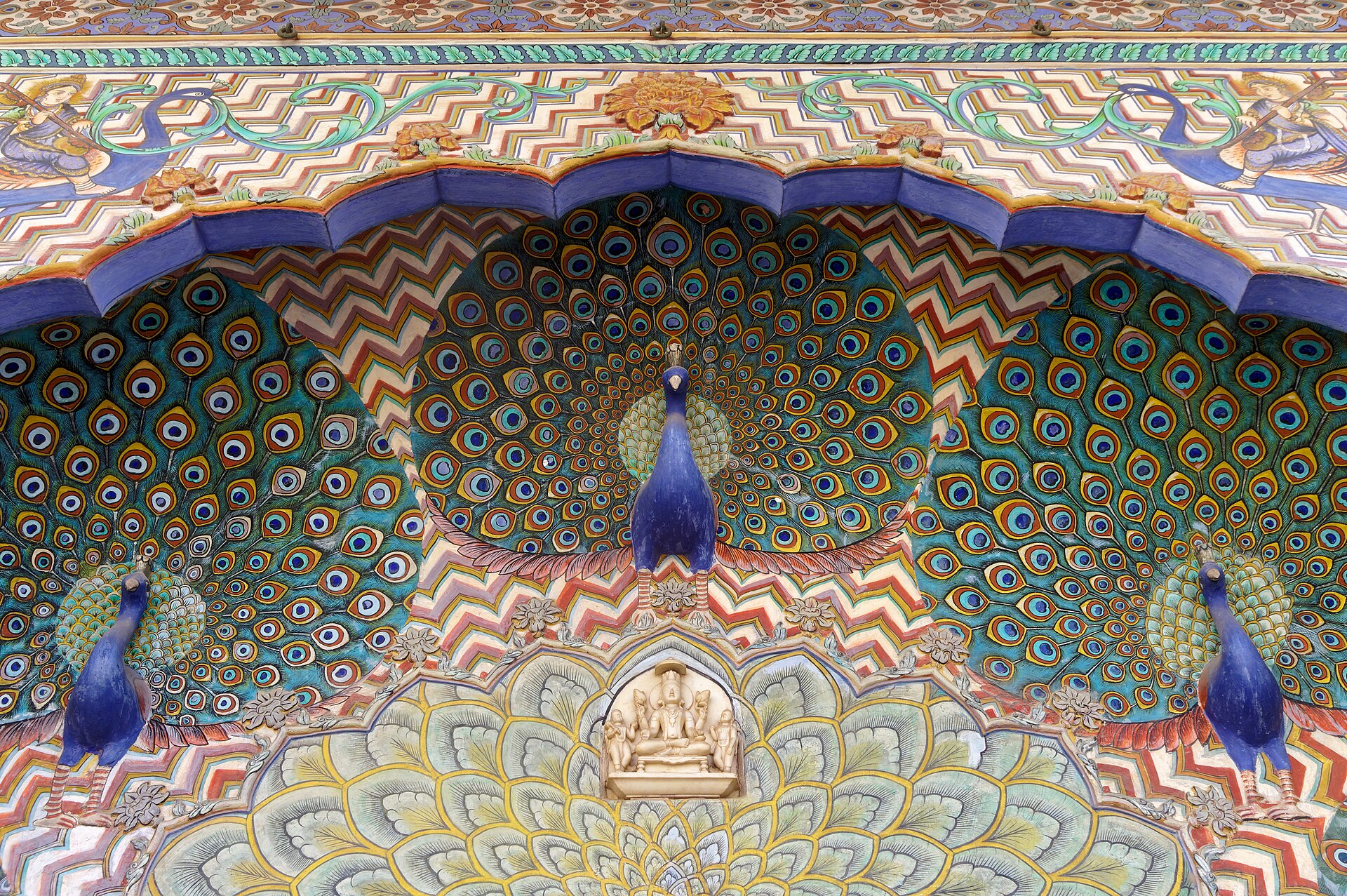
In Yazidi tradition, the world is in the care of a heptad of seven Holy Beings, often called Angels or the Seven Mysteries, and pre-eminent among them is Malak Taus, the Peacock Angel. The Keteba Jelwa, or Book of Illumination, claims to be the words of Malak Taus and states that he allocates responsibilities, blessings and misfortunes as he sees fit, and that it is not for the race of Adam to question him. During the tawusgerran, the circulation of the peacock, qawwals and other religious dignitaries travel to Yazidi villages carrying the senjaq, sacred images representing the peacock and associated with Malak Taus, and these images are venerated while taxes are collected from the pious, sermons are preached and holy water is distributed.
The sculpture Karttikeya, Commander of the Divine Army, Seated on a Peacock is shown on view in Gallery 142 and is a monumental basalt work of the Ganga period dated to about the twelfth century, probably made in the Madanapalle region of Andhra Pradesh. Carved in the round, Karttikeya rides a peacock with six heads and twelve arms, ten holding weapons aloft, since multiple arms and heads of Hindu deities usually denote super-human power.
The three-day exhibition The Peacock's Call: Mission LiFE for a Greener Tomorrow took place in February 2026 at Travancore House in New Delhi. Organised under Mission LiFE, it focused on the ecological and cultural significance of the Indian peafowl, India's national bird, promoting sustainable lifestyles and citizen-led conservation. Union Minister of State for Environment, Forest and Climate Change Kirti Vardhan Singh visited the exhibition and appreciated the initiative for linking India's national bird with Mission LiFE and public engagement for conservation. More than 2,000 visitors attended in the first two days, and the programme included quizzes, origami and poster-making competitions for students as well as expert talks on peacock conservation.
The Iranian king Nadir Shah plundered the original Peacock Throne during his 1739 sack of Delhi, and the blind Shah Alam II is shown seated on a replacement throne. The painting shows the emperor granting an audience, and a Persian inscription on the reverse lists his epithets, the artist's signature, and the date AH 1215 (1800-1801 CE).
10. Timeline
-
715 AH / 1315 CEAl-Jazari water-clock folioA folio from the al-Jazari water-clock manuscript.
-
1739Nadir Shah's sack of DelhiThe Iranian king plundered the original Peacock Throne during his sack of Delhi. 15Emperor Shah Alam II (r. 1760-1806) on the Peacock Throne, by Khairullah Musawir · Los Angeles County Museum of Art (LACMA) ↗
-
1800–1801 CE / AH 1215Khairullah Musawir's paintingThe painting shows Emperor Shah Alam II on the Peacock Throne, made in Delhi in opaque watercolor, gold, and ink on paper. 15
-
1995–2024Rise in recorded UK breeding numbersRecorded UK breeding numbers of the Indian Peafowl rose by 808 percent; trends for this scarce species are not routinely monitored. 4
-
February 2026The Peacock's Call exhibitionAn exhibition in New Delhi.
-
13 October 2003Photonic crystals in peacock feathersZi and colleagues published a study in PNAS in 2003 showing that the colours of peacock feathers are produced by two-dimensional photonic-crystal structures in the feather barbules.8Coloration strategies in peacock feathers (Zi et al., PNAS, 2003) · Proceedings of the National Academy of Sciences, via PubMed Central ↗
-
2003An engineering study of the trainS. C. Burgess presented a case study titled Aesthetics in nature: Case study of the peacock tail feathers in 2003 at the 14th International Conference on Engineering Design.16Aesthetics in nature: Case study of the peacock tail feathers (Burgess, 2003) · University of Bristol research portal (research-information.bris.ac.uk) ↗
11. Timeline: from al-Jazari's water clock to the 2022 Congo peafowl assessment
- 1315 (715 AH)Al-Jazari's peacock water clockThe Metropolitan Museum of Art holds a folio from al-Jazari's Book of the Knowledge of Ingenious Mechanical Devices showing the design for a water clock whose arch carries two peacocks, dated 715 AH or 1315 CE.
- 1739Nadir Shah takes the original Peacock ThroneDuring his sack of Delhi in 1739 the Iranian king Nadir Shah plundered the original Peacock Throne; the blind emperor Shah Alam II is shown seated on a replacement in a later painting.
- 1758Linnaeus names the Indian peafowlThe Indian peafowl carries the scientific name Pavo cristatus Linnaeus, 1758 and the name is still used in the IUCN Red List assessment of the species.
- 1766Linnaeus names the green peafowlThe green peafowl was given the scientific name Pavo muticus Linnaeus, 1766 and it remains the accepted name of the species.
- 1801A portrait on the Peacock ThroneKhairullah Musawir painted the Mughal emperor Shah Alam II on the Peacock Throne in 1801 in opaque watercolor, gold and ink on paper, made in Delhi under the Mughal Empire.
- 1936The Congo peafowl is describedAfropavo congensis, the Congo peafowl, was described for science by Chapin in 1936 and stands apart from the two Asian peafowl species in both plumage and habitat.
- 1965Congo peafowl breeding seasonalityVerheyen's work published in 1965 found that the Congo peafowl shows little receptivity to mating during the winter months, beginning in November.
- 13 October 2003Photonic crystals in peacock feathersZi and colleagues published a study in PNAS in 2003 showing that the colours of peacock feathers are produced by two-dimensional photonic-crystal structures in the feather barbules.
- 2003An engineering study of the trainS. C. Burgess presented a case study titled Aesthetics in nature: Case study of the peacock tail feathers in 2003 at the 14th International Conference on Engineering Design.
- 2016Indian peafowl stays Least ConcernThe 2016 global assessment retained the Indian peafowl as Least Concern under IUCN version 3.1 citing an extremely large range and a population trend that appeared stable.
- 7 August 2018Green peafowl assessed as EndangeredThe 2018 assessment classified the green peafowl as Endangered under criteria A2cd, A3cd and A4cd, describing a very rapidly declining and severely fragmented population.
- 24 April 2019Eyespots measured against predator visionKane and colleagues published a PLOS ONE study in 2019 comparing how peacock eyespots and other colourful feathers appear to peafowl and to dichromatic mammalian predators.
- 23 September 2021Congo peafowl reassessedThe Congo peafowl was assessed on 23 September 2021 and its status was moved from Vulnerable to Near Threatened under criterion C2a(i).
- 2022The Congo peafowl assessment is publishedThe IUCN Red List assessment of Afropavo congensis was published in 2022 and it lists the species as Near Threatened with a suspected population of 2,500 to 9,999 mature individuals.
- 1995 to 2024UK peafowl numbers riseBetween 1995 and 2024 British Trust for Ornithology figures record an 808 percent increase in UK breeding numbers of the Indian Peafowl.
- 5 February 2026A peacock conservation exhibition in New DelhiUnder Mission LiFE India's Ministry of Environment, Forest and Climate Change held a three-day exhibition on peacock conservation titled The Peacock's Call, running from 3 February 2026 to 5 February 2026 at Travancore House in New Delhi.
References (18)
- 1Common Peafowl — Smithsonian's National Zoo and Conservation Biology Institute WebView source
- 2Peacocks — National Geographic Society WebView source
- 3Peafowl — San Diego Zoo Wildlife Alliance WebView source
- 4Indian Peafowl (Pavo cristatus) — British Trust for Ornithology (BTO) Web↩View source
- 5Pavo cristatus (Indian blue peafowl) — Animal Diversity Web, University of Michigan Museum of Zoology WebView source
- 6How conspicuous are peacock eyespots and other colorful feathers in the eyes of mammalian predators? (PLOS ONE, 2019) — PLOS ONE (Kane et al.), via PubMed Central 2019 WebView source
- 7Afropavo congensis (Congo peafowl) — Animal Diversity Web, University of Michigan Museum of Zoology WebView source
- 8Coloration strategies in peacock feathers (Zi et al., PNAS, 2003) — Proceedings of the National Academy of Sciences, via PubMed Central 2003 Web↩View source
- 9Cortex Thickness Is Key for the Colors of Iridescent Starling Feather Barbules With a Single, Ordered Layer of Melanin Rods — Frontiers in Ecology and Evolution (University of Groningen / University of Fribourg) 2021 JournalView source
- 10Pavo cristatus, Indian Peafowl — The IUCN Red List of Threatened Species (2016 assessment) — IUCN Red List / BirdLife International 2016 Web↩View source
- 11Pavo muticus, Green Peafowl — The IUCN Red List of Threatened Species (2018 assessment) — IUCN Red List / BirdLife International 2018 Web↩View source
- 12Yazidis i. General — Encyclopaedia Iranica WebView source
- 13Karttikeya, Commander of the Divine Army, Seated on a Peacock — The Art Institute of Chicago WebView source
- 14Union MoS Shri Kirti Vardhan Singh reviews the Three-Day Exhibition on Peacock Conservation Organised under Mission LiFE — Press Information Bureau, Ministry of Environment, Forest and Climate Change, Government of India BookView source
- 15Emperor Shah Alam II (r. 1760-1806) on the Peacock Throne, by Khairullah Musawir — Los Angeles County Museum of Art (LACMA) 1760 Web↩View source
- 16Aesthetics in nature: Case study of the peacock tail feathers (Burgess, 2003) — University of Bristol research portal (research-information.bris.ac.uk) 2003 Web↩View source
- 17Afropavo congensis, Congo Peafowl — The IUCN Red List of Threatened Species (2022 assessment) — IUCN Red List / BirdLife International 2022 WebView source
- 18"Design for the Water Clock of the Peacocks", from al-Jazari's Book of the Knowledge of Ingenious Mechanical Devices — The Metropolitan Museum of Art BookView source