Taj Mahal
The white-marble mausoleum that the Mughal emperor Shah Jahan raised at Agra for Mumtaz Mahal — its construction, architecture, garden, calligraphy and conservation, from 1632 to the UNESCO inscription of 1983.
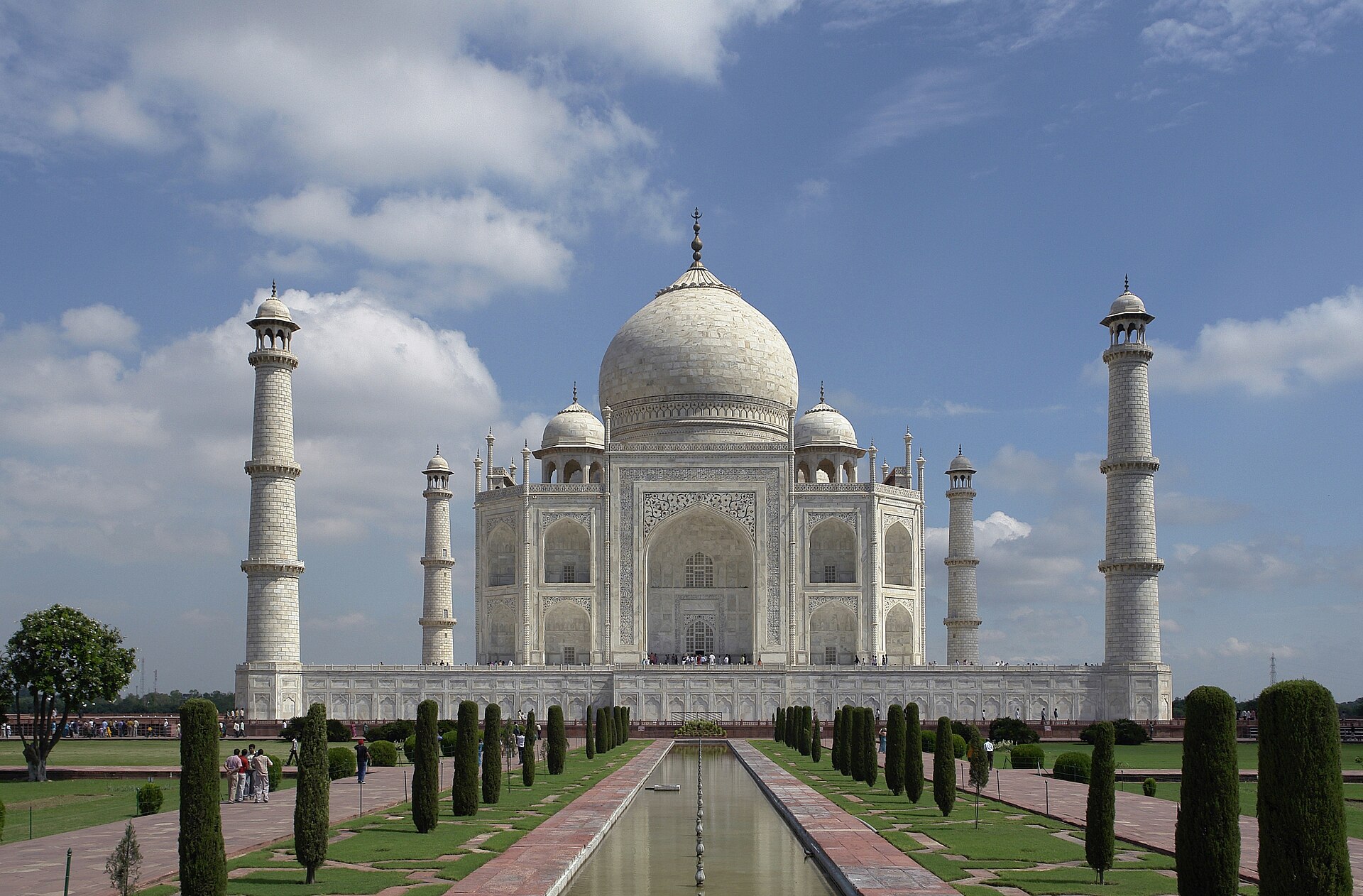
The Taj Mahal is a white-marble mausoleum complex on the right bank of the Yamuna in Agra, India, ordered by the Mughal emperor Shah Jahan in memory of his wife Mumtaz Mahal, who died in 1631. Construction began about 1632 under a team of architects and more than twenty thousand craftsmen, and the principal mausoleum was completed in 1648, with the outlying buildings and gardens finished by 1653. A UNESCO World Heritage site since 1983, the monument is celebrated for its symmetry, pietra dura inlay, Qur'anic calligraphy and charbagh garden, and is managed today by the Archaeological Survey of India within the Taj Trapezium Zone pollution-control regime.
In this article
- 1Overview
- 2Commission and Purpose
- 3Site and Setting
- 4Construction and Workforce
- 5Design and Architecture
- 6Materials and Decoration
- 7Garden
- 8Interior and Cenotaphs
- 9Later History and Conservation
- 10Timeline
- 11Timeline: from Shah Jahan's birth to the UNESCO inscription
- 12Frequently asked questions
- 13Knowledge graph
Overview
The Taj Mahal is a mausoleum complex in Agra, in the northern Indian state of Uttar Pradesh, commissioned by the Mughal emperor Shah Jahan in memory of his wife Mumtaz Mahal. It is regarded as the finest example of Mughal architecture, a style that fused Indian, Persian and Islamic traditions. The property was inscribed as a UNESCO World Heritage Site in 1983 under criterion (i). The Taj Mahal is one of the world's most iconic monuments, visited by millions of tourists each year. It attracts about 12,000 visitors a day.
1. Commission and Purpose
The Taj Mahal owes its existence to the death of Mumtaz Mahal, who died in 1631 during the birth of her fourteenth child at Burhanpur. When she died after giving birth, the emperor is reported to have refused to engage in court festivities and postponed two of his sons' weddings. Such stories have led to the Taj Mahal being referred to as an architectural symbol of love.
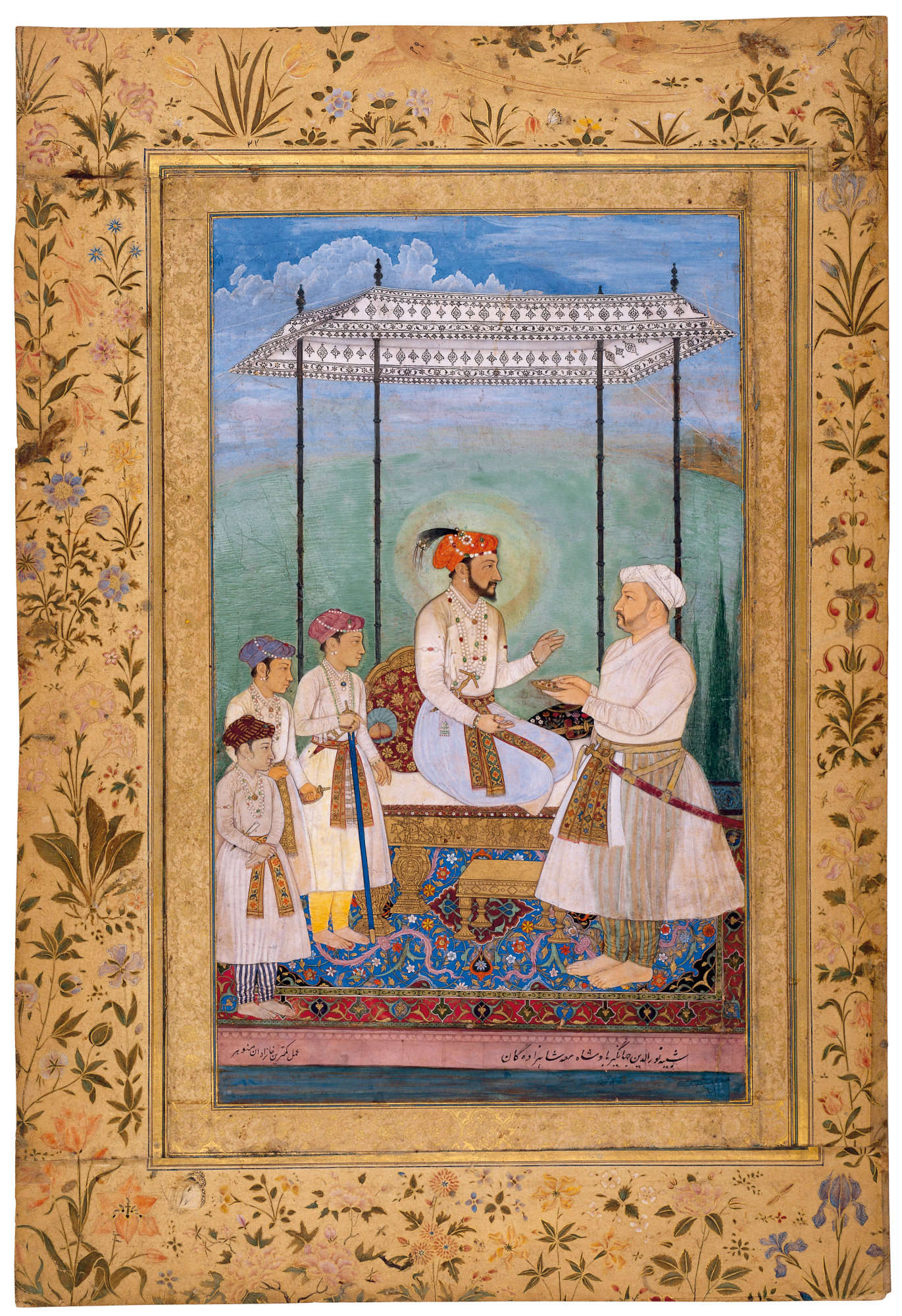
The mausoleum was raised by Shah Jahan, whose reign ran from 1628 to 1658 and who is most celebrated for his architectural achievements, the Taj Mahal being his and perhaps the country's best known monument. He selected the site for the mausoleum, located on the southern bank of the Yamuna River, and paid Raja Jai Singh of Amber four estates for the land. Shah Jahan was born in Lahore in 1592 and died at Agra in 1666.

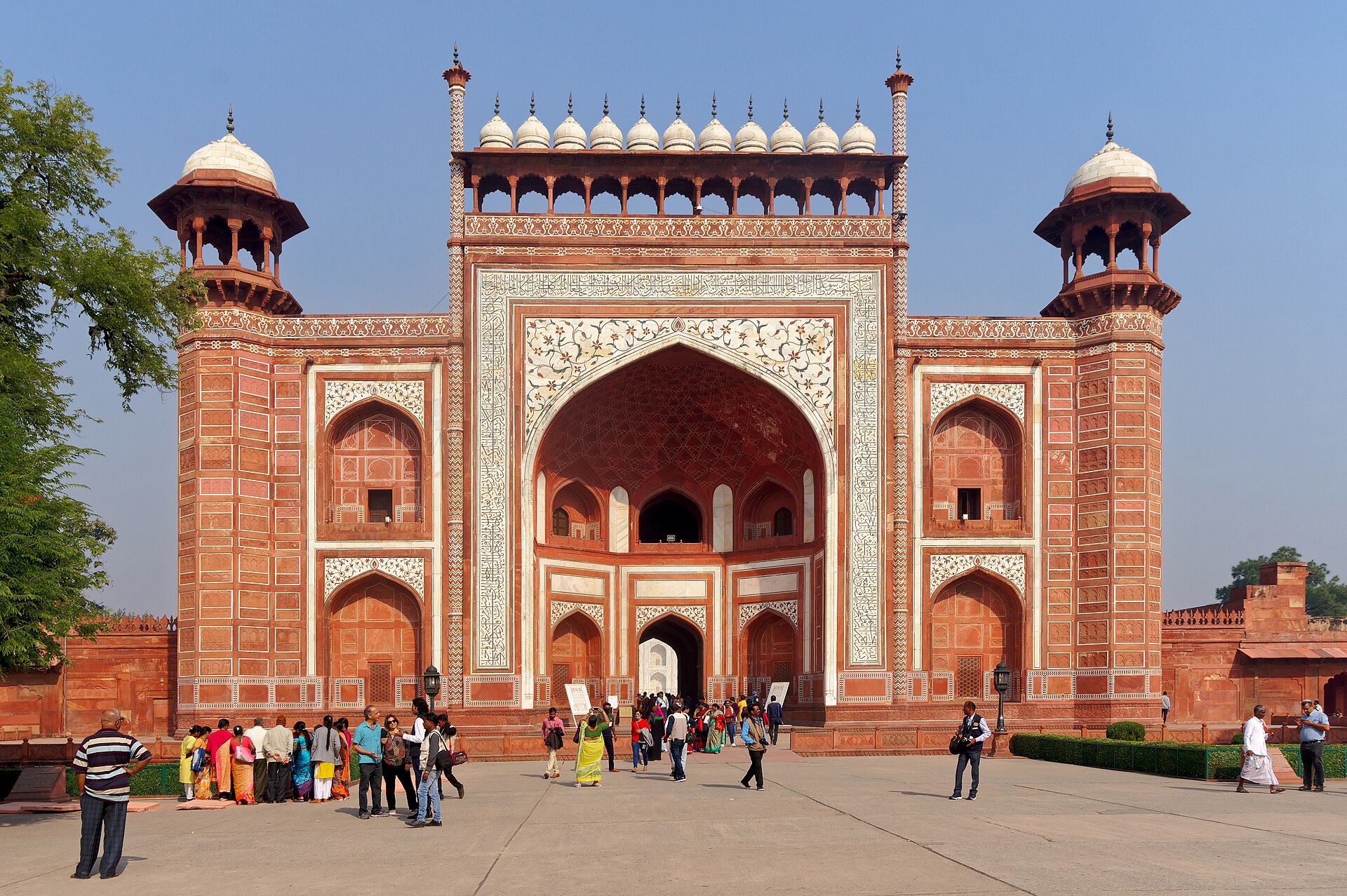
The five principal elements of the complex — main gateway, garden, mosque, jawab, and mausoleum with its four minarets — were conceived and designed as a unified entity according to the tenets of Mughal building practice, which allowed no subsequent addition or alteration. The rectangular ground plan measures 958 metres (3,143 feet) in length and 365 metres (1,200 feet) in width. Mughal mausoleums were commonly placed at the centre of their surrounding complex, but the main building of the Taj Mahal is located at one side of the rectangle nearest the river.
The Taj Mahal is an immense mausoleum of white marble, built in Agra between 1631 and 1648 by order of the Mughal emperor Shah Jahan in memory of his favourite wife; UNESCO describes it as the jewel of Muslim art in India and one of the universally admired masterpieces of the world's heritage. The principles of Shahjahani architecture expressed in the Taj Mahal include rational and strict geometry, perfect symmetrical planning with an emphasis on bilateral symmetry along a central axis, a hierarchical grading of materials, forms and colours, and sensuous attention to detail. The four corner minarets of the Taj Mahal are free-standing, another innovation in Mughal architecture, while the four corner towers of the main building are hexagonal and each has its own cupola.
2. Site and Setting
The Taj Mahal stands on the bank of the Jumna River in Agra, its elevation of inlaid white marble striking against the red sandstone of the other buildings in the complex. The rectangular complex runs roughly 1860 feet on the north-south axis and 1000 feet on the east-west axis, enclosed within a 42-acre (17-hectare) walled precinct. The riverfront terrace, the first part of the complex to be built, is the most ambitious ever raised in a Mughal riverfront garden scheme, unprecedented in size and decoration.
While bricks for internal constructions were locally prepared, the finest marble for external veneering work was obtained from quarries 250 miles away in Makrana, Rajasthan, the best material and skills having been employed from the outset so that the building would be remembered for its magnificence for ages to come.
3. Construction and Workforce
Construction began around 1632 and would continue for the next two decades, with the chief architect probably Ustad Ahmad Lahouri, an Indian of Persian descent who would later be credited with designing the Red Fort at Delhi. More than 20,000 workers, along with some 1,000 elephants, were brought in from India, Persia, the Ottoman Empire and Europe to build the mausoleum complex. According to a popular legend, Shah Jahan supposedly severed the hands and gouged the eyes of the artisans and craftsmen so that no one could recreate the Taj Mahal's beauty, but historians have found no evidence to support the story.
4. Design and Architecture
The design of the Taj Mahal is attributed to a team of architects. The architecture incorporated and reinterpreted many of the traditions, forms and symbolism of both indigenous Hindu architecture and the predominant Islamic architecture, a synthesis evident in the vegetative tracery, the inlay work, and the lotus dome and finial.
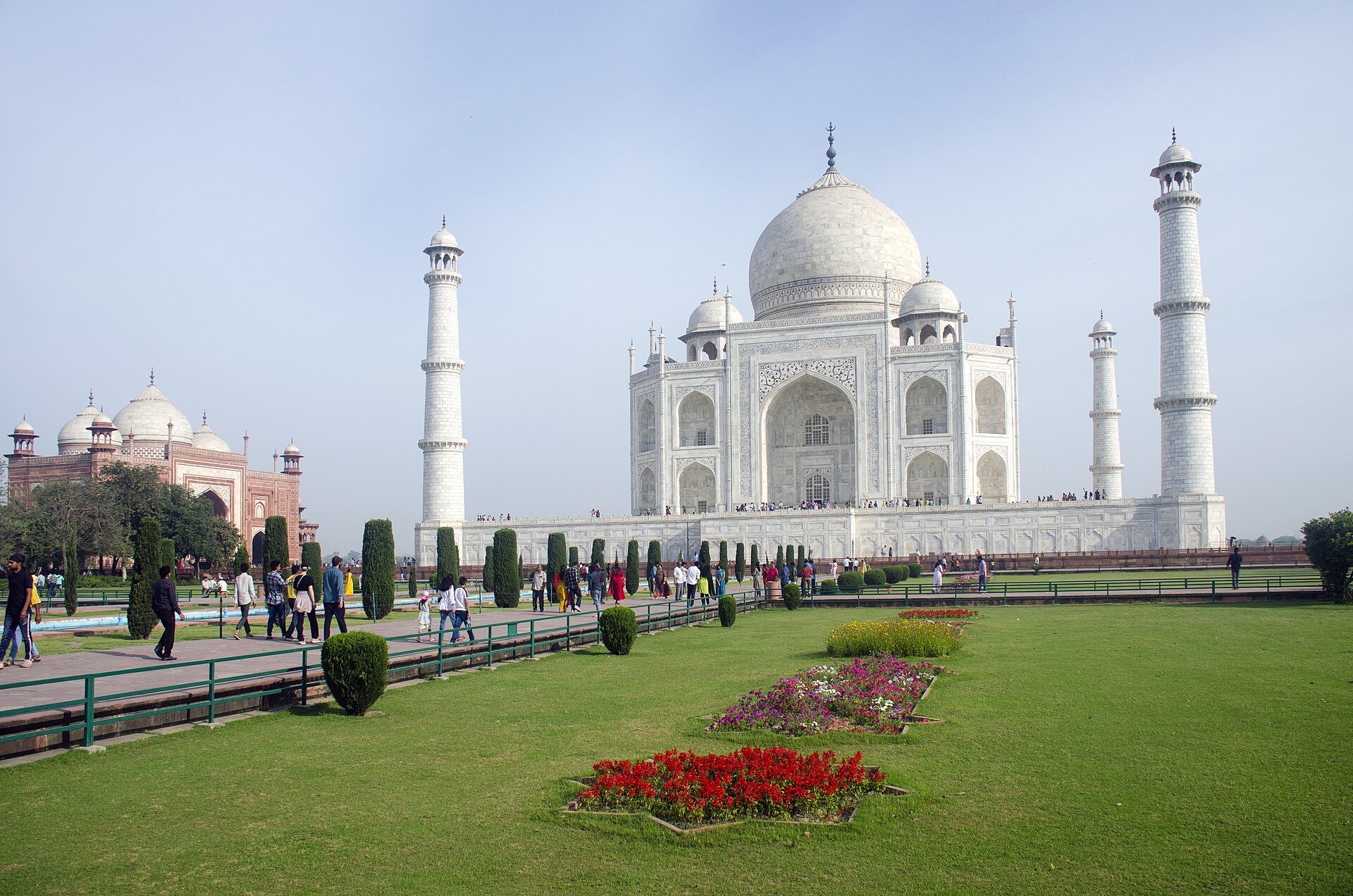
Resting in the middle of a wide plinth 23 feet (7 metres) high, the mausoleum proper is of white marble; it has four nearly identical facades, each with a wide central arch rising to 108 feet (33 metres) at its apex.The main dome reaches 240 feet (73 metres) at the tip of its finial and is surrounded by four lesser domes; it sits on a cylindrical drum roughly 23 feet high and is often called an onion dome, topped with a lotus design. Four free-standing minarets, each more than 130 feet tall, stand at the corners of the platform and were designed as working minarets, used by the muezzin to call the Islamic faithful to prayer. They were constructed slightly outside of the plinth so that, in the event of collapse, the material from the towers would tend to fall away from the tomb. The finial was originally gold and was replaced by a gilded-bronze copy in the early 19th century.
The main tomb building sits on a high square platform measuring 341 metres (1,119 feet) by 128 metres (420 feet), rising 6 metres (19.6 feet) above ground level, and large cylindrical wells were dug into the foundations to protect against flooding. The hall of the mausoleum has the form of a perfect octagon, 24 feet to a side, with two tiers of eight radiating niches, and the floor is paved in a geometrical pattern of octagonal stars alternating with pointed cruciform shapes.The interior of the mausoleum has a reverberation time of 28 seconds, providing an atmosphere where the words of the Hafiz, as they prayed for the soul of Mumtaz, would linger in the air.
The Taj Mahal is considered to be the greatest architectural achievement in the whole range of Indo-Islamic architecture, and its recognised architectonic beauty has a rhythmic combination of solids and voids, concave and convex, light and shadow. Mughal architecture reached its zenith during the reign of the emperor Shah Jahan, its crowning achievement being the magnificent Taj Mahal; the use of the double dome, a recessed archway inside a rectangular fronton, and parklike surroundings are all typical of the Shah Jahan period. The architects and craftsmen were masters of proportions and tricks of the eye: when one first approaches the main gate that frames the Taj, the monument appears incredibly close and large, but as one gets closer it shrinks in size, exactly the opposite of what one would expect. One of the allures of the Taj Mahal is its constantly changing hue: it may seem pearly gray and pale pink at sunrise, dazzling white at high noon, and orange-bronze when the sun sets, and in the evenings the Taj can appear translucent blue. In its 1983 evaluation ICOMOS recommended that the Taj Mahal and the Agra Fort form a joint proposition for inscription on the World Heritage List.
5. Materials and Decoration
Two decorative features recur throughout the complex. The first is pietra dura, the inlay of semiprecious stones such as lapis lazuli, jade, crystal, turquoise and amethyst in geometric and floral designs; the second is Arabic calligraphy. The colours of these inlays serve to moderate the dazzling expanse of the white marble.
Qur'anic verses were inscribed into the walls of the building, and designs were inlaid with semi-precious stones — coral, onyx, carnelian, amethyst, and lapis lazuli — adding to the splendor of the Taj's white exterior. The dominant theme of the carved imagery is floral.
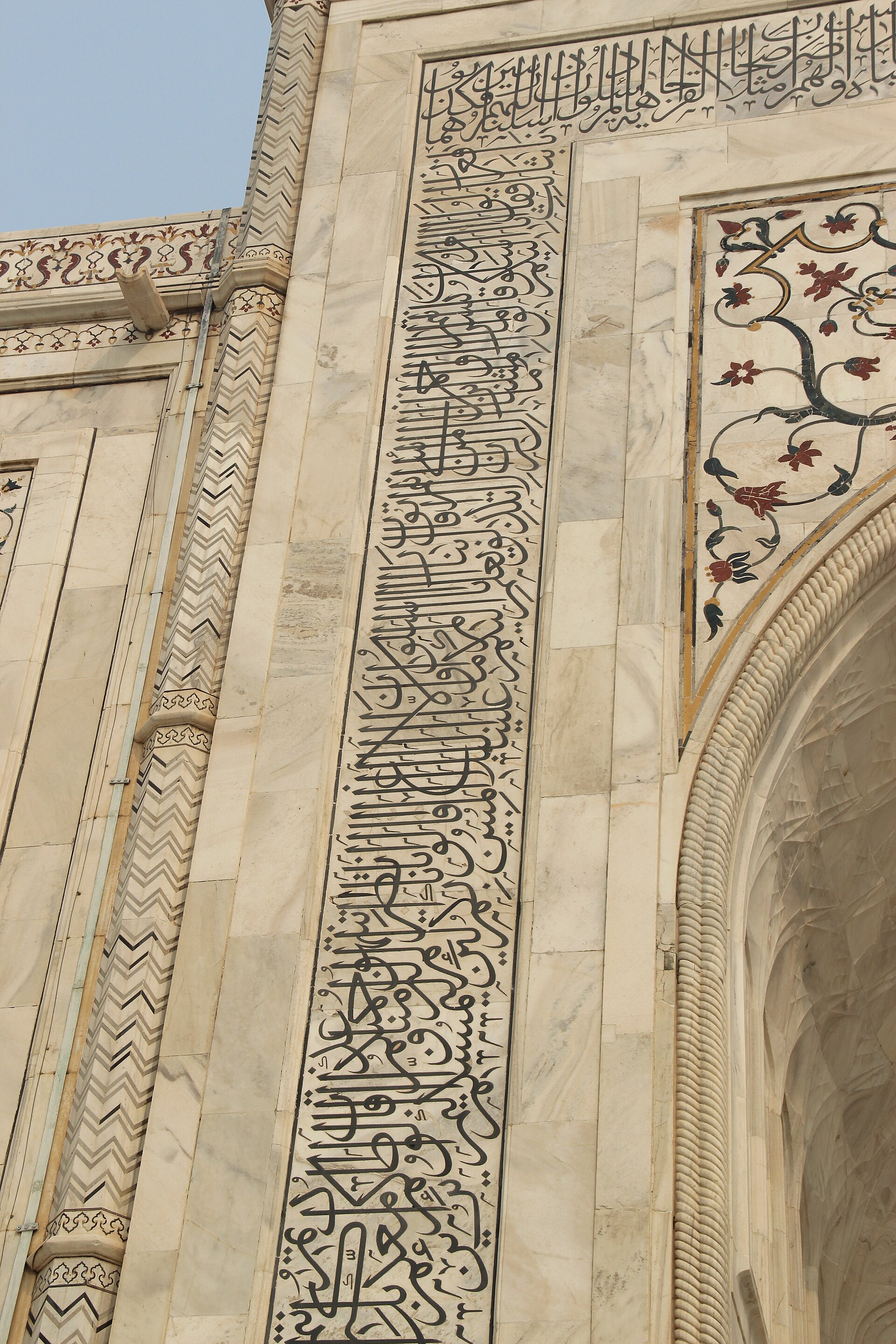
The calligraphic programme was carried out under the direction of Amanat Khan al-Shirazi, who oversaw the inscription of verses from the Qur'an across numerous sections of the Taj Mahal. One inscription in the sandstone gateway is known as Daybreak and invites the faithful to enter paradise.
6. Garden
The garden of the Taj Mahal belongs to the tradition of the paradise garden, a concept the Mughals brought from Persian Timurid gardens and knew as the charbagh, laid out in its ideal form as a square subdivided into four equal parts. Watercourses divide the ground into quadrants and sub-quadrants, and narrower cross-axial walkways, together with a surrounding walkway, form sixteen sub-quadrants. At the crossing of the walkways stands a raised platform of white marble with an ornamental pool containing five fountains; Kanbo claimed eulogistically that it held the water of the celestial Kausar, the Prophet's river in Paradise. The uniqueness of the Taj Mahal lies in remarkable innovations by the horticulture planners and architects of Shah Jahan: placing the tomb at one end of the quadripartite garden rather than in the exact centre added rich depth and perspective to the distant view of the monument.
7. Interior and Cenotaphs
The upper cenotaphs of Mumtaz Mahal and Shah Jahan stand in the octagonal hall of the tomb chamber, where the cenotaph of Mumtaz Mahal occupies the perfect centre. The cenotaph of Shah Jahan is larger and was installed more than thirty years later by the side of the latter on its west. The real graves lie in the lower tomb chamber, a practice adopted in the imperial Mughal tombs. The cenotaphs are aligned north-south with the head to the north, and the bodies were laid in their graves below on their side with their face turned towards Mecca, which in India is to the west.
The perforated marble screen was set up in 1643 to replace the original one of enamelled gold made by the goldsmith and poet Bibadal Khan on the occasion of the second anniversary of Mumtaz Mahal's death in 1633. It took ten years to make and cost 50,000 rupees, less than one-tenth of the cost of the gold screen.
8. Later History and Conservation
A tradition holds that Shah Jahan meant to raise a second mausoleum for his own remains on the far bank of the river, faced in black marble and joined to the Taj Mahal by a bridge; the plan was never realized, for he was deposed in 1658 by his son Aurangzeb and confined for the remainder of his life in Agra Fort. By the time Britain assumed rule over Agra in 1803 the Taj complex was dilapidated and the gardens were overgrown. During the Indian rebellion of 1857 the monument was defaced by British soldiers and government officials, who chiselled precious stones and lapis lazuli from its walls. A massive restoration project ordered by the British viceroy Lord Curzon was completed in 1908. The mausoleum has long drawn famous visitors: Princess Diana visited in February 1992, and the photograph of her sitting alone on a marble bench with the Taj behind her became one of the most famous images of the monument.
Modern conservation has centred on the air around the monument. An area of 10,400 sq km surrounding the Taj Mahal is defined to shield it from pollution, and in December 1996 the Supreme Court of India delivered a ruling banning the use of coal and coke in industries located in the Taj Trapezium Zone, a tract that comprises 40 protected monuments including three World Heritage Sites. Air pollution caused by emissions from factories and motor vehicles has damaged the mausoleum, notably its marble facade, and measures taken to reduce the threat include the closing of some foundries, the creation of a parkland buffer zone and the banning of nearby vehicular traffic.
9. Timeline
-
1631Construction beginsConstruction of the Taj complex began about 1631.13Creation History of the Taj Mahal · Department of Tourism, Government of Uttar Pradesh (official Taj Mahal website) ↗
-
1648Principal mausoleum completedThe principal mausoleum was completed in 1648.13
-
1653Outlying buildings and gardens finishedThe outlying buildings and gardens were finished in 1653.13
10. Timeline: from Shah Jahan's birth to the UNESCO inscription
- 5 January 1592Birth of Shah JahanShah Jahan was born in Lahore; he became the fifth Mughal emperor of India, reigning from 1628 to 1658.
- 1612Shah Jahan marries Arjumand Banu BegumHe married Arjumand Banu Begum, later known as Mumtaz Mahal, who became the favourite of his queens.
- February 1628Shah Jahan proclaimed emperorSupported by Asaf Khan, Shah Jahan proclaimed himself emperor at Agra after the death of his father Jahangir.
- 1631Death of Mumtaz MahalMumtaz Mahal died during the birth of her fourteenth child at Burhanpur; her remains were later transferred to Agra.
- about 1632Construction beginsBuilding of the Taj Mahal began about 1632, undertaken by a team of architects under the emperor Shah Jahan.
- 1643Marble screen set around the cenotaphsThe perforated marble screen replaced an earlier screen of enamelled gold made on the second anniversary of Mumtaz Mahal's death.
- 1648Mausoleum completedThe principal mausoleum of the Taj Mahal was completed in 1648, employing thousands of artisans and craftsmen.
- 1648Capital moved to DelhiShah Jahan transferred his capital from Agra to Delhi, creating the new city of Shahjahanabad there.
- 1653Outlying buildings and gardens finishedThe outlying buildings and gardens of the Taj Mahal complex were completed five years after the mausoleum.
- 1658Shah Jahan deposed and confinedAurangzeb declared himself emperor and strictly confined his father Shah Jahan in Agra Fort until his death.
- 22 January 1666Death of Shah JahanShah Jahan died at Agra and was interred alongside his wife Mumtaz Mahal, both cenotaphs enclosed within a marble lattice screen.
- 1857Defacement during the rebellionDuring the Indian rebellion the Taj Mahal was defaced by British soldiers and officials, who chiseled out precious stones from its walls.
- 1908Curzon restoration completedA massive restoration project ordered by the British viceroy Lord Curzon was completed, and the garden was remodelled with British-style lawns.
- 1983UNESCO World Heritage inscriptionThe Taj Mahal was designated a UNESCO World Heritage site under criterion (i).
- December 1996Supreme Court pollution rulingThe Supreme Court of India banned the use of coal and coke in industries in the Taj Trapezium Zone.
- 1998Restoration and research programmeA restoration and research program for the Taj Mahal was initiated in 1998 after decades of damage from air pollution.
11. Frequently asked questions
What exactly is the Taj Mahal, in architectural terms?
It is a mausoleum complex in Agra, western Uttar Pradesh, and is considered the finest example of Mughal architecture, a blend of Indian, Persian and Islamic styles.1Taj Mahal | Definition, Story, Site, History, & Facts · Encyclopaedia Britannica ↗
How large is the site, and what are its official coordinates?
What materials were used in its construction?
It is built of brick-in-lime mortar veneered with red sandstone and white Makrana marble, with hardstone inlay.2
Who inscribed the Qur'anic verses, and in what script?
The chief calligrapher was Amanat Khan al-Shirazi, also known as Abdul-Haq of Shiraz, who inscribed Qur'anic verses.21Calligraphy and inscriptions of the Taj Mahal · Department of Tourism, Government of Uttar Pradesh (official Taj Mahal website) ↗ The text is written in the thuluth script, and his signature appears in colophons within the marble inscriptions.21
How many Qur'anic passages appear on the monument?
There are twenty two passages from the Qur'an in all, including fourteen whole chapters, some of which are read out as part of the Islamic funeral ceremony itself.21
Who manages the site today?
It is managed by the Archaeological Survey of India, with the Taj Trapezium Zone pollution-control regime.2
References (21)
- 1Taj Mahal | Definition, Story, Site, History, & Facts — Encyclopaedia Britannica Web↩View source
- 2Taj Mahal — UNESCO World Heritage Centre — UNESCO World Heritage Centre Web↩View source
- 3Taj Mahal minarets damaged in storm — BBC News WebView source
- 4Taj Mahal — Archaeological Survey of India, Agra Circle WebView source
- 5The Taj Mahal — Smarthistory WebView source
- 6The Art of the Mughals after 1600 (Heilbrunn Timeline of Art History) — The Metropolitan Museum of Art 1600 WebView source
- 7Taj Mahal: Symbol of Love, Power, & Mughal Architecture — World History Encyclopedia WebView source
- 8Shah Jahan | Facts, Taj Mahal, & Family — Encyclopaedia Britannica WebView source
- 9Architecture of the Taj Mahal — Department of Tourism, Government of Uttar Pradesh (official Taj Mahal website) WebView source
- 10The Taj Exteriors — Department of Tourism, Government of Uttar Pradesh (official Taj Mahal website) WebView source
- 11Taj Mahal — HISTORY (A&E Television Networks) WebView source
- 12Eight Secrets of the Taj Mahal — Smithsonian Magazine WebView source
- 13Creation History of the Taj Mahal — Department of Tourism, Government of Uttar Pradesh (official Taj Mahal website) Web↩View source
- 14Mughal architecture | History, Characteristics, & Facts — Encyclopaedia Britannica WebView source
- 15ICOMOS advisory body evaluation No. 252: Taj Mahal — ICOMOS / UNESCO World Heritage Centre WebView source
- 16The Taj Garden — Department of Tourism, Government of Uttar Pradesh (official Taj Mahal website) WebView source
- 17The Taj Interiors — Department of Tourism, Government of Uttar Pradesh (official Taj Mahal website) WebView source
- 18How to Save the Taj Mahal? — Smithsonian Magazine WebView source
- 19History of the Taj Mahal — Department of Tourism, Government of Uttar Pradesh (official Taj Mahal website) WebView source
- 20Trump to Diana: Iconic Taj Mahal photos through the years — BBC News WebView source
- 21Calligraphy and inscriptions of the Taj Mahal — Department of Tourism, Government of Uttar Pradesh (official Taj Mahal website) Web↩View source