Cuneiform
The world's oldest writing system — from its invention by the Sumerians at Uruk, through its spread across the ancient Middle East, to its decipherment at Behistun and the clay libraries of Assyria.
Cuneiform was the writing system of the ancient Middle East for three millennia. Emerging at the end of the fourth millennium BCE as pictographic ledgers at Uruk, it developed into a script of wedge-shaped strokes used for some 15 languages, from Sumerian and Akkadian to Hittite and Old Persian. Rediscovered at Persepolis and Behistun, it was deciphered by Grotefend, Rawlinson, Hincks and their rivals in the 19th century, opening the literature and records of Mesopotamia — including the library of Ashurbanipal at Nineveh.
In this article
Overview
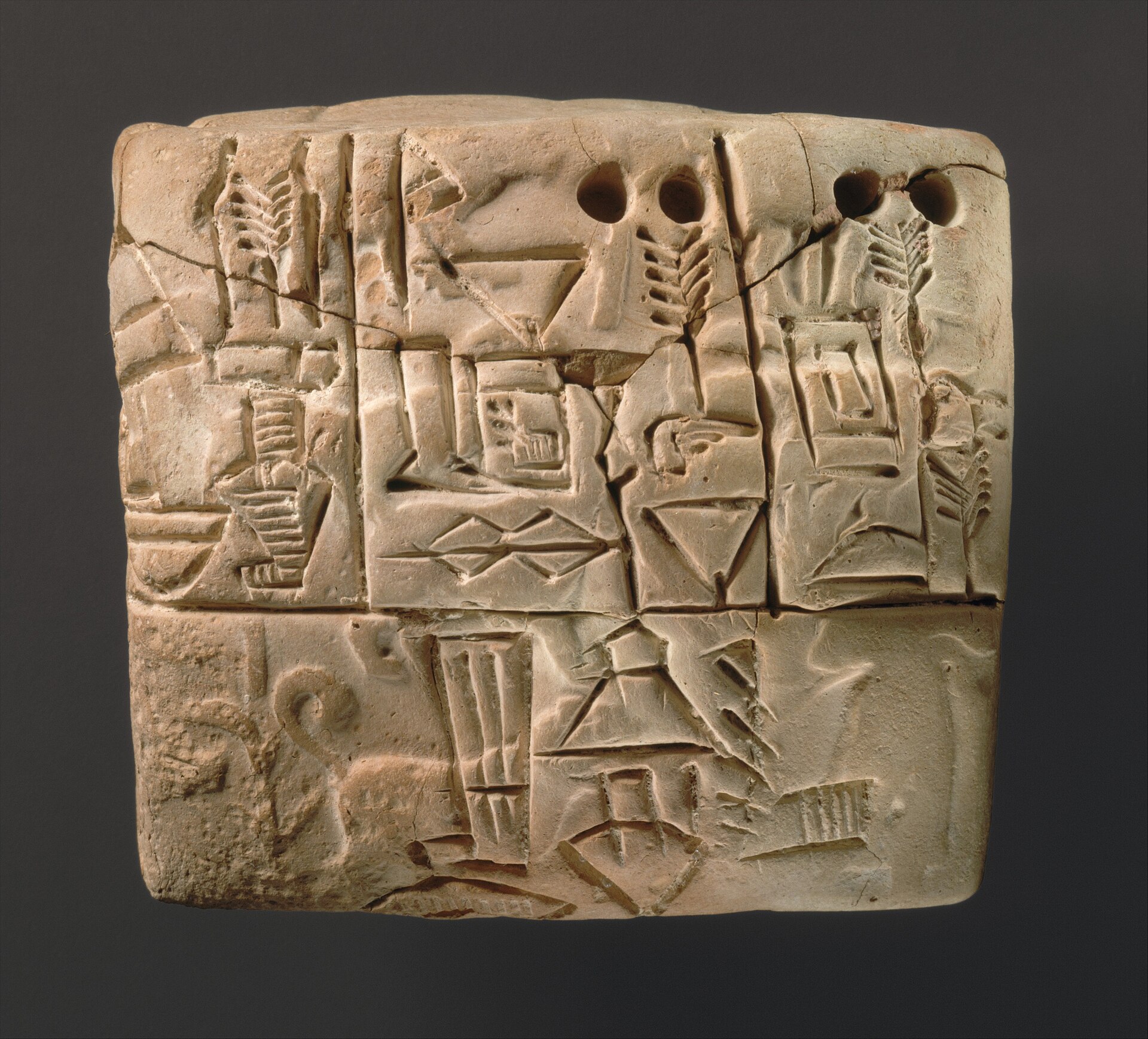
Cuneiform is, as far as is known, the oldest form of writing in the world. It is a logo-syllabic system, employing both phonetic characters and logograms, or word signs, and it could be used to write different languages. The script was first developed by the ancient Sumerians of Mesopotamia, and the earliest records come from Uruk in southern Mesopotamia.
Across an active history spanning roughly three millennia, cuneiform was used to write around 15 different languages, among them Sumerian, Akkadian, Babylonian, Assyrian, Elamite, Hittite, Urartian and Old Persian. By the second century CE knowledge of the characters had faded away.
1. Name and Writing Technique
The name of the script derives from the Latin cuneus, meaning "wedge," a reference to the wedge-shaped strokes that define its appearance. This form arose because the writing was pressed into soft clay with the slanted edge of a stylus, so that linear strokes acquired their characteristic wedge shape as the script grew successively more cursive over the course of the 3rd millennium BCE. Assyrian and Babylonian scribes worked with the thick stem of a reed, the Arundo donax, splitting the stalks to create a trapezoidal tip, pressing signs into damp clay and firing the inscribed tablets in a kiln, which made them almost indestructible.
Cuneiform employs between 600 and 1,000 characters impressed on clay, spelling words by dividing them into syllables, while other signs stood for whole words. The number of characters used in writing was reduced from over 1,000 to 600 in order to simplify and clarify the written word.
2. Origins and Early Development
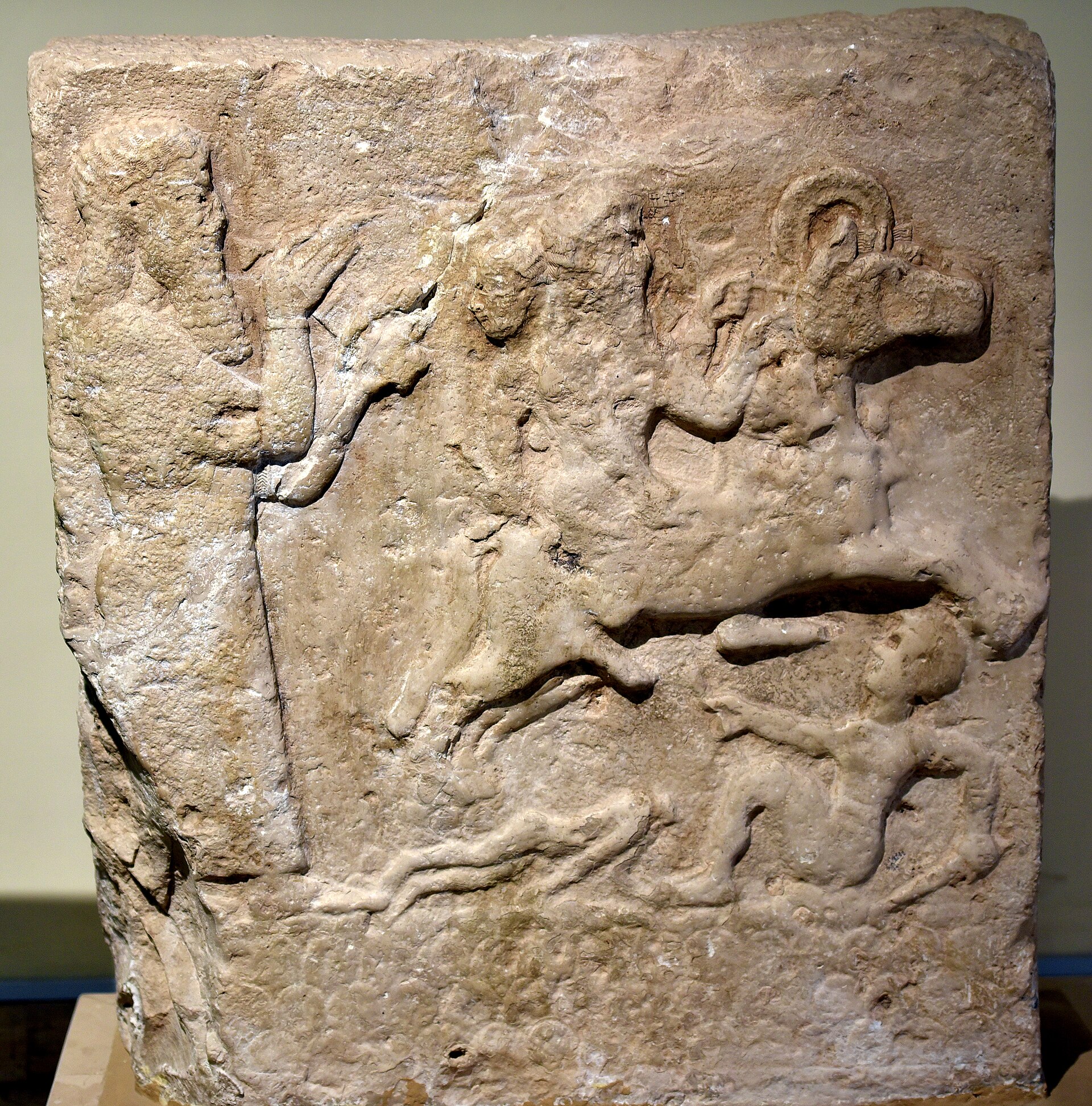
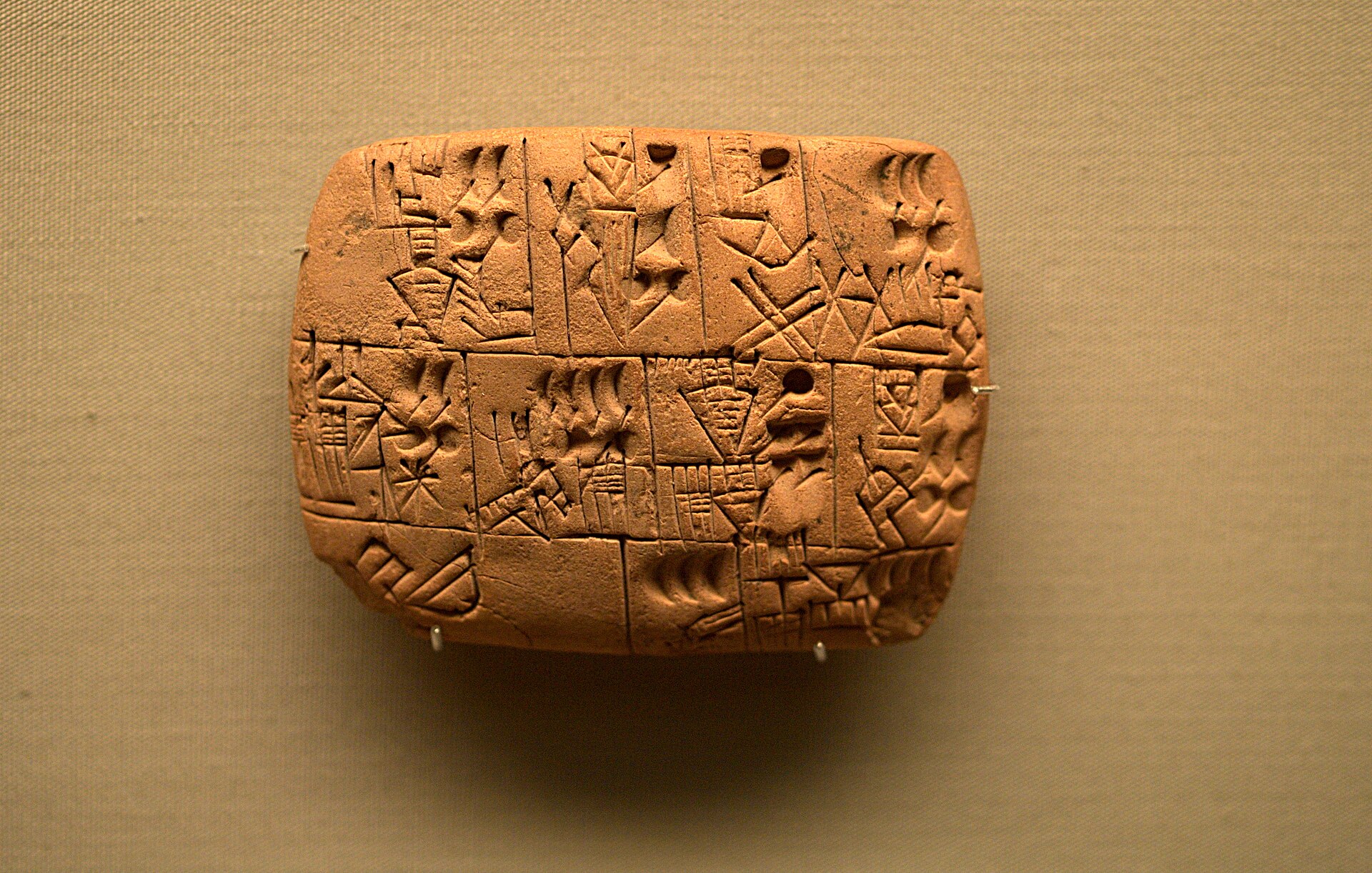
The earliest traces of cuneiform are traced to the end of the 4th millennium BCE, around 3200 BCE. Very early cuneiform is represented by an accounting tablet from Uruk III of the late fourth millennium BCE. The city of Uruk surpassed all others as an urban center, covered approximately 250 hectares, or.96 square miles, and has been called the first city in world history. On a tablet recording the allocation of beer, the symbol for beer, an upright jar with pointed base, appears three times, and alongside the pictographs are five different shaped impressions representing numerical symbols.
The alphabet was invented only in the early second millennium BCE, somewhere in the vicinity of Egypt, Sinai, or possibly Byblos in the Levant.
Compared to other ancient civilizations, Mesopotamian written sources are abundant, and above all they are original.
3. Spread, Languages and Later History
Written material in at least eight languages has been recovered from Ugarit: Akkadian, Ugaritic, Hittite, Luwian, Sumerian, Hurrian, Egyptian and an unknown language written in Cypro-Minoan. The alphabetic cuneiform of Ugarit is structurally almost identical to the linear alphabets that were becoming established elsewhere in the Levant and would develop into the Phoenician, Hebrew and Arabic alphabets.
Assyrian scholarship was focused on understanding the will of the gods, so the library focused on texts that interpreted omens from the gods. Ashurbanipal enjoyed scholarly pursuits and could read and write, which was unusual for a king.
The sexagesimal system of the Babylonians, that is to say base 60 in modern notation, underpinned counting in ancient Mesopotamia. Among the highlights of the Yale Babylonian Collection is a mathematical school tablet labelled YBC 7289 which approximates the square root of two.
A particularly exciting venture is the electronic Babylonian Literature project, which currently holds about 20,000 editions of tablet fragments from the British Museum. Searchable databases of cuneiform texts and artefacts include the Cuneiform Digital Library Initiative, the Open Richly-Annotated Cuneiform Corpus, Archibab, Achemenet, the Database of Neo-Sumerian Texts and the Electronic Text Corpus of Sumerian Literature. The CDLI pursues the systematic digital documentation and electronic dissemination of the entire cuneiform text corpus.
The latest known example of the script is an astronomical almanac from CE 75, found in southern Mesopotamia and predicting the appearances of stars, planets and other heavenly bodies.
4. The Library of Ashurbanipal
The Library of Ashurbanipal, of the 7th century BCE, is the oldest known systematically organized library in the world, established in Nineveh by the Neo-Assyrian king Ashurbanipal to preserve the history and culture of Mesopotamia. Its holdings were buried beneath the burning walls of Ashurbanipal's palace and were lost for over 2,000 years. The first broken and scattered remains came to light at Nineveh in 1849 and are now at the British Museum.
The Ashurbanipal Library, commonly referred to as the Kuyunjik Collection, is a convenient label for around 32,000 cuneiform tablets and fragments from the British Museum's excavations at Nineveh.
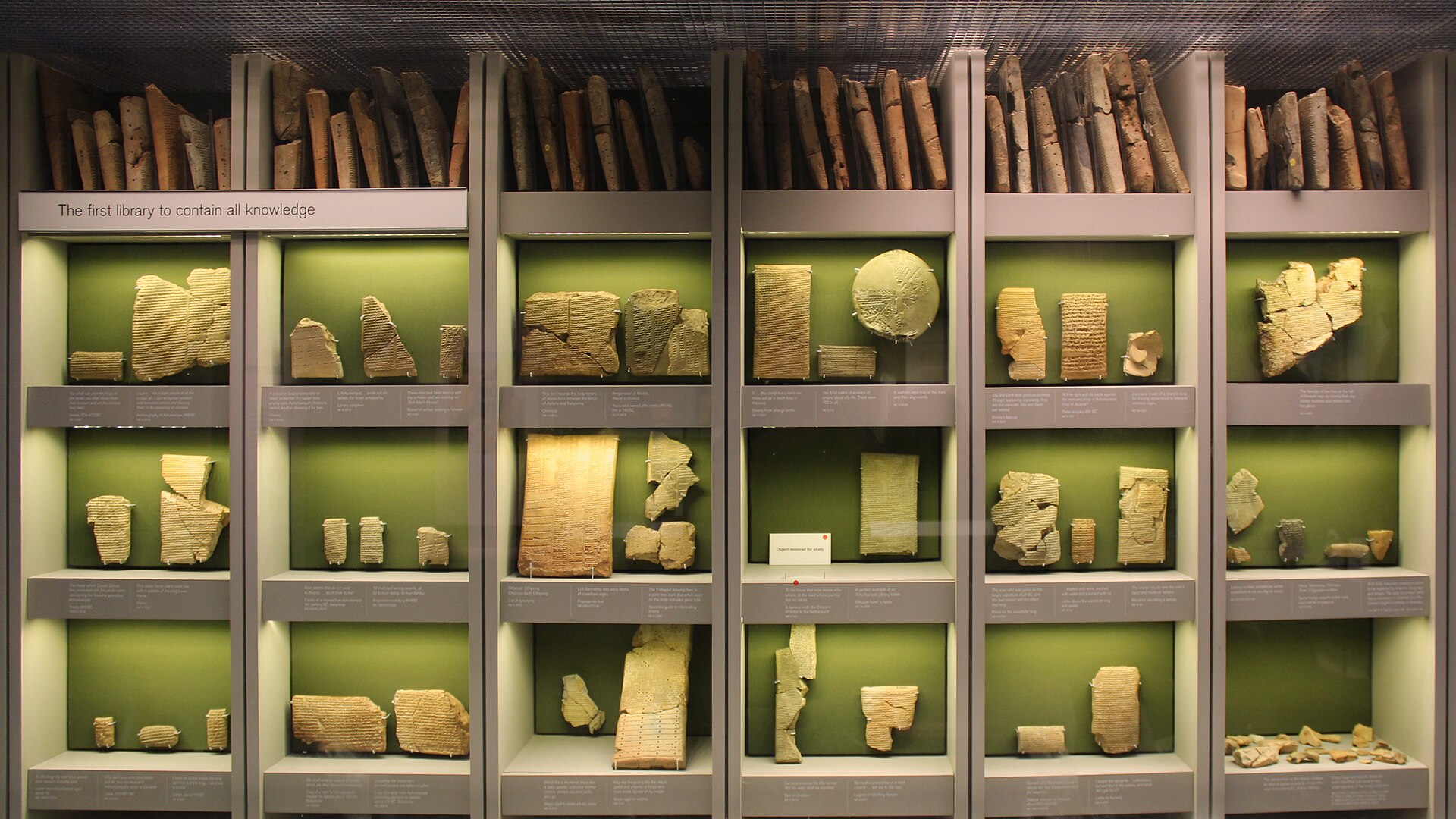
Cuneiform writing culminated in the extensive records from the library of Ashurbanipal at Nineveh, built up around 650 BCE. A large part of the library was produced on the orders of Ashurbanipal, King of Assyria from 669 to about 630 BC, though others are earlier.
5. Decipherment
Europe was already familiar with wedge-shaped cuneiform writing from copies made in 1765 by Carsten Niebuhr at the ruined Persian capital of Persepolis, and Grotefend, who began teaching at the Göttingen city school in 1797, worked from that material.
Sir Henry Creswicke Rawlinson was a British army officer and Orientalist who deciphered the Old Persian portion of the trilingual cuneiform inscription of Darius I the Great at Bīsitūn in Iran. Edward Hincks took the first great strides in deciphering Akkadian cuneiform in 1846 by searching for the names of ancient Persian kings in the parallel inscriptions, obtaining the approximate phonetic value of more than 100 Akkadian characters.
The discovery of the Gilgamesh flood story was announced in 1872 by George Smith, who was examining clay tablets that archaeologists had shipped back to London from Nineveh. On 20 May 1857 the judges gathered at the Royal Asiatic Society's townhouse on New Burlington Street to test the competing translations of cuneiform.
6. The Behistun Inscription
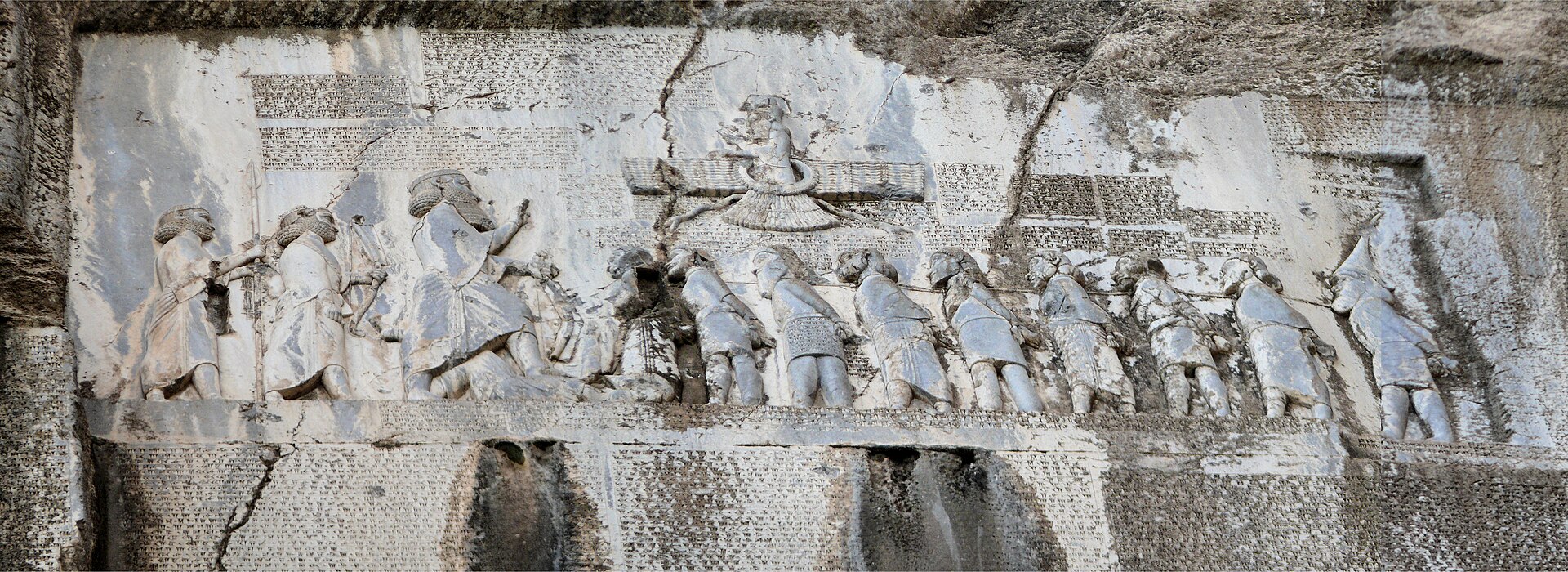
The Behistun Inscription is a relief with accompanying text carved 330 feet (100 meters) up a cliff in Kermanshah Province, western Iran. It stands at Bisotun, along the ancient trade route linking the Iranian high plateau with Mesopotamia, and its principal monument is the bas-relief and cuneiform inscription ordered by Darius I the Great when he rose to the throne of the Persian Empire in 521 BC. The inscription is trilingual in Old Persian, Elamite and Akkadian, relating Darius I's autobiography, his authority to rule by divine grace, and his triumph over those who opposed his rise to power.
Sir Henry Rawlinson copied the three cuneiform texts in 1835 and 1843; his copy enabled him and other notable scholars of the time to decipher the inscriptions. The English translation of the Behistun Persian text used by Livius was made by L. Thompson and published in London in 1907 as The Sculptures and Inscription of Darius the Great on the Rock of Behistun. Bisotun was inscribed on the World Heritage List in 2006 under criteria (ii) and (iii), with a property of 187 hectares.
7. Tablets, Collections and Research
Hundreds of thousands of cuneiform artifacts have been unearthed throughout Iraq, Syria, Iran and Turkey, and these archaeological discoveries are our main sources for Mesopotamian history. The British Museum's collection of cuneiform tablets, which includes the Kuyunjik tablets from Nineveh, is among the most important in the world, containing approximately 130,000 texts and fragments and perhaps the largest collection outside of Iraq.
8. Significance and Legacy
Cuneiform was the most widespread and historically significant writing system in the ancient Middle East, its active history comprising the last three millennia BCE. It and hieroglyphs continue to vie for the title of the oldest writing system, a title that rightfully belongs to cuneiform. Both predate the alphabet by far more than a thousand years.
9. Timeline: from the first tablets to the decipherment
- c. 3200 BCEFirst pictographic tablets at UrukCuneiform's origins are traced to the end of the 4th millennium BCE; the earliest records are pictographic tablets from Uruk, listing commodities with drawings, numerals and personal names.
- c. 2500 BCEThe Akkadians adopt the scriptAbout the middle of the 3rd millennium BCE the Sumerian writing system was adopted by the Akkadians, who kept its logograms but read them as Akkadian words.
- c. 1750 BCEThe Code of HammurabiThe Code of Hammurabi is written in Old Babylonian cuneiform, which developed through later eras into Middle and New Babylonian types.
- c. 1400 BCEAlphabetic cuneiform at UgaritCuneiform was adapted to a consonantal script of about 30 signs at the Canaanite city of Ugarit on the Syrian coast.
- c. 650 BCEThe library of AshurbanipalWriting culminates in the extensive records from the library of Ashurbanipal at Nineveh, destroyed with the Assyrian empire and rediscovered in the 19th century.
- c. 520 BCEThe Behistun inscriptionDarius I has the trilingual inscription and relief engraved about 100 meters above the road connecting Babylon and Ecbatana, on the rock of Bagastâna.
- c. 75 CEThe last datable tabletThe last datable cuneiform tablet is an astronomical almanac from southern Mesopotamia; by the second century CE the meaning of the characters had faded away.
- 1765Niebuhr copies PersepolisThe German traveler Carsten Niebuhr makes copies of the cuneiform inscriptions at the ruined Persian capital of Persepolis, which would inform later decipherment.
- 2 September 1802Grotefend's breakthroughGrotefend reports the first successful readings of Old Persian cuneiform; of the 13 symbols he deciphered, 9 were correct.
- 1837Rawlinson publishes at BehistunAfter two years of work, Rawlinson publishes his translations of the first two paragraphs of the Behistun inscription.
- 1846Hincks and the Akkadian signsEdward Hincks obtains the approximate phonetic value of more than 100 Akkadian characters by matching the names of Persian kings in the parallel inscriptions.
- 1849The library found at NinevehThe first broken and scattered remains of Ashurbanipal's library are found; the tablets are now at the British Museum.
- 20 May 1857The decipherment confirmedJudges gather at the Royal Asiatic Society on New Burlington Street to compare the competing translations, and the decipherment of Mesopotamian cuneiform is secured.
- November 1872George Smith reads the Flood TabletGeorge Smith reads the Babylonian flood story on a tablet from Nineveh — the first independent confirmation of a vast flood in ancient Mesopotamia.
- 2006Bisotun joins the World Heritage ListThe Behistun archaeological site is inscribed on the UNESCO World Heritage List under criteria (ii) and (iii).
References (24)
- 1How to write cuneiform — The British Museum WebView source
- 2The Mystery of the World's Oldest Writing System Remained Unsolved Until Four Competitive Scholars Raced to Decipher It — Smithsonian Magazine WebView source
- 3Cuneiform | Definition, History, & Facts — Encyclopaedia Britannica WebView source
- 4Cuneiform, an introduction — Smarthistory (The British Museum) WebView source
- 5Cuneiform — World History Encyclopedia WebView source
- 6The Alphabet: The First Thousand Years — The Ancient Near East Today (ASOR) WebView source
- 7The Origins of Writing — The Metropolitan Museum of Art, Heilbrunn Timeline of Art History (Ira Spar) WebView source
- 8Cuneiform Written Artifacts and Missing Evidence in the Study of the Ancient Near East — The Ancient Near East Today (ASOR) WebView source
- 9The Social Context of Writing in Ancient Ugarit — The Ancient Near East Today (ASOR) WebView source
- 10A library fit for a king — The British Museum WebView source
- 11Who was Ashurbanipal? — The British Museum WebView source
- 12An overview of Babylonian mathematics — MacTutor History of Mathematics Archive, University of St Andrews WebView source
- 13Highlights of the Yale Babylonian Collection — Yale Babylonian Collection, Yale University WebView source
- 14The Cuneiform Wide Web: From Card Catalogues to Digital Assyriology — The Ancient Near East Today (ASOR) WebView source
- 15About CDLI — Cuneiform Digital Library Initiative WebView source
- 16Library of Ashurbanipal — World History Encyclopedia WebView source
- 17What is the Library? (Ashurbanipal Library Project) — ORACC / The British Museum, University of Pennsylvania WebView source
- 18Georg Friedrich Grotefend | Middle High German, Epigraphy, Decipherment — Encyclopaedia Britannica WebView source
- 19Sir Henry Creswicke Rawlinson | Persian Scholar, Archaeologist, Decipherer — Encyclopaedia Britannica WebView source
- 20Epic Hero (George Smith and the Flood Tablet) — Smithsonian Magazine WebView source
- 21Behistun Inscription — World History Encyclopedia WebView source
- 22Bisotun — UNESCO World Heritage Centre WebView source
- 23Behistun (3): Translation of the Persian Text — Livius.org (trans. L.W. King and R.C. Thompson) WebView source
- 24Behistun — Livius.org (Jona Lendering) WebView source