Magnetar
A neutron star whose magnetic field is a thousand trillion times stronger than Earth's — strong enough to distort the vacuum itself.
A magnetar is a neutron star with an extreme magnetic field of roughly 10^9 to 10^11 tesla, a hundred million times stronger than any man-made magnet. They form in supernovae when a newborn neutron star's spin, heat and field combine to drive a dynamo that pushes the field past a quadrillion gauss. Their fields decay within about 10,000 years, so they are short-lived and often invisible outside X-rays and gamma rays. Two events defined the class: the 5 March 1979 flare from SGR 0526-66 across the Large Magellanic Cloud, and the 27 December 2004 giant flare from SGR 1806-20, which briefly outshone every cosmic flash ever recorded.
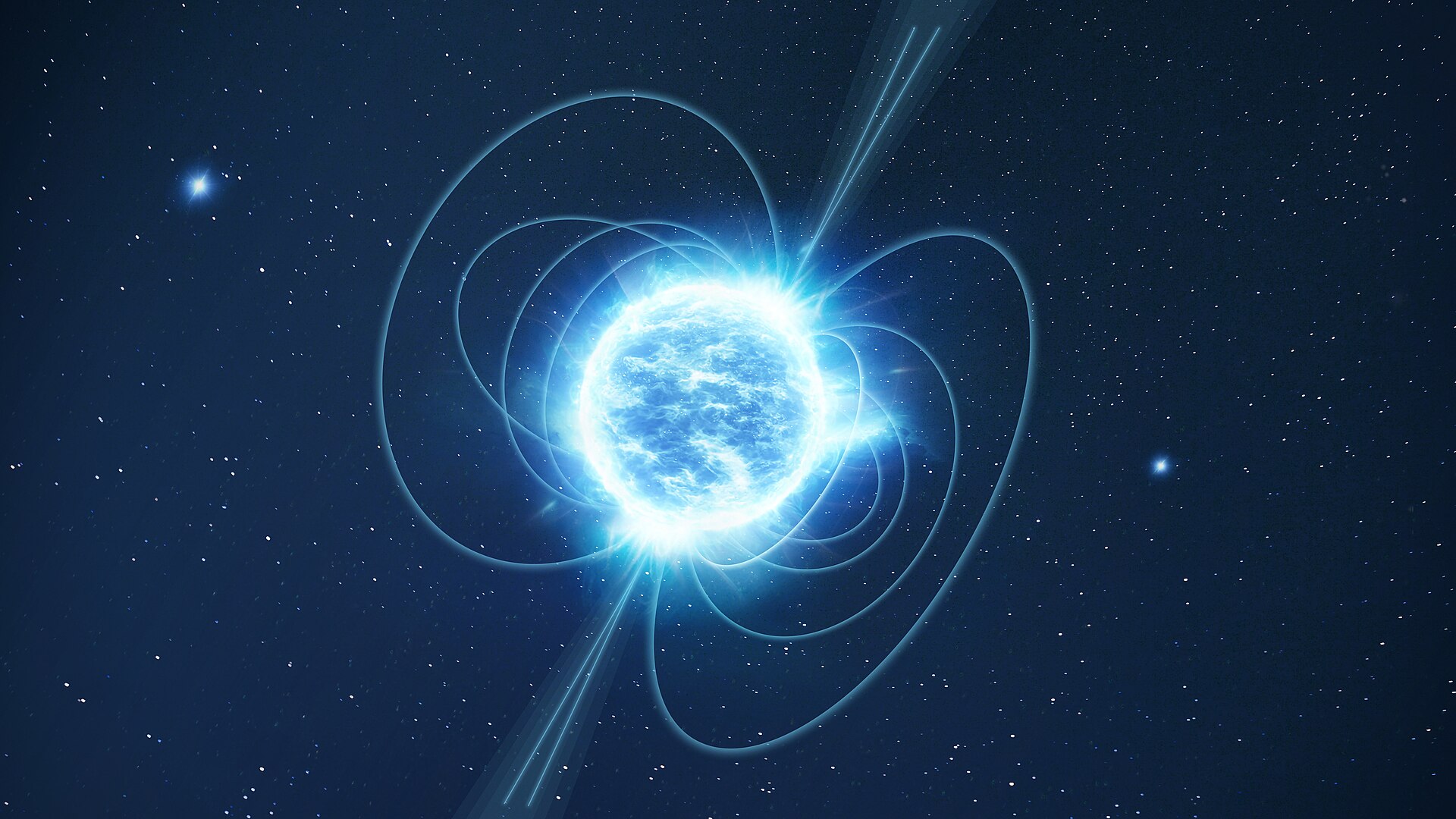
Overview
A magnetar is a neutron star whose magnetic field reaches an extreme intensity of roughly 10^9 to 10^11 tesla (10^13 to 10^15 gauss). It belongs to a special breed of neutron star rather than an ordinary one. When NASA prepared its overview of the subject only about a dozen magnetars had been found.
1. Magnetic field
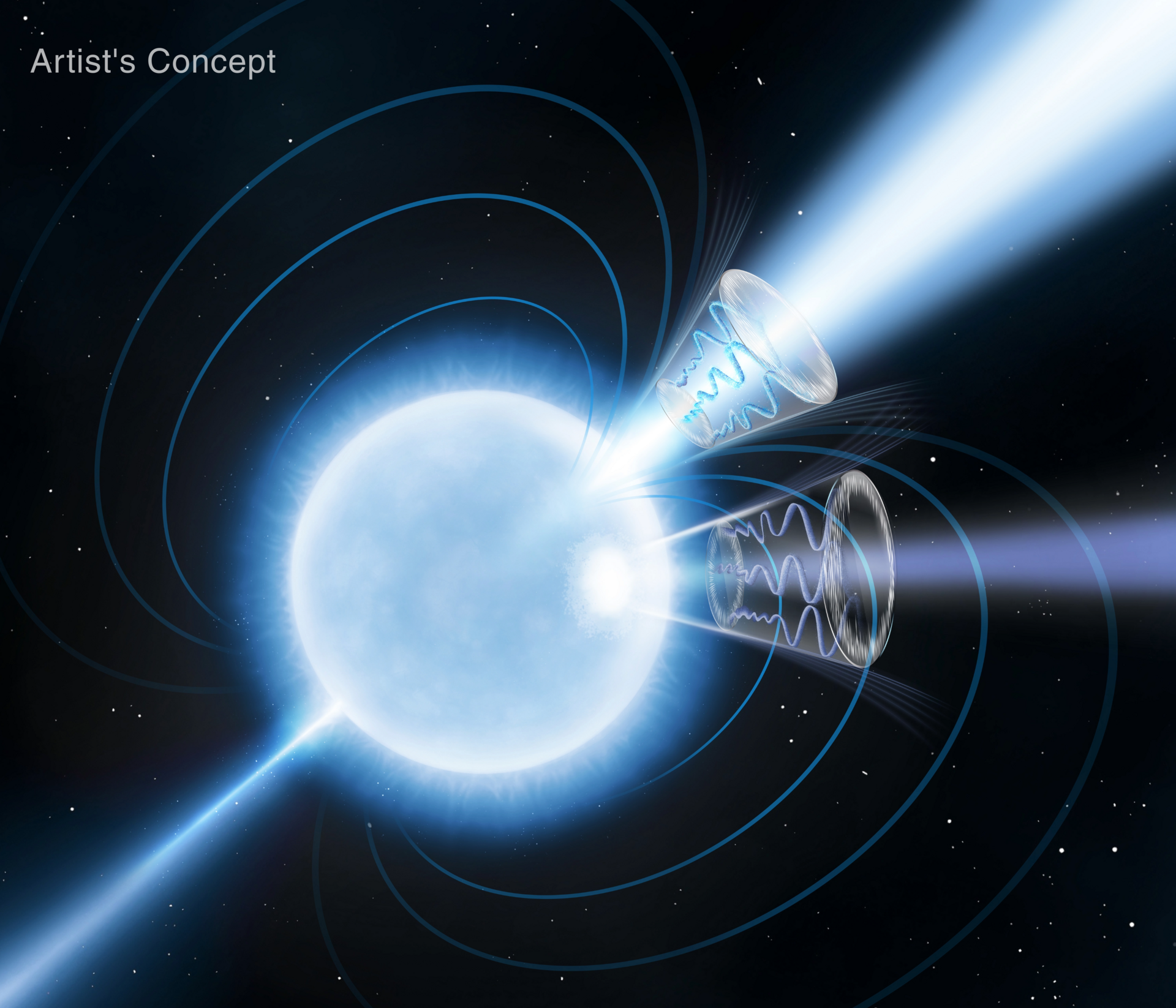
The magnetic field of a magnetar reaches strengths of 10^10 tesla, or 10^15 gauss, a regime in which the field itself dominates the physics of the star. At this strength the field is about a hundred million times stronger than any man-made magnet and roughly a trillion times stronger than Earth's field. The energy stored in the field is correspondingly extreme: at 10^10 T the magnetic energy density reaches 4.0 x 10^25 joules per cubic metre.
2. Physical properties
A magnetar measures roughly 20 kilometres across, equivalent to about 12 mi. Its mass is about 1.4 solar masses. The interior is so dense that a tablespoon of its material would have a mass of over 100 million tons.
3. Formation and evolution
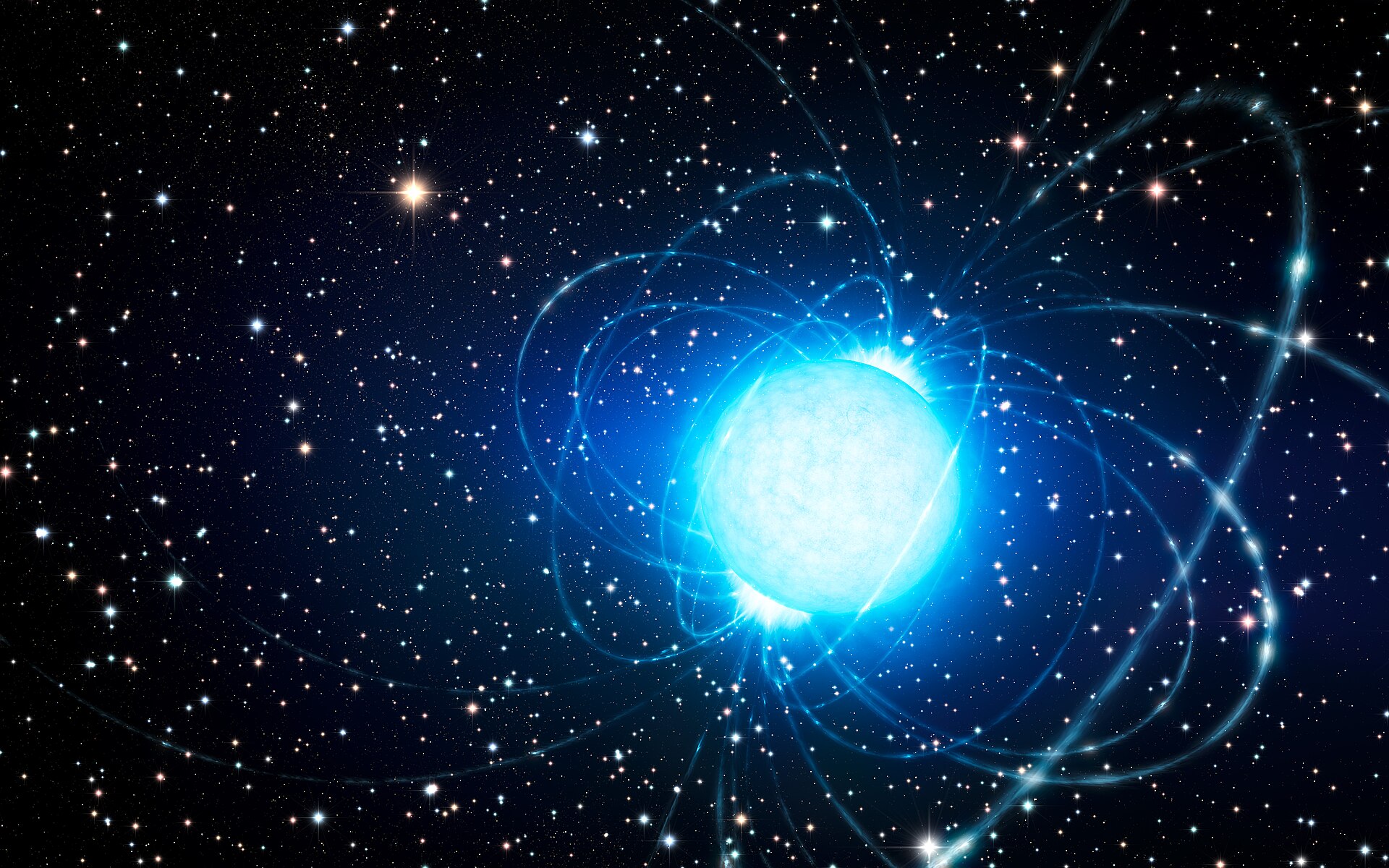
A magnetar begins as a neutron star born in a supernova, where the magnetic field is amplified by conservation of magnetic flux; halving a linear dimension increases field strength fourfold. Theorists proposed in 1992 that newborn neutron stars could hold fields greater than a quadrillion gauss, the maximum efficiency of a neutron star dynamo. Duncan and Thompson first proposed the magnetar idea in 1992 to explain soft gamma repeaters.
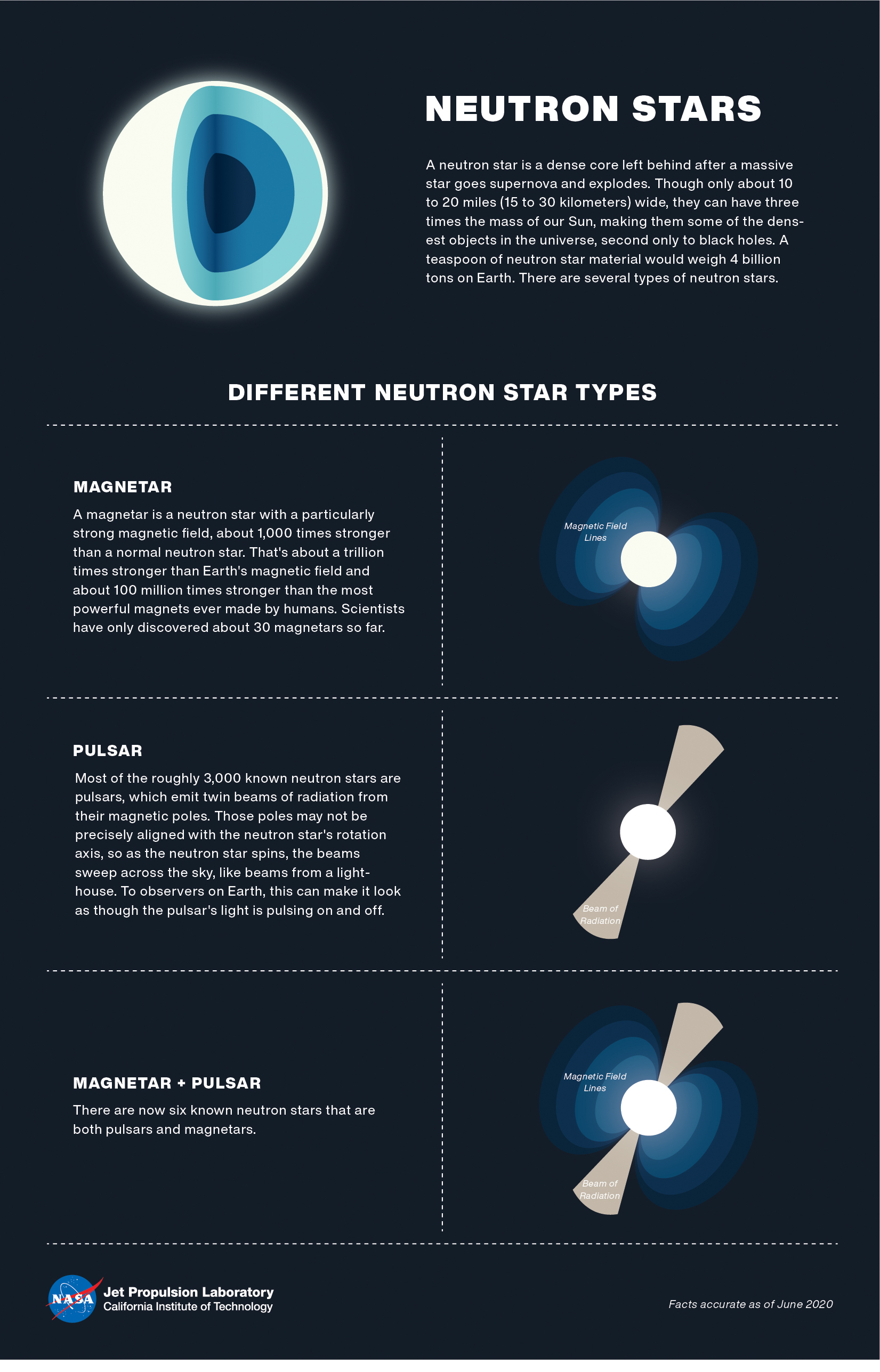
The strong field decays after about 10,000 years, after which activity and strong X-ray emission cease. Superstrong fields make a neutron star brake and cool, so magnetars are hard to observe in radio and X-rays and may litter the Galaxy as dark relics. Because the magnetar stage is a brief phase only about a dozen magnetars are known.
4. Rotation and spin-down
Most observed magnetars rotate once every 2 to 10 seconds, whereas typical radio pulsars rotate 1 to 10 times per second. NASA scientists estimate that magnetic fields act as brakes on a neutron star, so a higher field drives a faster spin-down rate. Kouveliotou's 1998 team measured the field using RXTE and ASCA data, finding SGR 1806-20 spinning once every 7.5 seconds.
5. Observational history
The observational record of magnetars begins with a signal that arrived without warning. Nine satellites recorded a rapid gamma-ray spike from the direction of the N49 remnant with 8-second pulsations. The giant burst of March 1979 lasted only 0.2 seconds but carried as much energy as the Sun emits in 1000 years. Nothing in the standard repertoire of stellar phenomena accounted for an event of such brevity and such yield.
A second decisive observation came at the end of 2004. For a tenth of a second the December 2004 flare released more energy than the Sun emits in 150,000 years. The extremity of the outburst reinforced the case for an object whose energy reservoir could not be gravitational or thermal alone.
-
5 March 1979First detectionGRB 790305b / SGR 0526-66.
-
March 1979Giant burstLasted 0.2 seconds; energy equal to the Sun's output over 1000 years.
-
March 1979Satellite detectionNine satellites recorded a rapid gamma-ray spike from the direction of the N49 remnant with 8-second pulsations.
-
1992Theoretical proposalFields greater than a quadrillion gauss proposed.
-
1992Magnetar ideaDuncan and Thompson propose the magnetar concept.
-
1998MeasurementKouveliotou team measurement.
-
27 December 2004Giant flareGiant flare from SGR 1806-20.
-
January 2021Catalogue count31 confirmed magnetars.
6. Giant flares
The giant flare of 27 December 2004 from SGR 1806-20 was brighter than any explosion ever detected from beyond the Solar System. For a tenth of a second it released more energy than the Sun emits in 150,000 years. Had the flare occurred within 10 light years it would have severely damaged Earth's atmosphere.
7. SGR 0526-66
SGR 0526-66 lies in the LMC N49 remnant and was the first soft gamma repeater ever found; for the record survey of 2015 it remained the only one known outside our galaxy. After the 1979 giant event SGR 0526-66 produced 16 weaker outbursts and has not been detected since 1983.
8. Population
The magnetar stage is a brief phase in the life of a neutron star, which is why only about a dozen magnetars are known today. Based on the number of magnetars seen today, one estimate puts the number of inactive magnetars in the Milky Way at 30 million or more. Magnetars carry a magnetic field estimated at one thousand trillion times the strength of Earth's magnetic field.
9. Key figures
The figures most often attached to magnetars concern their magnetic fields. One estimate places a magnetar's field at one thousand trillion times the strength of Earth's magnetic field 3Strongest Stellar Magnetic Field yet Observed Confirms Existence of Magnetars · NASA/GSFC HEASARC ↗. Measured against human technology and against the planet itself, the same field is described as about a hundred million times stronger than any man-made magnet and roughly a trillion times stronger than Earth's field 1Magnetar · Wikipedia ↗.
Population estimates extend beyond the objects actually observed. Working from the number of magnetars seen today, one estimate puts the count of inactive magnetars in the Milky Way at 30 million or more 1.
| Property | Value |
|---|---|
| Field vs Earth | one thousand trillion times the strength of Earth's magnetic field 3 |
| Field vs man-made magnet | about a hundred million times stronger than any man-made magnet 1 |
| Field vs Earth (alternate estimate) | roughly a trillion times stronger than Earth's field 1 |
| Estimated inactive magnetars in Milky Way | 30 million or more 1 |
10. Timeline
- 5 March 1979The first magnetar flareNine satellites record a 0.12-second gamma-ray spike from the direction of the N49 remnant in the Large Magellanic Cloud, followed by 8-second pulsations. The source is later named SGR 0526-66.
- 1992The magnetar theoryRobert Duncan and Christopher Thompson propose that newborn neutron stars can carry fields above a quadrillion gauss, and coin the term magnetar.
- 20 May 1998Field measuredKouveliotou's team combines RXTE and ASCA data to measure a field for SGR 1806-20 that is about 100 times stronger than a typical neutron star's, confirming magnetars.
- 27 December 2004The most powerful flareSGR 1806-20 unleashes a giant flare seen across the Galaxy, the brightest cosmic flash ever recorded from beyond the Solar System.
- 21 February 2008Pulsar-magnetar linkNASA and McGill researchers report a radio pulsar that also emits magnetar-like bursts, suggesting magnetars may be a phase in some pulsars' lives.
- 28 April 2020Fast radio burst linkSGR 1935+2154 emits a pair of luminous radio bursts, the first strong candidate for a Galactic fast radio burst.
11. Frequently asked questions
What is the energy density of a magnetar's magnetic field?
At 10^10 T the magnetic energy density reaches 4.0 x 10^25 joules per cubic metre.1
How large are the stars that collapse to form magnetars?
Magnetars form from stars 10 to 25 times the mass of the Sun.1
What share of supernovae produce magnetars?
About 1 in 10 supernovae gives rise to a magnetar.1
How many magnetars have been confirmed?
31 magnetars stood confirmed as of January 2021.1
How far away was the 2004 flare from SGR 1806-20?
SGR 1806-20 lies about 50,000 light-years from Earth.5NASA Observes One of Brightest Cosmic Explosions · NASA Swift / Goddard Space Flight Center ↗
How does the 2004 flare compare with earlier giant flares?
The SGR 1806-20 giant flare was 100 times more powerful than the only two other giant flares seen in 35 years.5
References (6)
- 1Magnetar — Wikipedia Web↩View source
- 2Magnetars: Special Stars With That Attractive Charm — NASA Goddard / Imagine the Universe WebView source
- 3Strongest Stellar Magnetic Field yet Observed Confirms Existence of Magnetars — NASA/GSFC HEASARC Web↩View source
- 4A Brief History of High-Energy Astronomy: 1975 - 1979 — NASA/GSFC HEASARC 1975 WebView source
- 5NASA Observes One of Brightest Cosmic Explosions — NASA Swift / Goddard Space Flight Center 2005 Web↩View source
- 6SGR 0526-66 — Wikipedia WebView source