Sundial
The sundial from the shadow clocks of Egypt to the astronomical instruments of Jaipur: gnomonics, hour lines, the equation of time, and the dials of the ancient, Islamic and European traditions.
The sundial is the earliest timekeeping device, reading the time of day from the shadow that a gnomon casts in the sun's rays. Egyptian obelisks and portable shadow clocks led to the hemispherical dials and hemicycles of the Greeks, to Vitruvius' rules of dialling and the great dials of Rome, and to the mosque dials of the medieval Islamic world, where astronomers aligned the gnomon with the earth's axis and produced hours of equal length. Because the sun's apparent motion is uneven and each place has its own longitude, the time a dial shows differs from clock time by the equation of time, a difference of up to about a quarter of an hour that survived until standard time and mechanical clocks displaced the sundial from civil timekeeping.
In this article
- 1Overview
- 2Principal Parts and the Gnomon
- 3Types of Sundial
- 4Timekeeping, Solar Time and the Equation of Time
- 5Vitruvius and the Rules of Dialling
- 6Egypt and the Ancient Near East
- 7Greek and Roman Sundials
- 8Sundials in the Islamic World
- 9Medieval Europe and the Renaissance
- 10The Jantar Mantar and Monumental Dials
- 11Standard Time and the Decline of Local Sundial Time
- 12Key Dates
- 13Frequently Asked Questions
- 14Timeline: from the obelisk to standard time
- 15Knowledge graph
Overview
A sundial is an instrument for telling the time that reads the hour from the position of a shadow cast by the sun on a marked surface. It is one of the oldest forms of timekeeper known and developed over a long history across many cultures.
1. Principal Parts and the Gnomon
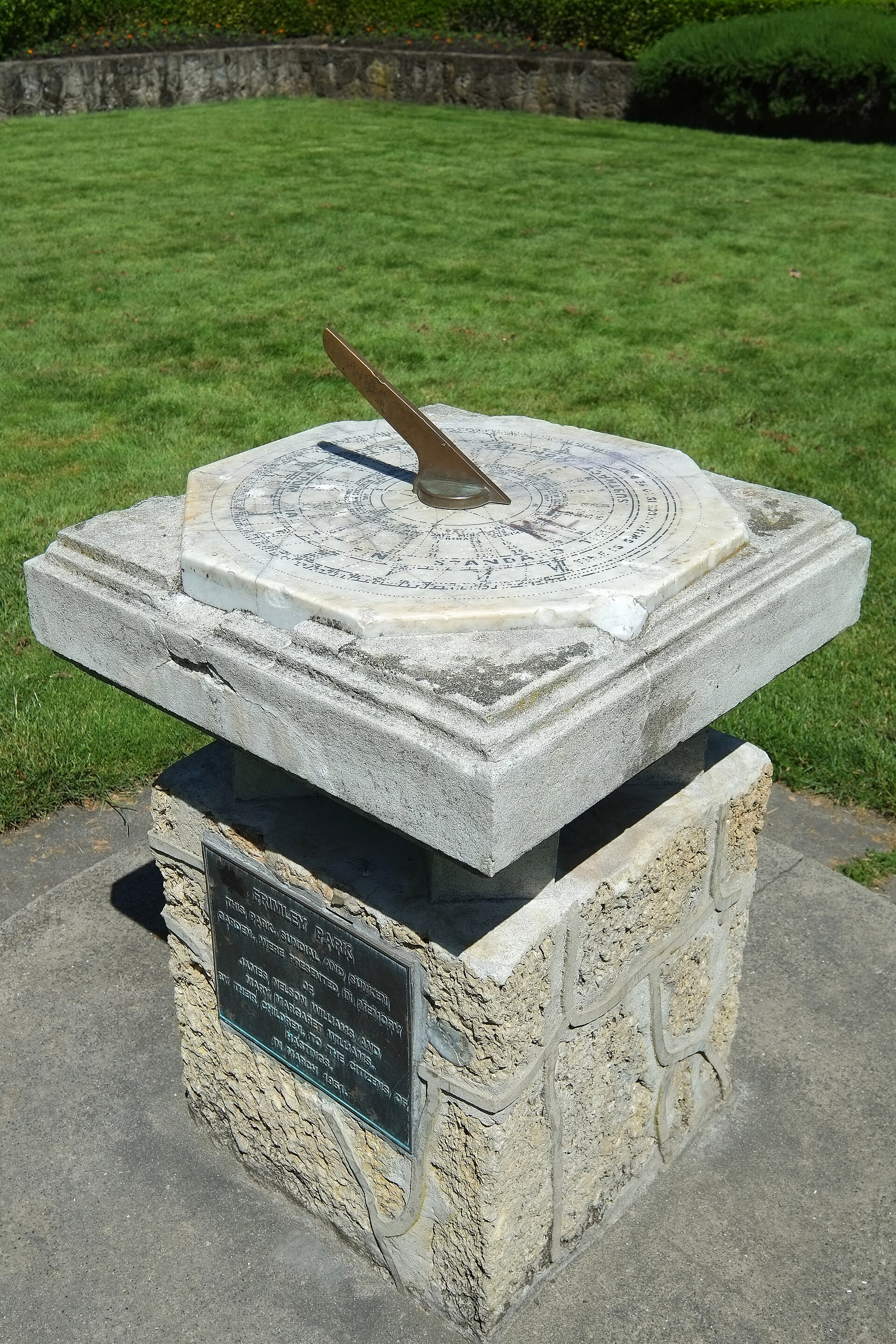
A sundial works through the cooperation of two principal parts: a dial surface bearing hour lines, and a gnomon whose shadow falls across them. The gnomon was originally a staff or pillar standing perpendicular in a place exposed to the sun, so that the length of the shadow it threw could easily be ascertained. The name later came to be applied to any sun-dial and especially to its finger — the shadow-throwing part that points to the hour. The shadow-casting edge of the gnomon is called the style.
Horologium was the name the ancients gave to the various instruments by which they measured the time of day and night, the earliest and simplest being the polos and the gnomon. The first crude sundial was probably no more than a vertical stake in the ground, and the changing length of its shadow came to be used, with stone markers, much as the hands of a clock are used today.
2. Types of Sundial
Sundials are commonly grouped into four types: hemispherical, cylindrical, conical and planar, the last being either horizontal or vertical. They were usually made in stone, with a concave surface marked out on which a gnomon cast its shadow.
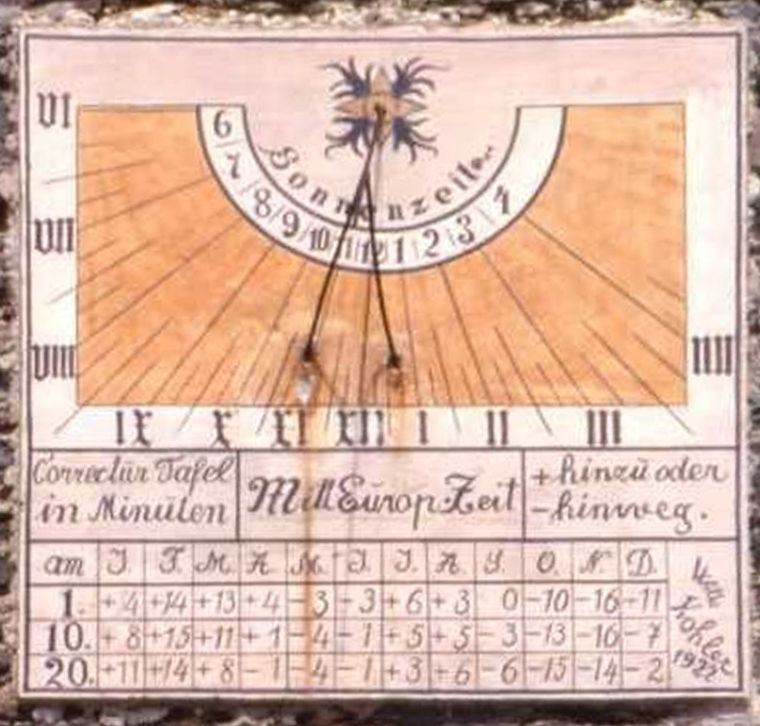
In an equatorial dial the dial surface is aligned parallel to the Earth's equator, and the gnomon stands at right angles to it and parallel to the rotation axis; because the Sun completes 360 degrees in 24 hours, the hour lines are set 15 degrees apart. In a horizontal dial the style is set at an angle equal to the local latitude, and its hour lines are not equidistant. Vertical dials, common on old houses and churches, likewise carry hour lines that are not equally spaced.
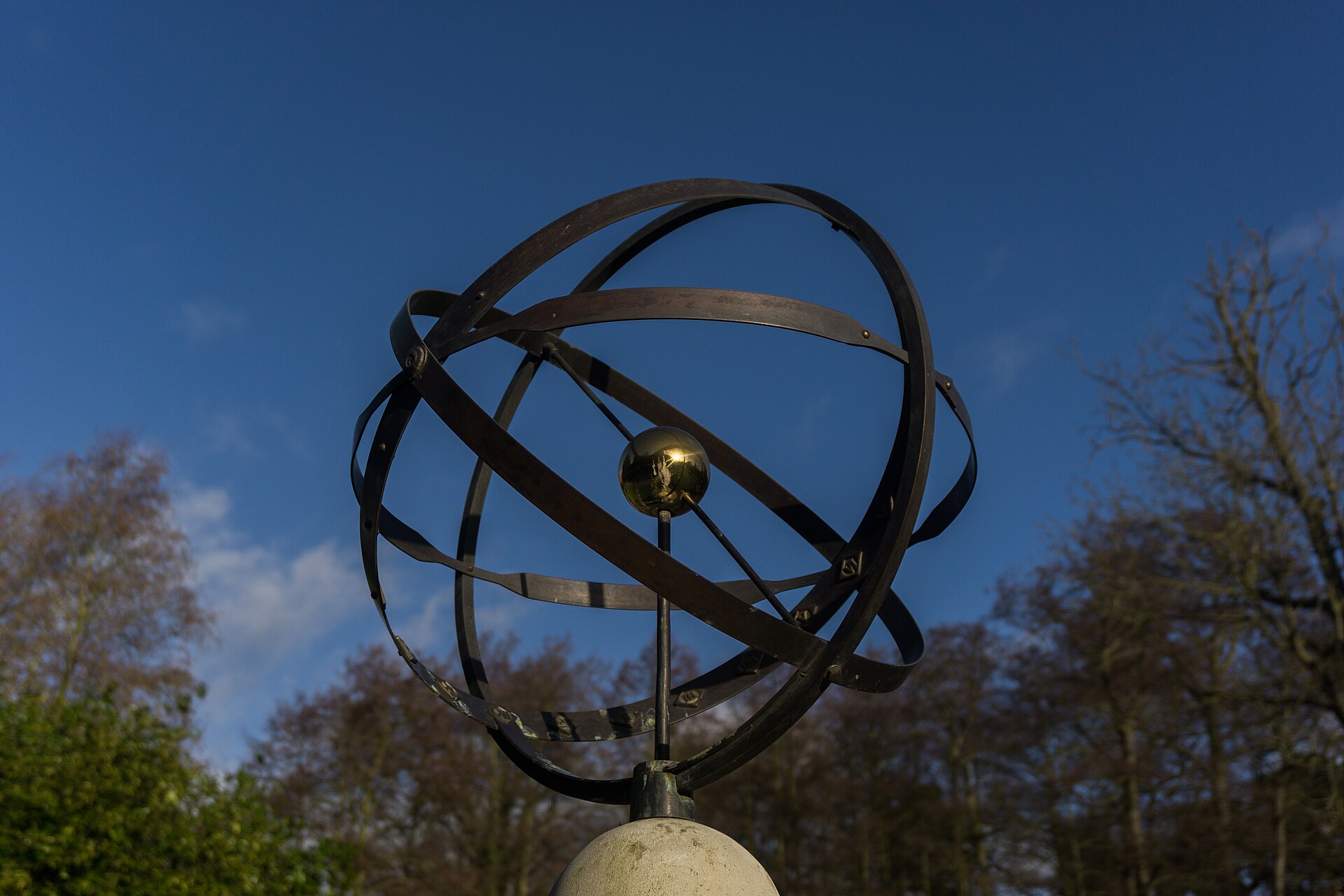
The underlying principle is that a rod placed parallel to the Earth's axis casts a shadow that moves uniformly, the Sun's passage through 15 degrees in one hour moving the shadow at the same rate. Arab dialists replaced vertical and horizontal gnomons with gnomons aligned parallel to the Earth's axis, which made equal-length hours possible throughout the year.
3. Timekeeping, Solar Time and the Equation of Time
Because the apparent sun describes a figure 8 through its annual motion in the sky, the analemma is visible only when the sun's position is compared with a mean time kept by a precise clock. The concept of the analemma was invented by Grandjean de Fouchy in 1740 to describe the apparent irregular motion of the sun.
A treatise the Analemma written by Diodoros was translated into Arabic, and the Persian polymath al-Biruni of Ghazna quotes it in his treatise On Shadows. The scientists of the Islamic world included al-Biruni, who wrote al-Qanun al-Mas'udi on astronomy and solar, lunar and planetary motions, and Ibn al-Haytham, who measured the thickness of the atmosphere.
Because the Sun's disc covers half a degree of the sky, which takes about two minutes of time to traverse, any measurement based on the solar motion carries a minimum error of about one minute.
4. Vitruvius and the Rules of Dialling
Vitruvius devotes the ninth book of De Architectura to the rules of dialling, which he derives from the shadow that a gnomon casts in the rays of the sun. Because the equinoctial shadow differs from place to place, the construction of a dial must be varied according to where it is to be erected.
At the equinoxes the shadow of a gnomon at Rome is eight ninths of its length, at Athens three fourths, at Rhodes five sevenths, at Tarentum nine elevenths and at Alexandria three fifths.
To regulate a water-dial for winter Vitruvius places the hours drawn from the analemma on a turning column together with the lines of the months, so that the indicator makes the hours long or short.
5. Egypt and the Ancient Near East
Egyptian obelisks, built as early as 3500 BCE, served as a kind of sundial, their moving shadows partitioning the day into morning and afternoon and marking the year's longest and shortest days. The earliest known sundial was found in Egypt and dates from at least 3500 years ago. The Egyptians were apparently the first civilization after the Sumerians to formally divide the day into parts something like our hours.
Another Egyptian shadow clock, possibly the first portable timepiece, came into use around 1500 BCE and divided a sunlit day into 10 parts plus two twilight hours. The merkhet, the oldest known astronomical tool, was an Egyptian development of around 600 BCE; a pair of merkhets allowed night hours to be marked off as stars crossed the meridian.
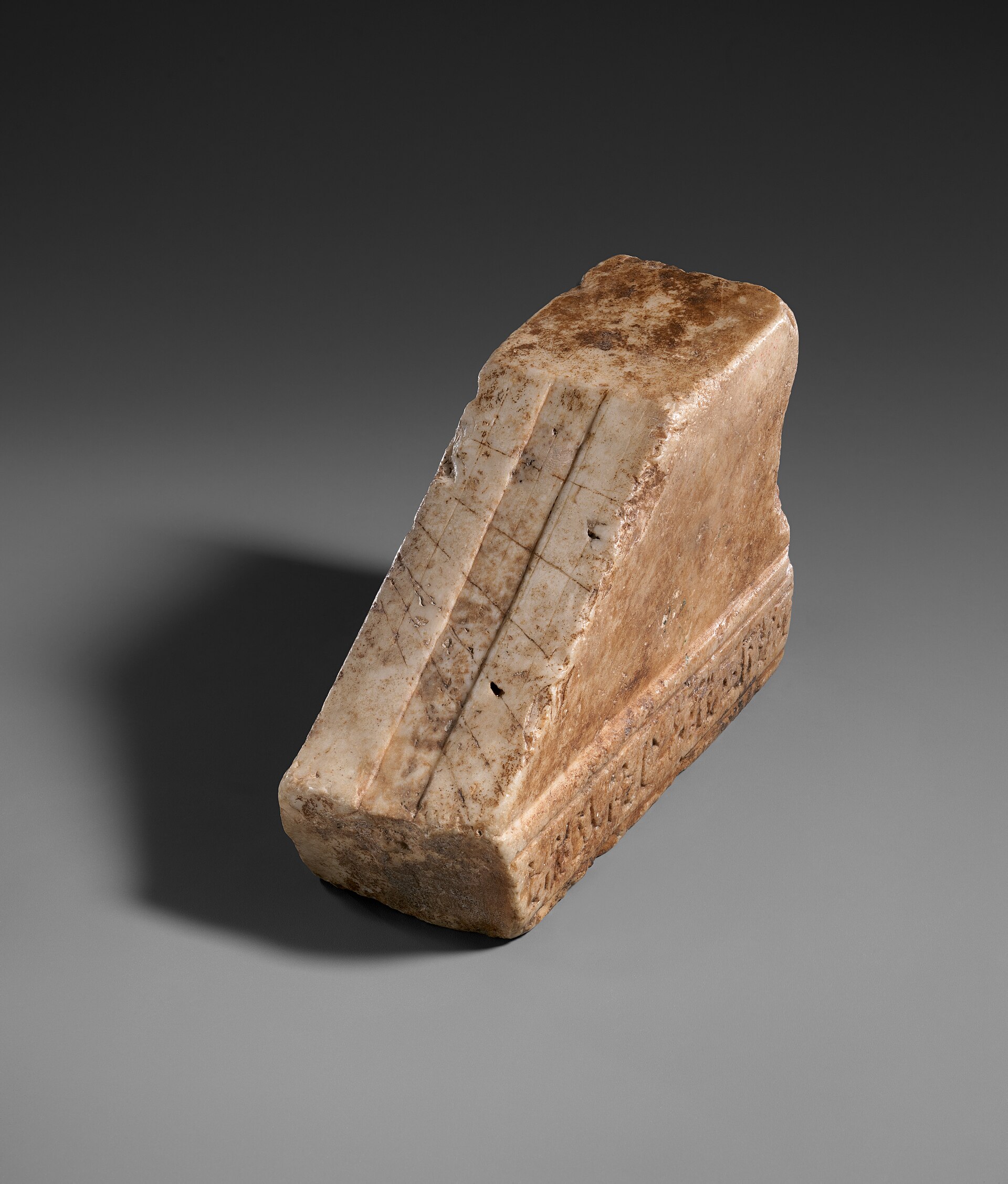
In ancient Egypt the daily cycle was divided into twenty-four hours, twelve of day and twelve of night, the latter reckoned by the movement of groups of stars called decans. Beginning in the New Kingdom, about 1500 B.C., there is evidence that sundials, shadow clocks and water clocks were used to measure the passing of the hours, though no evidence shows the Egyptians tracked minutes or seconds.
The Egyptian altitude sundial in the Science Museum Group collection is a wooden board with markings for units of time and a raised horizontal wooden gnomon, made in Egypt between 1000 and 800 BCE.
6. Greek and Roman Sundials
In the quest for year-round accuracy sundials evolved from flat plates into the hemispherical dial, a bowl cut into stone with a central vertical gnomon, and then into the hemicycle, said to have been invented about 300 BCE.
On the plain wall below the entablature of each face of the Tower of the Winds, lines are still visible which, with the gnomons that stood above them, formed a series of sundials, and a clepsydra stood at the centre of the building.
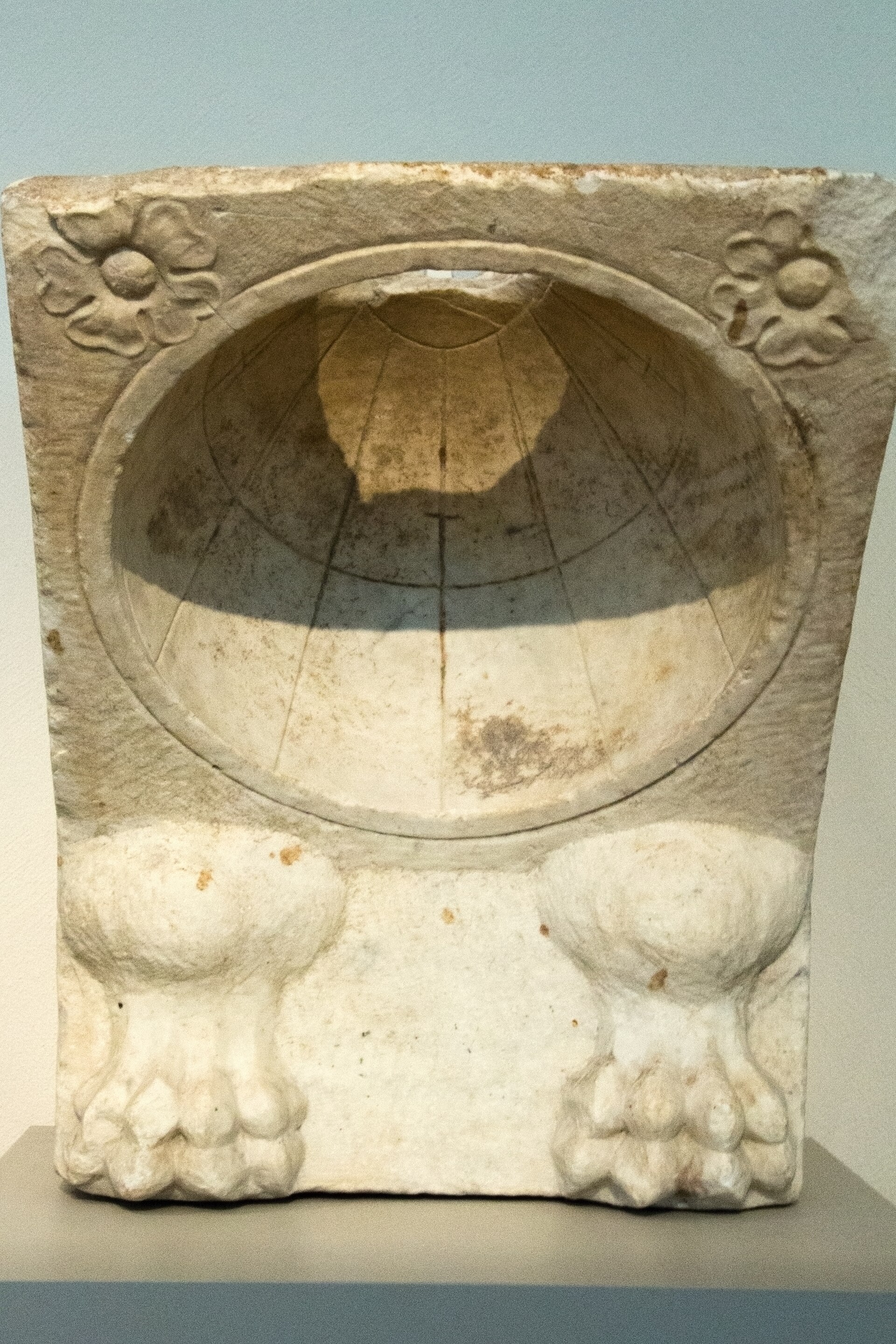
A 2,000-year-old intact and inscribed sundial, one of only a handful known to have survived, was recovered during the excavation of a roofed theatre in the Roman town of Interamna Lirenas near Monte Cassino in Italy.
7. Sundials in the Islamic World
Sundials were ubiquitous in medieval Islam because their shadows showed the time of the midday and afternoon prayers, two of the five prayers prescribed for faithful Muslims; by the eighth century the daytime prayers had come to be defined by the increase of the shadow over its minimum at midday, and the afternoon prayer began when the shadow of a vertical gnomon exceeded its noon length by the length of the gnomon; once the daytime prayers were defined by shadows, the sundial became the most appropriate device for regulating them.
Islamic prayer sets five daily times calculated from the position of the sun, and finding both those times and the direction of Mecca presented problems that scholars solved with mathematics, geography and astronomy. Astrolabes used by a mosque's timekeeper, the muwaqqit, carried lines for calculating prayer times by true astronomical time, among them lines for the dawn, midday and sunset prayers. Knowledge of timekeeping, ilm al-miqat, covered the finding of instantaneous time, the times of the five daily prayers, the direction of Mecca and the making of instruments, and those who worked on it were called muwaqqit or miqati.
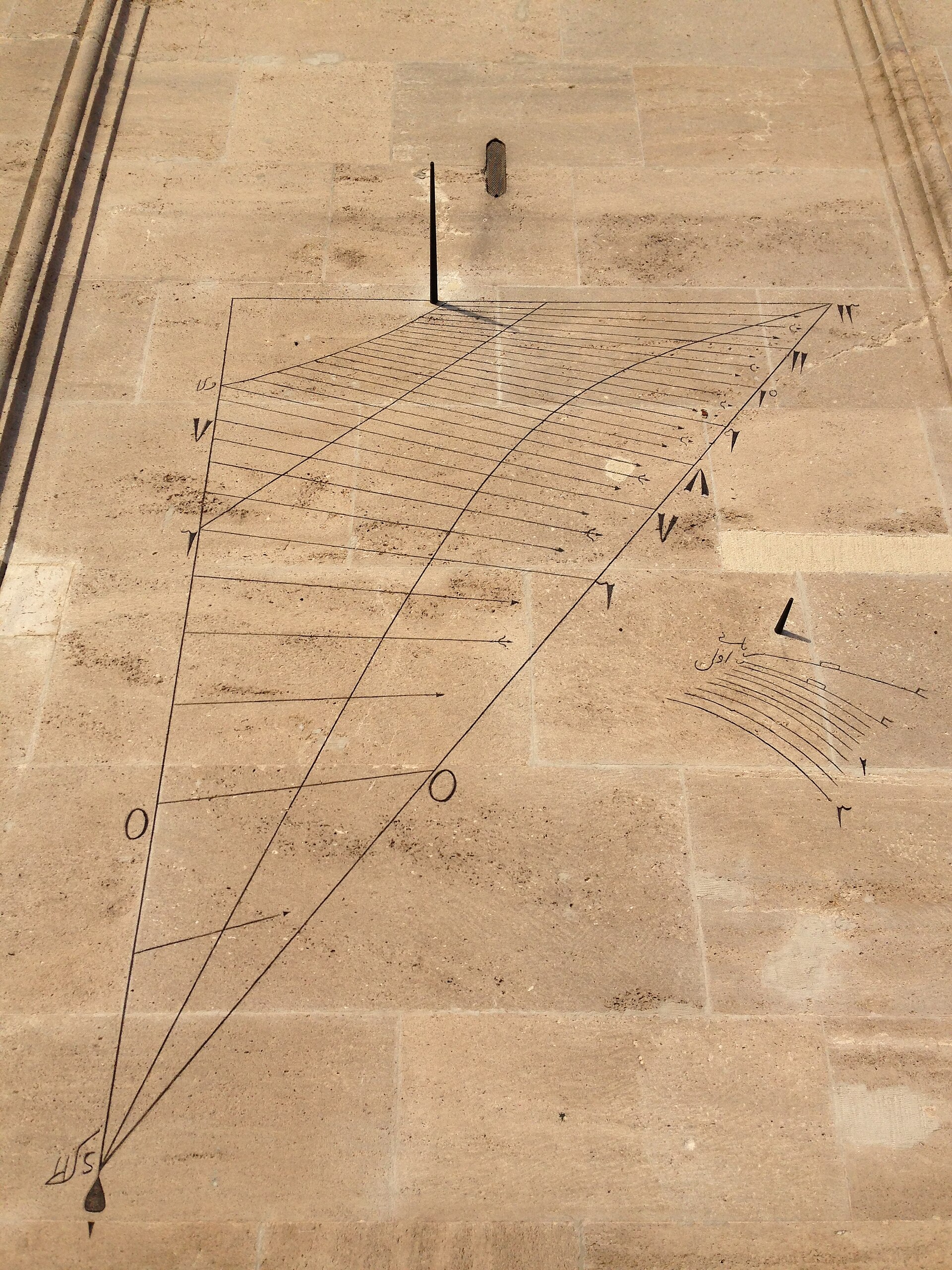
Timekeeping in the medieval Muslim world started in Baghdad in the 9th century, but it was the Mamluk-era astronomers of Egypt, Syria and Palestine who specialised in it and made some of the best astrolabes, astrolabe quadrants and sundials in the history of astronomy.
Habash al-Hasib, who worked in Baghdad in the ninth and tenth centuries, composed perhaps the first tables for making sundials, recording for ten latitudes and each seasonal hour the sun's height and the length and direction of the gnomon's shadow. Ibn al-Haytham showed, in his Treatise on the Hour Lines, that hour lines other than the noon line were not straight, but that each lay between two straight lines forming a very small angle, so that they were nearly straight.
The earliest surviving Islamic dial comes from eleventh century Cordoba and is the work of the astronomer Ibn al-Saffar, displaying lines for the seasonal hours, the beginnings of the seasons and the midday and afternoon prayers. In the second half of the fourteenth century the astronomer Ibn al-Shatir built for the great Umayyad Mosque in Damascus a horizontal sundial on a rectangular marble slate about two metres long, placed on one of the minarets; its gnomon was parallel to the polar axis and inclined to the horizon at about 33 and a half degrees, a common medieval value for the latitude of Damascus, and this was the first known proof that Muslims introduced the polar-axis sundial. Al-Marrakushi, working in Cairo in the late thirteenth century, composed a standard compendium on astronomical instruments with an extensive treatment of sundials, and the cylindrical dial he described was a Muslim invention of the ninth century.
8. Medieval Europe and the Renaissance
Through most of the Middle Ages, sundial styles continued to evolve, yet they did not depart far from ancient Egyptian principles. By the 10th century, several types of pocket sundials were in use, and one English model even compensated for the seasonal changes in the Sun's altitude.
The Renaissance brought rapid development in the making of sundials. Dials of this period were often given extra features, indicating the seasons, the calendar date, the times of sunrise and sunset, and the points of the compass.
In 1656, Christiaan Huygens made the first pendulum clock, regulated by a mechanism with a natural period of oscillation. Its error was less than a minute a day, and his later refinements reduced that error to less than 10 seconds a day.
9. The Jantar Mantar and Monumental Dials
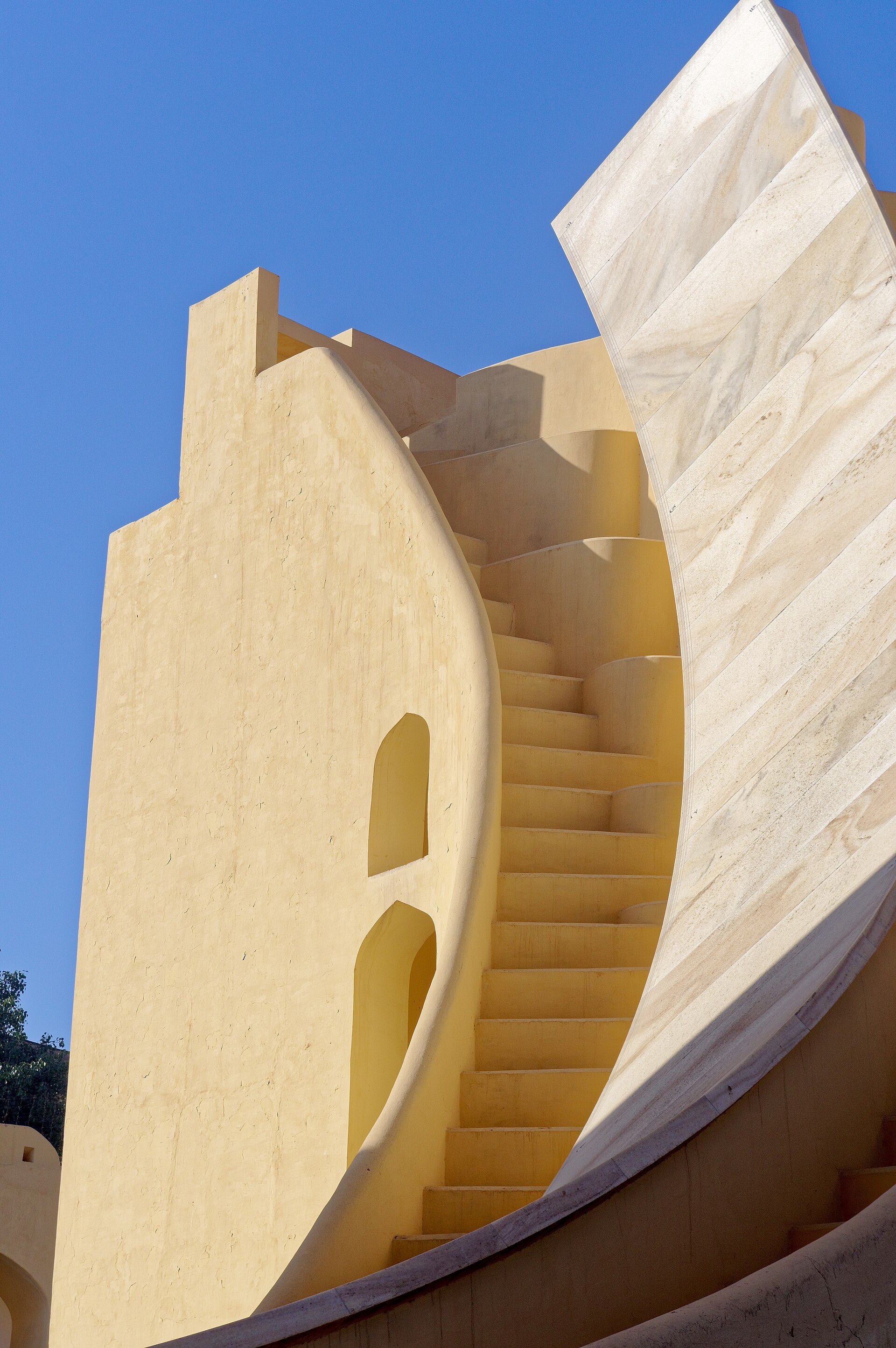
The Jantar Mantar in Jaipur is an astronomical observation site built in the early 18th century, comprising some 20 main fixed instruments — monumental masonry versions of known instruments designed for naked-eye observation of astronomical positions. It constitutes the most significant and best preserved set of fixed monumental instruments built in India in the first half of the 18th century, and some of them are the largest ever built in their categories. The site belongs to the tradition of Ptolemaic positional astronomy shared by many civilizations, and through this type of observation it contributed to the completion of the astronomical tables of Zij. Under its creator, the prince Jai Singh II, the observatory served as a meeting point for different scientific cultures and as a symbol of royal authority, expressed through its urban dimensions, its control of time and its rational and astrological forecasting capacities.
UNESCO judged the Jantar Mantar in Jaipur to be an outstanding example of the coming together of observation of the universe, society and beliefs, and a testimony to the ultimate culmination of the scientific and technical conceptions of the observatory tradition devised in the medieval world. Its inscription carries criteria (iii) and (iv) and a property of 1.8652 ha.
10. Standard Time and the Decline of Local Sundial Time
Most people relied on public sundials to tell the time, so local times differed across the country by up to about 30 minutes, and the difficulties this created eventually led to the creation of Standard Time based on the Prime Meridian at Greenwich.
A conference held at Washington in 1884 adopted the meridian passing through Greenwich as the initial or prime meridian for longitude and timekeeping, and the world's 24 time zones are on average 15 degrees wide. railroad industry implemented its Standard Railway Time System on 18 November 1883 in advance of the international accord, and in March 1918 an Act of Congress made standard timekeeping official in the United States.
11. Key Dates
-
3500 BCEEgyptian obelisks as sundialsObelisks are used as sundials in Egypt.9A Walk Through Time - Early Clocks · National Institute of Standards and Technology (NIST) ↗
-
around 1500 BCEPortable shadow clockAn Egyptian shadow clock, possibly the first portable timepiece, divides a sunlit day into 10 parts plus two twilight hours.9
-
about 1500 B.C.New Kingdom timekeepingEvidence from the New Kingdom shows sundials, shadow clocks and water clocks used to measure the passing of the hours, though nothing shows the Egyptians tracked minutes or seconds.10Telling Time in Ancient Egypt · The Metropolitan Museum of Art, Heilbrunn Timeline of Art History ↗
-
1000–800 BCEEgyptian altitude sundialAn Egyptian altitude sundial, object 1926-992.11Ancient Egyptian Altitude Sundial, or Shadow Clock, in pine (wood) · Science Museum Group Collection ↗
-
around 600 BCEThe merkhetThe merkhet comes into use.9
-
3rd century BCEEarliest surviving sundialThe earliest surviving sundial, from Delos.4Ancient Timekeeping · World History Encyclopedia ↗
-
about 300 BCEThe hemicycleThe hemicycle is invented.9
-
159 B.C.Public clepsydraScipio Nasica establishes a public clepsydra.1Horologium (Smith's Dictionary of Greek and Roman Antiquities, 1875) · LacusCurtius / penelope.uchicago.edu (Bill Thayer) ↗
-
30 BCEVitruvius on sundial stylesVitruvius describes 13 sundial styles.9
-
9th centuryBaghdad timekeepingTimekeeping begins in Baghdad.14Building time machines · History of Science Museum, University of Oxford (Inside HSM Oxford) ↗
-
11th centuryCordoba dialA dial by Ibn al-Saffar in Cordoba.6Sundials in Medieval Islamic Science and Civilization · J. L. Berggren, Simon Fraser University (The Compendium, NASS) ↗
-
13th centuryEqual-length hoursAbul-Hassan introduces equal-length hours.3Sundials · Royal Museums Greenwich ↗
-
late 13th centuryal-Marrakushi in Cairoal-Marrakushi works in Cairo.6
-
second half of the 14th centuryIbn al-Shatir's Damascus dialIbn al-Shatir's dial in Damascus.6
-
15th centuryEqual hours in general useEqual hours come into general use.3
-
1607–1653Elias Allen sun-and-moon dialElias Allen's sun-and-moon dial.19Sun-and-moon dial by Elias Allen · Science Museum Group Collection ↗
-
1656Huygens's pendulum clockHuygens's first pendulum clock.15A Walk Through Time - A Revolution in Timekeeping · National Institute of Standards and Technology (NIST) ↗
-
early 18th centuryJantar Mantar builtThe Jantar Mantar is built.16The Jantar Mantar, Jaipur · UNESCO World Heritage Centre ↗
-
1740The analemmaGrandjean de Fouchy invents the concept of the analemma.5Analemma and the Equation of Time (Sundials for Starters) · North American Sundial Society ↗
-
1833Time Ball first usedThe Time Ball is first used.17The Greenwich Time Ball and one time for all · Royal Museums Greenwich ↗
-
1840sRailway standard time in BritainRailway standard time is adopted in England, Scotland and Wales.18A Walk Through Time - World Time Scales · National Institute of Standards and Technology (NIST) ↗
-
18 November 1883U.S. Standard Railway Time SystemThe U.S. railroad industry implements its Standard Railway Time System.18
-
1884Greenwich prime meridianThe Washington conference adopts the Greenwich prime meridian.18
-
March 1918Standard timekeeping made officialAn Act of Congress makes standard timekeeping official in the United States.18
-
1976Horologium Augusti pavementEdmund Buchner predicts the location of the Horologium Augusti pavement.20Rome, Horologium Augusti · Livius.org ↗
-
2010Jantar Mantar inscriptionThe Jantar Mantar is inscribed as a UNESCO World Heritage Site.16
12. Frequently Asked Questions
Why does a sundial disagree with a clock?
Because the Earth's distance from the Sun varies through the year and the equator is inclined to its orbit by 23.5 degrees, apparent solar time differs from the mean solar time kept by clocks, a difference called the equation of time.3
How is a sundial laid out for a particular place?
In whatever place a dial is to be erected, the first step is to obtain the equinoctial shadow, from which the whole diagram of the analemma is then drawn on a plane surface 8Vitruvius: The Ten Books on Architecture, Book 9 · LacusCurtius / penelope.uchicago.edu (Bill Thayer) ↗. From the completed analemma the lines of winter, summer, the equinoxes and the months are projected, and as many varieties of dials as are desired may be constructed by this method 8.
Who were the inventors of the early dial forms?
Vitruvius names Berosus the Chaldean as the inventor of the semicircle hollowed in a square, Aristarchus of Samos as the inventor of the hemispherical scaphe, and Eudoxus as the inventor of the Arachne 8. The Plinthium, or Lacunar, was invented by Scopas of Syracuse, and an example of it could be seen in the Circus Flaminius at Rome 8.
When did the first sundial reach Rome, and did it keep good time there?
By one account the first sundial known at Rome was brought by Papirius Cursor twelve years before the war with Pyrrhus and placed before the temple of Quirinus 1. Made for a different latitude, it did not show the time correctly there, and the next dial regulated for the city was set up ninety-nine years afterwards by the censor Marcius Philippus 1.
What did the Romans do when the sky was cloudy?
Because sun-dials are useless when the sky is cloudy, Scipio Nasica in his censorship of 159 B.C. established a public clepsydra that indicated the hours of both day and night 1.
What was the Horologium Augusti?
The Horologium Augusti was a giant sundial in imperial Rome whose gnomon was an obelisk originally made for the pharaoh Psammetichus II, which Augustus had seized at Heliopolis after conquering Egypt in 30 BCE 20. In 1976 the German archaeologist Edmund Buchner predicted the location of the sundial's original pavement, and three years later he found it in the cellar of a cafeteria in the Via di Campo Marzio 20.
13. Timeline: from the obelisk to standard time
- as early as 3500 BCEObelisk shadow clocks in EgyptObelisks were built as early as 3500 BCE and their moving shadows formed a kind of sundial, partitioning the day into morning and afternoon and marking the year's longest and shortest days.
- around 1500 BCEThe earliest portable shadow clockAnother Egyptian shadow clock, possibly the first portable timepiece, came into use around 1500 BCE and divided a sunlit day into 10 parts plus two twilight hours.
- around 600 BCEThe merkhetThe merkhet, the oldest known astronomical tool, was an Egyptian development of around 600 BCE, and a pair of merkhets was used to establish a north-south line by aligning them with the Pole Star.
- about 300 BCEThe hemicycleThe hemicycle, said to have been invented about 300 BCE, removed the useless half of the hemispherical dial to give the appearance of a half-bowl cut into the edge of a squared block.
- 159 B.C.A public clepsydra in RomeBecause sundials are useless when the sky is cloudy, Publius Scipio Nasica in his censorship of 159 B.C. established a public clepsydra that indicated the hours both of day and night.
- 2nd century BCEThe Tower of the Winds at AthensThe Tower of the Winds, built by the astronomer Andronicus of Kyrrhos, once had nine sundials on its outer walls and contained a large water clock.
- 30 BCEAugustus takes the obelisk of Psammetichus IIAugustus, who had in 30 BCE conquered Egypt and seized the monolith at Heliopolis, used the obelisk as the gnomon of the Horologium Augusti, a giant sundial in the Field of Mars.
- first half of the 14th centuryMechanical tower clocks in ItalyIn the first half of the 14th century large mechanical clocks began to appear in the towers of several large Italian cities, and with them the reign of the sundial as the public timekeeper began to end.
- second half of the 14th centuryIbn al-Shatir's dial for the Umayyad MosqueIbn al-Shatir constructed for the great Umayyad Mosque in Damascus a horizontal sundial on a rectangular marble slate some 2 m x 1 m, placed on one of the minarets of the mosque.
- 1500 to 1510Spring-powered clocks in NurembergPeter Henlein of Nuremberg built spring-powered clocks between 1500 and 1510, and replacing the heavy drive weights permitted smaller and portable clocks and watches.
- 1656The first pendulum clockChristiaan Huygens made the first pendulum clock in 1656, regulated by a mechanism with a natural period of oscillation and accurate to less than a minute a day.
- early 18th centuryJai Singh's Jantar MantarThe Jantar Mantar in Jaipur, an astronomical observation site built in the early 18th century for the prince Jai Singh II, includes some 20 main fixed instruments, among them the giant Samrat Yantra sundial.
- 1833The Greenwich Time BallThe bright red Time Ball on top of Flamsteed House, first used in 1833, was one of the world's earliest public time signals, letting mariners on the Thames set their chronometers.
- 18 November 1883Standard Railway Time in the United StatesThe U.S. railroad industry implemented its Standard Railway Time System on 18 November 1883, anticipating the international accord on standard time.
- 1884The prime meridian conference at WashingtonAt a conference held in Washington in 1884 the meridian passing through Greenwich was adopted as the prime meridian for longitude and timekeeping, fixing the world's 24 time zones.
- 2016 CEThe Tower of the Winds reopensAfter restoration work was completed in 2016, the Tower of the Winds in Athens, for many years closed, could once again be entered by visitors.
References (21)
- 1Horologium (Smith's Dictionary of Greek and Roman Antiquities, 1875) — LacusCurtius / penelope.uchicago.edu (Bill Thayer) 1875 Web↩View source
- 2Sundials: Ancestors of Our Clocks — P. D. Anoop, Resonance (Indian Academy of Sciences) WebView source
- 3Sundials — Royal Museums Greenwich Web↩View source
- 4Ancient Timekeeping — World History Encyclopedia Web↩View source
- 5Analemma and the Equation of Time (Sundials for Starters) — North American Sundial Society Web↩View source
- 6Sundials in Medieval Islamic Science and Civilization — J. L. Berggren, Simon Fraser University (The Compendium, NASS) Web↩View source
- 7Astronomy and Astrology in the Medieval Islamic World — The Metropolitan Museum of Art, Heilbrunn Timeline of Art History WebView source
- 8Vitruvius: The Ten Books on Architecture, Book 9 — LacusCurtius / penelope.uchicago.edu (Bill Thayer) Book↩View source
- 9A Walk Through Time - Early Clocks — National Institute of Standards and Technology (NIST) Web↩View source
- 10Telling Time in Ancient Egypt — The Metropolitan Museum of Art, Heilbrunn Timeline of Art History Web↩View source
- 11Ancient Egyptian Altitude Sundial, or Shadow Clock, in pine (wood) — Science Museum Group Collection Web↩View source
- 12Archaeologists uncover rare 2,000-year-old sundial during Roman theatre excavation — University of Cambridge 2000 BookView source
- 13Prayer — History of Science Museum, University of Oxford BookView source
- 14Building time machines — History of Science Museum, University of Oxford (Inside HSM Oxford) Book↩View source
- 15A Walk Through Time - A Revolution in Timekeeping — National Institute of Standards and Technology (NIST) Web↩View source
- 16The Jantar Mantar, Jaipur — UNESCO World Heritage Centre Web↩View source
- 17The Greenwich Time Ball and one time for all — Royal Museums Greenwich Web↩View source
- 18A Walk Through Time - World Time Scales — National Institute of Standards and Technology (NIST) Web↩View source
- 19Sun-and-moon dial by Elias Allen — Science Museum Group Collection Web↩View source
- 20Rome, Horologium Augusti — Livius.org Web↩View source
- 21Tower of the Winds — World History Encyclopedia WebView source