Library of Alexandria
The royal library and Mouseion of Ptolemaic Alexandria — how it was founded, what its scholars achieved, and why its disappearance remains one of history's most debated losses.
The Library of Alexandria was the most famous library of classical antiquity, founded in Ptolemaic Egypt around 295 BCE as part of the Mouseion, a research institute in the royal quarter of Alexandria. It aimed to collect all the books in the world, incorporated written works from other nations including a full corpus of Egyptian records, and produced Callimachus's Pinakes catalogue; scholars such as Zenodotus, Eratosthenes of Cyrene and Theocritus worked there. Its ending is contested: ancient accounts blame Caesar's fire of 48 BCE, later warfare, or religious violence, while most modern scholars describe a gradual decline as royal patronage faded, and the Bibliotheca Alexandrina opened in 2002 as a modern successor.
In this article
- 1Overview
- 2Foundation and Patronage
- 3The Mouseion and Its Scholars
- 4Librarians and the Catalogue
- 5Acquisition of Books
- 6Size of the Collection
- 7Destruction: The Contested Accounts
- 8Later Losses and the Serapeum
- 9The Arab Conquest Story
- 10Site and Legacy
- 11Timeline: from 331 BCE to the Bibliotheca Alexandrina
- 12Frequently asked questions
- 13Knowledge graph
Overview
The Museum itself has been described as the most famous scholarly center of classical antiquity, gathering scholars from all over the world. The city soon became the political capital of Egypt and a center of Hellenistic culture, featuring one of the greatest libraries of the ancient world.
The library stood at Alexandria, Egypt, within the royal palace quarter known as the Bruchion. The Temple of the Muses was a shrine complex modeled on the Lyceum of Aristotle in Athens, located within the grounds of the Royal Palace in the Bruchion, the palace quarter.
1. Foundation and Patronage
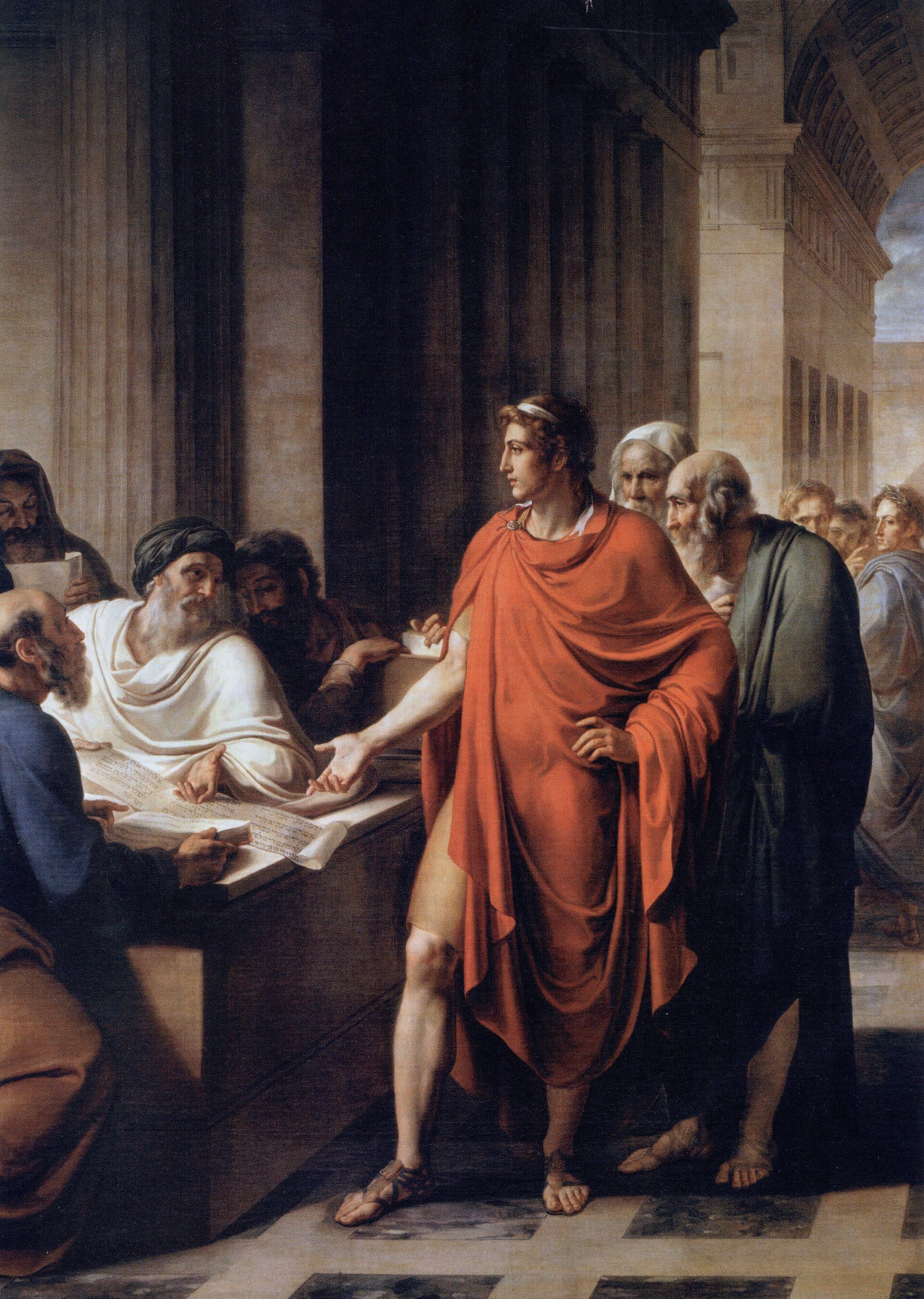
The Library of Alexandria is commonly said to have been founded around 295 BCE as part of the Alexandrian Museum. Its establishment is attributed to Ptolemy I Soter, who acted on the advice of Demetrius of Phalerum. About 295 BCE Ptolemy I charged Demetrius of Phaleron with the task of founding the library and the Mouseion.
Demetrius of Phalerum was a pupil of Aristotle and Theophrastus and ruled Athens for the Macedonian king Cassander from 317 to 307 BC before fleeing to Egypt. A member of the Peripatetic school and a former Athenian politician, he sought refuge at the court of Ptolemy I Soter around 297 BCE and became the king's adviser.
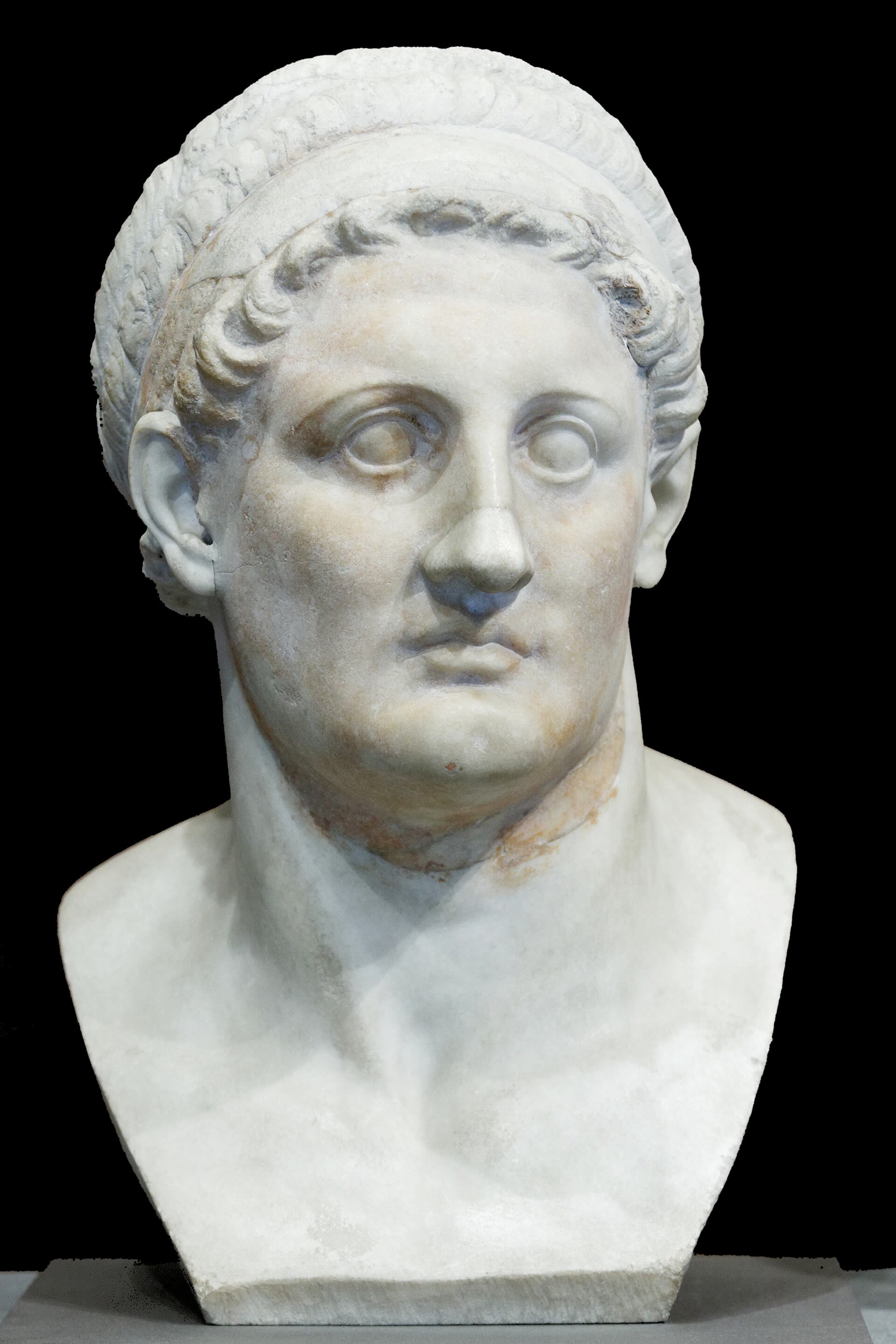
According to the Letter of Aristeas, written between c. 145 BCE, the idea for the library was suggested by Demetrius of Phalerum, though the authenticity of the letter has been challenged. The founding of the Library of Alexandria, actually two or more libraries, is obscure; it is believed that around 295 BCE Demetrius of Phalerum convinced Ptolemy I Soter to establish it.
2. The Mouseion and Its Scholars
Strabo describes the Museum as a part of the palaces, with a public walk, a place furnished with seats, and a large hall where the learned members took their common meal. The community of the Museum possessed property in common, and a priest, formerly appointed by the kings but in Strabo's day by Caesar, presided over it.
During the reign of Ptolemy II more than 100 scholars were housed within the Museum, tasked with research, lecturing, publishing, translating and copying. The sources say that "Ptolemy" provided the scholars with a library containing a huge collection of papyrus scrolls, entrusting them with the mission of exploring every field of human knowledge. The library aimed to collect "all the books in the world" with most texts in Greek, and it incorporated a full corpus of Egyptian records. Judging from the scholarly work produced in Alexandria, it seems likely that the whole corpus of Greek literature was amassed in the library.
Hellenistic poets including Theocritus, Callimachus and Apollonius of Rhodes resided at Alexandria, where Euclid systematized mathematical knowledge and Eratosthenes calculated the Earth's circumference. Eratosthenes compared the noon shadow at midsummer between Syene and Alexandria and gave the circumference of the Earth as 250,000 stadia. On the death of Callimachus in about 240 BC, Eratosthenes became the third librarian at Alexandria, in the library in a temple of the Muses called the Mouseion.
3. Librarians and the Catalogue
The first librarian of Alexandria was the scholar Zenodotus of Ephesus, appointed under Ptolemy II, during whose reign the Mouseion and an addition, the Royal Library, were constructed. The institution itself was the most famous library of classical antiquity and formed part of the research institute at Alexandria known as the Alexandrian Museum, or Mouseion — the "shrine of the Muses".
Although Callimachus of Cyrene is often cited as a librarian at Alexandria, he never held that position; he developed the library's finding system into what would now be called a "card catalog". His Pinakes — Tables of Persons Eminent in Every Branch of Learning Together with a List of Their Writings — was a comprehensive survey and catalog of extant Greek works in 120 books. Bagnall notes that this famous Pinakes, a systematic listing of genres, authors and works in 120 books, could not have held the information necessary to catalog hundreds of thousands of rolls.
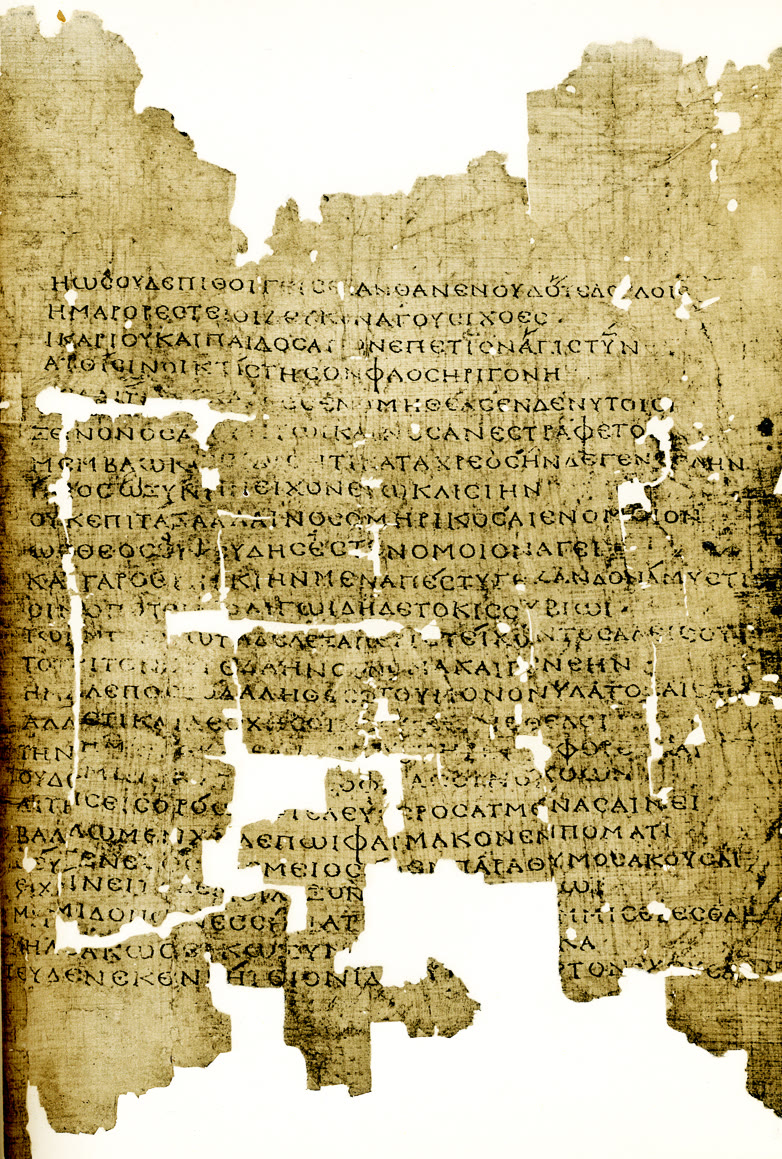
The last recorded Director of the great Library was the scholar and mathematician Theon, father of Hypatia, who was murdered by a Christian mob in Alexandria in 415 CE.
4. Acquisition of Books
Under Ptolemy III Euergetes the library's collection increased as books were taken from ships at port, copied, and the originals were then housed in the stacks. What the library retained, in such cases, was the original rather than the transcript returned to its owner.
A similar insistence on the original is reported in the case of the Athenian tragedians. Ptolemy III is said to have posted a bond of 15 talents to Athens to borrow the original manuscripts of Aeschylus, Euripides and Sophocles, then kept the originals and sent copies back.
One of the major acquisitions for the library was the 'books of Aristotle'. Athenaeus says Ptolemy II purchased the collection for a large sum, while Strabo says it was confiscated by Sulla in 86 BCE.
Plutarch reports the charge that Antony had bestowed upon Cleopatra the libraries from Pergamum, in which there were two hundred thousand volumes. The accusation was brought by Calvisius, a companion of Caesar, among accusations regarding Antony's behaviour towards Cleopatra.
5. Size of the Collection
No aspect of the Library of Alexandria has proved more resistant to agreement than the question of how much it actually held. The figure most often repeated is 500,000 works, though the same tradition concedes that this may have been an exaggeration 5Library of Alexandria · World History Encyclopedia ↗. A comparable estimate places the holdings at half a million documents at their peak, without clarifying whether books or papyrus scrolls are meant 3What happened to the Great Library at Alexandria? · World History Encyclopedia ↗. More generally, the library is said to have contained hundreds of thousands of papyrus and vellum scrolls 7Eratosthenes of Cyrene · MacTutor History of Mathematics Archive, University of St Andrews ↗. The sources themselves are surprisingly scanty, and almost nothing certain is known about the real dimensions of the collections 1The Ancient Library of Alexandria: A Model for Classical Scholarship in the Age of Million Book Libraries · Perseus Digital Library, Tufts University ↗.
The ancient testimony is not merely imprecise but internally inconsistent. The figure eventually reaches 700,000 in Aulus Gellius and Marcellinus 1. A footnote to Ammianus notes that he confuses two libraries, the Bruchion library and the Serapeum's, which contained 490,000 and 42,800 volumes respectively 10The Roman History, Book XXII (trans. J. C. Rolfe) · LacusCurtius, University of Chicago ↗. The same note states that the damage done by Caesar has been greatly exaggerated 10.
Modern scholarship has treated these numbers with open skepticism. Bagnall argues that the ancient figures for the size of the Library, or the number of volumes lost in the Alexandrine War, do not deserve any credence 8Alexandria: Library of Dreams (Proceedings of the American Philosophical Society 146) · Roger S. Bagnall, NYU Faculty Digital Archive ↗.
| Figure | Source/Claimant | Note |
|---|---|---|
| 500,000 works | Commonly cited figure | Possibly an exaggeration 5 |
| 42,800 rolls | Serapeum sister library | Probably copies of writings shelved in the bigger library 1 |
| 490,000 and 42,800 volumes | Footnote to Ammianus | Distinguishing the Bruchion library and the Serapeum 10 |
| 700,000 | Aulus Gellius and Marcellinus | Ancient figures vary disconcertingly 1 |
| Hundreds of thousands of scrolls | General tradition | Papyrus and vellum 7 |
| Half a million documents | Peak holdings | Unclear whether books or papyrus scrolls 3 |
6. Destruction: The Contested Accounts
The fate of the Library of Alexandria has come down to us less as a settled historical record than as a murder mystery with a number of suspects, the most popular being Julius Caesar, whose operations in 48 BCE are often blamed for setting fire to the library near the shore. Historians have charged different suspects with the destruction of the library, motivated in part by their own nationality or ideology: Gibbon blames the Christians, El-Abbadi blames Caesar, and Canfora blames the Arabs. Destruction claims cite Julius Caesar in 48 BCE, Aurelian in 272 CE, Diocletian in 297 CE, Christian zealots in 391 and 415 CE, or Muslim Arab invaders in the 7th century. The Royal Library may have been unintentionally destroyed in 48 BCE during Julius Caesar's civil war in Egypt, when a fire set to enemy ships spread to the library.
Plutarch relates that Caesar, forced to repel the enemy by using fire during the Alexandrian war, saw the fire spread from the dockyards and destroy the great library. Cassius Dio records that in the fighting at Alexandria the docks and the storehouses of grain among other buildings were burned, and also the library, whose volumes were said to be of the greatest number and excellence. An editorial note to Plutarch observes that the destruction of the Library can have been only partial.
In his book The Vanished Library, Luciano Canfora interprets the evidence from ancient writers as the destruction of manuscripts stored in warehouses near the port waiting for export, rather than the great Library itself. The same note adds that the Bruchion library was destroyed in AD 272 and the Serapeum in AD 391; it states that the damage done by Caesar has been greatly exaggerated. The library's district was destroyed in 272 CE in the war against Zenobia.
Since the Museum was certainly still operative in the Roman period, belief in a Caesarian destruction of the Library requires the uneconomical assumption that the Library was destroyed but the Museum was not. Bagnall notes that there is no ancient account of the foundation of the Library.
7. Later Losses and the Serapeum
The Library of Alexandria did not end in a single catastrophe. Ancient and modern accounts assign its losses to several distinct episodes, and scholars believe there is enough evidence that the destruction of the two libraries occurred at different times, with the Royal Library an unfortunate casualty of war.
Later losses fell upon the district and the daughter library. The daughter library, housed in the Serapeum, likely met its end in 391 when Theodosius I ordered the demolition of pagan temples and the Serapeum was attacked by Bishop Theophilus and his followers. The destruction of 391 CE was sanctioned by Theodosius I and carried out under Bishop Theophilus, and a Christian church was built on the site.
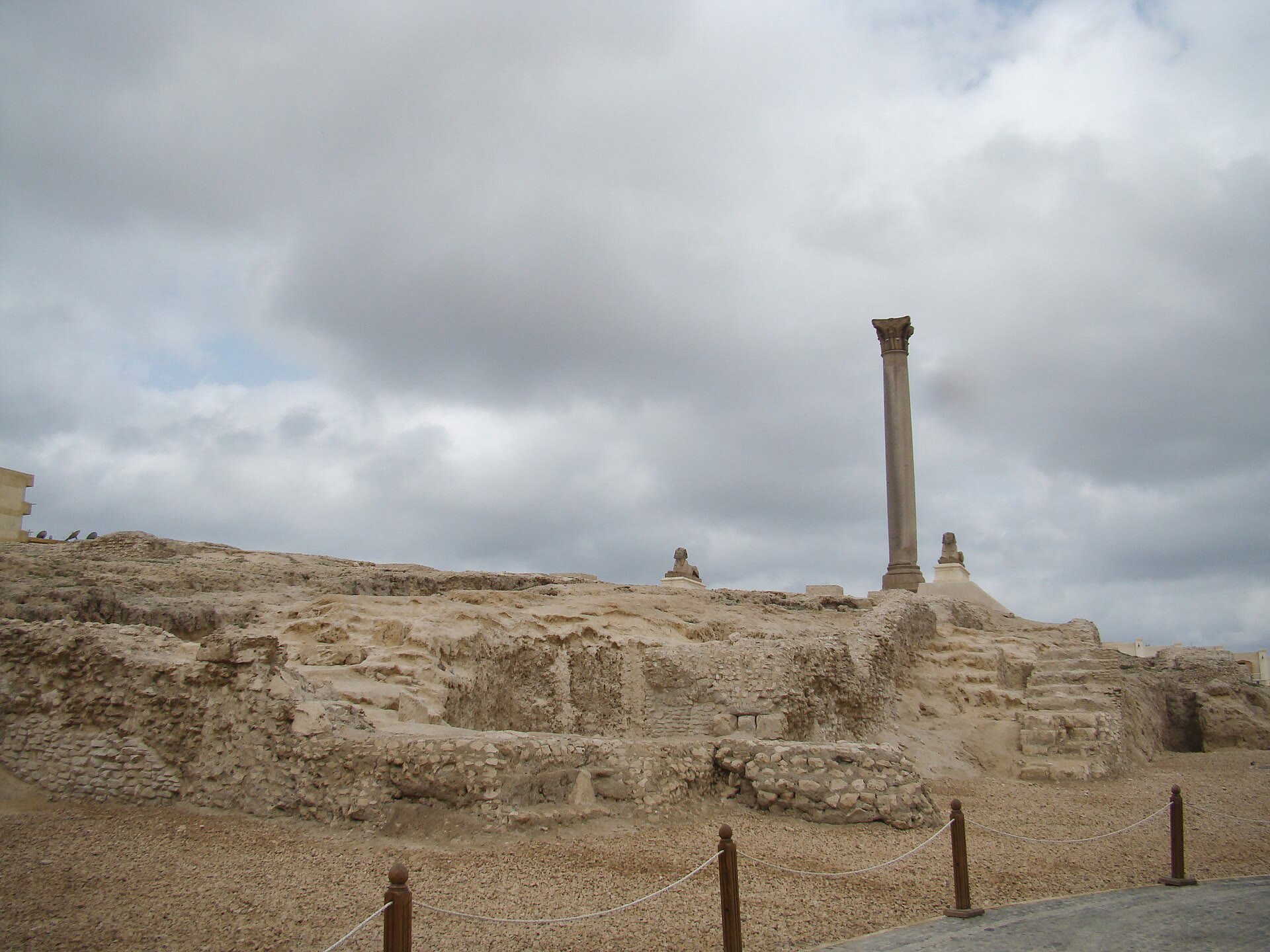
The fate of the Museum and its scholars frames the final chapter. In 389 all pagan monuments in Alexandria, including the Museum, were destroyed; in 391 the Serapeum was destroyed. In 414 the last leader of the philosophical school, Hypatia, was lynched by a Christian mob.
8. The Arab Conquest Story
For centuries the main point of contention was whether the library survived until the Arab conquest of Alexandria in the 7th century; scholars now agree both libraries perished long before it. 14 By the 7th century, when the Muslim Arabs are said to have burned the library's collection, there is no evidence that those books, or even their buildings, still existed in Alexandria. 5 In 640 CE the Arabs under General Amrou ibn el-Ass captured Alexandria after a long siege; according to the story, the conquering Arabs heard about a magnificent library and were anxious to see it. 3 The story relates that the Caliph, unmoved by the collection, stated that the books would either contradict the Koran and be heresy, or agree with it and be superfluous. 3
11Resurrecting Alexandria · The New Yorker ↗ Most contemporary scholars agree that the ancient Library of Alexandria had ceased to exist long before the Arab conquest. 14
9. Site and Legacy
The precise site of the ancient Library of Alexandria cannot now be fixed; it is known only to have lain within the royal palaces of the Ptolemies near the harbour.
A second, smaller collection was housed in the Serapeum, the temple of Serapis, and is commonly called the daughter library. Founded by Ptolemy Philadelphus, it contained 42,800 rolls, probably copies of the writings shelved in the bigger library.
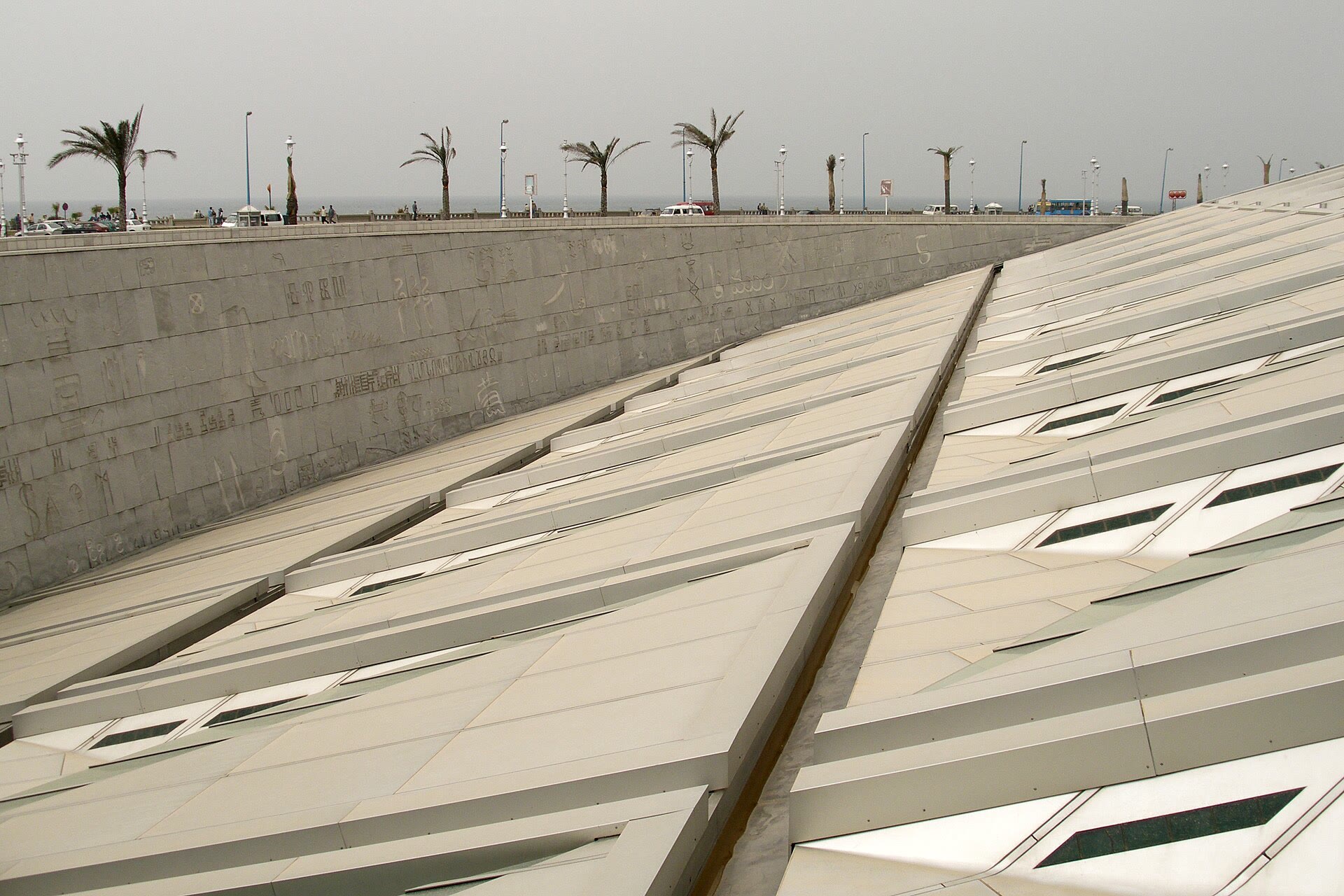
The idea of reviving the ancient library was first proposed in 1972 by Mostafa El-Abbadi, a professor at Alexandria University. In 1974, on a Presidential visit to Alexandria, Richard Nixon unwittingly acted as a catalyst to the library project by asking his Egyptian hosts where the ancient Library of Alexandria had stood. After UNESCO told El-Abbadi's group that it made agreements only with governments, the project was recast as the Revival of the Ancient Library of Alexandria, or the Bibliotheca Alexandrina.
In 1989 UNESCO sponsored a major international competition for a building design, attracting 524 entries from 58 countries. The $200 million structure, adjacent to Alexandria University and near the location of the ancient library, was completed in 2001, and takes the form of a massive cylinder emerging from the ground at a shallow angle only about 130 feet (40 metres) from the Mediterranean Sea. The Bibliotheca Alexandrina was officially opened on 16 October 2002 and was designed to house eight million volumes on seven cascading levels. It also houses a planetarium, a school of library and information science, facilities for the digital preservation of rare books and manuscripts, and a conference centre.
10. Timeline: from 331 BCE to the Bibliotheca Alexandrina
- 331 BCEAlexandria foundedAlexander the Great builds the city after his conquest of Egypt; it becomes the second-most important city of the Roman Empire in later centuries.
- c. 295 BCELibrary and Mouseion foundedPtolemy I Soter charges his adviser Demetrius of Phaleron with founding the library and the Mouseion in Alexandria.
- 246–221 BCEAcquisition drive under Ptolemy IIIUnder Ptolemy III Euergetes the library's collection increases as books are taken from ships at port, copied, and the originals housed in the stacks.
- c. 240 BCEEratosthenes becomes chief librarianOn the death of Callimachus, Eratosthenes becomes the third librarian at Alexandria, in the Mouseion.
- 145 BCEDecline begins under Ptolemy VIIIThe patronage of the library weakens and foreign scholars, among them the librarian Aristarchus of Samothrace, are expelled from Alexandria.
- 48 BCECaesar's fire in AlexandriaDuring Caesar's war in Egypt a fire spreads from the dockyards and destroys the great library, according to Plutarch.
- c. 20 BCEStrabo visits AlexandriaStrabo describes the Museum as still functioning as part of the royal palaces, showing the library had not been destroyed by Caesar's fire.
- 272 CEAurelian retakes AlexandriaIn the war with Zenobia's Palmyrene forces Aurelian retakes Alexandria and the library's district is destroyed; it is unknown whether the library buildings survived.
- 298 CEDiocletian sacks the cityDiocletian's troops sack Alexandria and the legion III Diocletiana is added to its garrison.
- 389 CEPagan monuments destroyedAll pagan monuments in Alexandria, including the Museum, are destroyed.
- 391 CESerapeum demolishedTheodosius I sanctions the demolition of the temples of Alexandria; the Serapeum is destroyed.
- 415 CEHypatia murderedThe last leader of the city's philosophical school, Hypatia, is lynched by a Christian mob.
- 641–642 CEArab conquest of AlexandriaThe city falls to the Arabs; a story that the caliph ordered the library's books burned first appears in the 13th century and is rejected by most scholars.
- 16 October 2002Bibliotheca Alexandrina opensThe modern library inspired by the ancient institution, proposed by Mostafa El-Abbadi in 1972, is officially opened in Alexandria.
11. Frequently asked questions
When and by whom was the Library of Alexandria founded?
It was founded around 295 BCE as part of the Alexandrian Museum, on the advice of Demetrius of Phalerum, by Ptolemy I Soter 4Library of Alexandria | Description, Facts, & Destruction · Encyclopaedia Britannica ↗ 3. The project was planned under Ptolemy I and came to fruition under his son Ptolemy II Philadelphus 7. Its first librarian was the scholar Zenodotus of Ephesus 5.
Where exactly was the library located?
It stood in Alexandria, Egypt, within the royal palace quarter known as the Bruchion 3. The Temple of the Muses was a shrine complex modeled on the Lyceum of Aristotle in Athens, located within the grounds of the Royal Palace 3. The exact location is unknown today, though it lay within the royal palaces of the Ptolemies near the harbour 11.
How large was the library's collection?
The number of works held is uncertain; 500,000 is most commonly cited, but this may have been an exaggeration 5. Ancient figures vary disconcertingly, from Seneca's 40,000 books to 700,000 in Aulus Gellius and Marcellinus 1. Ammianus Marcellinus reports that the unanimous testimony of ancient records declares 700,000 books were burned in the Alexandrine war under Caesar 10.
What was the Pinakes, and who created it?
The Pinakes was Callimachus's comprehensive survey and catalog of extant Greek works in 120 books, listing genres, authors and works 8 5. Although often cited as a librarian at Alexandria, Callimachus of Cyrene never held that position; he developed the library's finding system into what would now be called a card catalog 5.
How and when was the library destroyed?
Destruction claims cite Julius Caesar in 48 BCE, Aurelian in 272 CE, Diocletian in 297 CE, Christian zealots in 391 and 415 CE, or Muslim Arab invaders in the 7th century 5. Plutarch relates that Caesar, forced to repel the enemy by using fire during the Alexandrian war, saw the fire spread from the dockyards and destroy the great library 12The Life of Julius Caesar, The Parallel Lives · LacusCurtius, University of Chicago (trans. Bernadotte Perrin) ↗. The daughter library, housed in the Serapeum, likely met its end in 391 when Theodosius I ordered the demolition of pagan temples and the Serapeum was attacked by Bishop Theophilus and his followers 4.
Is the story that the Arabs burned the library true?
The story of Amr burning the books appears only in the 13th century, and most scholars reject it 14. For more than five centuries after the Arab conquest there was no reference to any accident to an Alexandrian library 14. Most contemporary scholars agree that the ancient Library of Alexandria had ceased to exist long before the Arab conquest, and Bernard Lewis wrote that it is surely time to acquit the Caliph Umar and Amr ibn al-As of the charge 14.
References (16)
- 1The Ancient Library of Alexandria: A Model for Classical Scholarship in the Age of Million Book Libraries — Perseus Digital Library, Tufts University Web↩View source
- 2Alexandria — Bible Odyssey, Society of Biblical Literature WebView source
- 3What happened to the Great Library at Alexandria? — World History Encyclopedia Web↩View source
- 4Library of Alexandria | Description, Facts, & Destruction — Encyclopaedia Britannica Web↩View source
- 5Library of Alexandria — World History Encyclopedia Web↩View source
- 6Strabo, Geography, Book 17, Chapter 1 (trans. H. C. Hamilton and W. Falconer) — Perseus Digital Library, Tufts University BookView source
- 7Eratosthenes of Cyrene — MacTutor History of Mathematics Archive, University of St Andrews Web↩View source
- 8Alexandria: Library of Dreams (Proceedings of the American Philosophical Society 146) — Roger S. Bagnall, NYU Faculty Digital Archive Web↩View source
- 9The Life of Antony, The Parallel Lives (trans. Bernadotte Perrin) — LacusCurtius, University of Chicago WebView source
- 10The Roman History, Book XXII (trans. J. C. Rolfe) — LacusCurtius, University of Chicago Book↩View source
- 11Resurrecting Alexandria — The New Yorker 2000 Web↩View source
- 12The Life of Julius Caesar, The Parallel Lives — LacusCurtius, University of Chicago (trans. Bernadotte Perrin) Web↩View source
- 13Roman History, Book XLII (trans. Earnest Cary) — LacusCurtius, University of Chicago BookView source
- 14Library of Alexandria: The fate of the Library of Alexandria (by Mostafa El-Abbadi) — Encyclopaedia Britannica Web↩View source
- 15Alexandria — Livius.org (Jona Lendering) Web↩View source
- 16Bibliotheca Alexandrina | History & Facts — Encyclopaedia Britannica WebView source
 Notre-Dame de Paris
 India
 Aristotle


