Christopher Columbus
The Genoese navigator who crossed the Atlantic in 1492 under the Spanish crown, founded the first European colonies in the Caribbean, and set in motion the Columbian Exchange and a legacy debated to this day.
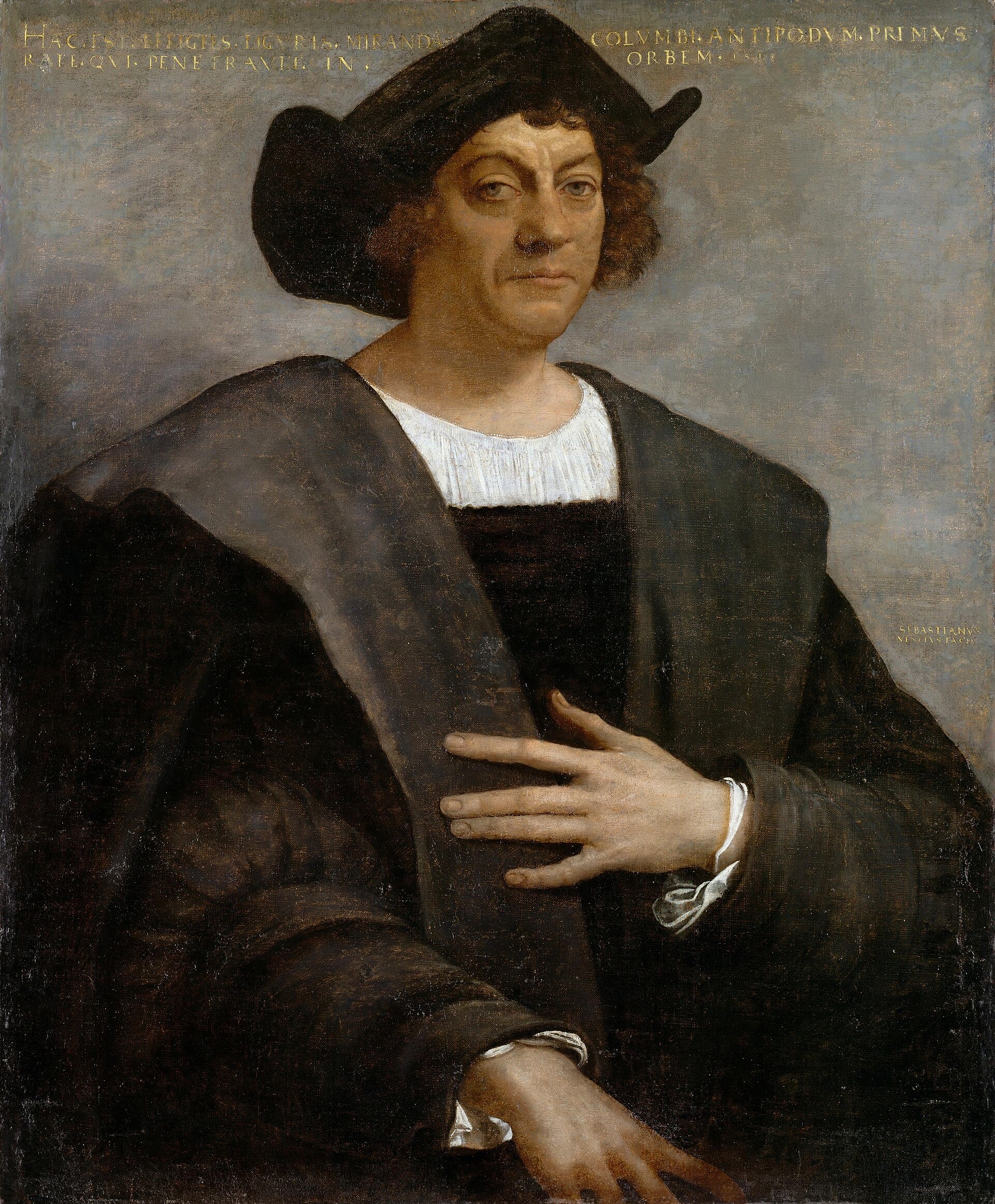
Christopher Columbus (1451-1506) was a Genoese navigator who made four transatlantic voyages for Ferdinand II of Aragon and Isabella I of Castile, reaching the Bahamas on 12 October 1492 and opening the way for European exploration and colonization of the Americas. He governed the new Spanish Indies until his arrest in 1500 and died at Valladolid in 1506 still believing he had reached Asia. His voyages began the Columbian Exchange of plants, animals and diseases and the enslavement of Caribbean peoples, and his reputation has been debated from his own lifetime to the present.
In this article
- 1Overview
- 2Origins and Early Life
- 3The Case for a Western Route
- 4Terms and Titles
- 5First Voyage (1492–93)
- 6Second Voyage and the Colony at La Isabela
- 7Third and Fourth Voyages
- 8Governance, Enslavement and Demographic Collapse
- 9The Columbian Exchange
- 10Reputation and Commemoration
- 11Key Facts
- 12Timeline: from Genoa to the age of exploration
- 13Knowledge graph
Overview
Christopher Columbus was a master navigator and admiral whose four transatlantic voyages opened the way for European exploration, exploitation and colonization of the Americas.
He was known as Cristoforo Colombo in Italian, Cristóbal Colón in Spanish, and Cristoffa Corombo in Ligurian. His principal titles were Admiral of the Ocean Sea and Viceroy and Governor of the Indies.
He traveled primarily to the Caribbean, including the Bahamas, Cuba, Santo Domingo and Jamaica.
The Library of Congress describes Columbus as a mysterious and controversial figure who has been variously described as one of the greatest mariners in history, a visionary genius, a national hero, a failed administrator, a naive entrepreneur, and a ruthless and greedy imperialist.
1. Origins and Early Life
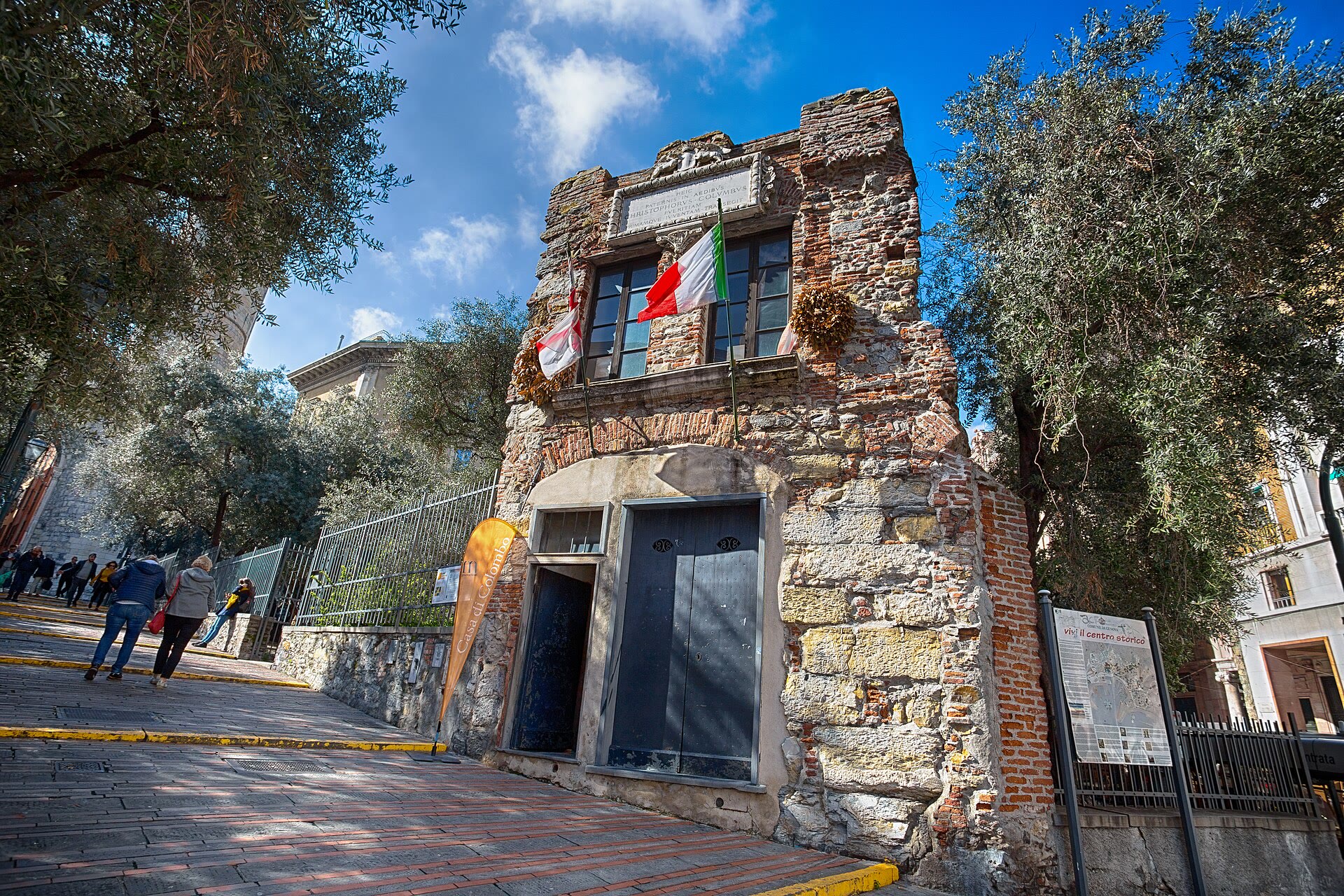
The great majority of scholars hold that Christopher Columbus was born in Genoa, part of present-day Italy, in 1451, into a Christian household. Their conclusion rests on his testament of 1498 together with archival documents from Genoa and Savona. He was the eldest son of Domenico Colombo, a Genoese wool worker and merchant, and Susanna Fontanarossa. His birth is placed between August 26 and October 31 of that year.
In Genoa he became an apprentice in his father's wool weaving business, while also studying mapmaking and sailing. His parents were Dominico Colombo and Susanna Fontanarossa.
After surviving a shipwreck off Cape Saint Vincent in 1476, Columbus based himself in Lisbon with his brother Bartholomew, where both were employed as chart makers. In 1477 he sailed to Iceland and Ireland, and in 1478 he was buying sugar in Madeira.
In 1479 Columbus met and married Felipa Perestrello e Moniz, a member of an impoverished noble Portuguese family, and their son Diego was born in 1480. From 1482 to 1485 he traded along the Guinea and Gold coasts of West Africa.
2. The Case for a Western Route
Columbus did not set out to discover a New World but to find a western sea route to the Far East, after the Silk Road land route was closed by the Ottoman Empire in 1453; this search launched the so-called Age of Exploration. National Geographic describes him as a fifteenth- and sixteenth-century explorer credited for connecting the Old World and the New World, born in Genoa in 1451, who persuaded King Ferdinand II and Queen Isabella I to sponsor his quest for a westward route to the Indies. World History Encyclopedia likewise presents him as a Genoese explorer, known as Cristoffa Corombo in Ligurian and Cristoforo Colombo in Italian, who became famous in his own time as the man who discovered the New World.
The Florentine astrologer and mathematician Paolo dal Pozzo Toscanelli, who had transcribed a map of the ancient geographer Strabo, suggested sailing west in order to reach Cathay in the East, and sent a copy of his map to Columbus in 1474. Columbus estimated the distance from the Canary Islands to Cathay at around 2,300 miles, but King John II of Portugal rejected the plan on the grounds that the estimate was too low, as the true distance was about 12,200 statute miles.
In 1484 Columbus began seeking support for an Atlantic crossing from King John II of Portugal but was denied aid; by 1486 he was firmly in Spain, asking for patronage from King Ferdinand and Queen Isabella. After at least two rejections, he obtained royal support in January 1492 chiefly through the interventions of the Spanish treasurer Luis de Santángel and of the Franciscan friars of La Rábida. Columbus had been present at the siege of Granada, the last Moorish stronghold to fall to Spain in January 1492, and was riding back from Granada to La Rábida when he was recalled to the Spanish court.
3. Terms and Titles
The Capitulations of Santa Fe, signed on 17 April 1492, granted Columbus the title of admiral and promised him ten percent of whatever valuables he might find on his voyages. His ambition was partly gratified by the title Admiral of the Ocean Sea awarded in April 1492 and by the grants enrolled in the Book of Privileges, a record of his titles and claims. His contract promised the monarchy ninety percent of the profits and made him viceroy or governor of any lands he took for the crown.
A royal letter of privileges was given at Granada on the 30th of April in the year of our Lord 1492. It willed that Columbus, after discovering and conquering the islands and continent in the ocean, should be their Admiral, Vice-Roy and Governour in them, and that for the future he might call and stile himself D.
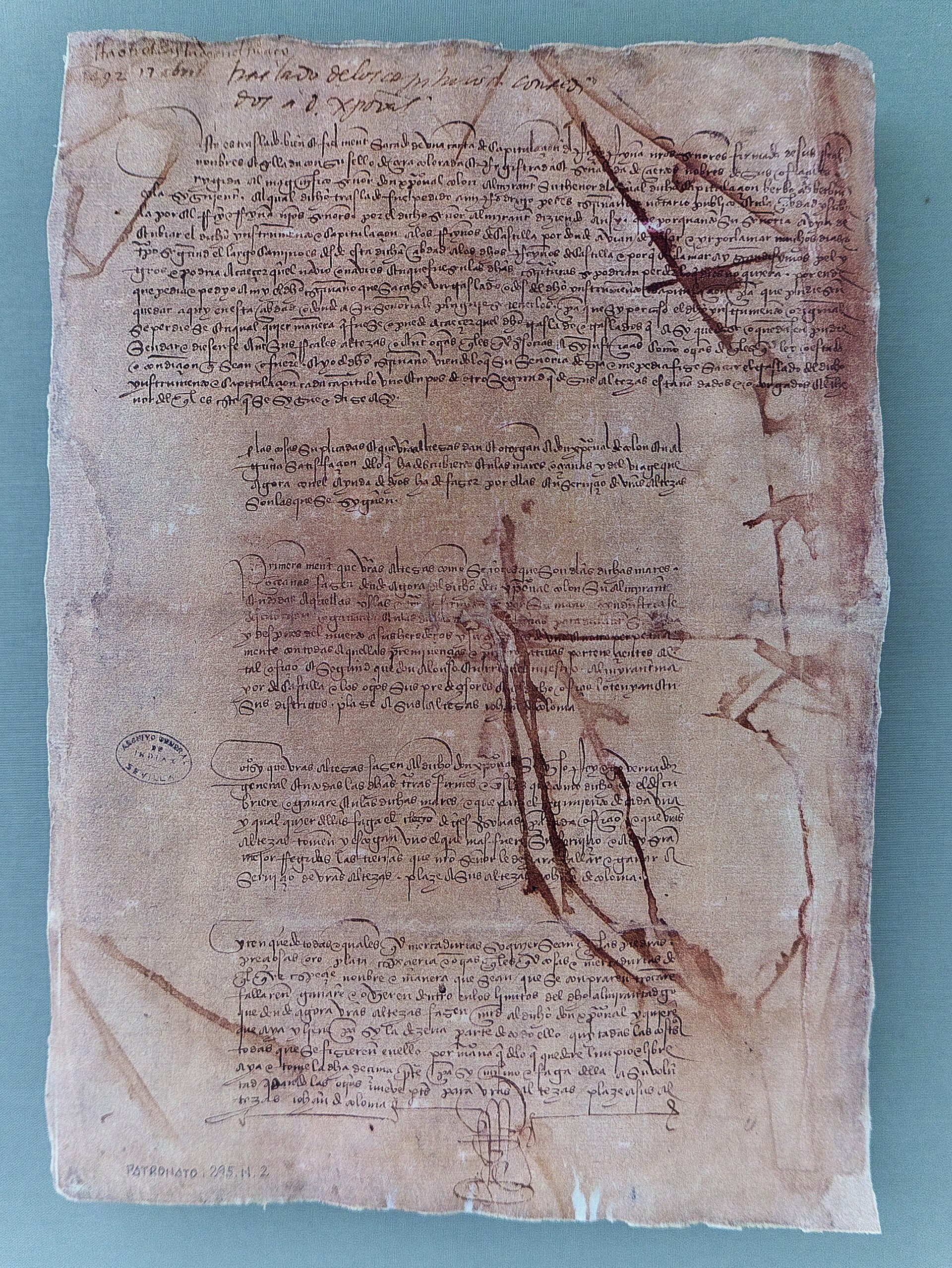
Queen Isabel and King Fernando had agreed to Columbus's lavish demands if he succeeded on his first voyage: he would be knighted, appointed Admiral of the Ocean Sea, made the viceroy of any new lands, and awarded ten percent of any new wealth.
On January 5 in 1502, prior to his fourth and final voyage to America, Columbus gathered several judges and notaries in his home in Seville to authorize authentic copies of the documents granting titles, revenues, powers and privileges to him and his descendants; these 36 documents are popularly called the Book of Privileges. The Library's copy of the Book of Privileges is the only one to contain the Papal Bull Dudum siquidem, a four-page letter composed by Pope Alexander VI on September 26 in 1493, thought by some scholars to contain the first written reference to a New World.
4. First Voyage (1492–93)
Columbus's first transatlantic voyage began on 3 August 1492, when he set sail from the bar of Saltes at Palos with a complement of 87 men on three ships. The fleet consisted of the Santa María, which served as flagship, together with the Pinta and the Niña. Columbus commanded the Santa María, while the Niña was led by Vicente Yanez Pinzon and the Pinta by Martin Pinzon.
After sunset on 11 October, the Pinta, the swiftest sailer, discovered land and made the signals; the land was first seen by a sailor called Rodrigo de Triana. Earlier the Admiral had perceived a light once or twice, appearing like the light of a wax candle moving up and down, and he directed the crew to keep a strict watch upon the forecastle.
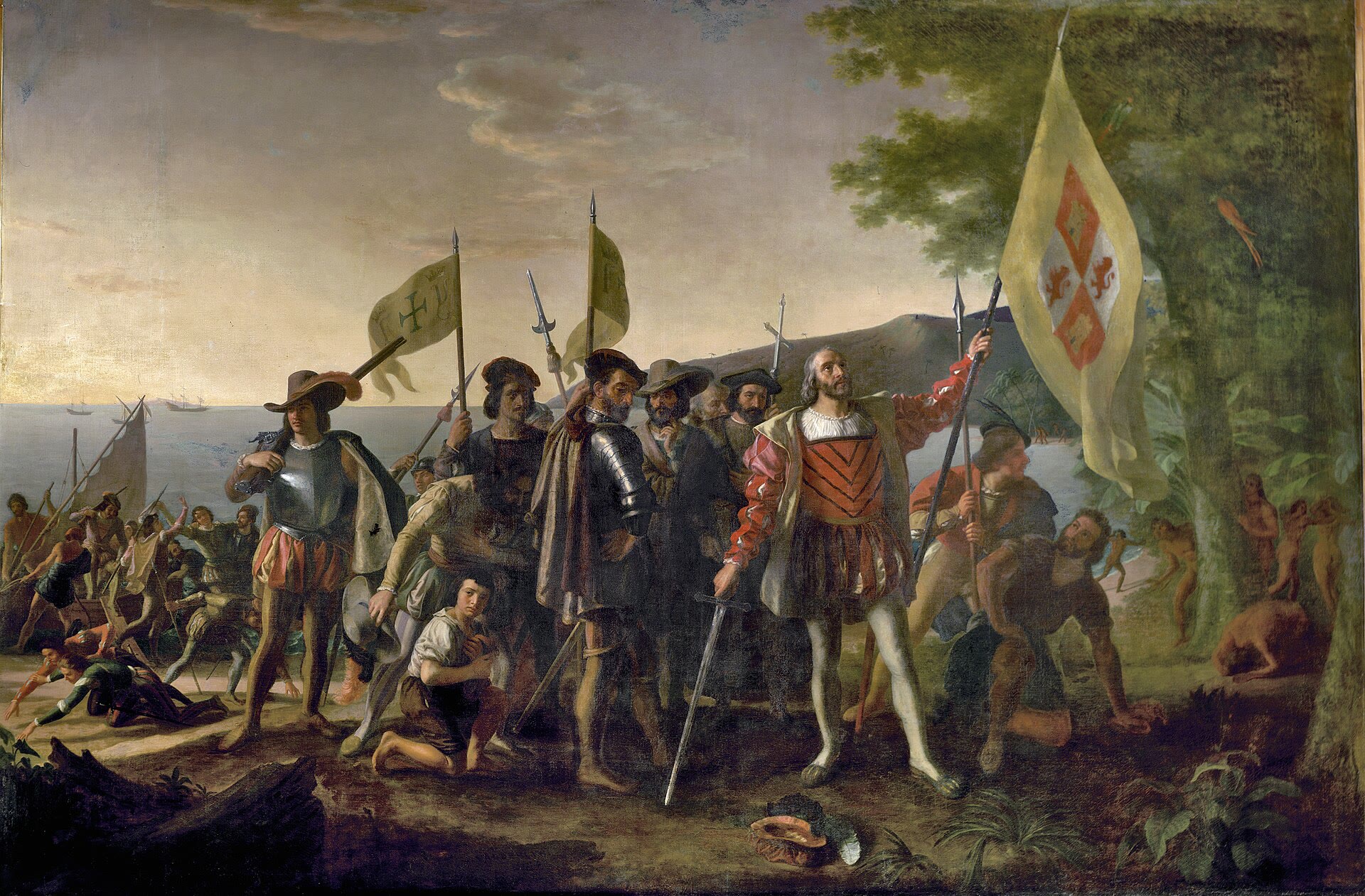
Landfall came on 12 October 1492 at Guanahani, an island of the Lucayos in the Bahamas, which Columbus renamed San Salvador. The Admiral landed in the armed boat with Martin Alonzo Pinzon and Vincent Yanez, his brother and captain of the Niña.
Columbus reported that the people were ingenious and would be good servants and that they would very readily become Christians, as they appeared to have no religion. He intended to carry home six of them to learn the language.
On Christmas 1492 the flagship Santa María lodged in a reef, and Columbus ordered his men to dismantle the ship and build a fort with its timbers onshore. Three weeks later he set sail aboard the Niña, leaving behind a fortified village christened Villa de la Navidad and 39 sailors charged with exploring the coast and amassing gold.
5. Second Voyage and the Colony at La Isabela
Columbus returned to the New World as governor of the lands he had claimed, leading a fleet of seventeen ships carrying some 1,500 men. The expedition was provisioned not merely for exploration but for settlement, bringing pigs, horses, cattle and other livestock, seeds and plants for crops, and the tools and equipment necessary to start a colony. The fleet also carried dogs intended for use in subduing the natives.
In 1493 Columbus built La Isabela on the north coast of Hispaniola, the first intentional European colonial town in the New World. It was conceived as a base from which to establish Spanish presence and dominion in the Indies. The settlement stands as the first European town founded in the Americas.
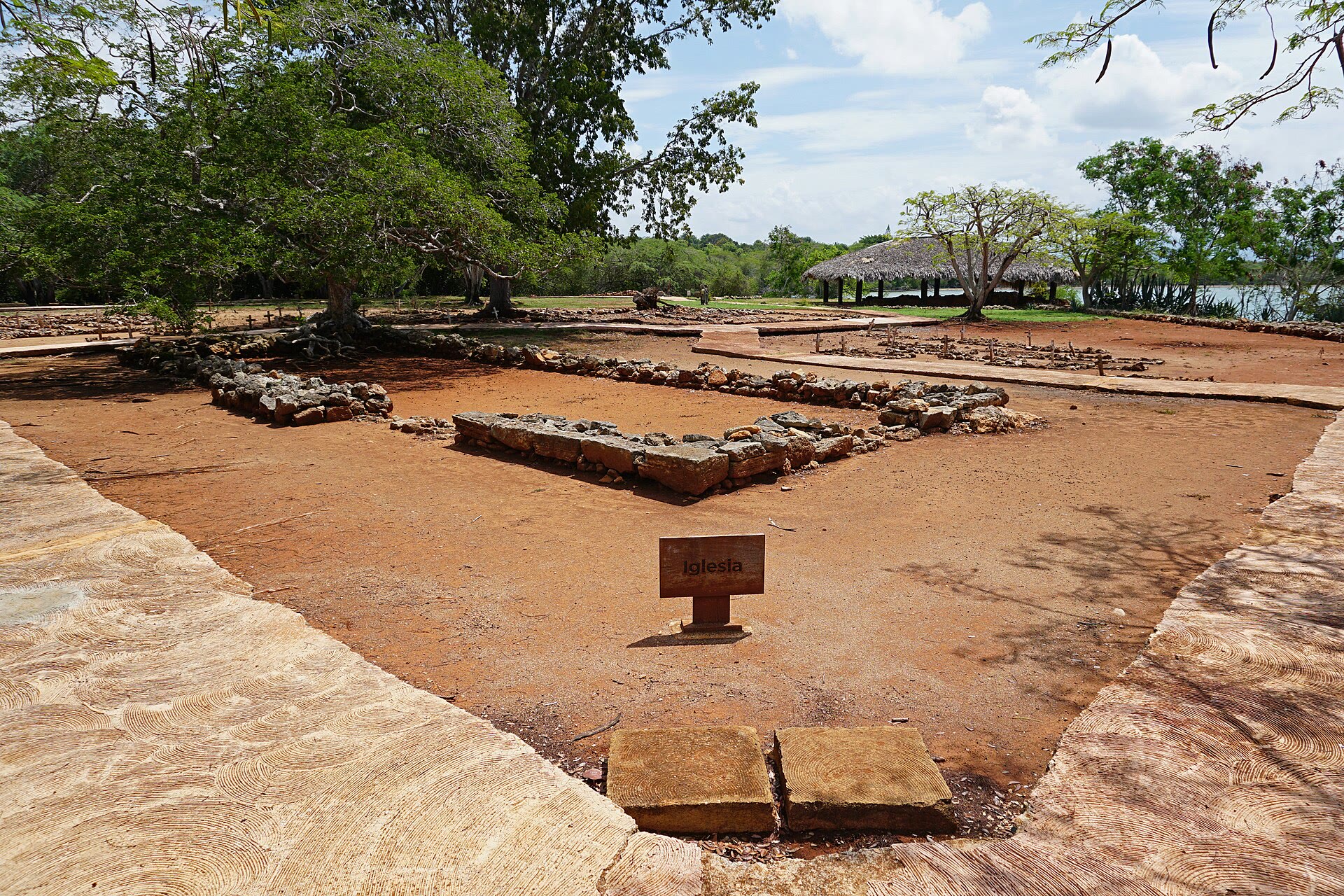
The town was enclosed by a wall with a fortified storehouse at one end and Columbus's citadel at the other. Within it, the Columbus house, built of rammed earth and cut limestone, is the oldest remnant of a European structure in the Americas.
The first Mass in the New World was celebrated at La Isabela on 6 January 1494, during the second voyage, in what is now the Dominican Republic. When Columbus returned a year later to enlarge the settlement, he found La Navidad in ashes, with no inhabitants and no gold.
The second voyage established the encomienda system, under which Spanish settlers claimed a large tract of land on which the natives provided labor in return for food, shelter and protection. Mastiffs, previously used by the Spanish against the Moors in the Reconquista, were included as an important asset on the voyage; the dogs terrorized the native people and broke attempts at resistance to the European conquest.
Evidence indicates that the last inhabitants of La Isabela desperately tried to extract silver from lead ore just before abandoning the failed mining operation in 1498 — the first known European extraction of silver in the New World. The smelting operation appeared to have used nearly 200 pounds of galena, a silver-bearing lead ore.
6. Third and Fourth Voyages
On the third voyage the first land sighted consisted of three mountains united at their base, and Columbus christened the island La Trinidad from the name of the Trinity. Off the mainland, inhabitants informed him that the country was called Paria, and he took four natives and proceeded westward. This voyage is dated 1498 to 1500 among his four transatlantic crossings.
On his fourth and final journey west in 1502, Columbus's goal was to find the Strait of Malacca. He returned with a fleet of 30 ships, 29 of which were lost in a storm off Santo Domingo, and he explored the islands off Honduras and mapped Costa Rica and other sites. The voyage lasted from 1502 to 1504.
A hurricane and storms left his ship so badly damaged that he and his crew were stranded on Jamaica for two years. Stranded there, Columbus frightened the natives into assisting him by claiming he would take the great light from the sky, and then accurately predicted the lunar eclipse of 29 February 1504 CE.
Columbus died at Valladolid on May 20 in 1506 due to illness and old age. Even until death he still firmly believed that he had traveled to the eastern part of Asia.
7. Governance, Enslavement and Demographic Collapse
The colonists under Columbus's authority enslaved many of the natives, sending some to Europe and using many to mine gold. His arrest in 1500 came on royal orders, and Bobadilla replaced him as governor. Ferdinand and Isabella ordered that arrest during his third voyage to the Americas, accusing him of having misused his judicial powers; although he was acquitted within the year, the monarchs nonetheless rescinded his titles.
Spaniards removed men from villages to work in gold mines and colonial plantations.
Possibly as many as three million souls — some 85 percent of the Taíno population — had vanished by the early 1500s.
The Lucayan people of the Bahamas were part of the broader Taíno culture, with a well-established society. When Columbus arrived there were about 40,000 Lucayans; within 25 years all of them were wiped out due to the diseases, hardships and slavery endured.
The Taíno world had its origins among the Arawak tribes of the Orinoco Delta and gradually spread from Venezuela across the Antilles, reaching its peak by the time of European contact. The Taíno impressed Columbus with their generosity, which may have contributed to their undoing; he noted that they should be good servants.
A new governor, Francisco de Bobadilla, was sent to the colony, and Columbus was taken prisoner on board a ship and sent back to Spain. The Taíno were about 500,000 strong when Columbus arrived, and within a few years of his arrival they had all but vanished, the vast majority wiped out by the arduousness of slavery and by exposure to European diseases.
The Taíno began to starve, many thousands fell prey to smallpox and other European diseases, and hundreds fell in fighting with the Spaniards. The Taíno were about 500,000 strong when Columbus arrived, and within a few years of his arrival they had all but vanished, the vast majority wiped out by the arduousness of slavery and by exposure to European diseases; in less than 30 years, through enslavement, murder and disease, the Lucayan people were essentially wiped out.
8. The Columbian Exchange
The term "Columbian Exchange" was coined by the historian Alfred W. Crosby to describe the impact of living organisms traded between the New World and the Old World. In 1972 Crosby published the book The Columbian Exchange, which is regarded as a founding text in the field of environmental history.
Crosby characterized the world of 1491 as a minimum of two worlds — the New World of the Americas and the Old World of Eurasia and Africa — brought together by Columbus. That convergence produced an exchange of native plants, animals and diseases across the oceans.
Smallpox took hold in areas of the New World in the early part of the 16th century and killed a great many American Indians, beginning with the Aztecs and the peoples of Mexico and Peru.
9. Reputation and Commemoration
Columbus's reputation has fluctuated greatly throughout history, both during his own lifetime and in the centuries since. He nevertheless died a disappointed man.
Scholarship advanced greatly between the quatercentenary celebrations of 1892–93 and the quincentenary of 1992. Over that span the older pro-European understanding gave way to one shaped from the perspective of the inhabitants of the Americas themselves.
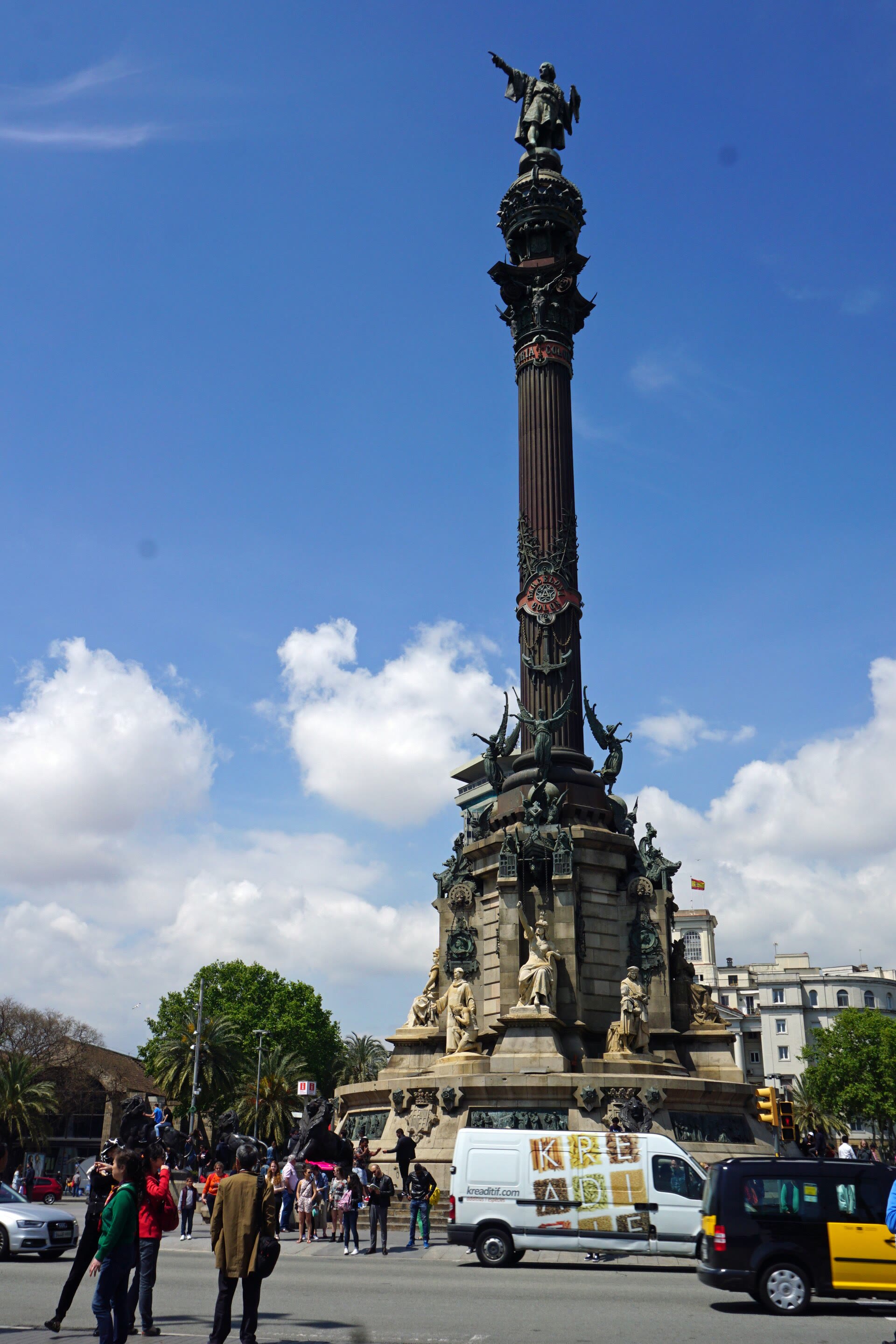
Columbus Day commemorates the landing of Christopher Columbus in the Americas on October 12 in 1492 and has been observed on the second Monday of October since 1971, the year it became a federal holiday. The day came to be marked by parades and public ceremonies. By the quincentennial in 1992, however, the holiday had become an occasion for discussing the European conquest of Native peoples, and alternatives such as Indigenous Peoples' Day were proposed.
The American cult of Columbus began rather badly, not with affection for Columbus himself but with a disdain for England and the desire for a uniquely American hero. The book by Washington Irving informed the decision of U.S. President Benjamin Harrison to proclaim a national day of observance in Columbus's honor in 1892 CE on the 400th anniversary of his arrival. Colorado was the first state to observe the holiday in 1906 CE.
On May 1 in 1893 CE, hundreds of thousands of fairgoers flocked to the grand opening of the World's Columbian Exposition in Chicago, held in celebration of the four hundredth anniversary of Columbus's first voyage to the Americas. Demonstrators later pulled down statues of Christopher Columbus in St. Paul, Minnesota, and Richmond, Virginia, and decapitated another in Boston, targeting monuments seen as symbols of white supremacy.
Columbus never claimed to have discovered America, and nothing in his journals or the writings of near-contemporaries suggests that scholars of his day believed the earth was flat while he proved it was round.
10. Key Facts
| Label | Value |
|---|---|
| Also known as | Master navigator and admiral 1Christopher Columbus | Biography, Nationality, Voyages, Ships, Route, & Facts · Encyclopaedia Britannica ↗ |
| Principal titles | Admiral of the Ocean Sea; Viceroy and Governor of the Indies 3Christopher Columbus: Man and Myth (1492: An Ongoing Voyage) · Library of Congress ↗ |
| Sponsors | Queen Isabel and King Fernando 3 |
| Fourth voyage | Explored the islands off Honduras and mapped Costa Rica and other sites 2Christopher Columbus · World History Encyclopedia ↗ |
11. Timeline: from Genoa to the age of exploration
- 1451Birth in GenoaChristopher Columbus was born in Genoa, between August 26 and October 31 according to Britannica, the eldest son of the wool worker and merchant Domenico Colombo.
- 1476Shipwrecked and settled in LisbonAfter surviving a shipwreck off Cape Saint Vincent, Columbus based himself in Lisbon with his brother Bartholomew and worked as a chart maker.
- 1479Marriage to Felipa PerestrelloColumbus met and married Felipa Perestrello e Moniz, a member of an impoverished noble Portuguese family; their son Diego was born in 1480.
- 1484Proposal to Portugal rejectedColumbus began seeking support for an Atlantic crossing from King John II of Portugal but was denied aid.
- 17 April 1492Capitulations of Santa FeColumbus and the monarchs Ferdinand II of Aragon and Isabella I of Castile signed the Capitulations of Santa Fe, granting him the title of admiral.
- 3 August 1492Departure from PalosColumbus set sail from the bar of Saltes at 8 o'clock with the Niña, the Pinta and the Santa María.
- 12 October 1492Landfall at GuanahaniLand was discovered at two o'clock in the morning; the island, called Guanahani by its people, was renamed San Salvador.
- 25 December 1492Wreck of the Santa MaríaHis flagship lodged in a reef on Christmas, and he ordered the ship dismantled to build the fort of La Navidad, leaving 39 men behind.
- 1493Second voyage and La IsabelaColumbus returned to the Caribbean with seventeen ships and some 1,500 men to colonize, building the first intentional European colonial town in the New World.
- 6 January 1494First Mass at La IsabelaThe first Mass in the New World was celebrated at La Isabela during Columbus's second voyage.
- 1498Third voyage and the mainlandOn his third voyage Columbus sighted Trinidad and reached the mainland coast of South America, the country the inhabitants called Paria.
- 1500Arrest and return in chainsFerdinand and Isabella ordered his arrest for having misused his judicial powers; he was sent back to Spain and his titles were later rescinded.
- 1502-1504Fourth voyageColumbus returned with a fleet of 30 ships, 29 lost in a storm off Santo Domingo; he explored Honduras and was stranded on Jamaica for two years.
- 29 February 1504Eclipse and rescue at JamaicaColumbus used his knowledge of a coming lunar eclipse to secure supplies from the islanders before being rescued and returned to Spain.
- 20 May 1506Death at ValladolidColumbus died at Valladolid on May 20, 1506, due to illness and old age, still believing he had reached the eastern part of Asia.
- 1892Columbus Day proclaimedPresident Benjamin Harrison proclaimed the 400th anniversary of Columbus's arrival a national holiday; it became an annual federal holiday in 1937.
References (20)
- 1Christopher Columbus | Biography, Nationality, Voyages, Ships, Route, & Facts — Encyclopaedia Britannica Web↩View source
- 2Christopher Columbus — World History Encyclopedia Web↩View source
- 3Christopher Columbus: Man and Myth (1492: An Ongoing Voyage) — Library of Congress Web↩View source
- 4Christopher Columbus — The Mariners' Museum and Park (Ages of Exploration) WebView source
- 5Christopher Columbus — National Geographic WebView source
- 6Privileges and Prerogatives Granted by Their Catholic Majesties to Christopher Columbus: 1492 — The Avalon Project, Yale Law School WebView source
- 7See it Now: Columbus's Book of Privileges — Library of Congress (Timeless blog) 2014 WebView source
- 8Christopher Columbus: Extracts from Journal (abstract of Bartolomé de las Casas) — Internet Medieval Sourcebook, Fordham University WebView source
- 9Why Haven't We Found Christopher Columbus's Ships? — National Geographic WebView source
- 10Oct 12, 1492 CE: Columbus Makes Landfall in the Caribbean — National Geographic Education WebView source
- 11The Lost Fort of Columbus — Smithsonian Magazine WebView source
- 12La Isabela: First European Town in America — Florida Museum of Natural History, University of Florida WebView source
- 13Early Columbus settlement was desperate to find metals — Florida Museum of Natural History, University of Florida WebView source
- 14Select Letters of Christopher Columbus, with Other Original Documents (trans. R. H. Major, 1870) — Project Gutenberg 1870 WebView source
- 15Intern Spotlight: The Shifting Reputation of Christopher Columbus — Library of Congress (Unfolding History blog) 2024 WebView source
- 16Who Were the Taíno, the Original Inhabitants of Columbus' Island Colonies? — Smithsonian Magazine WebView source
- 17History of the Bahamas — The Islands of The Bahamas (official website) WebView source
- 18Alfred W. Crosby on the Columbian Exchange — Smithsonian Magazine WebView source
- 19Columbus Day | History, Meaning, & Facts — Encyclopaedia Britannica WebView source
- 20Breaking Down the United States' Historical Obsession With Christopher Columbus — Smithsonian Magazine WebView source
 Spain
 Marco Polo
 Chocolate

