Linux
The free kernel announced in 1991 as "just a hobby" — now the common foundation of servers, phones, supercomputers and the cloud, from Torvalds' first post to GPLv3 and the longterm releases.
Linux is a free operating-system kernel first announced by Linus Torvalds on 25 August 1991, in a Usenet post describing "just a hobby, won't be big and professional like gnu" for 386 AT clones. It is the kernel — the program that allocates the machine's resources to other programs — normally used with the GNU Project's software to form the complete system Richard Stallman calls GNU/Linux; GNU had been under construction since January 1984 and was complete except for a kernel when Linux appeared. The kernel is released under GNU GPL version 2; the FSF's licence history runs from version 1 in 1989 and version 2 in June 1991 to version 3 released on 29 June 2007 — a revision whose anti-tivoization terms the Linux developers declined to adopt. Kernel development now follows a steady cadence: one mainline release every 9–10 weeks maintained by Torvalds, backported stable releases, and longterm kernels such as 6.12 kept alive until December 2028. Distributions turn the kernel into products and services — Red Hat Enterprise Linux, Debian, Fedora, openSUSE, Ubuntu and SUSE Linux Enterprise among them — sold by Red Hat under subscriptions, with Red Hat acquired by IBM on 9 July 2019. Dated figures in this article carry the year of the source that recorded them.
What Linux is: kernel, system and family
Strictly speaking, Linux is not the whole operating system but the kernel — the program that allocates a machine's resources to the other programs a user runs.1 Used together, they make a system that is, in essence, GNU plus a Linux kernel — GNU/Linux.1 Every distribution commonly called Linux is, by the same logic, a distribution of GNU/Linux.1 Richard Stallman asks that the whole system not be called Linux, since that means attributing the GNU Project's work to someone else.2
It is the combination that users actually run: pairing Linux with the then not-quite-complete GNU system yielded a complete free operating system.2 When the kernel was re-released under the GNU GPL in 1992, GNU and Linux together made it possible for the first time to run a PC without non-free software.3 The kernel travelled far beyond the desktop: by his 1999 essay, Torvalds could note Linux in embedded systems, controlling robotic devices, and flying on the space shuttle.4 That breadth rests on flexibility: the operating system is widely used in diverse environments because its kernel can be configured flexibly.5
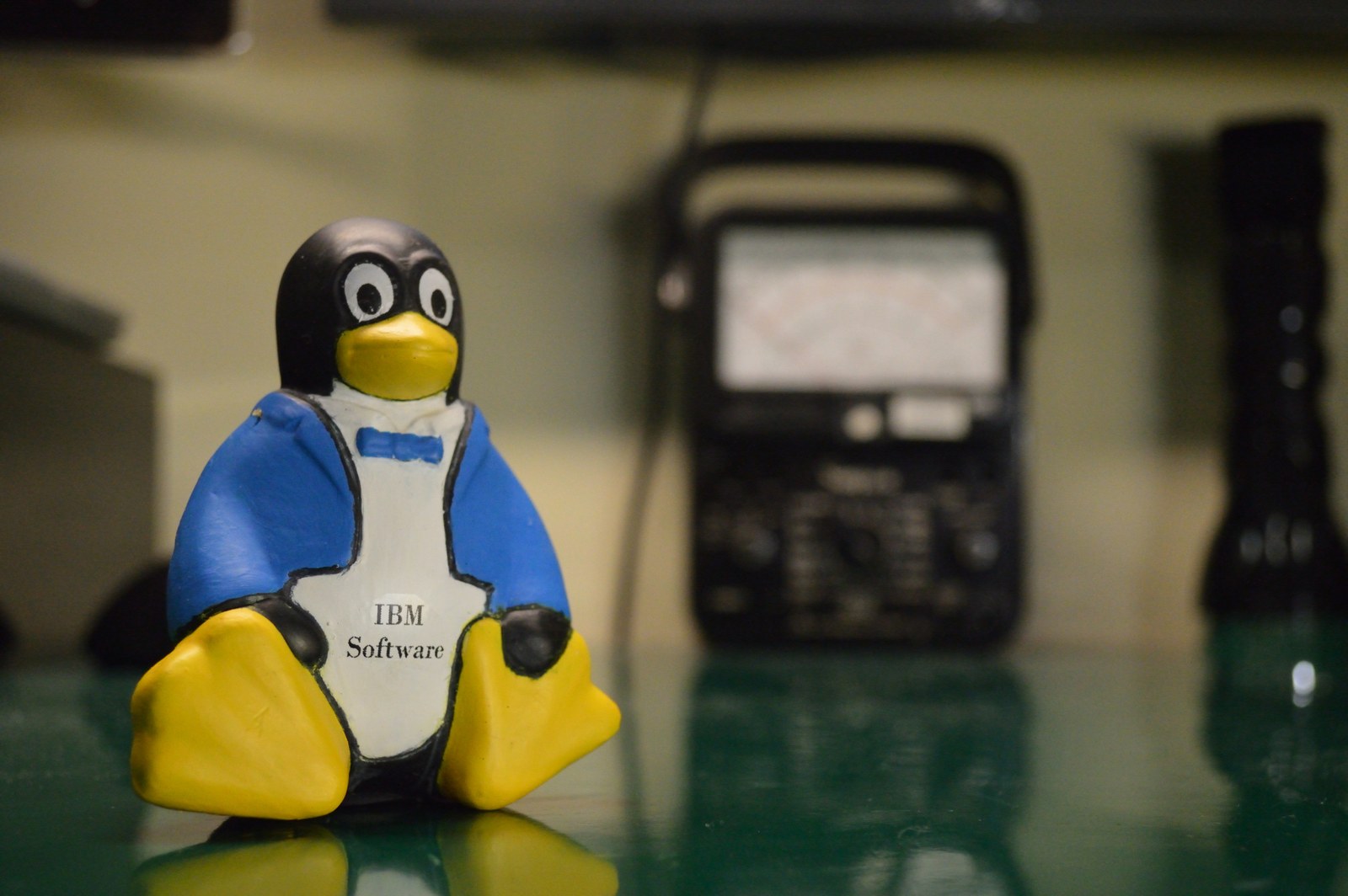
By 2000 it was the dominant choice for Internet servers and ISPs, for academia, for hobbyists and for computer-science research.6 Free systems such as Debian GNU/Linux ship with literally thousands of applications.6 The name itself is protected: it is registered as a trademark controlled by Linus Torvalds, with use governed by the Linux Trademark Institute.7 The mascot has its own terms: Larry Ewing created Tux the penguin with GIMP, and it may be used even commercially, as long as he receives proper credit.7
Before Linux: GNU, free software and the missing kernel
The story starts earlier: in September 1983 Richard Stallman announced a plan for GNU, a free software, Unix-like operating system.3 The name is a recursive joke: GNU stands for Gnu's Not Unix, the complete Unix-compatible system he set out to give away free to anyone who could use it.8 Work began in earnest in January 1984, when Stallman resigned from MIT and started writing GNU software.2 The departure was deliberate: had he stayed on the MIT staff, the institute could have claimed ownership of the work and imposed its own distribution terms.2
Distribution terms were the point: the GNU Manifesto puts GNU in a protected commons — everyone may modify and redistribute it, but no distributor may restrict further redistribution, and proprietary modifications are ruled out.8 The goal was to give users freedom, not merely to be popular, so the project needed terms that would prevent GNU software from being turned into proprietary software; the method is called copyleft.2 Its central idea is that everyone may run, copy, modify and distribute the program, but no one may add restrictions of their own.2 The specific implementation for most GNU software is the GNU General Public License, or GNU GPL.2
The Free Software Foundation followed in 1985, founded as a tax-exempt charity for free software development.2 Software counts as free when its users hold the four essential freedoms.9 Freedom 1 covers studying how the program works and changing it so it does your computing as you wish, with access to the source code as a precondition.9 Freedom 3 covers distributing copies of modified versions so the whole community can benefit from them.9 None of that means noncommercial: a free program must be available for commercial use, commercial development and commercial distribution.9
By 1990 the GNU system had only one major piece missing: the kernel.2 The intended replacement, the Hurd, is a collection of servers that run on top of Mach and do the various jobs of the Unix kernel.2 It started working reliably only in 2001, still a long way from ready for general use.1 Linux had already filled the gap: Torvalds' Unix-compatible kernel, written in 1991, started out proprietary and became free software in 1992.2 The result of joining Linux to that almost-finished GNU system was a complete free operating system.2
Callout: How Linux is licensed
August 1991: the announcement and the first releases
The founding document of Linux is a Usenet post: on 25 August 1991 Linus Torvalds announced a free operating system for 386(486) AT clones, describing it as just a hobby that would not be big and professional like GNU.10 The project had been brewing since April and was starting to get ready.10 By announcement time bash 1.08 and gcc 1.40 had been ported, and things seemed to work.10 He also stressed that the system was free of any minix code and had a multi-threaded file system.10
The first numbered release, 0.01, contained no binaries at all — just source code for people curious about what linux looked like.10 Version 0.02 followed on 5 October 1991, with sources placed at nic.funet.fi in the directory /pub/OS/Linux.10 It still required minix-386 to be compiled and minix to be set up, so it was not yet a standalone system.10 Early copyright was also stricter than the GNU copyleft — no money at all could change hands because of linux — a rule relaxed with 0.12.10
By December 1991 the kernel had reached version 0.11, still in beta yet already with a small following.10 Version 0.12 arrived on January 5th with major corrections, and proved very stable — no patches were needed for a long time.10 That was the release that made it: 0.12 is when linux started to spread a lot faster.10
Out of the hobby stage: ports, modules and the microkernel debate
In early 1992, with the Linux discussion having taken over comp.os.minix, Andrew Tanenbaum decided it was time to comment on Linux.11 His post of 29 January 1992 was titled LINUX is obsolete and argued that, among people who actually design operating systems, the debate was over: microkernels had won.11 He contrasted MINIX, a microkernel-based system, with LINUX, which he called a monolithic style system and a giant step back into the 1970s.11 Torvalds' reply conceded the charge: linux was monolithic, and he agreed that microkernels are nicer.11
Still, Linux was never a copy of anything: it aims to provide a Unix-compatible interface, but the kernel was written from scratch without reference to Unix source code, so it is not a port of Unix.4 Portability came slowly — in 1991 Torvalds judged porting impossible, since the kernel leaned on every conceivable feature of the 386 he could find.10 Later versions changed that, and linux was in fact ported to other architectures.10 The first serious port went to DEC's Alpha: it started in 1993, took about a year to complete, and established design principles that made later ports easier.4
Development kept growing: with the 2.0 kernel Linux grew up a lot, and loadable kernel modules were added at that point.4 On licensing, Torvalds decreed that system calls would not count as linking against the kernel, so programs running on top of Linux are not covered by the GPL.4 One early reason for the licence choice was the compiler: the GPL was the licence of the GCC compiler.4 By 1999 the kernel ran from PalmPilots to Alpha workstations, making it the most widely ported system available for PCs.4
Milestones and major distributions
The dated record below begins with GNU's announcement in September 1983.3 It runs through the 1991 announcement, the 1992 relicensing and the GPLv3 split to the longterm kernel 6.12.12 The distribution table that follows shows how that kernel reaches users as products and services.13
| Date | Milestone | Source note |
|---|---|---|
| September 1983 | GNU announced: a plan for a free software, Unix-like operating system3 | FSF press release on GPL version 33 |
| January 1984 | Stallman leaves MIT and begins writing GNU software2 | Richard Stallman, The GNU Project2 |
| 1985 | Free Software Foundation founded as a tax-exempt charity for free software development2 | Richard Stallman, The GNU Project2 |
| 1989 | GNU GPL version 1 released3 | FSF press release on GPL version 33 |
| June 1991 | GNU GPL version 2 released — the licence the Linux kernel still uses14 | GPL version 2 licence text, June 199114 |
| 25 August 1991 | Linus Torvalds announces his free operating system in comp.os.minix for 386(486) AT clones10 | Torvalds' 1991–1992 Usenet posts, collected 199210 |
| 5 October 1991 | Version 0.02 released for wider distribution, with sources at nic.funet.fi10 | Torvalds' 1991–1992 Usenet posts10 |
| 29 January 1992 | The Tanenbaum–Torvalds debate opens with the post LINUX is obsolete11 | Open Sources, Appendix A (O'Reilly, 1999)11 |
| 1992 | Linux relicensed as free software, fitting the last gap in the GNU system2 | Richard Stallman, The GNU Project2 |
| 1993 | The Alpha port starts and takes about a year to complete4 | Torvalds, The Linux Edge (O'Reilly, 1999)4 |
| January 1999 | The Linux Edge appears in the first edition of Open Sources4 | O'Reilly, Open Sources (1999)4 |
| 2001 | The GNU Hurd starts working reliably, still far from general use1 | GNU Project, Linux and the GNU System1 |
| 29 June 2007 | GPL version 3 released; the Linux kernel stays on version 23 | FSF press release on GPL version 33 |
| 9 July 2019 | IBM closes its acquisition of Red Hat, funded with debt and cash15 | IBM FY2019 Form 10-K15 |
| 17 November 2024 | Linux 6.12, a longterm kernel, released with a projected EOL of December 202812 | kernel.org, Active kernel releases12 |
| Distribution | What the record shows | Source note |
|---|---|---|
| Red Hat Enterprise Linux | An operating system built with open source software components, including the Linux kernel, designed expressly for enterprise computing13 | Red Hat FY2019 Form 10-K13 |
| Debian GNU/Linux | The FSF funded an early stage of its development1 | GNU Project, Linux and the GNU System1 |
| Fedora | Named among the freely available distributions Red Hat competes with13 | Red Hat FY2019 Form 10-K13 |
| CentOS | Named among the freely available distributions Red Hat competes with13 | Red Hat FY2019 Form 10-K13 |
| openSUSE | Named among the freely available distributions Red Hat competes with13 | Red Hat FY2019 Form 10-K13 |
| Ubuntu | Named among the freely available distributions Red Hat competes with13 | Red Hat FY2019 Form 10-K13 |
| SUSE Linux Enterprise Server | Named among Red Hat's competitors (EQT Partners' enterprise Linux)13 | Red Hat FY2019 Form 10-K13 |
How the kernel is made: cadence, maintainers and longterm versions
The release machine is regular: the mainline tree, where new features are introduced, is maintained by Linus Torvalds, and a new mainline kernel appears every 9–10 weeks.12 Each release opens a 2-week merge window during which new major features are introduced into the kernel.12 The merge window then closes and a 7-week stabilisation phase begins, publishing a release candidate each week.12 rc7 is usually the last release candidate — pre-releases carry the -rc suffix and must be compiled from source.12
Maintenance is layered: a designated maintainer backports fixes from the mainline tree to the stable kernel.12 Stable updates appear on an as-needed basis, usually once a week.12 Longterm kernels take only important bugfixes and therefore do not see very frequent releases, especially the older trees.12 Their projected EOL dates are not set in stone: each new longterm kernel usually starts with a 2-year projected end of life that can be extended if there is enough interest from industry.12
The flagship example is 6.12: Greg Kroah-Hartman and Sasha Levin maintain it, and it was released on 17 November 2024 with a projected end of life in December 2028.12 Distributions also maintain their own longterm kernels; those are not hosted at kernel.org and carry no support from kernel developers.12 The site itself is operated by the Linux Kernel Organization, a 501(c)3 nonprofit corporation.16 One quirk is worth remembering: the major version number means nothing — it is incremented when the number after the dot starts looking too big, and there is literally no other reason.12
The GPLv2-GPLv3 question
The kernel sits on the older licence: GNU GPL version 2, which the Free Software Foundation defines as Free Software.7 Version 3 took years: Stallman began revising the GPL in 2005, and in January 2006 the FSF opened a systematic public review with legal support from the Software Freedom Law Center.3 The FSF released version 3 on 29 June 2007.3 Its flashpoints were about control rather than features: it does not restrict a program's features and does not prohibit DRM, but it prohibits tivoization and Treacherous Computing used to stop users from changing the software.3
The FSF was clear that the licensing of Linux would be decided by the developers of Linux.3 With them staying on version 2, a GNU/Linux system ends up mixed: GNU packages using GPL version 3 alongside a Linux kernel that remained on GPL version 2.3 Red Hat's filing reads the business meaning: licences such as the GPL impose significant limits on a distributor's ability to license derivative works under more restrictive terms and generally require the distributor to disclose the source code of such works.13 A further consequence is firmware: it is not part of Linux and is not executed by the kernel, merely uploaded to a device during the driver initialisation stage.7
Firmware blobs now live in their own repository, linux-firmware, moved out of the main Linux tree to keep licensing clear.7 A fully free setup stays possible but expensive: Linux runs without non-free firmware binaries, usually at the cost of rendering much hardware inoperable.7 The GPL remains the most widely used free software licence; almost three quarters of all packages are distributed under it.3
Linux in business: Red Hat, IBM and the subscription model
Red Hat describes itself as a leading global provider of open source software solutions, using a community-powered approach to develop and offer its technologies.13 Its flagship, Red Hat Enterprise Linux, is an operating system built with open source software components, including the Linux kernel, and designed expressly for enterprise computing.13 The filing credits Torvalds and a relatively small group of engineers, many not employed by Red Hat, with the kernel's development and evolution — the heart of that operating system.13 Customers pay for support: they agree to purchase a support subscription for each unit of Red Hat software they deploy.13
Entry looks easy, and the filing says why: financial and legal barriers to creating a new Linux distribution are relatively low, since the components are publicly available under licences permitting copying, modification and redistribution.13 Competition is constant: Red Hat, SUSE, Amazon and Oracle all ship enterprise Linux kernels, and vendors compete with free options such as CentOS, Debian, Fedora, openSUSE and Ubuntu.13 Growth nonetheless: total revenue increased from $2.92 billion in fiscal 2018 to $3.36 billion in fiscal 2019.13 In a world where GPL terms limit traditional proprietary models, Red Hat treats its trademarks as possibly its most valuable intellectual property.13
The corporate story turned in 2019, when IBM's acquisition of Red Hat closed on 9 July 2019, funded through a combination of debt and cash, with incremental debt issued earlier that year.15 IBM frames the target in cloud terms: Red Hat is, in its words, the world's leader in open source technology, including Enterprise Linux — the operating system of the cloud — as well as containers and OpenShift.15 IBM's own forecast is Linux-shaped: as clients move more mission-critical workloads to the cloud, their multi-cloud environments will be based on a foundation of Linux, with Kubernetes to deploy, manage and scale container-based applications.15 A guide of the same era captured the momentum: Linux, started from scratch not even 10 years earlier, had been the favorite kernel of the Free Software world.6
In their own words
Much of Linux's early history survives in the principals' own words, from Usenet posts to essays and project pages.10 The exchange below set the tone: a modest announcement, a harsh rebuke, and a reply that conceded the theory.11 The licence and community statements that follow show how the project described itself to the outside world.7
I'm doing a (free) operating system (just a hobby, won't be big and professional like gnu) for 386(486) AT clones.
Linus Torvalds, announcement in comp.os.minix, 25 August 1991
LINUX is a monolithic style system. This is a giant step back into the 1970s.
Andrew Tanenbaum, LINUX is obsolete, comp.os.minix, 29 January 1992
True, linux is monolithic, and I agree that microkernels are nicer.
Linus Torvalds, replying in the Tanenbaum–Torvalds debate, 1992
Please don't fall into the practice of calling the whole system "Linux," since that means attributing our work to someone else.
The GNU Project, Linux and the GNU System
Linux kernel is released under the terms of GNU GPL version 2 and is therefore Free Software as defined by the Free Software Foundation.
The Linux Kernel Archives FAQ, kernel.org
The power of Linux is as much about the community of cooperation behind it as the code itself.
Linus Torvalds, The Linux Edge, Open Sources, 1999
Read together, the quotations mark the distance from a hobby announcement to an operating system the industry builds on.10 The community, in Torvalds' account, matters as much as the code itself.4
Linux by the numbers
The figures here are snapshots, each stamped with the source that recorded it.16 The volatile rows — the current kernel versions — carry their September 2026 dates.16 Two figures frame the whole article: GNU's share of a distribution's source code against Linux's, and the GPL's reach across free software.1
| Metric | Value | Source |
|---|---|---|
| GNU's share of a CD-ROM distribution's source code | About 28% — the largest single contingent1 | GNU Project, Linux and the GNU System1 |
| Linux's own share of the same distribution | About 3%1 | GNU Project, Linux and the GNU System1 |
| Mainline release cadence | One release every 9–10 weeks12 | kernel.org, Active kernel releases12 |
| Post-release cycle | 2-week merge window, then a 7-week bugfix and stabilisation period12 | kernel.org, Active kernel releases12 |
| Operator of kernel.org | Linux Kernel Organization, a 501(c)3 nonprofit corporation16 | The Linux Kernel Archives16 |
| Red Hat revenue, fiscal 2018 | $2.92 billion13 | Red Hat FY2019 Form 10-K13 |
| Red Hat revenue, fiscal 2019 | $3.36 billion13 | Red Hat FY2019 Form 10-K13 |
| Longterm kernel 6.12 | Released 17 November 2024; projected EOL December 202812 | kernel.org, Active kernel releases12 |
| GPL coverage of free software packages | Almost three quarters3 | FSF press release on GPL version 33 |
| Latest stable kernel (snapshot) | 7.2.6, dated 14 September 202616 | The Linux Kernel Archives16 |
| Latest mainline pre-release (snapshot) | 7.3-rc3, dated 13 September 202616 | The Linux Kernel Archives16 |
| Studied configurability window | Feature model history 2002–20245 | ACM TOSEM study (2025)5 |
Linux today: configurability, research and open questions
Configurability is the engine of that breadth: Linux is widely used in diverse environments because its kernel can be configured flexibly.5 A 2025 study in ACM Transactions on Software Engineering and Methodology analysed the kernel's configurability across its feature model's entire history, from 2002 to 2024.5 A decade earlier, a 2015 study in Empirical Software Engineering mined all known distributed version control systems to show how the official kernel repository's code history diverges from the complete development history.17 Those systems — git and mercurial, with Github and Bitbucket — revolutionised collaboration by letting developers exchange and integrate code changes peer-to-peer.17
Development has not slowed: the latest stable kernel recorded here is 7.2.6, dated 14 September 2026, with mainline 7.3-rc3 dated 13 September 2026.16 The longterm machinery keeps older lines alive at the same time: 6.12 is projected to be maintained until December 2028.12 The first open question is non-free firmware, and the price of refusing it is hardware support.7 The second is who decides the kernel's licensing — in the FSF's account, that decision belonged to the developers of Linux, and they stayed on GPLv2.3
Market structure is the third: Red Hat's filing lists AWS with Amazon Linux 2, EQT Partners with SUSE Linux Enterprise Server and Oracle with Oracle Linux among the competition, alongside freely available distributions.13 The community layer is the counterweight: the Linux Foundation says it helps companies and developers identify and contribute to the projects that matter, with the open source community addressing the challenges of industry and technology for the benefit of society.18 Torvalds' own 1999 formulation still fits: the strength of Linux owes as much to the community of cooperation behind it as to the code itself.4 Even the earliest framing survives: Linux really exists, but it remains only one part of the system people use.1
Timeline: from GNU in 1983 to the longterm kernels of the 2020s
GNU announced
Richard Stallman announced the plan to develop a free software Unix-like operating system called GNU.
GNU work begins
Stallman quit his job at MIT and began writing GNU software, starting with a compiler and GNU Emacs.
Free Software Foundation founded
The Free Software Foundation was created as a tax-exempt charity for free software development.
GPL version 1
The first version of the GNU General Public License was released, written by Richard Stallman with legal advice.
GPL version 2
The GNU General Public License version 2 was released; this is the licence the Linux kernel still uses.
Torvalds announces his operating system
Linus Torvalds posted to comp.os.minix about a free operating system, "just a hobby, won't be big and professional like gnu", for 386 AT clones.
Version 0.02 released
Torvalds released version 0.02 of the Linux kernel for wider distribution, with sources at nic.funet.fi.
"LINUX is obsolete"
Andrew Tanenbaum opened the Tanenbaum–Torvalds debate, arguing microkernels had won and that a monolithic Linux was a step back to the 1970s.
Linux relicensed as free software
After starting out proprietary, the Linux kernel was made free software, fitting the last gap in the GNU system.
First serious port
The port of the Linux kernel to DEC's Alpha architecture started and took about a year to complete.
"The Linux Edge" published
Torvalds' essay on Linux design and management appeared in the first edition of Open Sources: Voices from the Open Source Revolution.
The GNU Hurd becomes reliable
The GNU project's own kernel, the Hurd, finally started working reliably — long after Linux had filled its role.
GPLv3 revision process
Stallman began revising the GPL for version 3 in 2005, and in January 2006 the FSF opened a systematic public review.
GPL version 3 released
The Free Software Foundation released version 3 of the GNU General Public License, adding protection against tivoization; the Linux kernel stayed on version 2.
IBM closes its Red Hat acquisition
IBM completed its acquisition of Red Hat on 9 July 2019, funded through a combination of debt and cash, and described Red Hat's Enterprise Linux as "the operating system of the cloud".
Linux 6.12 LTS released
Linux 6.12, maintained by Greg Kroah-Hartman and Sasha Levin as a longterm kernel, was released with a projected end of life in December 2028.
Frequently asked questions
Is Linux an operating system or just a kernel?
Linux is not the whole system but the kernel — the part that allocates the machine's resources to the other programs you run.1 The complete system people use is basically GNU with Linux added, or GNU/Linux.1
Why do some people insist on calling it GNU/Linux?
GNU had been under construction since January 1984, and by 1990 it was almost complete, missing only a kernel.2 Stallman asks that the whole system not be called Linux, since that means attributing the GNU Project's work to someone else.2
Who created Linux, and when did it appear?
The kernel dates to 1991, when Linus Torvalds developed a Unix-compatible kernel and called it Linux; it was proprietary at first, and in 1992 he made it free software.2 He announced it on 25 August 1991 in comp.os.minix, pitching it as just a hobby that would not be big and professional like GNU, aimed at 386(486) AT clones.10
What licence is the Linux kernel under?
The kernel's licence is GNU GPL version 2, which the Free Software Foundation recognizes as Free Software.7 Version 3 arrived on 29 June 2007, but the Linux developers stayed on version 2, so a GNU/Linux system mixes GNU packages under GPLv3 with a GPLv2 kernel.3
How often does a new Linux kernel come out?
A new mainline kernel appears every 9–10 weeks, followed by a 2-week merge window and then a 7-week bugfix and stabilisation period with weekly release-candidate snapshots.12 Stable updates are backported from mainline and released on an as-needed basis, usually once a week.12
What is a longterm kernel, and how long does support last?
Longterm kernels receive only important bugfixes, and each new one usually starts with a 2-year projected EOL that can be extended if there is enough industry interest.12 Version 6.12 — maintained by Greg Kroah-Hartman and Sasha Levin and released on 17 November 2024 — is projected to be supported until December 2028.12
Linux at a glance
Sources & citations
Every factual claim in this article is drawn from the sources below. Bracketed numbers in the text link to the corresponding source.
- 1
- 2
- 3
- 4
- 5
- 6
- 7
- 8
- 9
- 10
- 11
- 12
- 13
- 14
- 15
- 16
- 17
- 18