Bosnia and Herzegovina
The Dinaric country of the Neretva and the Bosna — from the medieval Kingdom of Bosnia through four centuries of Ottoman and Austro-Hungarian rule, the Yugoslavia years and the 1992–95 war, to the Dayton-built state of today.
Bosnia and Herzegovina is a mountainous country in the western Balkan Peninsula, bordered by Croatia, Serbia and Montenegro and meeting the Adriatic Sea along a 20-km coastline. A medieval Bosnian kingdom (1180–1463) gave way to nearly four centuries of Ottoman rule, which left Sarajevo, Mostar and the Stari Most bridge; Austria-Hungary occupied the country in 1878 and annexed it in 1908, and the assassination of Archduke Franz Ferdinand in Sarajevo in 1914 helped trigger World War I. After 1945 the republic formed part of socialist Yugoslavia; its 1992 independence referendum was followed by a war that killed about 100,000 people and displaced more than two million. The Dayton Peace Agreement of 1995 created the two-entity state with a tripartite presidency that persists today; the Old Bridge at Mostar was rebuilt in 2004, and Bosnia and Herzegovina has been an EU candidate country since 2022.
In this article
- 1Overview
- 2Land and Geography
- 3Key Facts
- 4Historical Background
- 5Independence and the Bosnian War
- 6Postwar Political Structure
- 7International Relations and Euro-Atlantic Integration
- 8Cultural Heritage
- 9Timeline of Key Events
- 10Sarajevo
- 11Memory and Commemoration
- 12Timeline: from the medieval kingdom to the modern state
- 13Frequently asked questions
- 14Knowledge graph
Overview
Bosnia and Herzegovina is a country in Southeastern Europe, on the Balkan Peninsula. It is bordered by Croatia on the north, west and south, by Serbia on the east and Montenegro on the southeast, and reaches the Adriatic Sea along a narrow extension of land in the southwest. Its capital is Sarajevo, its area is 51,209 km² (19,772 sq mi), and its population is estimated at 3,386,000 (2026 est.). The official languages are Bosnian, Croatian and Serbian.
The country comprises two autonomous entities — the Federation of Bosnia and Herzegovina and Republika Srpska — and the Brčko District, governed by its own local government, under a federal government and rotating presidency. The Dayton Accords established Bosnia and Herzegovina as a state composed of two highly autonomous entities, the Republika Srpska and the Federation of Bosnia and Herzegovina. Its central institutions include a directly elected tripartite presidency, which rotates every eight months between one Bosniak, one Serb and one Croat member.
1. Land and Geography
Bosnia and Herzegovina lies in Southeastern Europe, on the Balkan Peninsula. Its terrain is largely mountainous, with the Dinaric Alps dominating the western border with Croatia and numerous ranges running through the country in a northwest–southeast direction. The Dinaric Alps themselves form a southeastern division of the Eastern Alps, running parallel to the Dalmatian coast from roughly Trieste and Slovenia south to Albania. The highest peak is Maglić, at 2,386 metres (7,828 feet), near the border with Montenegro.
The principal rivers are the Sava, the Bosna, the Drina and the Neretva. The Sava forms the northern boundary with Croatia, while the Bosna, Vrbas and Una flow north into the Sava, and the Drina forms part of the eastern boundary with Serbia. The Neretva crosses the karst to reach the Adriatic; it rises on Lebršnik Mountain, flows past Konjic and through Jablanica Lake, then runs southwest via Mostar to empty into the Adriatic Sea, with a total length of 225 km (140 miles).
The country's Adriatic coastline is only about 20 km (12 miles) long, bounded on both sides by Croatia, and contains no natural harbours. That narrow extension of land in the southwest is the country's sole reach to the Adriatic Sea.
2. Key Facts
Bosnia and Herzegovina is a country in Southeastern Europe on the Balkan Peninsula, bordered by Croatia on the north, west and south, by Serbia on the east and Montenegro on the southeast, and reaching the Adriatic Sea along a narrow extension of land in the southwest 2Bosnia and Herzegovina · Encyclopædia Britannica ↗. Its Adriatic coastline is only about 20 km (12 miles) long, bounded on both sides by Croatia, and contains no natural harbours 2. The country's highest peak is Maglić at 2,386 metres (7,828 feet), near the border with Montenegro 2. Its principal rivers are the Sava, which forms the northern boundary with Croatia; the Bosna, Vrbas and Una, flowing north into the Sava; the Drina, part of the eastern boundary with Serbia; and the Neretva, which crosses the karst to reach the Adriatic 2.
The Dayton Accords established Bosnia and Herzegovina as a state composed of two highly autonomous entities, the Republika Srpska and the Federation of Bosnia and Herzegovina 4Bosnia and Herzegovina: Government and society · Encyclopædia Britannica ↗. The country comprises two autonomous entities — the Federation of Bosnia and Herzegovina and Republika Srpska — and the Brčko District, governed by its own local government, under a federal government and rotating presidency 3Bosnia-Herzegovina country profile · BBC News ↗. The central institutions of Bosnia and Herzegovina include a directly elected tripartite presidency, which rotates every eight months between one Bosniak, one Serb and one Croat member 4. Under the Constitution, the Presidency of Bosnia and Herzegovina consists of three members: one Bosniac and one Croat directly elected from the Federation, and one Serb directly elected from the Republika Srpska 7Constitution of Bosnia and Herzegovina (Annex 4 of the General Framework Agreement for Peace) · Office of the High Representative (OHR) ↗.
| Fact | Value |
|---|---|
| Capital | Sarajevo |
| Area | 51,209 km² (19,772 sq mi) |
| Population | 3,386,000 (2026 est.) |
| Highest point | Maglić, 2,386 m (7,828 ft) |
| Coastline | About 20 km (12 miles); no natural harbours |
| Principal rivers | Sava, Bosna, Drina, Neretva |
| Official languages | Bosnian, Croatian, Serbian |
| Monetary unit | Convertible mark (KM), pegged to the euro |
| Head of state | Tripartite presidency (one Bosniak, one Croat, one Serb); chair rotates every eight months |
| Entities | Federation of Bosnia and Herzegovina; Republika Srpska; Brčko District |
3. Historical Background
The first written mention of Bosnia was recorded by the Byzantine emperor Constantine VII Porphyrogenitus, who described “Bosona” as a district in “baptized Serbia”. After the death of Emperor Manuel I Comnenus in 1180, Bosnian territory became for the first time an independent entity. A Bosnian state of some kind existed during most of the period from 1180 to 1463, despite Hungary's theoretical claim to sovereignty over it. Under Tvrtko I (ruled 1353–91), Bosnia acquired part of the Dalmatian coast and, for a brief period in the late 14th century, was the most powerful state in the western Balkans. Tvrtko I proclaimed himself the first King of Bosnia, legitimising the crown by tracing it to that sent by Pope Honorius III to Stefan the First-Crowned in 1217. The name Herzegovina derives from the title herceg (duke) taken by the nobleman Stefan Vukčić, who established his own rule over the territory of Hum.
Ottoman forces captured the central Bosnian settlement of Vrhbosna in 1448 and developed it into the city of Sarajevo; in 1463 they conquered most of the rest of Bosnia. Sarajevo is mentioned as Vrhbosna in 1415, and after the Ottoman conquest it developed as a trading centre and stronghold of Muslim culture. Ottoman Bosnia was divided into military-administrative districts called sanjaks, and in 1580 the area was raised to the full status of an eyalet, or province. From the mid-17th until the 18th century Bosnia was repeatedly a theatre of Ottoman wars with Austria, Hungary and Venice, and in 1697 a small Austrian army under Prince Eugene of Savoy marched to Sarajevo and burned it.
In 1875 a revolt against state tax collectors began among Christian peasants in the Nevesinje region of Herzegovina, and after the great powers intervened at the Congress of Berlin (1878) Bosnia and Herzegovina was placed under Austro-Hungarian occupation while remaining notionally under Turkish sovereignty. After 1878, Bosnia and Herzegovina was declared a “crown land” governed by a special joint commission under the Austro-Hungarian Common Ministry of Finance. In October 1908 Austria-Hungary announced the full annexation of Bosnia and Herzegovina, arousing intense nationalist feeling. Bitter resentment of the annexation among Serb and South Slav nationalists fed revolutionary groups and secret societies, among them Mlada Bosna (“Young Bosnia”), active in Bosnian schools and universities. On 28 June 1914 Franz Ferdinand was in Bosnia and Herzegovina, accompanied by his wife Sophie, as inspector general of the imperial army. On 28 June 1914 Archduke Franz Ferdinand, heir to the Habsburg throne, was killed in Sarajevo by a young assassin of Mlada Bosna, Gavrilo Princip; Austria-Hungary declared war on Serbia one month later.
In 1929 the kingdom was renamed Yugoslavia, and Bosnia and Herzegovina was divided among four new administrative districts called banovine. In 1946 the People's Republic of Bosnia and Herzegovina (from 1963, the Socialist Republic) became one of the constituent republics of communist Yugoslavia. Socialist Yugoslavia was formed in 1946, after Tito and his communist-led Partisans helped liberate the country; its 1963 constitution made Bosnia and Herzegovina one of six nominally equal republics. A change of official policy in the 1960s led to “Muslim” being accepted as a national identity: the phrase “Muslim in the ethnic sense” appeared in the 1961 census, and in 1968 the Bosnian Central Committee decreed that “the Muslims are a distinct nation”. In 1974 the Yugoslav presidency was vested for life in Tito; after his death in 1980 it passed to a rotating collective presidency of regional representatives. In the 1980s the rapid decline of the Yugoslav economy caused widespread public dissatisfaction with the political system, and nationalist politics destabilised the country.
4. Independence and the Bosnian War
In December 1990, multiparty elections brought the three national parties into a tripartite coalition government, with Alija Izetbegović leading a joint presidency. A referendum on independence followed on 29 February–1 March 1992, obstructed by Karadžić's party in most Serb-populated areas, and almost all who voted supported independence. Independence was proclaimed on 3 March 1992 and recognised on 7 April 1992. When the United States and the EC recognised Bosnia and Herzegovina's independence on 7 April 1992, Bosnian Serb paramilitary forces immediately began firing on Sarajevo and the artillery bombardment of the city began.
The conflict in Bosnia and Herzegovina was the deadliest of all those in the disintegrating Yugoslav Federation; on the eve of war its population was about 43 per cent Bosnian Muslims, 33 per cent Bosnian Serbs and 17 per cent Bosnian Croats. Within six weeks a coordinated offensive brought roughly two-thirds of Bosnian territory under Serb control; in May 1992 the army units and equipment in the country were placed under the command of Bosnian Serb general Ratko Mladić. The expulsion of most of the local Bosniak population from towns such as Zvornik, Foča and Višegrad produced the first victims of the process described as ethnic cleansing. The UN did not intervene in the war, but UNPROFOR troops facilitated humanitarian aid and later protected UN-declared “safe areas”; the UN failed to protect the safe area of Srebrenica in July 1995, when Bosnian Serb forces massacred more than 7,000 Bosniak men. In early July 1995, in the UN-declared safe area of Srebrenica, more than 8,000 Bosnian Muslim men and boys were executed by Serb forces in an act of genocide.
Following the Srebrenica massacre and another attack on a Sarajevo marketplace, NATO launched concentrated air strikes in late 1995, which — with a large-scale Bosniak-Croat land offensive — pushed the Bosnian Serbs to agree to U.S.-sponsored peace talks in Dayton, Ohio, in November. The General Framework Agreement for Peace in Bosnia and Herzegovina was initialed in Dayton on 21 November 1995 and signed in Paris on 14 December 1995. More than 100,000 people were killed and two million — more than half the population — were forced to flee their homes in a war that raged from April 1992 until a peace deal was initialled in Dayton in November 1995.
The siege of Sarajevo lasted from 5 April 1992 to 29 February 1996 — 1,425 days — making it the longest siege of a capital city in the history of modern warfare. Karadžić and Mladić were among 161 individuals indicted by the ICTY over its 24 years of existence, from every ethnicity and nationality in the conflict. In November 2017 Ratko Mladić was found guilty of war crimes and genocide for his role in the Srebrenica massacre and sentenced to life in prison.
5. Postwar Political Structure
The political order of postwar Bosnia and Herzegovina rests on the settlement reached at Dayton, which reconstituted the country as a state composed of two highly autonomous entities, the Republika Srpska and the Federation of Bosnia and Herzegovina. The same accords fixed the territorial division of the country, providing that 51 percent of the land would form the Croat-Bosniak federation and 49 percent a Serb republic. A third unit, the Brčko District in the northeast, was established as a self-governing special district by arbitration in 1997. The country's constitutional architecture is therefore tripartite in structure, comprising the two entities together with the Brčko District, which is governed by its own local government under a federal government and rotating presidency.
At the centre of that structure stands a directly elected tripartite presidency, which rotates every eight months between one Bosniak, one Serb and one Croat member. Under the Constitution, the Presidency consists of three members: one Bosniac and one Croat directly elected from the Federation, and one Serb directly elected from the Republika Srpska. An election in September 1996 produced a tripartite national presidency chaired by Izetbegović and an ethnically apportioned legislature dominated by nationalist parties. Implementation of the peace agreement was overseen by the internationally appointed Office of the High Representative, established under Dayton and later granted overriding executive powers, known as the “Bonn Powers,” which acted as the final authority.
6. International Relations and Euro-Atlantic Integration
NATO's engagement with Bosnia and Herzegovina began with the deployment of the Implementation Force in December 1995, which carried a one-year mandate to implement the military aspects of the Dayton agreement. That mission was succeeded by the NATO-led Stabilisation Force, which ran from December 1996 until 2 December 2004. On that date, a European Union-led force, Operation Althea, took over. Bosnia and Herzegovina became a NATO partner country in December 2006.
The country's relationship with the European Union advanced along a separate track, beginning with a formal application for membership submitted on 15 February 2016. In December 2022 the European Council granted Bosnia and Herzegovina the status of EU candidate country. In March 2024, acting on the Commission's recommendation of 12 March 2024, the European Council decided to open accession negotiations with Bosnia and Herzegovina. The country has accordingly held candidate status since December 2022, with accession negotiations opened in March 2024.
7. Cultural Heritage
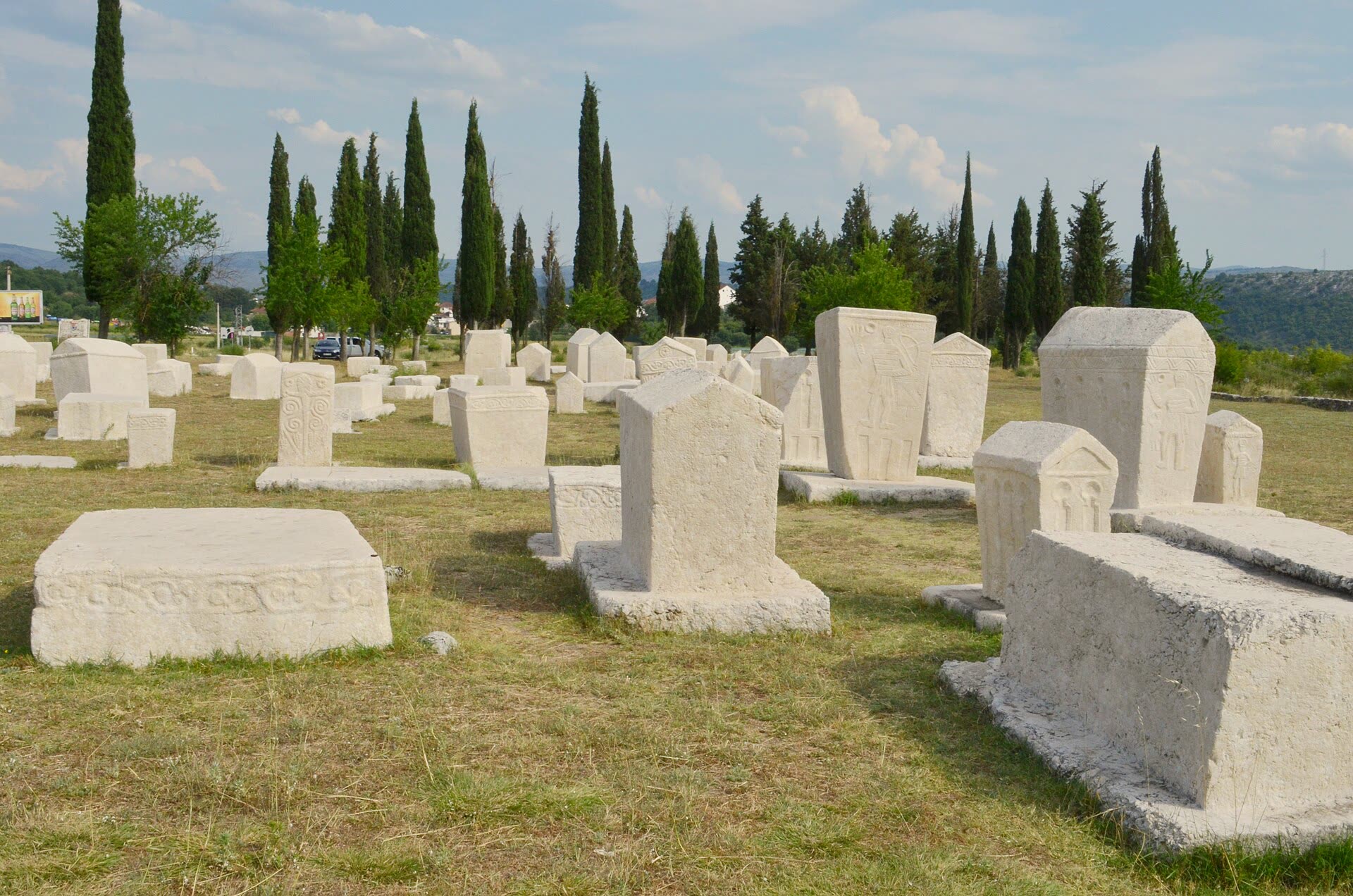
Bosnia and Herzegovina holds five UNESCO World Heritage properties. These are the Old Bridge Area of the Old City of Mostar, inscribed in 2005; the Mehmed Paša Sokolović Bridge, inscribed in 2007; the Stećci Medieval Tombstone Graveyards, inscribed in 2016; the Primeval Beech Forests; and Vjetrenica Cave, Ravno, inscribed in 2024. Vjetrenica Cave, Ravno, is among the country's most recent inscriptions.
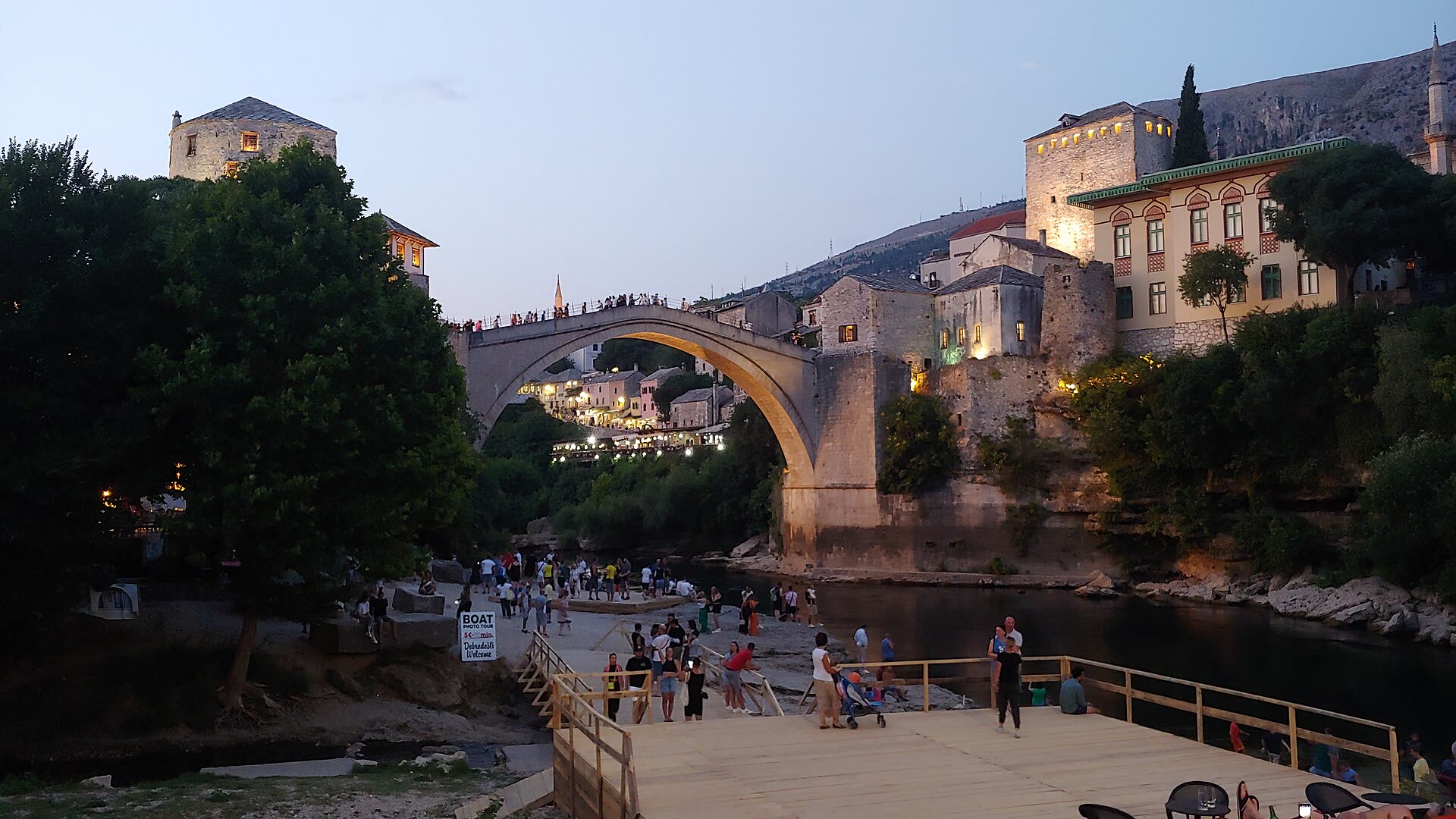
The Stari Most, or Old Bridge, was completed in 1566, destroyed on 9 November 1993, and rebuilt between 2001 and 2004. Its construction took about nine years. During the Bosnian War the bridge was destroyed by Croatian artillery on 9 November 1993. Reconstruction began in 2001 and was completed in 2004, and the bridge and the historic centre of Mostar were inscribed as a World Heritage site in 2005. Under UNESCO criterion (vi), the reconstructed Old Bridge and Old City of Mostar symbolise reconciliation, international cooperation and coexistence of communities from diverse cultural, ethnic and religious backgrounds. The Old Bridge was rebuilt in 2004, and many edifices of the Old Town were restored or rebuilt with the contribution of the international scientific committee established by UNESCO.
The Mehmed Paša Sokolović Bridge in Višegrad, across the Drina River, was built at the end of the 16th century by the Ottoman court architect Mimar Koca Sinan on the orders of Grand Vizier Mehmed Paša Sokolović. The serial World Heritage property of Stećci Medieval Tombstone Graveyards combines 28 sites in Bosnia and Herzegovina, western Serbia, western Montenegro and Croatia.
8. Timeline of Key Events
The recorded history of Bosnia begins with a single Byzantine reference: the emperor Constantine VII Porphyrogenitus described “Bosona” as a district within “baptized Serbia”. After the death of Emperor Manuel I Comnenus in 1180, Bosnian territory became for the first time an independent entity. A Bosnian state of some kind existed during most of the period from 1180 to 1463, despite Hungary's theoretical claim to sovereignty over it. Tvrtko I proclaimed himself the first King of Bosnia, legitimising the crown by tracing it to that sent by Pope Honorius III to Stefan the First-Crowned in 1217.
Ottoman forces captured the central Bosnian settlement of Vrhbosna in 1448 and developed it into the city of Sarajevo; in 1463 they conquered most of the rest of Bosnia. Sarajevo is mentioned as Vrhbosna in 1415, and after the Ottoman conquest it developed as a trading centre and stronghold of Muslim culture. Ottoman Bosnia was divided into military-administrative districts called sanjaks, and in 1580 the area was raised to the full status of an eyalet, or province. The Stari Most, or Old Bridge, was completed in 1566. From the mid-17th until the 18th century Bosnia was repeatedly a theatre of Ottoman wars with Austria, Hungary and Venice, and in 1697 a small Austrian army under Prince Eugene of Savoy marched to Sarajevo and burned it.
In 1875 a revolt against state tax collectors began among Christian peasants in the Nevesinje region of Herzegovina, and after the great powers intervened at the Congress of Berlin (1878) Bosnia and Herzegovina was placed under Austro-Hungarian occupation while remaining notionally under Turkish sovereignty. On 28 June 1914 Archduke Franz Ferdinand, heir to the Habsburg throne, was killed in Sarajevo by a young assassin of Mlada Bosna, Gavrilo Princip; Austria-Hungary declared war on Serbia one month later. On 28 June 1914 Franz Ferdinand was in Bosnia and Herzegovina, accompanied by his wife Sophie, as inspector general of the imperial army.
Socialist Yugoslavia was formed in 1946, after Tito and his communist-led Partisans helped liberate the country; its 1963 constitution made Bosnia and Herzegovina one of six nominally equal republics. In 1946 the People's Republic of Bosnia and Herzegovina (from 1963, the Socialist Republic) became one of the constituent republics of communist Yugoslavia. When the United States and the EC recognised Bosnia and Herzegovina's independence on 7 April 1992, Bosnian Serb paramilitary forces immediately began firing on Sarajevo and the artillery bombardment of the city began. The siege of Sarajevo lasted from 5 April 1992 to 29 February 1996 — 1,425 days — making it the longest siege of a capital city in the history of modern warfare. More than 100,000 people were killed and two million — more than half the population — were forced to flee their homes in a war that raged from April 1992 until a peace deal was initialled in Dayton in November 1995.
The UN did not intervene in the war, but UNPROFOR troops facilitated humanitarian aid and later protected UN-declared “safe areas”; the UN failed to protect the safe area of Srebrenica in July 1995, when Bosnian Serb forces massacred more than 7,000 Bosniak men. The General Framework Agreement for Peace in Bosnia and Herzegovina was initialed in Dayton on 21 November 1995 and signed in Paris on 14 December 1995. NATO's Implementation Force (IFOR) was deployed in Bosnia and Herzegovina in December 1995 with a one-year mandate to implement the military aspects of the Dayton agreement. Bosnia-Herzegovina is an independent state partially under international oversight under the terms of the 1995 Dayton Peace Accords, which ended the 1992–95 Bosnian war and the break-up of Yugoslavia.
In December 2022 the European Council granted Bosnia and Herzegovina the status of EU candidate country. In March 2024, on the basis of the Commission's recommendation of 12 March 2024, the European Council decided to open accession negotiations with Bosnia and Herzegovina.
9. Sarajevo
Sarajevo is the capital of Bosnia and Herzegovina. The city is mentioned as Vrhbosna in 1415, and after the Ottoman conquest it developed as a trading centre and stronghold of Muslim culture. Ottoman forces captured the central Bosnian settlement of Vrhbosna in 1448 and developed it into the city of Sarajevo; in 1463 they conquered most of the rest of Bosnia.
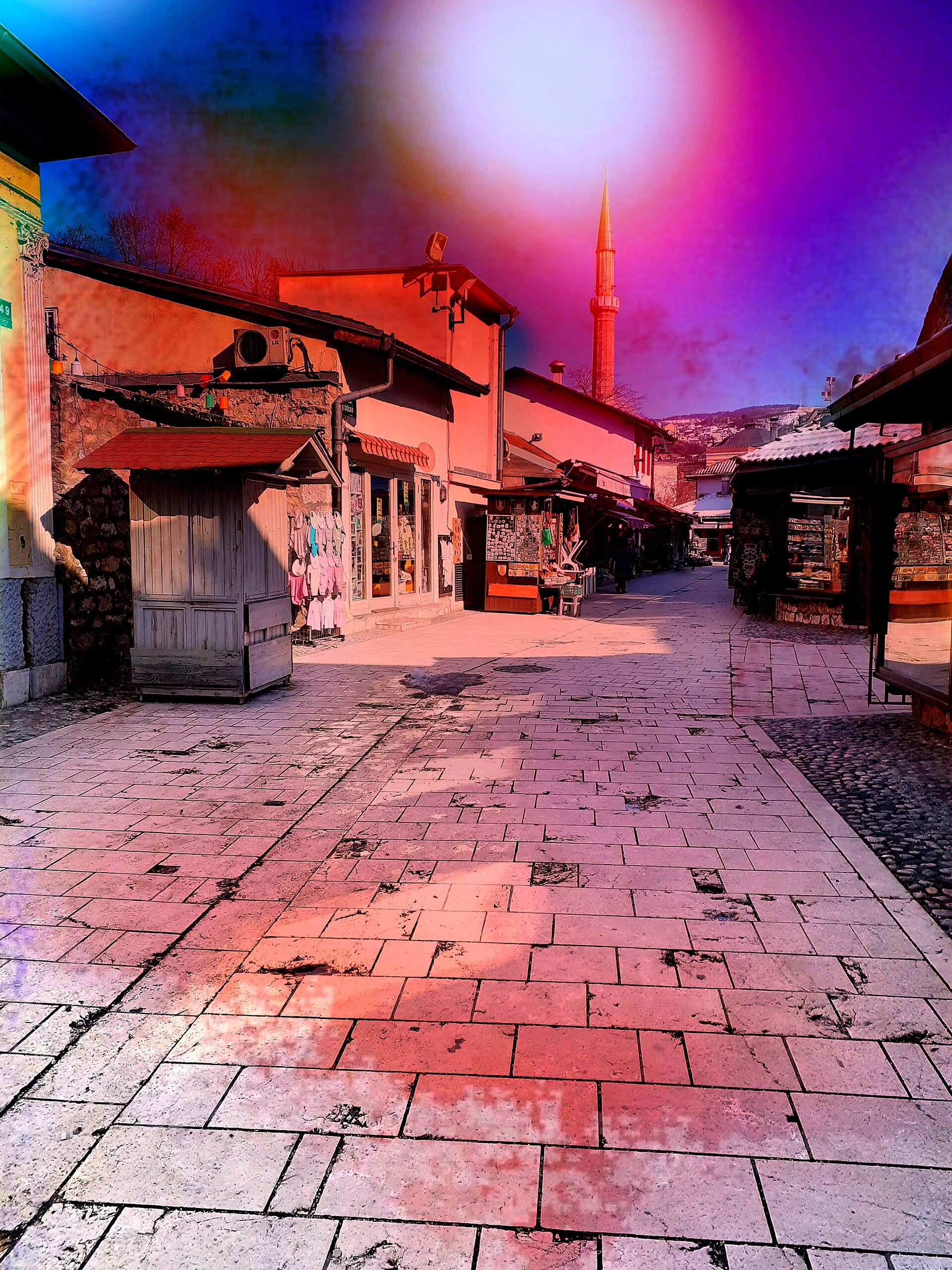
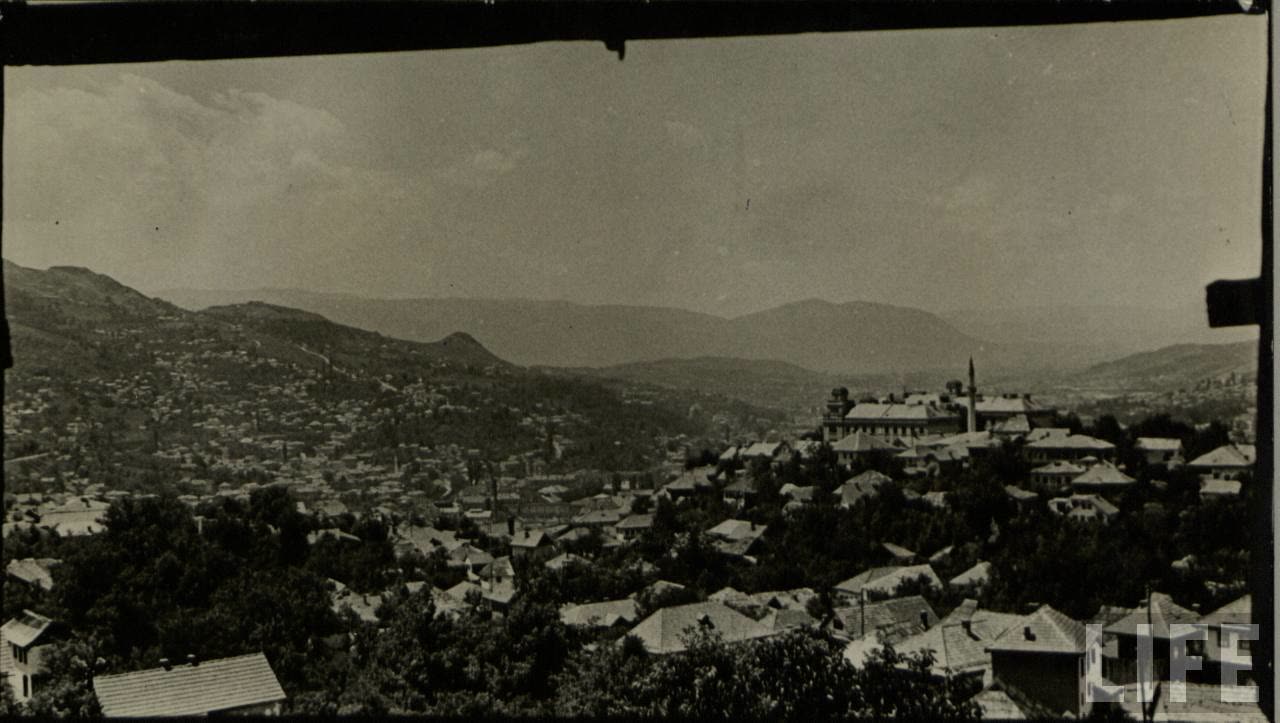
Sarajevo hosted the 1984 Winter Olympic Games. On 28 June 1914 Archduke Franz Ferdinand, heir to the Habsburg throne, was killed in Sarajevo by a young assassin of Mlada Bosna, Gavrilo Princip; Austria-Hungary declared war on Serbia one month later. On that day Franz Ferdinand was in Bosnia and Herzegovina, accompanied by his wife Sophie, as inspector general of the imperial army. One month after the assassination, on 28 July 1914, Austria-Hungary declared war on Serbia, setting off the chain of alliances that became World War I.
10. Memory and Commemoration
In May 2024 the UN General Assembly, in a resolution sponsored by Germany and Rwanda, designated 11 July as the International Day of Reflection and Commemoration of the 1995 Genocide in Srebrenica. 28International Day of Reflection and Commemoration of the 1995 Genocide in Srebrenica, 11 July · United Nations ↗
Karadžić and Mladić were among 161 individuals indicted by the ICTY over its 24 years of existence, from every ethnicity and nationality in the conflict. 20Bosnia and Herzegovina: Postwar Bosnia and Herzegovina · Encyclopædia Britannica ↗
The memory of the 1992–95 war is anchored in the events that defined its course. In early July 1995, in the UN-declared safe area of Srebrenica, more than 8,000 Bosnian Muslim men and boys were executed by Serb forces in an act of genocide. 16The Conflicts — about the former Yugoslavia · International Criminal Tribunal for the former Yugoslavia (UN ICTY) ↗ The UN did not intervene in the war, but UNPROFOR troops facilitated humanitarian aid and later protected UN-declared “safe areas”; the UN failed to protect the safe area of Srebrenica in July 1995, when Bosnian Serb forces massacred more than 7,000 Bosniak men. 14Bosnia and Herzegovina: Bosnia and Herzegovina in communist Yugoslavia (with the Independence and war section) · Encyclopædia Britannica ↗ The siege of Sarajevo lasted from 5 April 1992 to 29 February 1996 — 1,425 days — making it the longest siege of a capital city in the history of modern warfare. 19Siege of Sarajevo · Wikipedia ↗ More than 100,000 people were killed and two million — more than half the population — were forced to flee their homes in a war that raged from April 1992 until a peace deal was initialled in Dayton in November 1995. 16
The pursuit of accountability has been a central element of commemoration. In November 2017 Ratko Mladić was found guilty of war crimes and genocide for his role in the Srebrenica massacre and sentenced to life in prison. 20 Karadžić and Mladić were among 161 individuals indicted by the ICTY over its 24 years of existence, from every ethnicity and nationality in the conflict. 20 The Dayton Accords provided that 51 percent of the land would form the Croat-Bosniak federation and 49 percent a Serb republic. 14 The Dayton Accords established Bosnia and Herzegovina as a state composed of two highly autonomous entities, the Republika Srpska and the Federation of Bosnia and Herzegovina. 4
Commemoration also takes material form in the country's cultural heritage. The Old Bridge was rebuilt in 2004, and many edifices of the Old Town were restored or rebuilt with the contribution of the international scientific committee established by UNESCO. 25Old Bridge Area of the Old City of Mostar · UNESCO World Heritage Centre ↗ Under UNESCO criterion (vi), the reconstructed Old Bridge and Old City of Mostar symbolise reconciliation, international cooperation and coexistence of communities from diverse cultural, ethnic and religious backgrounds. 25 One of Bosnia and Herzegovina's most recent World Heritage inscriptions is Vjetrenica Cave, Ravno, listed in 2024. 23Bosnia and Herzegovina — World Heritage Convention, State Party page · UNESCO World Heritage Centre ↗
11. Timeline: from the medieval kingdom to the modern state
- c. 1180After Manuel I Comnenus dies, a Bosnian territory becomes an independent entityWith Byzantine rule gone and neither Croatia nor Hungary restoring control, a Bosnian territory emerges for the first time as an independent entity; a Bosnian state of some kind exists for most of the period from 1180 to 1463.
- 26 October 1377Tvrtko I crowned King of BosniaTvrtko I has himself crowned King of “The Serbs, Bosnia, the Primorje (Seaside), and the western lands”, elevating Bosnia from a banate to a kingdom.
- 1463Ottoman conquest of BosniaAfter Ottoman forces capture the central Bosnian settlement of Vrhbosna in 1448 and develop it into Sarajevo, they conquer most of Bosnia proper in 1463; the last fortress in Herzegovina falls in 1482.
- 1557–1566Stari Most completed at MostarSüleyman the Magnificent commissions Hayruddin, a pupil of the architect Sinan, to replace a wooden suspension bridge; the work takes about nine years and the bridge is completed in 1566.
- 1878Austro-Hungarian occupation beginsThe Congress of Berlin decides that Bosnia and Herzegovina, while remaining notionally under Turkish sovereignty, will be occupied and governed by Austria-Hungary; Austro-Hungarian troops take control, overcoming vigorous local resistance.
- October 1908Austria-Hungary annexes Bosnia and HerzegovinaThe sudden announcement of full annexation provokes a diplomatic crisis lasting many months and deep resentment among Serb and South Slav nationalists, feeding the Mlada Bosna (“Young Bosnia”) movement.
- 28 June 1914Assassination of Archduke Franz Ferdinand in SarajevoGavrilo Princip, a member of Mlada Bosna, shoots the Habsburg heir and his wife Sophie in Sarajevo; one month later, on 28 July, Austria-Hungary declares war on Serbia, precipitating World War I.
- 1918Incorporated into the Kingdom of Serbs, Croats, and SlovenesAt the end of World War I, Bosnian politicians from all three main communities join in creating the new South Slav state, in which Bosnia and Herzegovina has no formal status of its own.
- 1946Constituent republic of socialist YugoslaviaThe People’s Republic (from 1963, Socialist Republic) of Bosnia and Herzegovina becomes one of the constituent republics of the Federal People’s (from 1963, Socialist Federal) Republic of Yugoslavia.
- 29 February–1 March 1992Independence referendum and the start of warAlmost all who take part in the referendum vote for independence, which President Izetbegović proclaims on 3 March; the United States and the EC recognise the country on 7 April, and Bosnian Serb forces begin shelling Sarajevo.
- 11 July 1995Srebrenica massacreIn the UN-declared safe area of Srebrenica, Bosnian Serb forces execute more than 8,000 Bosniak men and boys in an act of genocide.
- 21 November & 14 December 1995Dayton Peace AgreementThe General Framework Agreement for Peace in Bosnia and Herzegovina is initialed in Dayton on 21 November 1995 and signed in Paris on 14 December 1995; its Annex 4 contains the country’s Constitution.
- 2004Stari Most rebuilt in MostarThe UNESCO-overseen reconstruction with original materials and techniques, begun in 2001, is completed in 2004; the Old Bridge and the historic centre of Mostar are inscribed as a World Heritage site in 2005.
- 15 February 2016Application for European Union membershipBosnia and Herzegovina formally applies for membership in the European Union.
- December 2022 – March 2024EU candidate status and the opening of accession negotiationsThe European Council grants Bosnia and Herzegovina candidate country status in December 2022 and decides in March 2024 to open accession negotiations.
12. Frequently asked questions
Where is Bosnia and Herzegovina, and what does its landscape look like?
It lies in Southeastern Europe, on the Balkan Peninsula, bordered by Croatia on the north, west and south, by Serbia on the east and Montenegro on the southeast, and it reaches the Adriatic Sea along a narrow extension of land in the southwest 2. The country is largely mountainous, with the Dinaric Alps dominating its western border with Croatia and many ranges running through it in a northwest–southeast direction 2. Its highest peak is Maglić, at 2,386 metres (7,828 feet), near the border with Montenegro 2.
How long is the country's coastline, and does it have any ports?
The Adriatic coastline is only about 20 km (12 miles) long, bounded on both sides by Croatia, and contains no natural harbours 2.
What is the capital, and how many people live in the country?
How is Bosnia and Herzegovina governed?
The Dayton Accords established it as a state composed of two highly autonomous entities, the Republika Srpska and the Federation of Bosnia and Herzegovina 4. Arbitration in 1997 established Brčko, in the northeast, as a self-governing special district 4. The central institutions include a directly elected tripartite presidency, which rotates every eight months between one Bosniak, one Serb and one Croat member 4.
When did Bosnia and Herzegovina become independent, and what ended the war that followed?
Independence was proclaimed on 3 March 1992 and recognised on 7 April 1992 14. The General Framework Agreement for Peace in Bosnia and Herzegovina was initialed in Dayton on 21 November 1995 and signed in Paris on 14 December 1995 18The General Framework Agreement for Peace in Bosnia and Herzegovina · Office of the High Representative (OHR) ↗.
What is the country's status in relation to the European Union?
In December 2022 the European Council granted Bosnia and Herzegovina the status of EU candidate country 22Bosnia and Herzegovina — Enlargement and Eastern Neighbourhood · European Commission ↗. In March 2024, on the basis of the Commission's recommendation of 12 March 2024, the European Council decided to open accession negotiations with Bosnia and Herzegovina 22.
References (28)
- 1Bosnia and Herzegovina — Wikipedia WebView source
- 2Bosnia and Herzegovina — Encyclopædia Britannica Web↩View source
- 3Bosnia-Herzegovina country profile — BBC News Web↩View source
- 4Bosnia and Herzegovina: Government and society — Encyclopædia Britannica Web↩View source
- 5Dinaric Alps — Encyclopædia Britannica WebView source
- 6Neretva River — Encyclopædia Britannica WebView source
- 7Constitution of Bosnia and Herzegovina (Annex 4 of the General Framework Agreement for Peace) — Office of the High Representative (OHR) Web↩View source
- 8Bosnia and Herzegovina: History — Encyclopædia Britannica WebView source
- 9Kingdom of Bosnia — Wikipedia WebView source
- 10Sarajevo — Encyclopædia Britannica WebView source
- 11Bosnia and Herzegovina: Ottoman Bosnia — Encyclopædia Britannica WebView source
- 12Bosnia and Herzegovina: Bosnia and Herzegovina under Austro-Hungarian rule — Encyclopædia Britannica WebView source
- 13Franz Ferdinand, Archduke of Austria-Este — Encyclopædia Britannica WebView source
- 14Bosnia and Herzegovina: Bosnia and Herzegovina in communist Yugoslavia (with the Independence and war section) — Encyclopædia Britannica Web↩View source
- 15Yugoslavia (former federated nation, 1929–2003) — Encyclopædia Britannica 1929 WebView source
- 16The Conflicts — about the former Yugoslavia — International Criminal Tribunal for the former Yugoslavia (UN ICTY) Web↩View source
- 17Bosnian War — Encyclopædia Britannica WebView source
- 18The General Framework Agreement for Peace in Bosnia and Herzegovina — Office of the High Representative (OHR) Web↩View source
- 19Siege of Sarajevo — Wikipedia Web↩View source
- 20Bosnia and Herzegovina: Postwar Bosnia and Herzegovina — Encyclopædia Britannica Web↩View source
- 21Peace support operations in Bosnia and Herzegovina (1995-2004) — NATO 1995 WebView source
- 22Bosnia and Herzegovina — Enlargement and Eastern Neighbourhood — European Commission Web↩View source
- 23Bosnia and Herzegovina — World Heritage Convention, State Party page — UNESCO World Heritage Centre Web↩View source
- 24Stari Most — Encyclopædia Britannica WebView source
- 25Old Bridge Area of the Old City of Mostar — UNESCO World Heritage Centre Web↩View source
- 26Mehmed Paša Sokolović Bridge in Višegrad — UNESCO World Heritage Centre WebView source
- 27Stećci Medieval Tombstone Graveyards — UNESCO World Heritage Centre 1504 WebView source
- 28International Day of Reflection and Commemoration of the 1995 Genocide in Srebrenica, 11 July — United Nations 1995 Web↩View source
 The Periodic Table
 Muhammad Ali
 Ottoman Empire