Andromeda Galaxy
The nearest large galaxy to the Milky Way: its 2.5-million-light-year distance, naked-eye visibility, trillion-star population, satellite system, central black hole and the predicted collision with our own galaxy.
The Andromeda Galaxy, also known as Messier 31 or NGC 224, is a spiral galaxy about 2.5 million light-years away in the constellation Andromeda and the largest member of the Local Group. Visible to the naked eye as a faint elongated cloud, it holds roughly 1 trillion stars, a 140-million-sun black hole at its core and a system of dwarf satellites, about half of which form a vast thin co-rotating plane. In about four billion years it is expected to merge with the Milky Way, a scenario first laid out by NASA from Hubble measurements in 2012 and refined by Gaia proper-motion studies.
In this article
- 1Overview
- 2Key Data
- 3Observation and Appearance
- 4Structure and Composition
- 5Satellites and Companions
- 6Historical Observations
- 7Hubble's Distance Measurement
- 8Hubble's Panoramic Surveys
- 9Future Collision with the Milky Way
- 10Dynamics and Proper Motion
- 11Local Group Context
- 12Timeline: from al-Sufi's little cloud to the 2025 Hubble mosaic
- 13Knowledge graph
Overview
The Andromeda Galaxy is a spiral galaxy in the constellation Andromeda, cataloged as Messier 31 (M31) and NGC 224. It is the largest member of the Local Group and the nearest large spiral to the Milky Way.
It is best observed during November.
1. Key Data
| Property | Value | Source |
|---|---|---|
| Type | Spiral galaxy | nasa-messier-31 |
| Catalog designations | Messier 31 (M31), NGC 224 | seds-messier-m31 |
| Constellation | Andromeda | nasa-messier-31 |
| Distance | About 2.5 million light-years | jpl-spitzer-andromeda |
| Apparent size | 178 x 63 arc minutes | seds-messier-m31 |
| Number of stars | Over 1 trillion | nasa-hubble-hidden-history |
| Coordinates (J2000) | 00h 42m 44.3s, +41d 16m 09s | swinburne-cosmos-m31 |
2. Observation and Appearance
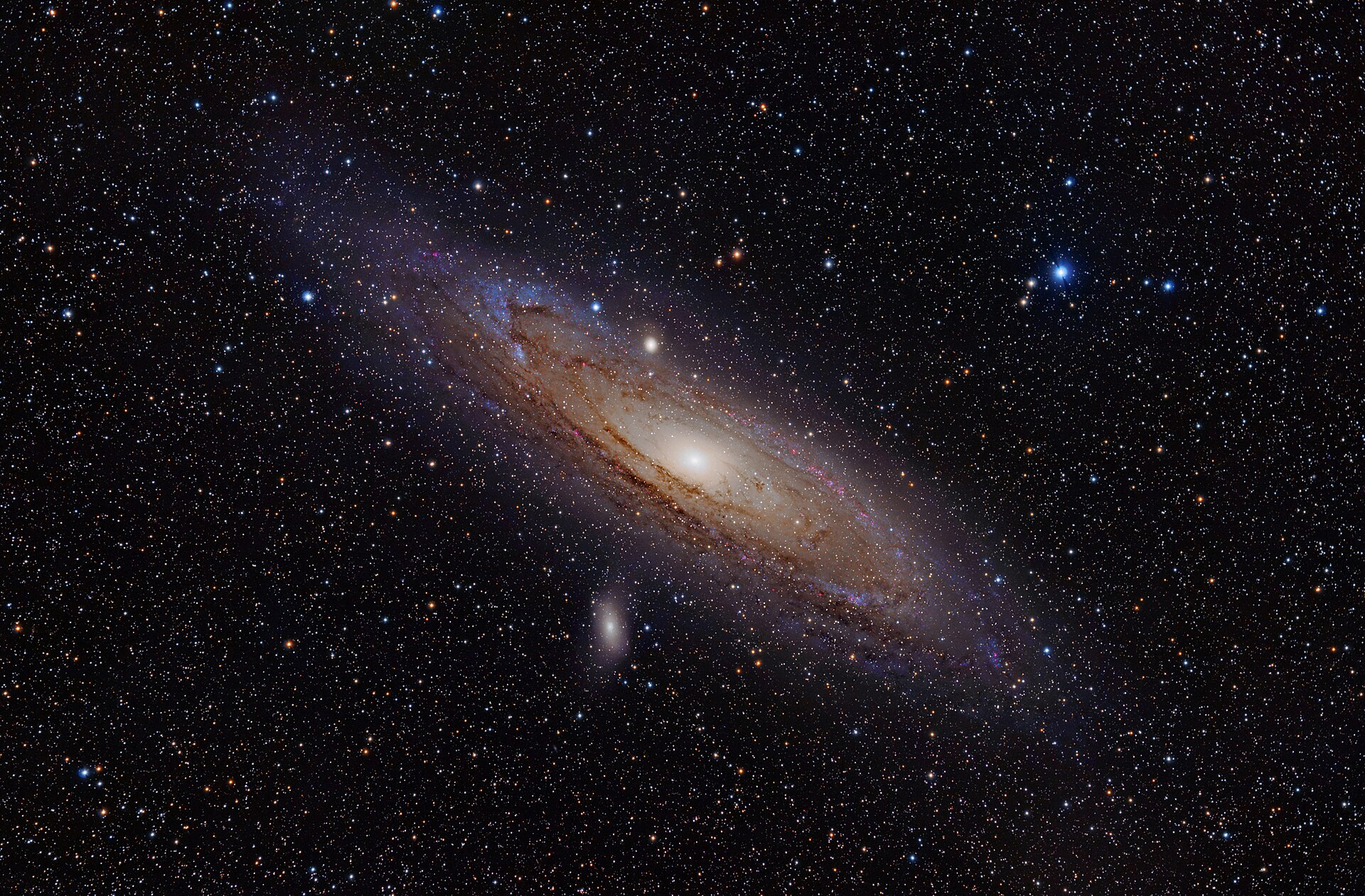
On a very clear autumn night the Andromeda Galaxy can be seen with the naked eye as a faint, cigar-shaped object roughly the apparent angular diameter of the Moon. Its apparent magnitude of 3.1 keeps it visible even in areas with moderate light pollution, and it is one of only three galaxies that can be spotted from Earth with the naked eye. In angular size it spans six times the apparent diameter of the full Moon.
Small telescopes reveal the object's true nature: a family of hundreds of billions of stars. The galaxy is a spiral. Its disk is seen almost edge-on, tilted by 77 degrees relative to Earth's view.
Hubble imaging traces the galaxy from its central galactic bulge, where stars are densely packed together, across lanes of stars and dust to the sparser outskirts of its outer disc. A smooth distribution of cooler red stars underlies the entire galaxy, tracing its evolution over billions of years.
3. Structure and Composition
Andromeda looks like a transitional type of galaxy between a star-forming spiral and an elliptical galaxy dominated by aging red stars. It seems to be more highly populated with younger stars and unusual features like coherent streams of stars, implying a more active recent star-formation history than the Milky Way. In the ultraviolet view, the wisps of blue making up Andromeda's spiral arms are neighborhoods that harbor hot, young, massive stars, while the central orange-white ball reveals a congregation of cooler, old stars. The large groups of blue stars in the galaxy indicate the locations of star clusters and star-forming regions in the spiral arms, while dark silhouettes trace complex dust structures.
A team of astronomers using NASA's Hubble Space Telescope discovered a double nucleus in the center of the neighboring spiral galaxy M31 located in the constellation Andromeda. The HST pictures show two bright spots at the heart of M31: the dimmer of the two light-peaks appears to mark the exact center of the galaxy. M31 has long been known to have a bright and extremely dense grouping of a few million stars clustered at the very center of its spherical hub.
Astronomers calculated that the black hole's mass is 140 million Suns, which is three times more massive than once thought. The blue stars are whipping around the black hole in much the same way as planets in our Solar System are revolving around the Sun. The region around the black hole is barely visible at the center of the disk.
Andromeda hosts a planar subgroup of satellites comprising about half of the population, a structure at least 400 kiloparsecs in diameter but extremely thin, with a perpendicular scatter of less than 14.1 kiloparsecs. Radial velocity measurements reveal that the satellites in this structure have the same sense of rotation about their host. The plane identified is approximately aligned with the pole of the Milky Way's disk and with the vector between the Milky Way and Andromeda.
4. Satellites and Companions
M32 is located 22 arc minutes south of the nucleus and NGC 205 about 35 arc minutes north-west of the main galaxy. Messier 32 is a compact elliptical satellite galaxy of the Andromeda Galaxy with apparent magnitude 8.1 in the constellation Andromeda. Messier 110 is an elliptical satellite galaxy of the Andromeda Galaxy at a distance of 2.7 million light-years with apparent magnitude 8.0 in the constellation Andromeda.
A possible culprit for that history is the satellite galaxy Messier 32 which resembles the stripped-down core of a once-spiral galaxy that may have interacted with Andromeda in the past.
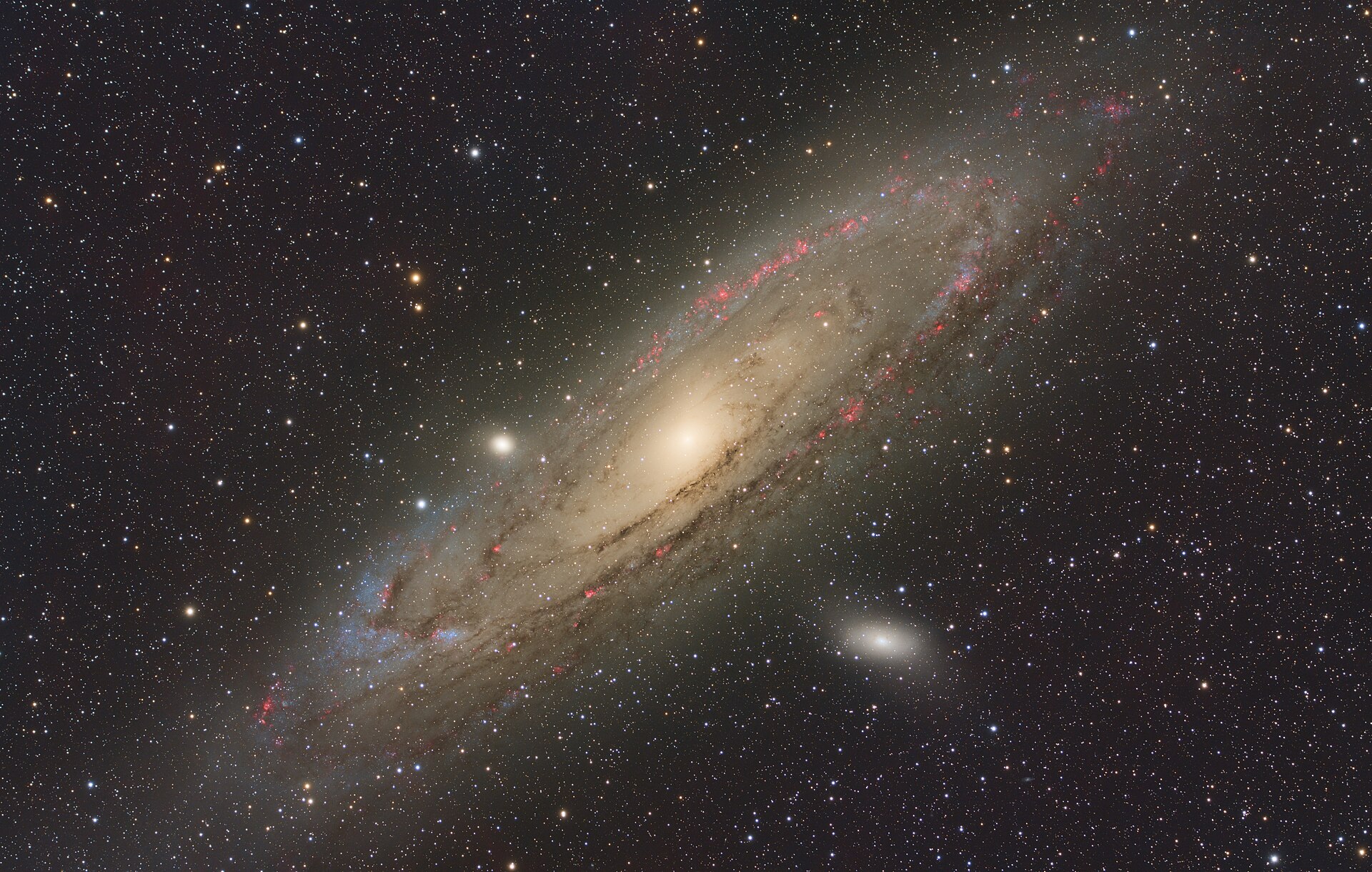
The brightest star cloud in the Andromeda galaxy is NGC 206 (H V.36). William Herschel took the brightest star cloud in the Andromeda galaxy into his catalog after his discovery observation of October 17 in 1786; it is listed today as NGC 206 in the New General Catalogue.
5. Historical Observations
The earliest known record of the object now called the Andromeda Galaxy appears in al-Sufi's The Book of Fixed Stars from the year 964, where it is described and depicted as a Little Cloud. The object was known by that name to the Persian astronomer, who set down much of his work in both textual descriptions and pictures. The cloud was apparently commonly known to the astronomers of Isfahan, very probably before 905 AD.
In 1887 Isaac Roberts obtained the first photographs of the Andromeda Nebula, which showed the basic features of its spiral structure for the first time.
The meeting of the National Academy of Sciences in Washington on 26 April 1920, at which Shapley and Curtis both spoke, has passed into the literature as The Great Debate. The two resulting papers published in the May 1921 Bulletin of the National Research Council contain the best presentations of the opposing arguments over the dimensions of our galaxy and the status of the spiral nebulae.
Because Hubble was unaware of the two Cepheid classes his distance was incorrect by a factor of more than two; the error was not discovered until 1953 when the 200-inch Palomar telescope began observing.
-
Before 905 ADKnown at IsfahanThe cloud was apparently commonly known to the Isfahan astronomers, very probably before 905 AD.15Al Sufi (903-986 AD) · SEDS (Students for the Exploration and Development of Space) ↗
-
964First known recordFirst known report of the object.3Messier 31 (The Andromeda Galaxy) · NASA Science (Hubble) ↗
-
October 17, 1786Herschel observes the brightest star cloudThe brightest star cloud, now NGC 206, enters his catalog.1Messier Object 31 · SEDS (Students for the Exploration and Development of Space) ↗
-
1887First photographs of spiral structureThe first photographs reveal the spiral structure.1
-
26 April 1920The Great DebateShapley and Curtis present opposing views.16The 'Great Debate': What Really Happened · NASA Astronomy Picture of the Day ↗
-
May 1921Opposing arguments publishedThe papers from the debate are published.16
-
1953Distance error discoveredThe distance error is discovered when the 200-inch Palomar telescope begins observing.1
Simon Marius provided the first telescopic description of the object in 1612 without claiming its discovery. Slipher of Lowell Observatory measured its radial velocity at about 300 km/sec in approach, the highest ever recorded at the time.
Charles Messier cataloged it on August 3, 1764, unaware of the earlier reports, and ascribed its discovery to Marius.
6. Hubble's Distance Measurement
In the 1920s, Edwin Hubble examined photographic plates from the Mount Wilson Observatory's 100-inch telescope and used them to determine the distance to the Andromeda Nebula, decisively demonstrating the existence of other galaxies far beyond the Milky Way. On the night of October 5-6 in 1923 he took a plate of the Andromeda Galaxy with the Hooker 100-inch telescope of the Mount Wilson Observatory. That plate, bearing identification number H335H, is famous for having led to the discovery of the first Cepheid variable star in M31, and it established beyond any doubt that M31 was a separate galaxy from our own.
The first Cepheid variable discovered has its letter N crossed out and is marked VAR!, showing that Hubble originally thought it was a nova but eventually found that it varied in brightness like a Cepheid. Discovering that a star near the upper right corner was actually a type of variable star known as a cepheid, Hubble crossed out the N and wrote VAR!. A white circle identifies V1, the Cepheid variable star discovered by astronomer Edwin Hubble in 1923 in the Andromeda galaxy. Thanks to the work of Harvard astronomer Henrietta Leavitt, cepheids could be used as standard candle distance indicators.

This star allowed Hubble to calculate a reliable distance to Andromeda, proving that it was a separate galaxy outside our Milky Way.
7. Hubble's Panoramic Surveys
The 2015 image was the biggest Hubble image ever released, showing over 100 million stars and thousands of star clusters embedded in a section of the galaxy's pancake-shaped disc stretching across over 40,000 light-years. The panoramic image has a staggering 1.5 billion pixels, meaning more than 600 HD television screens would be needed to display the whole image.
NASA's Hubble Space Telescope released in January of 2025 a panoramic view of the neighboring Andromeda galaxy built from over 600 overlapping snapshots collected over more than 10 years.
The panorama started with the Panchromatic Hubble Andromeda Treasury (PHAT) program, which photographed the northern half of Andromeda in near-ultraviolet, visible and near-infrared wavelengths. The full mosaic was carried out under two Hubble programs and required over 1,000 Hubble orbits spanning more than a decade. The combined programs collectively cover the entire disk of Andromeda.
Hubble's sharp imaging capabilities can resolve more than 200 million stars in the Andromeda galaxy, detecting only stars brighter than our Sun. The detailed look at the resolved stars will help astronomers piece together the galaxy's past history, which includes mergers with smaller satellite galaxies.
8. Future Collision with the Milky Way
The Milky Way is destined to get a major makeover during its encounter with Andromeda, which is predicted to happen about four billion years from now. The scenario has been likened to a baseball batter watching an oncoming fastball: Andromeda approaches more than two thousand times faster, yet about four billion years remain before the strike.
Stars inside each galaxy are so far apart that they will not collide with other stars during the encounter, though they will be thrown into different orbits around the new galactic center. It is likely the Sun will be flung into a new region of the galaxy, but Earth and the solar system are in no danger of being destroyed.
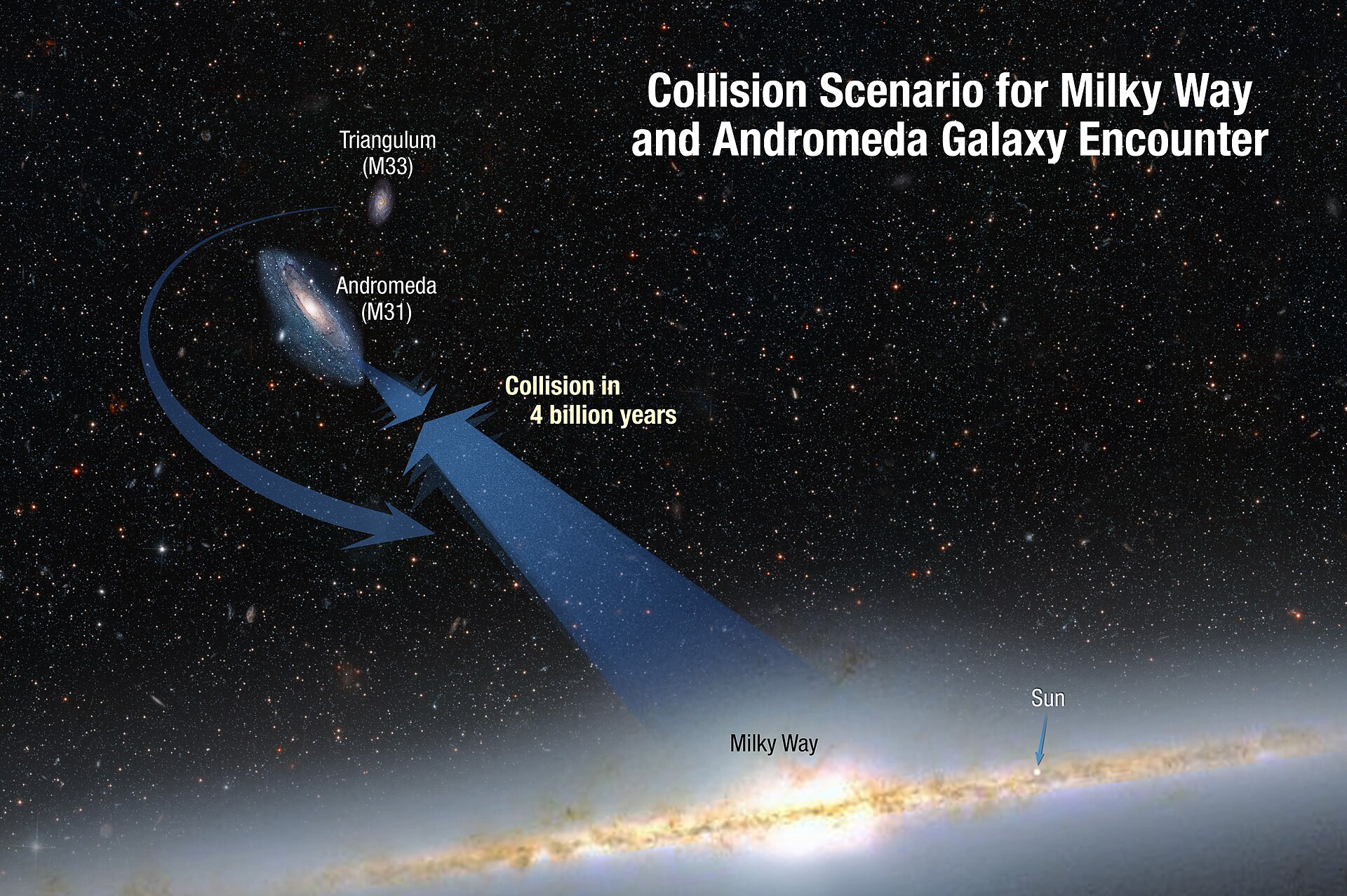
Computer simulations indicate it will take an additional two billion years after the encounter for the interacting galaxies to merge and reshape into a single elliptical galaxy. M31's small companion Triangulum M33 will join in the collision and may later merge with the pair; there is a small chance it will hit the Milky Way first.
A later editor's note on the 2012 release states that subsequent Hubble and Gaia observations now cast doubt on the certainty of the Milky Way colliding with Andromeda.
9. Dynamics and Proper Motion
The Andromeda Galaxy and the Milky Way are approaching each other at about 100 km/sec. M31 has a galactocentric velocity of -120 km/s and is one of a few galaxies that are approaching the Milky Way. Its heliocentric radial velocity is about 300 km/sec in approach.
In the second Gaia data release, the center-of-mass proper motion of each galaxy was measured relative to surrounding background quasars. The results are consistent with earlier measurements from Hubble Space Telescope optical imaging and Very Long Baseline Array water maser observations, lending confidence that all these measurements are robust. The new results imply that the M31 orbit toward the Milky Way is somewhat less radial than previously inferred. The larger tangential velocity implied by the average DR2 and HST proper motions means that a future direct collision between the two galaxies is less likely. The Gaia DR2 proper motions exclusively support orbits where M33 is falling into the Andromeda galaxy for the first time.
Van der Marel and colleagues determined the velocity vector of M31 with respect to the Milky Way from Hubble proper-motion measurements and used it to constrain the mass of the Local Group. The measurements imply a radial velocity of M31 with respect to the Milky Way of about -109 km/s and a tangential velocity of about 17 km/s. The velocity vector of M31 is statistically consistent with a radial, head-on collision orbit towards the Milky Way. Bayesian combination with other mass estimates yields a Local Group mass of about 3.17 trillion solar masses.
A 2024 study provided an updated inference of the proper motion of M31 using Gaia DR3 proper motions of bright stars from the disc, showing that the inconsistencies most likely arise from systematic uncertainties. The updated favoured proper motion values are 46.9 microarcseconds per year in right ascension and -29.1 microarcseconds per year in declination, with systematics determined at 90% confidence. The study highlights that the systematics are the dominant source of uncertainty, their magnitudes being comparable to the proper motion of M31 itself. If similar progress is made with the upcoming Gaia DR4 mission, future estimates could match the uncertainty level of Hubble and could be used to refine the dynamics and history of both galaxies.
10. Local Group Context
The Milky Way sits in a neighborhood with over 50 other galaxies called the Local Group, whose members range in size from dwarf galaxies to Andromeda, our nearest large galactic neighbor. The Local Group itself sits just off the edge of the Virgo cluster and is part of the Laniakea supercluster.
Andromeda forms the Local Group together with its companions M32 and M110 plus the Milky Way, M33 and others. Dwarf satellite galaxies are thought to be the remnants of the population of primordial structures that coalesced to form giant galaxies like the Milky Way.
11. Timeline: from al-Sufi's little cloud to the 2025 Hubble mosaic
- c. 905Persian astronomers know the little cloudThe object later called the Andromeda Galaxy was already commonly known to Persian astronomers at Isfahan as the little cloud, very probably before 905 AD.
- 964Al-Sufi records the objectAbd al-Rahman al-Sufi described and depicted the star cloud in his Book of Fixed Stars, the first known report of what is now catalogued as M31.
- 1612First telescopic descriptionSimon Marius gave the first telescopic description of the nebula, though he did not claim its discovery.
- August 3, 1764Messier adds M31 to his catalogCharles Messier cataloged the nebula as the 31st entry of his catalog, unaware of al-Sufi's and Marius's earlier records.
- October 17, 1786Herschel catalogs NGC 206William Herschel recorded the brightest star cloud in the galaxy as H V.36; the cloud later received the designation NGC 206.
- 1887First photographs show spiral structureIsaac Roberts obtained the first photographs of the Andromeda Nebula, which showed the basic features of its spiral structure for the first time.
- 1912Slipher measures the radial velocityV. M. Slipher measured the radial velocity of the nebula and found it approaching at about 300 km/sec, the highest velocity measured up to then.
- 26 April 1920The Great DebateHarlow Shapley and Heber D. Curtis debated the scale of the universe and the status of spiral nebulae at the National Academy of Sciences in Washington.
- 5-6 October 1923Hubble's VAR! plateEdwin Hubble took plate H335H of M31 with the Hooker 100-inch telescope at Mount Wilson, capturing the first Cepheid variable star found in the galaxy.
- 20 July 1993A double nucleus revealedHubble astronomers announced a double nucleus at the center of M31, two bright spots whose dimmer peak marks the galaxy's exact center.
- 20 September 2005Blue disk around the black holeHubble spectroscopy identified a mysterious disk of young blue stars around the supermassive black hole at the core of M31 and raised its mass estimate to 140 million Suns.
- 5 June 2006Spitzer counts a trillion starsInfrared observations with the Spitzer Space Telescope confirmed that Andromeda holds roughly 1 trillion stars, against a couple of hundred billion in the Milky Way.
- 31 May 2012A collision predictedNASA astronomers announced that the Milky Way and Andromeda are destined to collide in about four billion years, with a later editor's note casting doubt on the certainty.
- 2 January 2013A vast thin plane of satellitesNature published evidence that about half of Andromeda's dwarf satellites form a thin, co-rotating plane at least 400 kiloparsecs across.
- 5 January 2015Andromeda in HDHubble released its sharpest and biggest image of Andromeda, a 1.5-billion-pixel panorama showing over 100 million stars.
- 7 February 2019Gaia measures the motion of AndromedaUsing Gaia DR2 and Hubble data, astronomers measured the center-of-mass proper motion of M31, finding its orbit toward the Milky Way somewhat less radial than previously inferred.
- 29 November 2024Proper motion reassessedA Gaia DR3 study updated the proper motion of M31 and showed that systematic uncertainties remain the dominant source of error.
- 16 January 2025The largest Andromeda mosaicESA/Hubble unveiled a 2.5-billion-pixel photomosaic of Andromeda built from more than 600 snapshots collected over more than 10 years, resolving 200 million stars.
References (25)
- 1Messier Object 31 — SEDS (Students for the Exploration and Development of Space) Web↩View source
- 2Andromeda galaxy — Swinburne University of Technology (COSMOS Encyclopedia) WebView source
- 3Messier 31 (The Andromeda Galaxy) — NASA Science (Hubble) Web↩View source
- 4Hubble traces hidden history of the Andromeda Galaxy — ESA/Hubble WebView source
- 5GALEX Image: Andromeda, the Galaxy Next Door — Caltech (NASA GALEX) WebView source
- 6Andromeda Galaxy — StarDate Online (McDonald Observatory, University of Texas at Austin) WebView source
- 7Andromeda in HD — ESA/Hubble WebView source
- 8NASA's Hubble Traces Hidden History of Andromeda Galaxy — NASA Science (Hubble) WebView source
- 9Hubble Space Telescope Finds a Double Nucleus in the Andromeda Galaxy — HubbleSite (NASA/STScI) 1993 WebView source
- 10Hubble Finds Mysterious Disk of Blue Stars Around Black Hole — NASA Science (Hubble) WebView source
- 11Mysterious disk of blue stars around a black hole — European Space Agency WebView source
- 12A vast, thin plane of corotating dwarf galaxies orbiting the Andromeda galaxy — Nature JournalView source
- 13Messier 32 — NASA Science (Hubble) WebView source
- 14Messier 110 — NASA Science (Hubble) WebView source
- 15Al Sufi (903-986 AD) — SEDS (Students for the Exploration and Development of Space) Web↩View source
- 16The 'Great Debate': What Really Happened — NASA Astronomy Picture of the Day 1920 Web↩View source
- 17APOD: 2011 July 1 — VAR! — NASA Astronomy Picture of the Day 2011 WebView source
- 18Hubble's Famous M31 VAR! plate — Carnegie Science (Carnegie Institution for Science) WebView source
- 19Snapshots of the Star that Changed the Universe — HubbleSite (NASA/STScI) 2011 WebView source
- 20NASA's Hubble Shows Milky Way is Destined for Head-on Collision with Andromeda Galaxy — NASA Science (Hubble) WebView source
- 21First Gaia Dynamics of the Andromeda System: DR2 Proper Motions, Orbits, and Rotation of M31 and M33 — The Astrophysical Journal (IOP Publishing) 1538 JournalView source
- 22The M31 Velocity Vector. II. Radial Orbit Towards the Milky Way and Implied Local Group Mass — arXiv (van der Marel et al.) JournalView source
- 23Reassessing the proper motions of M31/M33 with Gaia DR3 — Astronomy & Astrophysics (EDP Sciences) 2024 WebView source
- 24Galaxies — NASA Science WebView source
- 25Andromeda Adrift in Sea of Dust in New NASA Image — NASA Jet Propulsion Laboratory (Spitzer Space Telescope) WebView source
 Jupiter
 Saturn
 The Milky Way